Act I
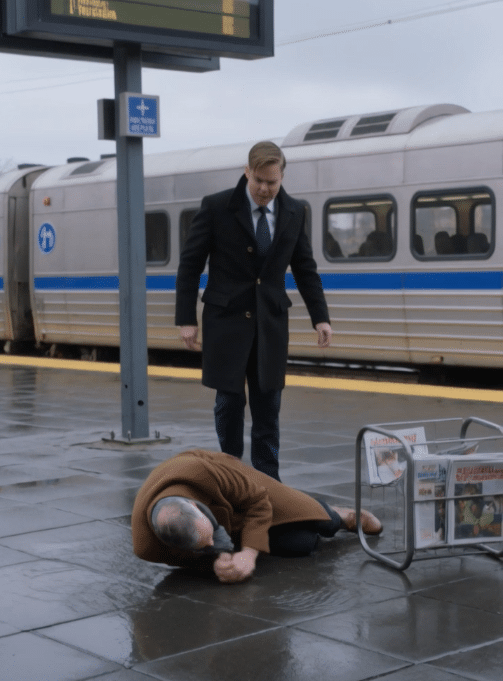
The newspaper stand shook for less than a second.
One folded paper slipped from the wooden rack, landed in a shallow puddle on the freezing platform, and sent a tiny splash across the polished leather toe of a passing businessman.
That was all it took.
The old newspaper seller froze. His trembling hands came together instantly, fingers interlocked in silent apology before a single word could leave his mouth.
He was seventy-four years old. His shoulders were bent from decades of work, and only a handful of newspapers remained unsold beside a small stack of coins that represented the morning’s earnings.
The young businessman looked down at his expensive shoes as if they had been drenched in sewage instead of touched by a few drops of dirty water.
His jaw tightened.
His eyes filled with contempt.
Then his voice sliced through the station.
“Trash. Look at my shoes.”
The entire platform heard him.
Hundreds of commuters slowed just enough to look before continuing on. Some frowned. Others pretended they hadn’t noticed.
No one moved.
The old man bowed his head lower.
He wasn’t protecting his pride anymore.
He was protecting his chance to survive another day.
The winter had been especially cruel. Sales had fallen. Every coin mattered. Every newspaper left on the stand represented food he still hoped someone would buy before sunrise disappeared into another busy morning.
He whispered nothing.
His clasped hands said enough.
Please…
It was clearly an accident.
The businessman didn’t care.
He reached toward the newspaper stand.
For one horrifying second, people assumed he intended to grab another paper.
Instead, he swept the small stack of change into his own hand.
Coins disappeared into his fist.
The old man’s eyes widened.
He instinctively leaned forward—not to fight, not to grab them back—but simply out of disbelief.
The businessman answered that movement with violence.
His foot drove forward.
The kick landed squarely against the old man’s chest.
Everything happened at once.
The elderly seller crashed backward across the wet platform.
His elbow struck the icy tiles, leaving only a faint streak of blood against the cold concrete.
The newspaper rack tipped sideways.
Remaining papers slid across the flooded platform, soaking into the freezing water that now carried away the last products he had hoped to sell that morning.
Gasps echoed around the station.
Still…
No one stepped in.
But someone had just witnessed everything.
And he wasn’t standing on the platform.
Act II
The old man curled instinctively, struggling to breathe.
Years of hardship had already weakened his body.
This attack simply reminded him how fragile old age could become when dignity meant nothing to strangers.
The businessman wasn’t finished.
He stepped closer without hesitation.
Two more brutal kicks landed against the old man’s back and side.
The elderly seller instinctively folded inward, his hands still pressed together—not defending himself, but pleading.
Not for justice.
Only for mercy.
The crowd watched in frozen silence.
Some passengers lowered their eyes.
Others quietly backed away.
Everyone knew the same uncomfortable truth.
Power often belonged to whoever shouted the loudest.
The businessman stared down with complete satisfaction.
His coffee remained perfectly balanced in one hand.
The stolen coins rested comfortably inside the other.
“Beg somewhere else.”
He laughed softly.
To him, the old seller wasn’t a person.
He was background scenery.
An inconvenience.
Someone too poor to matter.
Few people knew anything about the elderly man.
Most believed he had always sold newspapers at the station.
Few realized he had once supervised the maintenance crews that kept the railway running through the harshest winters.
Forty years earlier, before retirement, he had become legendary among station workers for refusing bribes from contractors who wanted to cut safety inspections.
More than once, his stubborn honesty had prevented accidents that could have killed hundreds of passengers.
When retirement finally came, life rewarded him with anything but peace.
His wife died after a long illness.
Medical bills consumed nearly every saving.
His son passed away years later.
His daughter moved overseas and vanished from contact after her own family fell apart.
Selling newspapers had never been his dream.
It was simply the last honest job that allowed an old man to remain independent.
Few recognized him anymore.
Time had erased the respect his name once carried.
Or so everyone believed.
Because someone else remembered perfectly.
And that someone had just arrived.
Act III
The staff elevator doors burst open with a sharp metallic sound.
Conversation stopped instantly.
Station employees straightened before they even saw who had stepped out.
Security officers moved first.
Behind them walked a tall man wearing a long black overcoat over a perfectly tailored suit.
His expression revealed nothing.
No anger.
No panic.
Only absolute control.
Workers who had ignored the assault seconds earlier now stood rigidly at attention.
The businessman frowned.
He had expected applause.
Instead…
The atmosphere had completely changed.
The newcomer walked directly toward the scattered newspapers.
Toward the elderly seller.
Toward the fist still wrapped tightly around stolen coins.
Security immediately surrounded the old man, shielding him from further harm while another officer knelt beside him.
The businessman finally spoke.
“Who is this supposed to be?”
No one answered.
The station chief’s eyes never left the coins.
His face grew colder.
When he finally spoke, every word carried the weight of unquestioned authority.
“Call security. Now.”
No shouting.
No threats.
Just one command.
Within seconds, more officers flooded the platform.
Passengers instinctively stepped backward.
The businessman finally sensed something was wrong.
Very wrong.
Because nobody questioned the man giving orders.
Nobody.
Not even senior station managers.
He looked around, expecting someone to defend him.
Instead, every employee avoided his eyes.
The confidence that had fueled his cruelty began to crack.
But the worst revelation had not yet arrived.
The station chief hadn’t come because of a random assault.
He had come because he recognized the victim immediately.
Act IV
The businessman tried to laugh.
“This old beggar?”
The station chief slowly turned toward him.
His stare alone silenced the platform.
“You have no idea who you just attacked.”
Years earlier, when the railway operating company had been struggling with corruption, one employee repeatedly refused illegal contracts that would have endangered thousands of commuters.
That employee wasn’t rewarded.
He was forgotten.
Until today.
The station chief had started his own career under that very man.
Fresh out of engineering school, he had been mentored by the elderly supervisor who believed that every passenger deserved to return home alive.
He still remembered something the old man had once told him.
“Steel doesn’t fail because it’s weak. It fails because someone decided honesty was too expensive.”
Those words had shaped an entire career.
Long after retirement, the station chief quietly ensured the old man could continue selling newspapers inside company property without paying rent.
Not charity.
Respect.
The elderly seller had refused every larger financial gift ever offered.
“I’ll earn my meals while I still can,” he always said.
That stubborn dignity was exactly why everyone inside senior management knew him.
Not as a newspaper seller.
As the conscience that had once protected the railway itself.
The businessman looked from face to face.
Nobody smiled.
Nobody defended him.
His expensive shoes no longer mattered.
The stolen coins suddenly felt heavier than gold.
The station chief glanced toward the old man’s scattered newspapers.
Security officers carefully gathered every soaked page as though handling priceless documents.
Not because newspapers were valuable.
Because the man who sold them was.
The businessman finally understood.
This wasn’t about status.
It was about character.
And he possessed none.
Yet one final truth would destroy whatever confidence remained.
Act V
An internal investigation moved faster than anyone expected.
Station surveillance captured every second.
The accidental splash.
The stolen change.
The first kick.
The two follow-up kicks.
The elderly seller never resisted.
He never raised a hand.
He simply pleaded.
The recordings spread quickly through executive offices.
Within hours, the businessman was identified.
His employer received the footage before lunchtime.
His firm’s board learned that one of its rising executives had violently assaulted an elderly worker over a few drops of dirty water while stealing the day’s earnings from a man old enough to be his grandfather.
The consequences came swiftly.
Employment disappeared.
Business partnerships evaporated.
His carefully polished reputation collapsed faster than the newspaper stand he had kicked apart.
Meanwhile, something unexpected happened.
Passengers returned.
Not out of curiosity.
Out of gratitude.
People who had once hurried past the tiny newspaper stand now stopped each morning to buy a paper they didn’t necessarily need.
Some left extra change.
Others simply thanked the old man for everything he had unknowingly done decades earlier to keep strangers safe.
He accepted every newspaper sale with the same quiet smile.
Nothing more.
The station chief visited often, never treating him like a hero in public.
Only like the mentor he had never stopped respecting.
On that freezing morning, hundreds of people had witnessed how quickly cruelty could rise from something meaningless.
But they also witnessed something even rarer.
Real authority never needed to shout.
It arrived quietly.
Protected the powerless.
Remembered the forgotten.
And forced arrogance to face the one thing it could never buy.
As security surrounded the trembling businessman, the confidence drained from his face completely.
His fingers slowly loosened around the stolen coins.
His breathing became shallow.
For the first time that morning, fear replaced pride.
He stared toward the silent man in the black overcoat, unable to understand why everyone else obeyed him without question.
His voice barely escaped his lips.
“Who are you?”