Act I
“That’s all I have.”
The old man’s voice barely rose above the roar of traffic overhead, but it carried something far heavier than fear. It carried the weight of a life that had already lost almost everything.
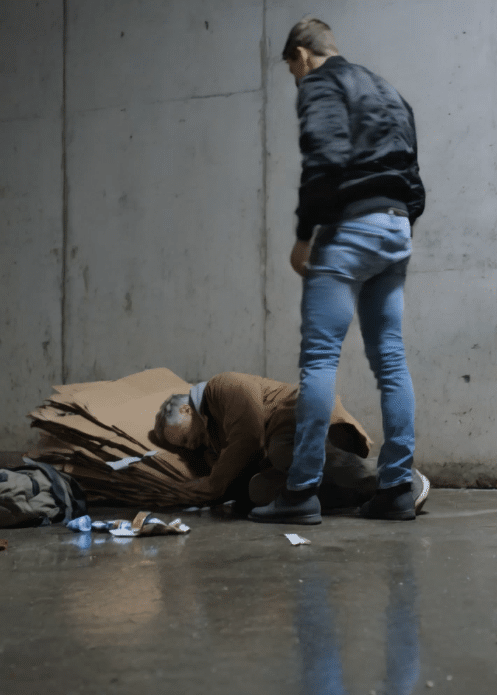
The backpack slipped from his trembling hands as three young men laughed beneath the cold concrete overpass. Rainwater glistened across the pavement while battered cardboard boxes collapsed around his feet.
The leader held the faded backpack just out of reach, grinning as though he had discovered the world’s funniest joke.
The seventy-one-year-old reached forward again, his weathered fingers shaking from exhaustion more than age.
“Trash. Then you have nothing.”
The words landed harder than the laughter surrounding him.
People nearby noticed.
Some slowed.
Some stared.
Not one stepped forward.
The old man lunged one final time.
That was all the excuse the young leader needed.
His boot slammed squarely into the old man’s chest with brutal force.
The impact hurled the frail body backward into a pile of cardboard boxes that exploded against the damp concrete wall. His right hand scraped across rough cement, leaving behind only a thin streak of blood before he instinctively curled into himself, struggling to breathe.
The backpack flew free.
A faded photograph.
Several folded letters.
A worn pocket Bible.
An old military medal.
Everything scattered across the wet ground.
The old man crawled desperately toward them.
Before he could reach a single item, two more powerful kicks crashed into his back and side.
The laughter echoed beneath the bridge.
No one moved.
No one spoke.
Everyone believed they were watching another cruel scene that would be forgotten by morning.
They couldn’t have been more wrong.
Because the backpack held far more than anyone imagined.
Act II
To strangers, he was simply another homeless veteran sleeping beneath an overpass.
Most never learned his name.
Some never even looked twice.
For nearly fifteen years, he had drifted quietly through the city after disappearing from a life no one believed he had ever lived.
His name was Arthur Whitmore.
Decades earlier, Arthur had built one of the country’s largest engineering firms alongside his closest friend, Victor Ashford.
Arthur designed.
Victor negotiated.
Together they became extraordinarily wealthy.
Until one winter afternoon, Arthur’s wife and daughter died in a highway collision caused by a drunk driver.
The tragedy shattered him.
He walked away from the company.
Walked away from his fortune.
Walked away from every board meeting, every investment, every mansion.
Victor begged him to stay.
Arthur vanished instead.
Years passed.
The company transformed into a global empire under Victor’s leadership.
Everyone assumed Arthur had died long ago.
Only one person knew otherwise.
Victor never stopped searching.
Every year, investigators quietly checked shelters, hospitals, veterans’ programs, and missing-person databases.
Arthur refused every attempt to bring him home.
He believed he no longer deserved the life he once had.
Yet he never threw away the old backpack.
Inside rested every piece of the family he had lost.
Their final photograph.
His daughter’s birthday cards.
Letters from his wife.
Military citations.
Original company documents.
Even an unsigned agreement proving Arthur had voluntarily surrendered billions without demanding a single dollar in return.
To everyone else, it looked worthless.
To Arthur, it was the last remaining home he possessed.
The young men had stolen far more than an old bag.
And fate was already racing toward the underpass.
Act III
The leader planted his spotless white sneaker on the scattered belongings and lifted the backpack over his shoulder like a trophy.
“Sleep without it.”
His friends burst into laughter again.
Arthur’s eyes never left the bag.
He ignored the pain in his ribs.
Ignored the cold soaking through his coat.
Ignored the blood on his hand.
Everything that still mattered was inside that backpack.
Then the darkness disappeared.
Brilliant headlights flooded the underpass so suddenly that everyone shielded their eyes.
Tires screamed.
A black SUV stopped only a few yards away.
Its doors opened before the engine even settled.
Two bodyguards stepped out first.
Neither hurried.
Neither shouted.
Their silence somehow felt more dangerous than violence.
Then the final passenger emerged.
A tall man in a charcoal overcoat.
Silver at his temples.
Perfectly polished shoes.
A face carved by decades of authority.
Victor Ashford.
One glance was enough.
He recognized Arthur instantly.
Time seemed to freeze.
The old man lying beside broken cardboard.
The scattered photograph.
The familiar military medal.
The backpack.
Victor had imagined this reunion a thousand different ways.
Never like this.
He looked toward the young men.
His expression became colder than the rain.
The bodyguards positioned themselves between Arthur and the attackers without touching anyone.
Victor extended one finger toward the backpack.
His voice cut cleanly through the silence.
“Put the backpack down.”
The command wasn’t loud.
It didn’t need to be.
Something in his tone made every witness instinctively step backward.
Even the traffic overhead seemed distant.
But the greatest revelation had not yet arrived.
Because the young bully had unknowingly chosen the worst possible victim in the city.
Act IV
The leader laughed nervously.
“You own this street or something?”
Victor didn’t answer.
Instead, one of the bodyguards bent down and carefully picked up the rain-soaked photograph.
He handed it to Victor.
Victor stared at the smiling little girl captured forever in the picture.
“I remember taking this,” he whispered.
Arthur slowly looked up.
For the first time in years, recognition softened his exhausted eyes.
“Victor…”
The name escaped like a forgotten memory.
Gasps spread through the growing crowd.
People began recognizing the man beside the SUV.
Some reached for their phones.
Others suddenly understood why armed security stood perfectly still instead of rushing forward.
Victor knelt beside Arthur without caring that his expensive coat touched the wet pavement.
“You disappeared,” Victor said quietly.
“I searched everywhere.”
Arthur gave the faintest smile.
“I wasn’t lost.”
“I just couldn’t go back.”
Victor’s eyes filled with emotion.
“You never stopped being family.”
One bodyguard carefully opened the recovered backpack.
Every item remained inside.
The company documents.
The handwritten letters.
The medal.
The faded memories.
Victor gently returned the backpack to Arthur’s shaking hands.
Then he stood.
The warmth vanished from his face.
He turned toward the three young men.
Within minutes, police vehicles arrived.
Several witnesses who had remained silent finally found the courage to speak.
Security cameras mounted beneath nearby businesses had captured everything.
The kicks.
The theft.
The humiliation.
There would be no argument about what happened that night.
The leader suddenly realized the game had ended long before he understood who had entered the underpass.
But one final truth remained.
Act V
Arthur spent several weeks recovering from bruised ribs and exhaustion.
Victor never pressured him to return to his former life.
Instead, he visited every day.
Sometimes they spoke.
Sometimes they simply sat together in silence.
Healing, they both discovered, could not be forced.
Months later, Arthur agreed to help establish a foundation for elderly veterans and homeless seniors who had quietly slipped through society’s cracks.
The project bore no billionaire’s name.
It carried only one simple inscription near the entrance.
Everyone carries something the world cannot see.
The old backpack was placed inside a glass display case.
Not because it was valuable.
Because it reminded every visitor how easily dignity can be stolen—and how power should always be used to restore it.
As for the three young attackers, the evidence left little room for denial.
Their cruelty followed them into courtrooms, employers’ offices, and every future opportunity they believed would always be waiting.
The moment that once amused them became the moment that defined them.
Witnesses later admitted that the most unforgettable part of that night wasn’t the arriving SUV.
It wasn’t the bodyguards.
It wasn’t even the wealthy businessman kneeling on soaked concrete beside an old friend.
It was the expression on the bully’s face after hearing four simple words.
His confident smile disappeared.
His shoulders stiffened.
His voice trembled for the first time.
The camera caught only him, isolated beneath the glare of the headlights.
“Who are you?”
By then, everyone else already knew.
The real question was never who Victor Ashford was.
It was why it took a powerful stranger for ordinary people to remember the humanity of the man who had whispered, “That’s all I have.”