Act I
“This belongs to me.”
The twelve-year-old boy’s voice shook, but his grip never loosened.
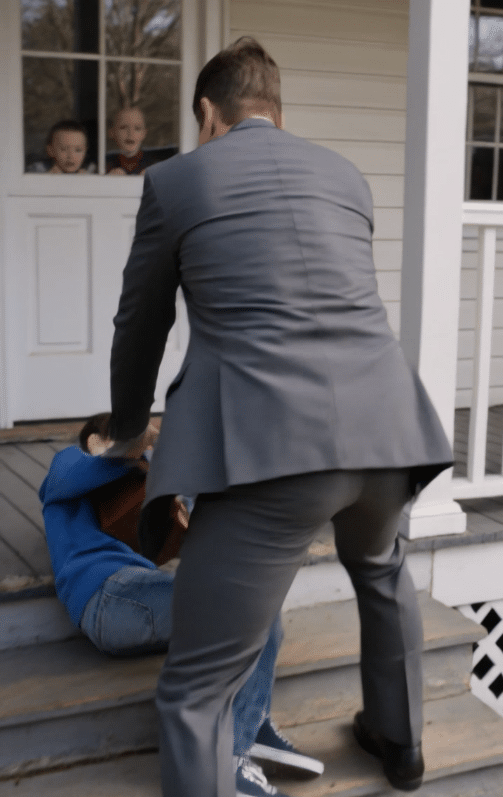
Standing at the foot of the orphanage porch, he wrapped both arms around a small wooden box as two well-dressed brokers closed in from opposite sides. Behind the white fence, frightened children pressed their faces against the windows, silently watching what no child should ever have to witness.
The older broker smiled as though the outcome had already been decided.
“Trash. Hand it over.”
The boy took one step backward.
There was nowhere left to run.
The broker lunged, yanking violently at the wooden box. When the boy refused to let go, a powerful kick slammed into his chest, sending him crashing backward into the edge of the porch steps.
The box nearly slipped free.
His elbow struck the weathered wood, leaving a thin streak of blood as pain spread across his arm. He curled instinctively around the box, refusing to release it despite the tears filling his eyes.
Loose papers peeked through the cracked lid.
Deeds.
Legal documents.
Old handwritten letters.
The broker saw them and smiled wider.
While the child struggled to breathe, two more brutal kicks landed against his back and side.
Still…
He never let go.
Looking down with open contempt, the broker sneered.
“Kids don’t inherit land.”
Every adult standing nearby froze.
Not one stepped between them.
They believed they were watching a helpless orphan lose the only thing he owned.
They had no idea they were witnessing the beginning of a battle over a fortune worth millions.
Act II
The orphanage records listed him simply as Noah Parker.
Age twelve.
No known relatives.
Parents deceased.
That was the version the world believed.
What almost no one knew was that Noah’s parents had spent years quietly building hundreds of acres of farmland before dying in a tragic highway accident.
They never lived extravagantly.
Every dollar went back into the land they loved.
Before their deaths, they signed a carefully prepared trust protecting their son until he reached adulthood.
The original inheritance papers had been placed inside a handcrafted wooden box built by Noah’s father.
His mother had written a note and tucked it beneath the documents.
“If you’re reading this, never believe you’re alone.”
After the accident, distant relatives disappeared.
Friends stopped calling.
The boy entered foster care before eventually arriving at the orphanage.
Only one mistake had been made.
The existence of the land had become public through county records.
That attracted people who specialized in finding vulnerable heirs before they understood what belonged to them.
The two brokers weren’t there to negotiate.
They intended to make the documents disappear.
Without the originals, challenging ownership would become almost impossible.
To them, Noah wasn’t a grieving child.
He was simply an obstacle standing between them and valuable property.
But there was one person who had spent months searching for the missing heir.
And he had arrived just in time.
Act III
Noah lay against the porch, his arms locked around the wooden box despite the pain shooting through his body.
One broker reached for the papers.
The other prepared to pry the box from the boy’s fingers.
Then every head turned.
A convoy of black vehicles swept through the orphanage gates before stopping abruptly across the front lawn.
Car doors opened in perfect sequence.
Bodyguards stepped out first.
Behind them came a distinguished lawyer carrying a leather briefcase.
Finally, a tall man in a black suit and long navy coat emerged from the center vehicle.
His expression was calm.
His eyes were anything but.
The bodyguards immediately moved between the brokers and the child.
The lawyer walked directly toward Noah, kneeling beside him without touching the box.
The stranger never looked away from the brokers.
Instead, he raised one hand.
“Don’t touch the child.”
His voice wasn’t loud.
It didn’t need to be.
The entire yard fell silent.
Even the children watching through the windows stopped crying.
The brokers exchanged uneasy glances.
Something had changed.
The confidence they carried only seconds earlier began slipping away.
Because the man standing before them wasn’t simply another witness.
He knew exactly what was inside the wooden box.
Act IV
“My name is Jonathan Reeves,” the stranger said calmly.
“I am the executor of David and Emily Parker’s estate.”
The lawyer carefully removed sealed court documents from his briefcase.
“The original trust became active the moment Noah was located.”
One broker laughed nervously.
“He’s just an orphan.”
Jonathan’s expression hardened.
“No.”
“He’s the legal owner of every acre his parents left behind.”
The lawyer opened the wooden box only after Noah nodded in agreement.
Inside rested the original deeds, notarized trust documents, family letters, and a sealed envelope addressed to Noah.
The lawyer handed him the letter first.
With trembling hands, Noah unfolded the faded paper.
“If anyone ever tries to convince you that you’re too small to protect what’s yours, remember this: courage isn’t measured by age. It’s measured by what you’re willing to hold onto when everyone tells you to let go.”
Tears blurred the words.
Jonathan quietly placed a reassuring hand on the boy’s shoulder.
“You protected exactly what your parents hoped you would.”
Around them, witnesses finally found their voices.
Several staff members stepped forward.
Others admitted they had seen the assault from the beginning.
Security cameras covering the orphanage entrance had recorded every second.
The attempted theft.
The assault.
The brokers’ threats.
There would be no denying any of it.
The balance of power had shifted completely.
Act V
The weeks that followed transformed Noah’s life.
The court confirmed the trust exactly as his parents intended.
Jonathan Reeves remained his legal guardian until the estate could be fully transferred, ensuring every decision served Noah’s future instead of someone else’s greed.
The farmland was placed under professional management, with its income funding Noah’s education, healthcare, and every opportunity his parents had dreamed of providing.
But Jonathan insisted on one promise.
“No amount of land will ever matter more than the kind of man you become.”
Noah never forgot those words.
Years later, after graduating from law school, he returned to the same orphanage—not as the frightened boy clutching a wooden box, but as an attorney establishing a free legal program for children whose voices had been ignored.
The old wooden inheritance box remained in his office.
Not as a reminder of wealth.
As a reminder that justice often survives because someone refuses to let go.
People later spoke about the fortune.
Others remembered the convoy of black cars.
But everyone who witnessed that afternoon remembered one final image.
The broker’s smile disappeared.
His confidence crumbled.
Only fear remained on his face as he stared at the man who had destroyed his scheme with a single sentence.
“Who are you?”
By then, everyone already knew.
The child hadn’t been rescued because he was rich.
He had been protected because, for the first time since losing his parents, someone powerful chose to stand between greed and an innocent boy.