Act I
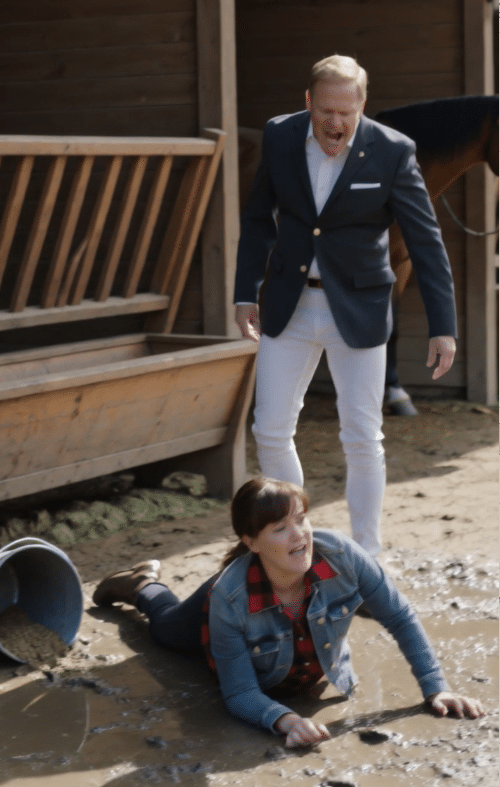
The muddy farmyard fell silent as the stable owner stormed across the paddock, his face burning with anger.
One of the farm’s prized horses had suddenly fallen ill.
Without waiting for the veterinarian’s findings, he pointed directly at the worker standing beside the feed trough, still holding an empty feed bucket.
“I fed him the same feed…”
Her voice shook.
She had followed the same routine she had followed every morning for nearly five years. Every scoop had come from the same storage bin used for every horse on the property.
None of that mattered.
“Trash. You poisoned my horse.”
Workers stopped what they were doing.
Stable hands exchanged uneasy glances.
The frightened employee suddenly found herself standing alone beneath the weight of an accusation no evidence supported.
Then the sound of tires crunching across the gravel interrupted the chaos.
Act II
The worker hadn’t grown up around horses.
She had learned everything on the job after taking the position to support her family following the closure of the local factory.
She arrived before sunrise.
She stayed long after sunset.
The horses trusted her because she treated every one of them with patience.
Even the sick gelding had eagerly walked toward her each morning at feeding time.
That was why the accusation hurt more than anyone realized.
She wasn’t simply being blamed for a mistake.
She was being accused of betraying the very animals she had devoted years to caring for.
Meanwhile, the veterinarian who had examined the horse had already reached an important conclusion.
The report simply hadn’t reached the stable yard yet.
Act III
A black SUV rolled through the entrance.
The corporate owner of the farm stepped out, followed by the attending veterinarian and the farm manager.
The veterinarian carried a sealed report folder.
The corporate owner surveyed the tense scene before calmly speaking four words.
“Show him the vet report.”
The stable owner’s expression changed instantly.
Moments earlier, he had sounded completely certain.
Now uncertainty crept across his face.
The veterinarian opened the folder.
The surrounding workers leaned forward.
No one spoke.
Act IV
The report ruled out poisoning.
The horse’s illness had been linked to a sudden intestinal condition unrelated to the morning feed.
Laboratory testing showed no toxins in the feed samples.
The feed storage remained uncontaminated.
The veterinarian also confirmed that every horse fed from the same batch had remained healthy.
The worker had followed established feeding procedures exactly as instructed.
The accusation collapsed under the weight of professional evidence.
The corporate owner turned toward the stable owner.
“Next time,” he said quietly, “find the facts before you find someone to blame.”
Silence spread across the yard.
Several employees lowered their heads, realizing how quickly they had accepted an accusation simply because it came from someone in authority.
Act V
The corporate owner publicly cleared the worker’s name before the entire staff.
He thanked the veterinarian for insisting on a complete examination before drawing conclusions and announced that future incidents would require formal investigation before blame could be assigned.
The worker looked toward the recovering horse in the stable.
For a moment, she wasn’t thinking about the accusation.
She was simply relieved the animal would recover.
As employees slowly returned to their duties, many quietly apologized for doubting her.
The stable owner remained standing beside the untouched feed trough, staring at the veterinary report that had dismantled every assumption he had made.
Long after the horse regained its strength, the employees remembered something even more important.
On a farm built on trust, the greatest danger had never been the illness itself.
It had been the willingness to condemn an innocent person before the truth had a chance to arrive.