Act I
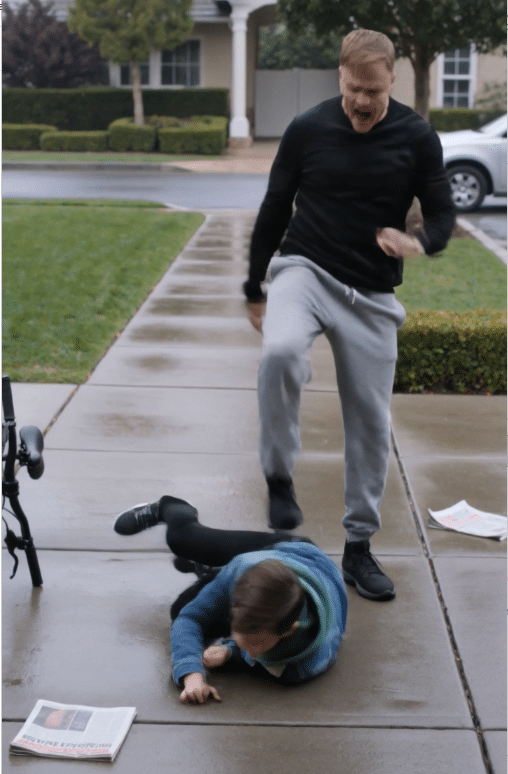
The wealthy homeowner burst across his front lawn before the paperboy even understood why he was yelling.
An expensive carbon-fiber sport bicycle lay on its side near the driveway.
That was all the man needed.
Without asking a single question, he charged toward the thirteen-year-old boy pedaling slowly along the wet suburban street with a crossbody newspaper bag bouncing against his side.
A violent kick slammed into the boy’s back.
His delivery bike twisted sideways, throwing him onto the rain-soaked sidewalk as newspapers exploded across the pavement like scattered leaves.
The bicycle he’d been riding clattered to the ground beside him.
His knee struck the concrete, leaving only a thin line of blood.
He curled instinctively around his newspaper bag, terrified more than hurt.
“I didn’t touch your bike…”
His voice cracked.
The wealthy neighbor stood over him, breathing heavily, convinced he had already solved the mystery.
“Trash. You broke it.”
Morning birds continued singing above the trees as though nothing unusual had happened.
But every nearby neighbor had heard the shouting.
Front doors opened.
Curtains moved.
Several people stepped outside.
None came closer.
The expensive bicycle remained where it had fallen.
The paperboy looked from the damaged bike to the angry homeowner, unable to understand why he had suddenly become the target.
He had simply been delivering newspapers before sunrise.
Nothing more.
The morning that should have earned him a few dollars before school had turned into a nightmare.
And it was only getting worse.
Act II
The boy struggled onto one knee, trying to gather the newspapers now soaked by the damp sidewalk.
Before he could reach them, another kick struck his side.
The bundle slipped from his hands again.
A third kick landed against his back.
The neighbors gasped.
No one stepped forward.
The wealthy homeowner pointed toward the expensive bicycle as though its price alone proved the boy’s guilt.
“You’ll pay for it.”
The words echoed through the quiet neighborhood.
The paperboy lowered his head.
Not because he admitted anything.
Because he already knew he could never afford what the bicycle was worth.
He delivered newspapers every morning before school.
After classes, he stocked shelves at a neighborhood grocery store twice a week.
Every dollar mattered.
His father had passed away three years earlier after a long illness.
Since then, the boy had insisted on helping his mother with rent, groceries, and utility bills.
His sneakers were worn thin.
His green hoodie had been patched twice at the elbows.
His old bicycle rattled every time he pedaled.
Yet every customer along his route knew one thing.
Their newspaper always arrived on time.
Even during heavy rain.
Even in winter.
He had built a reputation on honesty.
One accusation threatened to destroy it all.
The wealthy neighbor didn’t care.
In his mind, expensive property deserved immediate justice.
The frightened child deserved none.
Then another front door opened.
And everything changed.
Act III
A man in a long dark coat stepped calmly onto the sidewalk.
Unlike everyone else, he wasn’t looking at the fallen bicycle.
He was looking at his phone.
Morning sunlight reflected sharply across the screen, making its contents impossible for anyone else to see.
He walked toward the crowd with measured confidence.
When he finally stopped, he looked directly at the furious homeowner.
“My camera recorded everything.”
Silence.
Even the birds seemed to disappear beneath the sudden stillness.
The wealthy neighbor frowned.
For the first time, uncertainty appeared behind his anger.
The witness held the phone closer.
Still, the screen remained hidden by glare.
Nobody could see the recording.
The paperboy couldn’t.
The neighbors couldn’t.
Only the homeowner understood that whatever was on that phone had the power to destroy every accusation he had just shouted.
The witness offered no explanation.
He didn’t need one.
His certainty was enough.
The atmosphere shifted immediately.
The boy remained seated beside the scattered newspapers, watching in confusion.
He had no idea what the camera had captured.
Only that someone had finally spoken before condemning him.
But the truth stretched back several minutes before anyone noticed the bicycle on the ground.
Act IV
The security camera overlooking the neighboring driveway had quietly recorded the entire morning.
Long before the paperboy entered the street, the wealthy homeowner had been unloading gardening supplies from his garage.
In a hurry, he leaned his expensive sport bicycle carelessly against the edge of the driveway instead of placing it securely on its stand.
A gust of wind swept through moments later.
The unstable bicycle slowly rolled forward.
Its front wheel turned.
Gravity did the rest.
The bicycle toppled onto the pavement.
No one touched it.
No one pushed it.
No one even stood nearby.
Almost a full minute later, the paperboy appeared at the far end of the street, tossing newspapers with practiced accuracy from his old delivery bike.
He never looked toward the driveway.
He never rode across the lawn.
He never came within several feet of the expensive bicycle.
Then the homeowner noticed the fallen bike.
Instead of checking what had happened, he saw the passing child and chose the easiest explanation.
The poor boy must be responsible.
Evidence had never mattered.
Convenience had.
The witness quietly lowered the phone.
He never played the recording for the crowd.
He simply allowed the homeowner enough time to remember exactly what he had done before rushing outside.
Sometimes guilt recognizes itself before anyone else needs to explain it.
The neighbors slowly understood.
This wasn’t just about a bicycle.
It was about how quickly people assign blame when the accused lacks money, status, or power.
Several adults bent down to gather the scattered newspapers.
One elderly woman carefully wiped rainwater from a bundle before handing it back to the trembling boy.
No one spoke.
Their actions said enough.
Only one person remained trapped inside the consequences of his own assumptions.
The homeowner.
Act V
The paperboy slowly stood, wincing as he brushed dirt from his gray joggers.
His knee still carried a thin streak of blood, but he ignored it.
His first concern was counting the newspapers.
Customers were waiting.
Missing deliveries meant complaints.
Complaints meant losing part of the income his family depended on.
The witness watched quietly before helping lift the boy’s old delivery bicycle upright.
No speeches followed.
No dramatic confrontation.
Truth rarely needs to raise its voice.
Around them, neighbors finished collecting the last scattered newspapers.
Some offered quiet smiles.
Others avoided looking directly at the boy, ashamed they had believed the accusation without question.
The wealthy homeowner stood alone near his front lawn.
His expensive bicycle suddenly seemed insignificant.
The cost of repairing carbon fiber no longer mattered.
What couldn’t be repaired so easily was the damage he had inflicted on a hardworking child whose only mistake had been riding past the wrong house at the wrong moment.
He stared at the phone still resting calmly in the witness’s hand.
Every confident word he had shouted echoed back inside his own mind.
His breathing slowed.
His face turned pale.
His certainty disappeared.
Barely able to force the words out, he whispered,
“Recorded what?”
No one answered.
The phone never needed to reveal its screen.
Because the most important recording wasn’t stored on a device.
It had already been captured in the memories of every neighbor who watched a frightened thirteen-year-old paperboy accused, attacked, and humiliated for a mistake he never made.
And on that quiet suburban street, just after dawn, everyone learned how dangerous certainty becomes when it arrives before the truth.