Act I
The milk bottles shattered across the concrete before anyone could react.
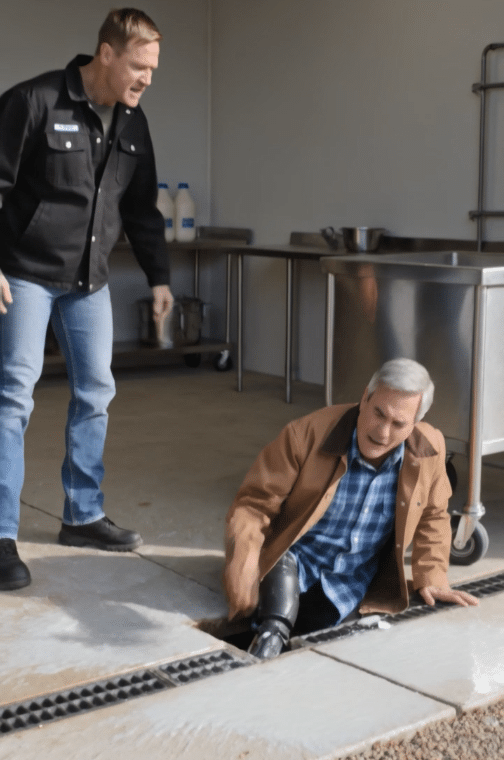
A stainless steel cart lurched to one side after one wheel dropped into a narrow floor drain gap. Two glass sample bottles tumbled onto the ground, exploding into white splashes of milk and scattered shards just steps away from the VIP tasting table.
Grant Keller never looked at the floor.
He looked straight at Earl Miller.
“You did this!”
Before the seventy-four-year-old worker could steady himself, the farm manager drove a hard kick into his chest. Earl crashed against the side of the milk cart, his prosthetic leg twisting awkwardly beneath him as the cart rattled across the concrete.
Workers gasped.
VIP guests froze.
Earl’s hand struck the edge of the cart, leaving only a thin streak of blood before he instinctively curled away from the broken glass, breathing in painful, uneven bursts.
“The wheel caught in the drain…” he whispered.
Grant towered over him, red with anger.
“Trash. You ruined my biggest tasting.”
No one spoke.
No one moved.
Grant stepped closer and struck him twice more with cruel kicks to his back and side.
“You cost this farm everything.”
To Grant, the failed tasting wasn’t simply embarrassing.
It threatened the biggest business opportunity of his career.
And in his panic, he decided one elderly employee would make the perfect scapegoat.
What he didn’t realize was that the most important visitors had just arrived.
Act II
Earl Miller had spent nearly five decades working around dairy farms.
After losing part of his leg in a machinery accident years earlier, he refused to retire.
“I can still work,” he always said.
Maybe not as quickly.
Maybe not as strongly.
But carefully.
Always carefully.
The family-owned dairy hired him to move milk crates, prepare tasting samples, and mentor younger workers who had never learned the value of patience.
Everyone trusted Earl.
He inspected every cart before loading it.
He tied every crate securely.
He never rushed, even when others did.
That morning, however, dozens of visitors crowded the tasting area ahead of an important meeting with a national food distributor.
The pressure inside the farm was obvious.
Employees hurried.
Managers barked instructions.
No one noticed that one drain cover beside the tasting path had settled unevenly after recent maintenance.
Its narrow gap waited like a trap.
As Earl pushed the sample cart toward the guests, one wheel slipped into it.
The accident lasted less than a second.
Grant never saw the wheel catch.
He saw only broken bottles.
And because he feared losing everything he had worked toward…
He blamed the weakest person standing nearby.
Act III
The sound of tires crunching across gravel echoed through the yard.
A convoy of black SUVs rolled past the visitor entrance and stopped beside the tasting area.
Every head turned.
Doors opened almost in unison.
Victor Hayes stepped out wearing a long black coat over a tailored gray suit, followed by several assistants carrying folders and tablets.
Grant forced a smile.
He started walking toward them.
Victor ignored him completely.
Instead, his eyes locked onto Earl lying beside the overturned cart.
Without hesitation, Victor crossed the yard, bent down, and gently helped the elderly worker to his feet before saying a single word.
The entire VIP team stopped behind him.
No one approached the tasting table.
No one reached for the remaining sample bottles.
Victor looked quietly at Earl’s injured hand.
Then he turned toward Grant.
His expression never changed.
“We don’t need to see more.”
Silence swept across the yard.
Grant blinked.
“What do you mean?”
Victor didn’t answer.
Instead, he nodded once toward his assistants.
Almost immediately, the group turned away from the tasting area.
The business meeting was over before it had truly begun.
Grant’s confidence disappeared.
Because he suddenly understood.
The visitors weren’t judging spilled milk.
They were judging him.
Act IV
The farm owner hurried from the processing building after hearing the commotion.
One glance told him everything he needed to know.
Broken bottles.
The damaged drain.
Earl struggling to stand.
Victor preparing to leave.
An employee quietly pointed toward the floor.
The drain gap was obvious now.
Even the stainless cart remained trapped exactly where its wheel had fallen.
Grant’s accusation began collapsing under the weight of simple facts.
The farm owner crouched beside the cart and pulled the wheel free.
“It wasn’t carelessness,” he said.
“It was the floor.”
Several workers nodded immediately.
They had reported the uneven drain days earlier.
Repairs had been delayed because preparations for the VIP visit took priority.
Grant swallowed hard.
The truth had never been hidden.
He simply never looked.
Instead, he chose anger over responsibility.
And violence over leadership.
Around him, workers slowly stepped away.
Not because anyone ordered them to.
Because respect had shifted completely.
Grant still wore the manager’s badge.
But in that moment, no one saw a leader.
They saw a man willing to sacrifice an innocent employee to protect his own reputation.
Act V
A paramedic cleaned the scrape on Earl’s hand while another employee adjusted the strap on his prosthetic leg.
The injury would heal.
The humiliation would take longer.
Victor stood beside him before returning to his vehicle.
“We choose partners by how they treat people when something goes wrong,” he said quietly.
“Today we got our answer.”
The convoy drove away.
No contracts were signed.
No tasting took place.
Later that afternoon, the farm owner reviewed witness statements and inspected the accident site himself. The damaged drain had caused the cart wheel to catch exactly as Earl had tried to explain. He had followed every procedure expected of him.
Grant wasn’t remembered because two sample bottles broke.
He was remembered because he responded to an accident with cruelty.
An internal investigation followed.
The neglected maintenance issue was corrected immediately.
Grant was removed from his management role pending the outcome of the investigation, and the farm introduced new safety inspections to ensure hazards were addressed before visitors arrived.
Earl was asked to help train new employees—not only in handling equipment, but in the patience and professionalism that had defined his entire career.
Months later, Victor Hayes returned.
Not because of the tasting.
Because he believed a business willing to learn from failure deserved another chance.
The new agreement they eventually signed wasn’t built on flawless presentations.
It was built on accountability.
The broken bottles were replaced that same day.
The drain was repaired by the next morning.
But everyone who witnessed that afternoon remembered something far more valuable.
A great business can recover from an accident.
It rarely recovers from losing its humanity.
And sometimes, the most expensive deal isn’t the one you fail to close.
It’s the one you lose the moment you stop treating people with dignity.