Act I
The slap silenced the ballroom.
One second, the wedding was glowing beneath warm gold lights. Crystal chandeliers reflected across white tablecloths, champagne glasses shimmered beneath floral arrangements, and officers in dress uniforms stood beside wealthy guests as the daughter of a powerful general prepared to celebrate the most important night of her life.
The next second, a woman’s head snapped sideways.
The general had hit her.
Hard.
She caught herself against the back of a chair, one hand gripping the polished wood as the room seemed to tilt around her. A red mark began to rise across her cheek.
Nobody moved.
The woman slowly straightened.
She was thirty-six, dressed in a plain black suit that looked almost deliberately invisible among the medals, ribbons, expensive gowns, and immaculate uniforms surrounding her. Her brown hair was pulled into a simple low bun.
There was nothing about her that announced importance.
No visible rank.
No decorations.
No entourage.
Just a quiet woman standing near the family table after a tiny accident.
It had started with a champagne tray.
A server had passed behind her, forcing her to step sideways. In doing so, her shoulder brushed the bride’s arm.
A single drop of champagne landed on the white wedding dress.
The woman immediately apologized.
But apparently, an apology wasn’t enough.
The general had crossed the room with the fury of a man who believed embarrassment was something other people were responsible for preventing.
Now he stood over her.
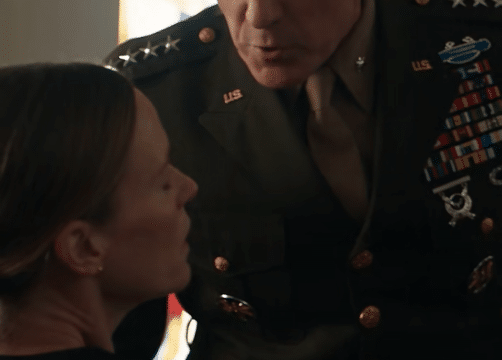
His gray hair was perfectly styled. His dress uniform carried enough medals to make the front of his jacket glitter beneath the ballroom lights.
His voice cut through the silence.
“People like you don’t ruin my daughter’s wedding and walk away.”
The woman breathed slowly.
Her cheek burned.
Her eyes did not leave his.
“It was an accident. I already apologized.”
A few guests lowered their phones.
One woman covered her mouth.
A young officer near the groom’s side stared at the floor, visibly horrified.
The general seemed to mistake the woman’s composure for defiance.
He took half a step toward her.
But then she reached down to steady herself.
And something flashed beneath the ballroom lights.
A dark ring.
Old.
Almost black.
It sat on the fourth finger of her right hand, engraved with a tiny symbol that most people wouldn’t have noticed.
One person did.
The young officer’s face suddenly lost all its color.
He stared at the ring.
Then at the woman.
Then back at the ring.
His expression changed so quickly that the man standing beside him noticed.
The officer swallowed.
“General… maybe don’t touch her again.”
The general turned sharply.
For the first time, uncertainty flickered through the room.
But the general didn’t see it.
He only saw another young officer challenging him at his daughter’s wedding.
And his pride was already wounded.
“This is my family’s night,” he said coldly. “She is nothing here.”
The woman looked down at the ring.
Then back at him.
Her voice was quiet.
“That ring knows whose night this really is.”
The general’s expression froze.
He finally looked at her hand.
And for the first time that evening, the most powerful man in the room looked afraid.
Because he knew that symbol.
He just hadn’t expected to see it here.
And the woman he had called “nothing” was about to remind him exactly what he had forgotten.
Act II
Twenty minutes earlier, nobody would have guessed the woman was important.
She had arrived alone.
No driver had opened a door for her. No aide had announced her arrival. She hadn’t been surrounded by officers or greeted by a line of important guests.
She simply entered the ballroom, checked the seating arrangement, and took a position near the edge of the family table.
That was exactly where she wanted to be.
For years, she had learned the value of being overlooked.
Power, she had discovered, rarely announced itself when it was real.
The general understood power differently.
To him, power was visible.
It was the uniform.
The medals.
The handshakes.
The people who stood when he entered a room.
Tonight, all of it was on display.
His daughter had married into another prominent military family, and the wedding had become less like a private celebration and more like a gathering of America’s military elite.
Senior officers occupied the family tables.
Young lieutenants circulated between guests.
Retired commanders laughed beneath portraits of the hotel’s founders.
Every conversation seemed to contain a rank, a title, or a name that mattered.
And at the center of it all stood the general.
He loved his daughter.
But he also loved what her wedding represented.
Status.
Legacy.
Influence.
Nothing was supposed to go wrong.
Especially not in front of his guests.
The woman in black had understood that from the moment she entered.
She had also noticed something else.
The general’s security arrangements were careless.
A service corridor near the ballroom remained partially blocked by decorative equipment. Staff moved too quickly around the family table. Several guests had been drinking heavily.
She had quietly mentioned it to a nearby coordinator.
The coordinator nodded.
Then ignored her.
That was fine.
She hadn’t come to make a scene.
She had come to observe.
Because there was a reason she had been invited.
And that reason had nothing to do with the champagne.
Across the ballroom, the young groomsman kept watching her.
His name was Daniel.
Thirty years old.
An officer with enough ambition to know exactly when to keep his mouth shut.
At first, he assumed she was simply another guest.
Then he saw the ring.
He had seen that symbol once before.
Not in person.
In a photograph.
It had been buried inside an old training archive, one of those images officers were told not to discuss outside certain rooms.
He remembered the symbol because of the story attached to it.
Not the official story.
The one people whispered.
A ring like that wasn’t a decoration.
It was a mark of something older.
Something that existed above ordinary rank.
Daniel had never expected to see one on a woman’s hand at a wedding.
And certainly not on the hand of someone the general had just slapped.
When the general raised his voice, Daniel’s stomach tightened.
When the general struck her, it dropped.
But when the ring caught the light, Daniel understood that the slap was no longer the most important thing that had happened.
He wanted to stop the general.
He also knew better than to explain what he had recognized.
Not here.
Not in front of everyone.
Not until he was absolutely certain.
So he gave the only warning he dared.
“General… maybe don’t touch her again.”
The general dismissed him.
Of course he did.
Men like him rarely believed warnings from people beneath them.
But the woman heard the warning.
And she understood exactly why Daniel had given it.
Her eyes moved briefly toward him.
A tiny acknowledgment.
Then she turned back to the general.
He was still angry.
Still convinced he owned the room.
Still convinced the woman had no power.
He had no idea how close he was to discovering the difference between authority and actual control.
Because the ring had a history—and the general had once sworn never to speak about it.
Act III
The ballroom remained silent.
The bride stood several feet away, one hand hovering near the stained portion of her dress.
She looked frightened now.
Not because of the champagne.
Because she was beginning to understand that something far more serious had happened.
“Dad,” she whispered.
The general didn’t hear her.
His eyes were fixed on the woman.
“You think a little piece of jewelry makes you important?”
The woman said nothing.
He took another step.
Daniel stepped backward.
That movement drew the attention of an older officer seated behind the family table.
The older man had been watching everything without speaking.
His eyes moved from Daniel to the woman’s hand.
Then his face changed.
He recognized the ring too.
He didn’t say anything.
He didn’t have to.
His silence was enough.
The general finally noticed.
“What?”
The older officer lowered his eyes.
“Nothing, sir.”
The general’s jaw tightened.
He hated uncertainty.
He hated being watched.
Most of all, he hated the feeling that people in the room knew something he didn’t.
He pointed toward the woman.
“You’re going to leave.”
She remained still.
“You heard me.”
Still nothing.
“You have embarrassed my daughter, disrupted her wedding, and now you’re standing there like you’re above everyone else.”
The woman finally spoke.
“I didn’t embarrass your daughter.”
Her voice remained remarkably calm.
“You did.”
“No.”
She looked briefly at the bride.
“Your daughter was embarrassed by what you did.”
A collective breath seemed to move through the ballroom.
The general’s face hardened.
For years, people had learned not to contradict him publicly.
This woman had just done it without raising her voice.
That was somehow worse.
He stepped forward again.
But Daniel’s voice came quietly from behind him.
“Sir.”
The general stopped.
Daniel’s eyes were fixed on the ring.
“Look at it.”
The general didn’t move.
“Sir,” Daniel repeated.
The general finally looked.
The engraved symbol was tiny.
A dark circle surrounding a narrow geometric mark.
There was no name.
No rank.
No number.
But something about it triggered a memory.
Years ago.
A closed meeting.
A room beneath an old administrative building.
A file placed on a table.
A warning from someone senior to him.
If you ever see this symbol again, you will treat the person wearing it as if they outrank the room.
The general’s breathing changed.
He remembered laughing at the instruction.
He had been younger then.
Ambitious.
Certain that the old rules were disappearing.
The woman watched him remember.
She didn’t smile.
She didn’t gloat.
That made it worse.
“Who are you?” he asked.
For the first time, there was no anger in his voice.
Only uncertainty.
The woman looked toward the wedding table.
“Tonight?”
She glanced at the bride.
“I’m just a guest.”
Daniel stared at her.
He knew that wasn’t true.
The general knew it too.
But the woman wasn’t going to explain.
She didn’t need to.
The ring was explanation enough for those who understood it.
The general suddenly remembered another detail from that old briefing.
The symbol wasn’t given for rank.
It was given for trust.
And there were very few people left who were authorized to wear it.
His face drained of color.
But his pride fought against his memory.
“No,” he whispered.
The woman heard him.
“Yes.”
The older officer behind the table slowly stood.
Every conversation in the ballroom died.
The general looked at him.
The older officer didn’t speak.
He simply lowered his head.
Not toward the general.
Toward the woman.
That tiny movement was enough.
The general understood.
He had not slapped an ordinary guest.
He had not humiliated a junior officer.
He had not even embarrassed someone beneath his authority.
He had just struck a person whose identity was deliberately hidden from almost everyone in the room.
And he had done it in front of witnesses.
At his daughter’s wedding.
But the worst part was still coming—because the ring didn’t just tell them who she was. It reminded them why she had come.
Act IV
The general’s daughter began to cry.
Not loudly.
Just enough for the tears to catch the golden light.
“Dad,” she said again.
This time he heard her.
He looked at her.
Then at the woman.
Then back at the ring.
His entire understanding of the evening had collapsed.
The woman reached up and touched her reddening cheek.
There was pain there.
Real pain.
But no fear.
“You should have listened,” she said.
The general swallowed.
“To what?”
“To the people trying to protect you from yourself.”
Daniel remained several feet away.
He looked like he wanted to disappear.
The general suddenly understood why.
Daniel hadn’t been protecting the woman from the general.
He had been protecting the general from making a mistake he could never undo.
The general’s eyes dropped again to the ring.
“You were sent here.”
It wasn’t a question.
The woman didn’t answer.
She didn’t have to.
The older officer finally spoke.
“She was asked to observe.”
The general turned toward him.
“Observe what?”
The older man looked around the ballroom.
The blocked service corridor.
The crowded family table.
The careless staff movement.
The officers drinking too much.
The lack of basic security discipline.
Then he looked at the general.
“Everything.”
Silence.
Suddenly, the champagne spill seemed absurdly small.
The general had spent the evening worrying about a stain on his daughter’s wedding dress.
Meanwhile, the woman had been quietly documenting failures that could have endangered hundreds of people.
And instead of listening to her, he had humiliated her.
Then struck her.
The realization hit harder than the slap.
The woman looked toward the bride.
“I didn’t come here to ruin your wedding.”
The bride wiped her eyes.
“Then why?”
The woman paused.
“Because your father asked for a quiet review months ago.”
The general stared at her.
He remembered.
A private request.
A concern he had raised after a previous event.
He had expected paperwork.
He had expected someone to inspect procedures and send a report.
He had never expected the person doing the inspection to walk into his daughter’s wedding dressed like an ordinary guest.
And he certainly hadn’t expected her to witness his own behavior as part of that review.
The general looked around the ballroom.
Everyone was watching him now.
Not with admiration.
Not with fear.
With uncertainty.
The same people who had spent the evening laughing at his jokes were suddenly avoiding his eyes.
He looked at the woman again.
“Why didn’t you tell me who you were?”
She answered quietly.
“Because then you would have behaved differently.”
The sentence landed like a verdict.
The general said nothing.
She continued.
“I needed to know what happened when nobody thought you were being evaluated.”
His face tightened.
The woman wasn’t shouting.
She didn’t need to.
“You showed me.”
Daniel lowered his eyes.
The older officer remained silent.
The bride stared at her father as if she were seeing him clearly for the first time.
The general’s hand trembled slightly.
He looked again at the ring.
That old symbol had protected people before.
It had witnessed decisions made behind closed doors.
It had belonged to people who were trusted precisely because they could walk into powerful rooms without announcing themselves.
And now one of those people stood in front of him with a red mark on her cheek.
The general finally understood the true humiliation.
It wasn’t that he had lost control of the room.
It was that the room had finally seen him without the protection of his rank.
And when the woman lifted her hand again, the general realized the ring was not a warning anymore—it was evidence.
Act V
Nobody touched the champagne.
Nobody laughed.
The wedding music had stopped.
The ballroom felt strangely smaller now.
The general’s daughter stood beside the table, tears still on her face.
Her father looked at her.
“I didn’t mean—”
She shook her head.
“Don’t.”
One word.
It stopped him.
The woman stood quietly nearby.
She could have destroyed him in that moment.
She could have humiliated him the way he had humiliated her.
She could have told the room everything.
Instead, she reached for the chair she had used to steady herself.
Then she stood straight.
“Your daughter’s wedding doesn’t belong to your rank,” she said.
The general looked down.
“It belongs to her.”
The bride closed her eyes.
For the first time that evening, her father had nothing to say.
The woman turned toward the door.
Daniel moved aside to let her pass.
As she walked by him, he quietly said, “I’m sorry.”
She stopped.
“You warned him.”
“I should have done more.”
She looked at him.
“You did enough to make him look.”
Daniel glanced toward the general.
“No,” he said quietly. “I think the ring did that.”
A faint expression crossed her face.
Not quite a smile.
Something more tired.
“Sometimes,” she said, “people only recognize the truth when they’re afraid of it.”
Then she walked away.
The ballroom remained frozen.
The general stayed beside the family table, surrounded by medals that suddenly seemed much heavier than they had an hour earlier.
His daughter slowly removed the stained section of her dress from his hands when he tried to touch it.
“You were worried about a drop of champagne,” she said.
He looked at her.
“You didn’t notice what you spilled.”
She walked away.
The general stood alone.
For decades, he had believed authority meant never being questioned.
Tonight, he discovered the opposite.
Real authority didn’t need to shout.
It didn’t need medals.
It didn’t need a room full of people standing when you entered.
Sometimes it looked like a woman in a plain black suit quietly accepting an apology that should never have been necessary.
Sometimes it looked like an old ring on an ordinary hand.
And sometimes, the most dangerous person in the room was the one nobody noticed.
Hours later, the ballroom would still be talking about what happened.
Some would remember the slap.
Some would remember the general’s face when he recognized the symbol.
Others would remember the young officer stepping back as though he suddenly understood that history had walked into the wedding wearing black.
But the woman would remember something else.
The moment the general looked at the ring.
The moment arrogance disappeared.
The moment he finally understood that the woman he had called “nothing” had never needed his permission to matter.
She had only needed him to reveal who he was.
And he had done exactly that.
The ring remained on her hand as she disappeared beyond the ballroom doors.
Its symbol was still unexplained.
But everyone who had seen the general’s face understood one thing.
Whatever that ring meant…
He was terrified of it.