Act I
The flag had just begun to rise when the woman stepped out of formation.
It was barely a movement.
One boot shifted half a step forward. Her shoulders remained square. Her eyes stayed on the ranks.
But everyone noticed.
The morning ceremony was supposed to be perfect.
Rows of soldiers stood motionless on the concrete beneath the pale gold light of sunrise. The color guard stood rigid near the flagpole. The American flag moved slowly in the morning breeze, and every voice had fallen silent.
Then a young soldier near the third row suddenly turned pale.
His knees trembled.
His breathing became shallow.
The woman noticed immediately.
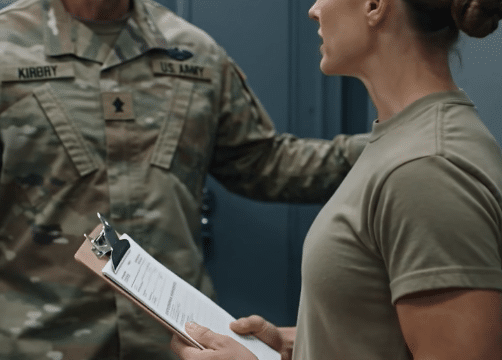
She was thirty-three, brown hair tucked beneath a patrol cap, olive uniform neat and regulation-perfect. There was nothing dramatic about her appearance.
But she noticed things.
A soldier’s posture.
A missed movement.
A dangerous hesitation.
She saw the young man’s weight shift backward.
He was about to fall.
She stepped slightly out of position.
“He is about to collapse, Colonel.”
The colonel turned.
His expression changed instantly.
Not to concern.
To anger.
The ceremony was his responsibility, and he saw her movement as an insult.
“You don’t interrupt my flag ceremony for weakness.”
The young soldier swayed again.
The woman looked toward him.
“Sir, he needs—”
The colonel crossed the space between them.
Then came the slap.
Her patrol cap flew from her head and struck the concrete.
A collective gasp moved through the formation.
Her face turned with the impact.
For one second, she remained completely still.
Then she straightened.
Her cheek was already beginning to redden.
But she didn’t lower her eyes.
The colonel stood over her, furious.
He had expected fear.
He got silence.
The woman took one controlled breath.
Then another.
Around them, soldiers stared straight ahead because they didn’t know what else to do.
But one older officer near the color guard had stopped looking at the colonel.
He was looking at the ground.
Because something had fallen from beneath the woman’s collar.
Something dark.
Something that should never have been there.
A small black dog tag had struck the concrete directly beside the flagpole.
The older officer saw the engraving.
And suddenly, the color drained from his face.
“Colonel…” he said quietly.
The colonel turned.
The older officer pointed toward the ground.
“Look down.”
The colonel sneered.
“I don’t look down for people beneath me.”
The woman slowly bent to retrieve her patrol cap.
Her fingers closed around the brim.
Then she looked at the black tag lying near her boot.
Her expression didn’t change.
“You should,” she said.
She lifted her eyes to the colonel.
“That’s where your mistake is.”
The colonel finally looked down.
And the moment he saw the tag, something inside his face broke.
“That tag…?”
He had spent years believing he knew exactly who stood beneath him. That morning, he discovered he had been wrong.
Act II
The ceremony had been scheduled for 0700.
By 0655, everything was already perfect.
The formations were aligned.
The color guard had inspected their equipment twice.
The flagpole stood at the center of the concrete courtyard, surrounded by soldiers who had been trained to treat ceremony as something almost sacred.
And the colonel had made it clear that nothing was to interfere.
He had been in command long enough to believe precision was the same thing as discipline.
He demanded silence.
Perfect posture.
Perfect timing.
Perfect obedience.
What he didn’t tolerate was interruption.
Especially not in front of senior officers.
The woman knew that.
Everyone did.
She also knew something the colonel apparently didn’t.
The young soldier in the third row wasn’t simply nervous.
His face had gone gray.
His eyes were struggling to focus.
His knees were beginning to buckle.
She had spent enough years watching soldiers to recognize the signs.
She could have ignored it.
She could have remained perfectly still and let the ceremony continue.
That would have been safer for her career.
Instead, she stepped out.
Because sometimes doing the right thing meant accepting that someone would be angry.
The colonel saw only the movement.
He didn’t see the soldier.
He saw disobedience.
And when the woman warned him, he felt publicly challenged.
That was the real trigger.
Not the ceremony.
Not the soldier.
His pride.
The slap had shocked everyone because it happened so quickly.
The woman hadn’t raised her voice.
She hadn’t insulted him.
She hadn’t refused an order.
She had simply reported a safety problem.
And for that, he had decided she deserved to be humiliated.
The young soldier she had tried to protect was now being held upright by another soldier.
His breathing was slowly returning to normal.
Nobody mentioned it.
Nobody dared.
The colonel turned back toward the woman.
“You made a spectacle of yourself.”
She looked at him.
“No, sir.”
His jaw tightened.
“You stepped out of formation.”
“Yes.”
“You interrupted a formal ceremony.”
“Yes.”
“And you questioned my authority.”
“No.”
That answer made him pause.
The woman continued.
“I reported a soldier in distress.”
The colonel stared at her.
Then he gave a bitter laugh.
“You think that distinction matters?”
She did not answer.
Because she knew it did.
But the older officer near the color guard was no longer listening to the argument.
His attention remained on the black dog tag.
He had seen one like it before.
Not recently.
Years ago.
Long before most of the soldiers standing there had even joined the service.
The tag had belonged to someone whose identity had never appeared in ordinary personnel records.
Someone who operated outside the usual chain of recognition.
The old officer remembered being warned about the symbol engraved into its surface.
Not its name.
Not its meaning.
Only one instruction.
If you ever see this mark again, don’t ask questions in public.
The officer had never expected to see it again.
Certainly not hanging from the neck of a junior-looking woman in an olive uniform.
And certainly not after watching a colonel strike her.
He looked toward the colonel.
Then toward the woman.
She was retrieving her patrol cap.
She had every reason to be angry.
Instead, she looked calm.
Too calm.
That was when the old officer understood something even more unsettling.
She hadn’t been surprised by the tag falling.
She had been surprised that he recognized it.
Their eyes met for half a second.
The older officer lowered his gaze.
It was almost imperceptible.
But the colonel noticed.
“What’s wrong with you?”
The older officer didn’t answer.
The colonel stepped toward him.
“I asked you a question.”
The officer looked back at him.
Then at the tag.
His voice was barely audible.
“Sir, you should let this go.”
The colonel’s pride flared again.
He had already been embarrassed.
Now an older officer was telling him what to do.
He refused.
And by refusing, he walked directly into the trap he had created himself.
Because the woman wasn’t hiding her identity from the colonel anymore. She was waiting to see how far his arrogance would take him.
Act III
The colonel pointed toward the woman’s patrol cap.
“Put it on.”
She picked it up.
For a moment, she simply held it.
Then she looked toward the young soldier who had nearly collapsed.
“He needs medical evaluation.”
The colonel’s expression hardened.
“He’ll be fine.”
The woman looked back at him.
“You don’t know that.”
“I said he’ll be fine.”
The old officer closed his eyes for a moment.
That sentence told him everything.
The colonel wasn’t interested in whether the soldier was safe.
He was interested in ending the interruption.
The woman seemed to understand the same thing.
She slowly slipped the black dog tag back beneath her collar.
The colonel saw the movement.
“What’s that?”
She didn’t answer.
“I asked you a question.”
The woman placed her patrol cap back on her head.
The colonel stepped closer.
“Take it out.”
Silence.
“Now.”
She looked at him.
“No.”
The word was quiet.
But it carried.
The colonel’s eyes narrowed.
“You’ve got a serious problem with authority.”
“No, sir.”
“Then why are you refusing me?”
“Because you don’t need to know.”
The old officer’s head snapped toward her.
The colonel stared.
Nobody spoke to him like that.
Not in public.
Not during a ceremony.
Not while he was wearing his dress uniform.
He stepped closer.
“What exactly do you think you are?”
The woman said nothing.
The colonel looked toward the other officers.
“Does anyone know who this soldier is?”
Nobody answered.
That silence should have warned him.
Instead, he interpreted it as weakness.
He turned back toward the woman.
“You interrupted my ceremony.”
He pointed toward her collar.
“You’re carrying something you refuse to identify.”
Then he smiled without humor.
“And you think that makes you special?”
The woman looked at the flag.
Then at him.
“No.”
Her eyes settled on his.
“I think what happened next will.”
The colonel’s smile disappeared.
The older officer suddenly stepped forward.
“Sir.”
The colonel turned.
“What?”
The older man pointed toward the concrete.
The black tag had slipped loose again.
It rested in full view beneath the flagpole.
This time, the sunlight struck the engraving directly.
The colonel looked down.
He saw a series of tiny markings.
He couldn’t read them from where he stood.
But he recognized the shape surrounding them.
His expression changed.
Only slightly.
Enough for the older officer to notice.
The colonel looked again.
Then again.
His breathing slowed.
Years earlier, he had been briefed about that mark.
Not by someone his rank.
By someone above the ordinary structure of command.
He remembered the room.
The closed door.
The folder placed in front of him.
The warning.
He remembered being told that some identities were deliberately concealed because their value depended on remaining invisible.
He remembered laughing afterward.
He had thought the entire thing sounded exaggerated.
A myth used to keep ambitious officers obedient.
Until now.
The woman watched him.
She knew he had recognized it.
But she didn’t explain.
That was important.
The symbol was supposed to be recognized, not announced.
The colonel looked toward the old officer.
The old officer didn’t meet his eyes.
Instead, he lowered his head.
That tiny gesture terrified him more than any spoken accusation could have.
Because the old officer was not showing respect to the colonel.
He was showing respect to the woman.
The colonel’s face tightened.
“Who are you?”
She remained silent.
“Answer me.”
Still nothing.
He looked around the courtyard.
The soldiers were standing motionless.
But the atmosphere had changed.
The ceremony no longer belonged to him.
Everyone was waiting.
The woman finally bent down and picked up the tag.
She held it between two fingers.
“You should have stopped when he warned you.”
The colonel swallowed.
“What is that?”
She looked at the tag.
Then back at him.
“Something you were taught to recognize.”
His face went pale.
Because now he remembered exactly where he had seen that symbol.
And exactly what he had been told about the people allowed to carry it.
The colonel had spent years commanding others. He had never imagined that one small piece of black metal could make him question his own place in the formation.
Act IV
The old officer finally spoke.
“Colonel.”
The colonel looked at him.
“You remember the briefing.”
It wasn’t a question.
The colonel’s throat tightened.
“That’s impossible.”
The woman said nothing.
The old officer continued.
“You were told not to interfere with anyone carrying that mark.”
The colonel looked at him sharply.
“When?”
The older officer’s expression was grim.
“Before you made colonel.”
The words landed heavily.
The colonel stared at the woman.
She didn’t look triumphant.
That somehow made everything worse.
She looked disappointed.
Not afraid.
Not angry.
Disappointed.
The colonel glanced toward the young soldier.
The soldier was now sitting safely against a nearby wall, drinking water.
Alive.
Stable.
Protected.
The woman had been right.
The colonel had been wrong.
But that wasn’t the part that frightened him most.
He remembered why the old briefing existed.
The people who carried that symbol weren’t important because of rank.
They were important because they were trusted with something ordinary authority couldn’t reach.
They could observe.
Report.
Intervene.
And disappear again without needing applause.
The colonel had just attacked one of them in front of an entire formation.
He looked at his own hand.
The hand that had struck her.
For the first time, it seemed unfamiliar.
The woman noticed.
“You understand now.”
He looked at her.
“I didn’t know.”
“That isn’t the defense you think it is.”
His eyes hardened instinctively.
Then softened.
He had no argument left.
The woman stepped closer.
“You didn’t know who I was.”
She paused.
“But you knew what I was doing.”
The colonel stared.
“You saw a soldier in trouble.”
He said nothing.
“You saw someone report it.”
Nothing.
“You decided the ceremony mattered more.”
The colonel looked away.
“And when I challenged you, you used your rank to silence me.”
The courtyard remained silent.
The woman touched her cheek.
The red mark was still visible.
“I could have told you who I was before you struck me.”
The colonel looked back.
“Why didn’t you?”
“Because then you would have listened for the wrong reason.”
The sentence cut deeper than an accusation.
She continued.
“You would have protected that soldier because you were afraid of me.”
The colonel’s eyes dropped.
“I wanted to know whether you would protect him because it was right.”
He had no answer.
The old officer looked toward the flag.
The ceremony had stopped.
The American flag continued moving above them in the morning wind.
For years, the colonel had treated ceremony as a demonstration of discipline.
Now he understood that discipline without judgment was only obedience.
The woman turned toward the formation.
“Resume the ceremony.”
The colonel looked up.
She hadn’t ordered him.
She had simply spoken.
The old officer nodded.
Slowly, the color guard returned to position.
The young soldier was escorted away for evaluation.
The colonel remained standing beside the flagpole.
For once, nobody was looking at his medals.
They were looking at his choices.
And the man who had demanded perfect posture could no longer hide the fact that his own had collapsed.
But the final humiliation wasn’t that the colonel had been exposed. It was that the woman never needed to reveal her name at all.
Act V
The ceremony resumed several minutes later.
The flag rose slowly.
The formation stood at attention.
The morning sun climbed higher.
Everything looked normal again.
But nothing was.
The colonel stood at the front with his hands behind his back.
He didn’t speak.
He couldn’t.
His authority remained visible.
His rank was still pinned to his uniform.
His medals still caught the sunlight.
But the illusion surrounding them was gone.
The woman stood several yards away.
Her patrol cap was back in place.
Her uniform was straight.
The black dog tag was hidden beneath her collar again.
No announcement came.
No dramatic introduction.
No name was read over a loudspeaker.
The ceremony simply continued.
And somehow, that was more powerful than anything else could have been.
When it ended, soldiers began to move.
The old officer approached the woman.
“You knew I would recognize it.”
She looked at him.
“I hoped you would.”
“You shouldn’t have had to come here.”
“I didn’t.”
He waited.
“I was assigned to observe something else,” she said.
His eyes narrowed.
“Then why did you intervene?”
She glanced toward the young soldier being escorted toward medical personnel.
“Because that wasn’t part of the assignment.”
The old officer nodded slowly.
He understood.
Some rules existed on paper.
Others existed because people had learned the cost of ignoring them.
The colonel approached from behind.
Both of them turned.
For several seconds, nobody spoke.
Finally, the colonel looked at the woman.
“I owe you an apology.”
She said nothing.
“I also owe that soldier one.”
Still nothing.
He swallowed.
“I was wrong.”
The woman studied him.
Then she nodded once.
“Remember that the next time someone steps out of formation.”
The colonel lowered his eyes.
“Yes, ma’am.”
The old officer noticed.
So did everyone nearby.
The woman turned and began walking away.
The colonel watched her disappear across the concrete.
He never learned everything about her.
He never asked.
Because he finally understood that some secrets were not meant to satisfy curiosity.
They existed to test character.
And that morning, his character had been tested long before the black dog tag ever touched the ground.
He had failed before anyone knew the answer.
The woman reached the edge of the courtyard.
Her hand briefly touched the tag beneath her collar.
The dark metal rested against her uniform.
Invisible again.
Just as it had been meant to be.
Behind her, the colonel stood beneath the flag.
He looked up at it.
Then down at his own hands.
For the first time in years, he seemed to understand something simple.
The people beneath you are not beneath you because they are weaker.
And a ceremony is not made honorable by perfect silence.
It is made honorable when someone is willing to break that silence for the right reason.
The colonel had tried to punish her for doing exactly that.
He had believed rank gave him permission.
The black tag had reminded him that rank was never the same thing as judgment.
And as the last soldiers left the courtyard, one question remained unanswered.
What exactly was engraved beneath that dark metal?
The colonel knew.
The old officer knew.
And the woman knew.
But nobody else would be told.
Because the most powerful secrets were not always the ones that were revealed.
Sometimes, they were the ones that made a powerful man finally understand why he should have looked down.