Act I
The radio hit the mud before anyone understood what was happening.
It landed beside the tent line with a dull splash, half-buried in wet earth, its tiny indicator light still blinking through the darkness.
The woman immediately reached for it.
“That radio has to stay on, Major.”
Her voice was calm.
That was what made the Major angrier.
Around them, the field camp was barely visible beneath the trees. Canvas tents stood in uneven rows. Guy-lines stretched across the muddy ground. A small field stove hissed somewhere behind them, while a handheld flashlight cut narrow white beams through the darkness.
The emergency radio was supposed to remain active overnight.
Everyone knew that.
But the Major had decided his officers wanted water.
And he had decided she would fetch it.
“You don’t give orders in my camp.”
He snatched the radio from her hand and threw it.
She immediately moved toward it.
That was when his boot struck her from behind.
She fell hard beside the tent line.
Mud splashed across her olive field jacket and cheek. Her hands hit the ground, and for a second, she lost her breath.
A young soldier holding a flashlight froze.
The Major stood over her.
The woman winced.
Then reached for the radio again.
Not for herself.
For the signal.
For the emergency channel.
The Major stared down at her.
“You heard me.”
She slowly pushed herself upright.
Her brown hair had come loose from its low bun. Mud streaked one side of her face.
But her eyes remained steady.
The Major sneered.
“You don’t give orders in my camp.”
Nobody answered.
Nobody dared.
Then the woman moved toward the fallen radio again.
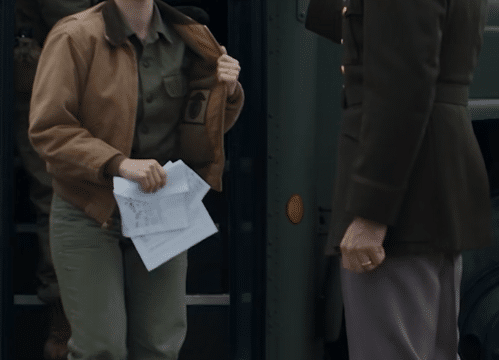
And as she did, her jacket pulled open.
The young soldier’s flashlight shifted.
The beam landed inside her jacket.
For one second, the entire camp seemed to stop breathing.
There was a dark patch sewn beneath the inner lining.
No ordinary unit marking.
No visible rank.
Just a strange symbol in faded thread.
The young soldier’s hand began to shake.
“Major…” he whispered.
The Major turned.
“Look where the light is.”
The young soldier swallowed.
The Major’s eyes narrowed.
“Point that light away and shut up.”
The beam remained frozen.
The woman looked at the Major.
Her cheek was muddy.
Her breathing was controlled.
Then she looked at the radio lying in the dirt.
“You just turned off the wrong radio.”
The Major followed her gaze.
Then the flashlight.
Then the patch.
His expression changed.
“Wrong radio…?”
He thought he had just punished a stubborn soldier. He had no idea what he had actually shut down.
Act II
The field exercise had been running for three days.
By midnight, exhaustion had settled over the camp.
The soldiers were cold.
Their uniforms were dirty.
The forest around them was black and restless, with wind moving through the branches and making the tent fabric snap softly against its supports.
The emergency radio was one of the few things everyone treated differently.
It wasn’t there for convenience.
It was there because the camp could lose contact with the outside world during the exercise.
That was why the woman had stayed beside it.
She was thirty-four.
She wasn’t the highest-ranking person in the camp.
She wasn’t the loudest.
And she certainly wasn’t interested in impressing the Major.
She was there to make sure the emergency channel remained active.
The Major didn’t care.
He had spent the evening drinking coffee near the command tent, barking orders at exhausted soldiers and complaining that his officers weren’t being served quickly enough.
When he wanted water, he looked toward her.
“You. Get it.”
She didn’t move.
“The radio has to stay monitored.”
“Someone else can monitor it.”
“No.”
His face hardened.
“What did you say?”
She repeated herself.
“The emergency channel has to stay active overnight.”
He stepped closer.
“That’s an order.”
She looked at the radio.
“Then assign someone else.”
The Major’s jaw tightened.
There were soldiers nearby.
That mattered.
He wasn’t used to being challenged in front of people.
Especially not by someone who remained completely calm while doing it.
He reached for the radio.
She held on.
“Don’t.”
He pulled harder.
She released it.
The radio flew into the mud.
The Major kicked her moments later.
Nobody expected it.
The young soldier with the flashlight almost stepped forward.
Then stopped.
Fear held him in place.
Everyone in that camp knew what happened to people who challenged the Major.
The woman slowly sat up.
She didn’t look at the soldiers.
She looked at the radio.
The indicator was still blinking.
Good.
It hadn’t broken.
She crawled forward and reached for it.
The Major laughed.
“You care more about that piece of equipment than you do about following orders.”
She wiped mud from her mouth.
“No.”
She looked up.
“I care about what happens if it goes silent.”
The Major shook his head.
“You people always think everything is an emergency.”
She stared at him.
“This one is.”
The Major turned away.
“Get water.”
She remained where she was.
“No.”
He spun around.
“What?”
“I said no.”
The young soldier’s flashlight moved slightly.
He didn’t understand why she wasn’t afraid.
He didn’t understand why she kept protecting the radio.
And he certainly didn’t understand why the oldest sergeant in the camp, who had watched the entire confrontation from beside a tent, suddenly looked deeply uncomfortable.
The sergeant had recognized something.
Not the woman.
Not yet.
The symbol.
Years earlier, he had seen a similar patch inside a sealed equipment case.
It had been attached to documentation nobody was supposed to discuss.
He remembered the instructions.
If the symbol appeared during an exercise, do not question the bearer publicly.
Do not interfere.
Do not attempt to identify them.
And above all, do not assume they are subordinate simply because they appear to be.
The sergeant looked at the woman.
She didn’t look back.
That told him enough.
She knew.
The Major didn’t.
And that was dangerous.
Because the woman wasn’t protecting the radio merely out of duty. She knew something about the signal that the Major had never been cleared to know.
Act III
The radio continued blinking in the mud.
A faint burst of static came through its speaker.
Everyone heard it.
The Major didn’t.
Or perhaps he simply didn’t care.
He was focused on the woman.
“You’re done.”
She picked up the radio.
“No.”
His expression hardened.
“You’re relieved.”
“No.”
“You think this is funny?”
“No.”
Every answer was calm.
That made him furious.
The woman checked the radio’s indicator.
Then the frequency.
Then the battery.
The emergency channel was still active.
She exhaled quietly.
The Major noticed.
“What are you checking?”
“Whether you damaged it.”
His face darkened.
“You’re more concerned about that radio than my authority.”
She looked at him.
“Your authority isn’t the issue.”
“Then what is?”
She paused.
“The signal.”
The young soldier’s flashlight moved across the mud.
The Major stepped toward her.
“What signal?”
The woman didn’t answer.
He pointed at the radio.
“Explain.”
“I don’t have to.”
That was the wrong answer.
The Major’s pride snapped.
He reached toward her jacket.
She stepped back.
He stopped.
For a moment, neither moved.
Then the wind shifted.
Her field jacket opened slightly.
The flashlight beam slipped inside again.
This time, the symbol was unmistakable.
The young soldier stared.
His face went white.
“Major… look where the light is.”
The Major didn’t even turn.
“Point that light away and shut up.”
The soldier froze.
His grip tightened around the flashlight.
The beam remained.
The woman looked down at the patch.
Then back at the Major.
There was something different in her expression now.
Not fear.
Not anger.
Recognition.
She knew the moment had arrived.
The Major finally looked.
He saw the symbol.
For several seconds, he said nothing.
Then he laughed once.
“That?”
The woman didn’t respond.
He stepped closer.
“That’s supposed to scare me?”
Still nothing.
The Major reached toward the patch.
The young soldier flinched.
“Don’t.”
The word escaped before he could stop it.
The Major turned slowly.
“What did you say?”
The young soldier looked terrified.
“I said—”
“You don’t tell me what to do.”
The Major turned back.
Then he looked at the patch again.
Something about the symbol bothered him.
Not because he recognized it.
Because he almost recognized it.
A memory surfaced.
A briefing.
A dark room.
A senior official speaking without slides, without documents, without leaving anything behind.
There had been a symbol.
A patch.
A warning.
The Major had been younger.
He had assumed it was part of some obscure oversight structure that would never affect him.
Then the briefing had ended.
Everyone had been told to forget it.
He had.
Until now.
The woman was watching him.
“You remember.”
It wasn’t a question.
The Major’s face tightened.
“I remember nothing.”
“Then you shouldn’t be afraid.”
He looked at her.
“I am not afraid.”
She glanced toward the radio.
“You should be.”
A burst of static came from the muddy speaker.
Then another.
The young soldier stepped back.
The Major stared at the radio.
“What is that?”
The woman picked it up.
“A call you just made impossible to receive.”
His face changed.
“What?”
She held the radio against her chest.
“You turned off the wrong radio.”
The Major stared at her.
The words suddenly meant something different.
The emergency channel wasn’t merely carrying routine traffic. It was waiting for someone to answer.
Act IV
The camp went silent.
Even the wind seemed quieter.
The Major looked around.
No one moved.
The soldiers who had been pretending not to watch were now watching openly.
The old sergeant finally stepped forward.
“Sir.”
The Major looked at him.
“What?”
The sergeant glanced at the patch.
Then at the radio.
Then lowered his voice.
“You need to stop.”
The Major’s face hardened.
“You too?”
The sergeant didn’t answer.
He didn’t need to.
His eyes told the story.
The Major looked back at the woman.
“What exactly are you?”
She gave him no answer.
He tried again.
“Who sent you?”
Nothing.
“Are you intelligence?”
Silence.
“Internal oversight?”
Nothing.
“Some kind of inspector?”
The woman shook her head.
“You’re asking the wrong question.”
“Then what’s the right one?”
She looked at the radio.
“Why was I here?”
The Major stared.
She continued.
“Because someone was worried about this camp.”
His face tightened.
“Worried about what?”
She looked around.
The muddy tents.
The dark tree line.
The exhausted soldiers.
The emergency equipment.
“The same things you ignored.”
The Major’s expression became defensive.
“This camp is secure.”
“No.”
“You don’t know that.”
“I know the radio was assigned for a reason.”
He looked toward it.
“You’re telling me someone was monitoring us?”
“I didn’t say that.”
The Major’s breathing changed.
The woman continued.
“You assumed the radio was just another piece of equipment.”
She paused.
“It wasn’t.”
The old sergeant closed his eyes.
He understood.
The patch wasn’t the only clue.
It was the confirmation.
The woman had been watching the camp because something important was expected to happen overnight.
The emergency channel wasn’t merely a backup.
It was a test.
And the Major had just failed it in front of someone who had authority to document everything.
He looked at the young soldier.
“You.”
The flashlight soldier froze.
“What did you see?”
The young man couldn’t speak.
The woman answered for him.
“Enough.”
The Major looked at her.
“You’ve been evaluating us.”
“No.”
She stepped closer.
“I’ve been watching you.”
The difference was devastating.
The Major looked down at his muddy boots.
Then at the radio.
Then at the patch.
His arrogance was finally cracking.
“You could have told me.”
The woman looked at him.
“And you would have behaved differently.”
He said nothing.
“You would have protected the radio because you knew I was watching.”
Silence.
“You would have checked on the soldiers because you knew someone important might review the exercise.”
Her voice remained quiet.
“But that’s not what I needed to know.”
The Major swallowed.
“What did you need to know?”
She looked directly into his eyes.
“What happens when nobody important is watching?”
The answer was all around them.
A radio thrown into mud.
A soldier kicked beside a tent.
A young man too frightened to intervene.
An officer more concerned with getting water than maintaining an emergency channel.
The Major had given her the answer without realizing it.
He looked toward the patch again.
This time, he didn’t try to touch it.
He didn’t ask for an explanation.
He simply stared.
And suddenly, he understood why nobody had explained the symbol.
Because people who carried it didn’t need to announce themselves.
The Major’s face went pale.
The woman noticed.
“You finally understand.”
He whispered, “Who are you?”
She looked at the radio.
Then at him.
“Someone who was listening.”
And that was when the Major realized the most frightening part of the night: the report had probably already begun before he ever touched her.
Act V
The radio suddenly crackled.
Everyone turned.
A voice came through the static.
It was brief.
The woman listened.
Then she answered.
“Received.”
The channel went quiet.
The Major stared at her.
“Who was that?”
She didn’t answer.
He looked toward the old sergeant.
The sergeant shook his head.
Don’t ask.
The message had been received.
That was enough.
The woman placed the radio on a dry wooden crate.
Then she looked at the Major.
“You were worried about water.”
He said nothing.
“You were worried about appearances.”
Still nothing.
“You were worried that a soldier refusing an order would make you look weak.”
The Major lowered his eyes.
“But you weren’t worried about why she refused.”
He finally looked at her.
She nodded toward the radio.
“She was right.”
The Major glanced at the young soldier.
He was still holding the flashlight.
The Major looked away.
For the first time that night, he seemed ashamed.
Not because someone outranked him.
Not because someone might file a report.
Because the people he commanded had watched him choose his pride over their safety.
The woman bent down and picked up a piece of mud-covered equipment beside the radio.
She wiped it clean.
“You don’t have to like the person who corrects you.”
The Major listened.
“You just have to care enough to find out whether they’re right.”
He nodded once.
Barely.
Then he looked at the patch.
“Will I ever know what that means?”
The woman gave him a tired expression.
“No.”
“Why?”
“Because if you need to know, someone will tell you.”
The answer left him silent.
She turned away.
The young soldier approached her cautiously.
He lowered his flashlight.
“Ma’am?”
She stopped.
“Thank you.”
She looked at him.
“For what?”
“For not leaving the radio.”
She glanced at the blinking indicator.
“That wasn’t bravery.”
She paused.
“That was the job.”
The young soldier nodded.
The woman walked toward the edge of the camp.
Behind her, the Major remained beside the muddy tent line.
His boots were covered in the same mud as hers.
His gloves were dirty.
His uniform was stained.
But those things didn’t matter.
What mattered was the silence.
For the first time that night, nobody was afraid to speak.
The emergency radio remained on.
The tents stood against the wind.
The forest stayed dark.
And beneath the woman’s field jacket, the mysterious patch disappeared again into shadow.
Nobody asked what it meant.
Nobody dared.
The Major watched her disappear between the tents.
Then he looked down at the radio he had thrown away.
A small green light blinked steadily.
Still transmitting.
Still waiting.
He finally understood the cruel irony of the night.
He had believed the woman was refusing his order because she thought she was above him.
But she had never been trying to outrank him.
She had been trying to keep him from making a mistake.
And when he kicked her into the mud, he had revealed exactly why someone had needed to watch his camp in the first place.
The woman had never needed to threaten him.
She hadn’t needed to shout.
She hadn’t even needed to reveal her identity.
All she had needed was a working radio, a hidden patch, and enough patience to let the Major expose himself.
As the last flashlight disappeared into the trees, the Major looked once more at the place where the patch had been revealed.
Then came the question he could not stop thinking about.
What exactly had that radio been waiting to receive?
And why had the woman been the only person in the entire camp who knew it mattered?