Act I
The warehouse was too large for one argument to stay private.
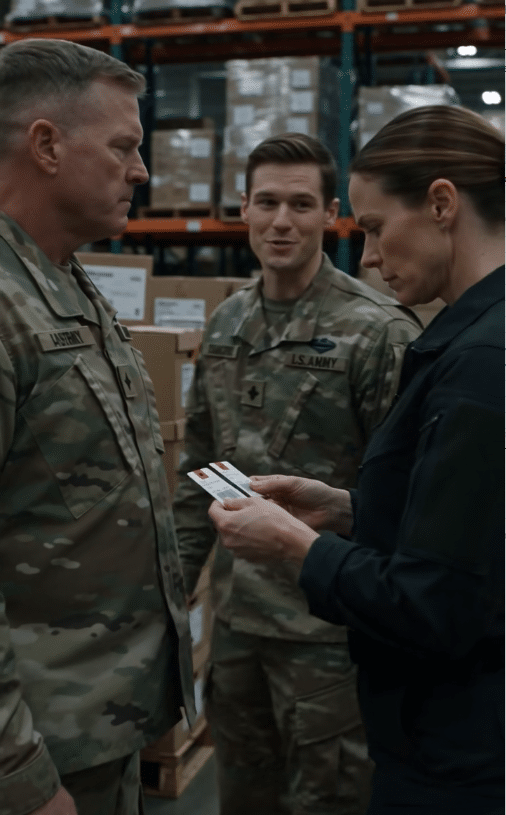
Rows of military crates stretched beneath harsh white lights. Forklifts moved between towering pallets, scanners chirped, and shipping tags fluttered in the air whenever a loading bay door opened.
At the center of it all, a woman in a dark field jacket stood beside a pallet with two shipping tags in her hands.
She looked nothing like a senior officer.
No uniform.
No visible rank.
Just a clipboard, black boots, and the patient concentration of someone who had found something wrong.
A Captain noticed her first.
He turned toward the Logistics Colonel standing nearby.
“Colonel, she keeps checking boxes that aren’t her business.”
The Colonel looked over.
His expression immediately hardened.
The woman didn’t even glance up.
She compared the numbers again.
Then she held the tags side by side.
“These serial numbers were changed.”
The Colonel walked toward her.
“What did you say?”
She showed him the tags.
“These serial numbers were changed.”
The Captain gave a short laugh.
“She’s been doing that all morning.”
The Colonel snatched the clipboard from her hand.
“You don’t inspect my supply line without authorization.”
The woman reached for it.
He threw it to the concrete.
The crack of plastic against the floor silenced the nearest workers.
She bent down to recover the shipping tag.
That was when the Colonel stepped back.
And kicked her hard in the midsection.
The impact drove the air from her lungs.
She fell beside the pallet, one hand catching the floor while the shipping tag remained clenched in the other.
Boxes rattled above her.
Nobody moved.
The Colonel looked down at her.
“Paper rats don’t inspect my supply line.”
She breathed through the pain.
Then slowly began to rise.
She didn’t drop the evidence.
And when she finally stood, something beneath her sleeve became visible.
The Warrant Officer holding a scanner saw it.
His face changed instantly.
Act II
The old scar was barely noticeable.
It ran across the inside of her wrist, faded enough that most people would have missed it.
Beside it sat a tiny unit mark.
The field-jacket sleeve had normally kept both hidden.
Now the sleeve had shifted just enough.
The sixty-year-old Warrant Officer froze.
His scanner lowered.
His eyes locked onto the mark.
He had spent decades around military logistics.
He had seen thousands of insignias.
Thousands of uniforms.
Thousands of names.
But that tiny mark was different.
He knew it.
Or, more precisely, he knew what it meant.
The Captain noticed the Warrant Officer staring.
“What?”
The older man didn’t answer.
The Colonel turned.
“What are you looking at?”
The Warrant Officer swallowed.
Then looked directly at the woman’s wrist.
“Colonel… what is that mark?”
The Colonel glanced at it.
Nothing registered.
He looked almost annoyed that anyone had interrupted him.
“I don’t care about an old scar.”
The Warrant Officer’s face tightened.
The woman had recovered her posture.
One hand remained against her abdomen.
The other still held the shipping tag.
She was breathing carefully now.
But her eyes were clear.
Steady.
Unafraid.
The Colonel stepped toward her again.
“Give me that tag.”
She didn’t.
“That’s not a request.”
“It’s evidence.”
The Colonel laughed.
“Evidence of what?”
She looked toward the pallets.
“That someone changed those serial numbers.”
The Captain shifted uncomfortably.
The Colonel noticed.
“Nobody changed anything.”
The woman held up the tag.
“Then you won’t mind me documenting it.”
The Colonel’s expression darkened.
He hated that word.
Documenting.
Because documentation had consequences.
Paper didn’t shout.
Paper didn’t threaten.
Paper simply remained.
And once it entered the right system, it could travel farther than any officer’s authority.
The Warrant Officer looked at the scar again.
His expression had become almost fearful.
The woman noticed.
She didn’t explain.
Instead, she simply rolled her sleeve down halfway.
Then she looked back at the Colonel.
The warehouse seemed quieter than before.
The Colonel still believed he controlled the room.
He hadn’t yet realized that the oldest man standing there might know exactly who he had just put his hands on.
Act III
The Colonel reached for the shipping tag.
The woman pulled it away.
“Don’t.”
One word.
Quiet.
Firm.
The Colonel stared at her.
“You’ve got a lot of confidence for someone without a uniform.”
She didn’t respond.
The Warrant Officer did.
“Sir…”
The Colonel snapped toward him.
“What?”
The older man’s mouth opened.
Then closed.
He looked at the woman again.
There was something in his face now that went beyond surprise.
Recognition.
Memory.
Fear.
The Colonel noticed.
“What is it?”
The Warrant Officer shook his head.
“Nothing, sir.”
“Then act like it.”
The Captain had stopped smiling completely.
He looked from the Warrant Officer to the woman.
Then at the tiny mark on her wrist.
He didn’t understand it.
But he understood fear.
And the Warrant Officer was afraid.
The woman finally turned toward the older soldier.
“He does. He remembers where I got it.”
The Warrant Officer said nothing.
That silence was louder than an explanation.
The Colonel stared at them both.
“Who?”
No answer.
“Who remembers?”
The woman turned back toward him.
The warehouse lights reflected in her eyes.
“You should know.”
The Colonel’s expression tightened.
He had seen countless inspectors come through his facilities.
Most arrived with paperwork.
Most announced themselves.
Most wanted signatures.
This woman had done none of those things.
She had walked in quietly.
Checked the numbers.
Found the discrepancy.
And refused to surrender the evidence even after being attacked.
That was not the behavior of someone who had wandered into the wrong warehouse.
The Colonel looked again at her wrist.
The tiny mark was still visible.
Something stirred in his memory.
A mission.
A logistics convoy.
A field operation years ago.
A woman whose identity had never been discussed in his presence.
A report that had vanished from circulation.
He couldn’t connect the pieces.
Not yet.
But the Warrant Officer could.
And that was enough to make the Colonel nervous.
Act IV
The Colonel stepped away from the pallet.
For the first time, he wasn’t looking at the shipping tag.
He was looking at the woman.
“Where did you get that mark?”
She said nothing.
“Who were you with?”
Silence.
The Warrant Officer lowered his eyes.
The Colonel caught the movement.
“You know her.”
The older man didn’t answer.
The Colonel’s voice became sharper.
“I asked you a question.”
The Warrant Officer finally looked up.
But instead of answering, he glanced at the woman’s wrist.
That tiny movement told the Colonel everything he needed to know.
There was history here.
Old history.
The kind that didn’t belong in an inventory warehouse.
The Captain moved closer to the Colonel.
“Sir, maybe we should—”
“Stay out of it.”
The words came quickly.
But the confidence behind them was weaker.
The woman slowly placed the shipping tag on her clipboard.
Then she picked up the fallen paperwork.
Every movement was controlled.
She was still in pain.
The Colonel could see it.
Yet she hadn’t asked for help.
Hadn’t complained.
Hadn’t once looked away from him.
That bothered him more than anger would have.
Anger could be dismissed.
Fear could be exploited.
But composure was harder to control.
The Warrant Officer stared at her.
Decades of military memory seemed to be moving behind his eyes.
Then the Colonel remembered something else.
The old unit mark.
He had seen it before.
Not on a current roster.
Not on a standard logistics patch.
It belonged to a chapter of military history that very few people in the warehouse would have known.
The Colonel’s face changed.
Only slightly.
But the Warrant Officer noticed.
So did the Captain.
The woman said nothing.
She didn’t need to.
The Colonel’s authority had depended on everyone accepting that he knew more than they did.
Now he was standing in a warehouse surrounded by people who appeared to know something he had forgotten.
Something connected to that scar.
Something connected to the woman.
And possibly something connected to the very supply records he had been trying to keep under control.
He looked at the Warrant Officer.
The older man wouldn’t meet his eyes.
That was when the Colonel’s certainty finally began to break.
Act V
The warehouse continued operating around them.
A forklift beeped somewhere in the distance.
A scanner chirped.
A crate shifted on a pallet.
But inside the small circle surrounding the Colonel, everything felt frozen.
The woman stood upright with the shipping tag in her hand.
Her jacket sleeve had fallen back into place, but the Colonel had already seen the mark.
He couldn’t forget it.
The Warrant Officer knew it.
That much was obvious.
The Captain knew something was wrong, even if he didn’t understand what.
And the woman seemed completely certain that the Colonel would eventually remember.
The General’s name never came up.
No secret document was opened.
No explanation was offered.
There was only the scar.
The mark.
And the older soldier’s terrified recognition.
The Colonel looked at the woman again.
“Who are you?”
She didn’t answer.
Instead, she tucked the evidence safely beneath her arm.
Then she met his eyes.
Not like an employee.
Not like an inspector.
Like someone who had walked into the warehouse already knowing how the story would end.
The Colonel looked at her wrist.
His mind searched through old operations, old command rosters, old investigations.
Then one memory surfaced.
A name without a face.
A face without a name.
A mission everyone had stopped discussing.
And suddenly the scar made sense in a way he didn’t want it to.
He looked at the Warrant Officer.
The older man remained silent.
The Colonel’s breathing became shallow.
The Captain stepped backward.
The woman didn’t move.
For the first time, the Colonel seemed less concerned about the altered serial numbers than about the person who had come to find them.
His eyes narrowed.
Then widened.
His voice dropped.
“He knows you…?”
And the warehouse fell silent.