Act I
The ballroom went silent when the old man hit the floor.
One moment, the military charity gala had been filled with polished conversation, clinking glasses, and the soft glow of chandeliers. The next, a seventy-five-year-old guest was lying beside a front-row table while silverware trembled from the impact.
The man who had kicked him didn’t even look ashamed.
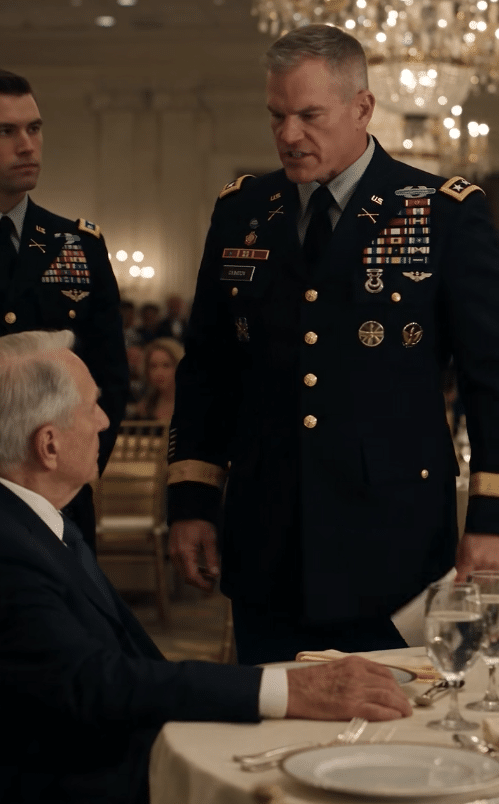
He was a Major General in full dress uniform, ribbons covering his chest, his posture rigid beneath the ballroom lights. He had arrived late and expected the best seat in the room to be waiting for him.
Instead, someone else was sitting there.
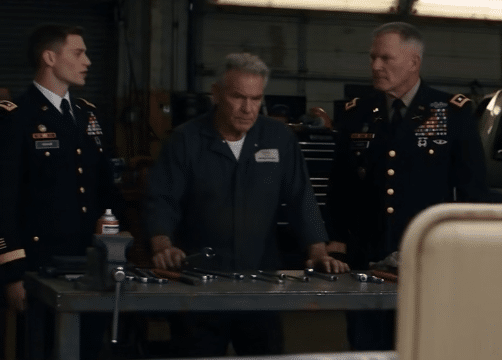
The General’s Lieutenant Colonel aide had approached first.
“General, he says that seat was assigned to him.”
The elderly man had barely looked up from the invitation resting beside his plate.
“It was.”
Two words.
No argument.
No disrespect.
Just fact.
But the General heard something entirely different.
He looked at the old man’s plain black suit, silver hair, and complete lack of visible military decorations.
“You’re telling me I’m supposed to sit behind donors and civilians?”
The old man calmly folded his invitation.
“I’m telling you the seat has a name on it.”
The General’s jaw tightened.
Around them, conversations began to fade.
Everyone understood what was happening.
The old man wasn’t challenging the General.
He simply wasn’t surrendering.
The General snatched the invitation from the table and threw it down.
“Stand up.”
The elderly man stood.
But he didn’t move away.
That was enough.
The General stepped backward, creating space between them, then drove one hard kick into the old man’s torso.
The impact sent him backward into the chair.
The chair scraped violently across the floor before he fell beside the table.
Glasses rattled.
A fork struck a plate.
Then nothing.
The old man drew a painful breath.
Slowly, he pushed himself upright.
The General looked down at him.
“Old civilians don’t take command seating.”
The old man said nothing.
He straightened his jacket.
And when the fabric shifted, something hidden inside his breast pocket caught the ballroom light.
A tiny metal pin.
Across the room, a retired Admiral saw it.
And immediately stopped breathing.
But the old man had never shown the pin to anyone.
So why did the Admiral look as though he had just seen a ghost?
Act II
The gala had been built around military tradition.
That was why the room was filled with uniforms.
Senior officers sat beside wealthy donors. Retired commanders spoke quietly with active-duty leaders. Veterans who had spent decades serving the country were scattered among people who now funded scholarships, rehabilitation programs, and family support initiatives.
The front tables were reserved.
Not because they were glamorous.
Because the invitations had been assigned months earlier.
The elderly guest had arrived early.
He had greeted staff by name.
He had thanked the volunteers.
Then he had taken his assigned seat and waited.
Nobody had noticed anything unusual about him.
That was precisely how he preferred it.
He wore an old black suit that had been carefully maintained for years. There were no ribbons on his chest. No medals. No visible insignia.
Nothing announced his history.
The Major General, however, had spent much of his career being announced by his uniform.
He was accustomed to rooms changing when he entered them.
People stood.
Assistants moved.
Conversations paused.
Seats opened.
That night, one seat hadn’t.
His aide had apparently assumed the problem would be simple.
It wasn’t.
“General, perhaps we can move him to another table.”
The old man had heard that.
He simply continued sitting.
When the General approached, he had given him every opportunity to leave without humiliation.
The old man never insulted him.
Never questioned his rank.
Never raised his voice.
He only said what was true.
“It was.”
The General couldn’t accept that.
And when violence came, it came not because the old man had threatened him, but because he had refused to perform submission.
After the kick, the old man could have walked away.
Instead, he returned to the same chair.
He adjusted his tie.
Straightened his jacket.
And remained standing beside the seat that had been assigned to him.
The gesture was small.
But it carried something unmistakable.
He wasn’t trying to win.
He was refusing to be erased.
At the neighboring table, the retired Admiral remained standing.
His eyes were fixed on the small metal pin inside the old man’s jacket.
The Major General noticed.
“What are you looking at?”
The Admiral didn’t answer immediately.
His face had changed completely.
A few seconds earlier, he had been talking to another guest.
Now his expression was grave.
Almost frightened.
He looked at the pin again.
Then at the elderly man.
Then at the General.
Finally, he spoke.
“General… perhaps you should leave that seat alone.”
The Major General scoffed.
“It’s a pin, Admiral.”
The Admiral didn’t sit down.
And that was when the aide realized something was wrong.
The General had dismissed a retired Admiral before.
But never had that Admiral looked at a piece of metal as though it carried the weight of an entire career.
The elderly man quietly closed his jacket.
Except he didn’t close it completely.
He left the pin visible.
Just enough.
Because apparently, the Admiral already knew what the General did not.
Act III
The pin was smaller than a coin.
It had no readable name.
No large emblem.
Nothing that a casual observer could understand.
To most people in the ballroom, it was simply an unusual piece of metal.
To the retired Admiral, it was something else.
He had seen one before.
Not often.
Not in ordinary ceremonies.
Not on uniforms.
There had been very few made.
Only twelve.
And those twelve had not been distributed as ordinary decorations.
The Admiral remembered that much.
He remembered an old command structure that existed before the current generation of officers.
He remembered names that rarely appeared in public histories.
He remembered a period when certain decisions had been made quietly, far from cameras and ceremony.
And he remembered the people who had been trusted with responsibilities no ordinary insignia could represent.
His eyes returned to the elderly man’s face.
The silver hair.
The calm expression.
The absolute absence of fear.
Then the suit.
The plain black suit suddenly looked different.
Not cheap.
Not civilian in the way the General had assumed.
Deliberately civilian.
The old man had spent the evening among donors and veterans without once mentioning his military past.
Why?
The Admiral knew better than to ask aloud.
The Major General did not.
“You recognize that thing?”
The Admiral’s silence was answer enough.
The General turned toward the old man.
“What’s so special about it?”
The elderly guest adjusted the edge of his jacket.
“He knows.”
The General frowned.
“Who?”
The old man glanced toward the Admiral.
The retired Admiral remained motionless.
Then the old man said quietly:
“He knows why only twelve were made.”
The General’s expression changed.
“Only twelve?”
Nobody answered.
The ballroom seemed to contract around them.
A waiter stopped halfway between tables.
The aide lowered his eyes.
Several veterans exchanged uneasy looks.
The General stared at the tiny insignia again.
For the first time that evening, he wasn’t looking at an old civilian.
He was looking at a question.
And the person standing closest to the answer was a retired Admiral who suddenly seemed unwilling to speak.
Act IV
The General had spent years learning how to recognize symbols.
He knew what medals meant.
He knew which ribbons carried prestige.
He knew the difference between ceremonial decorations and operational honors.
But this pin was different.
It wasn’t displayed.
It had been hidden.
Inside the suit.
Almost as though the person wearing it didn’t need anyone else to know.
That unsettled him.
“What unit?”
The old man didn’t answer.
“What command?”
Still nothing.
The Admiral finally spoke.
“General, leave it.”
The Major General turned toward him.
“You expect me to walk away because an old man has a pin?”
“No.”
The Admiral’s voice was quiet.
“I expect you to walk away because you’ve already crossed a line.”
The General stared at him.
The old man remained beside the chair.
His breathing had steadied.
His cheek was untouched.
Only the soreness in his torso remained from the kick.
But his composure had become almost unnerving.
He wasn’t angry.
He wasn’t celebrating the General’s discomfort.
He wasn’t demanding an apology.
He simply stood there.
As though he had already lived through far more difficult rooms than this one.
The Admiral looked at him again.
For a moment, their eyes met.
Something passed between them that required no words.
Recognition.
History.
An understanding that the Major General was nowhere near the center of the story he thought he was controlling.
The aide finally took a step backward.
The General noticed.
“You too?”
The Captain’s face tightened.
He didn’t answer.
The General looked back at the old man.
The tiny pin was still visible.
Twelve made.
A retired Admiral standing in alarm.
A veteran guest refusing to explain.
And an elderly man who had absorbed a violent blow without once behaving like a victim.
The General’s certainty began to fracture.
He had wanted the room to see an ordinary civilian being put in his place.
Instead, the room was beginning to see something else.
The old man slowly took his assigned seat.
No one stopped him.
No one moved him.
And no one dared touch the jacket again.
The General remained standing.
For the first time that evening, his own rank seemed insufficient to explain what was happening.
But one detail still bothered him.
Why had the Admiral recognized the pin instantly?
And what had those twelve men been entrusted with?
Act V
The gala never returned to normal.
The music continued somewhere beyond the ballroom doors, but nobody at the front tables seemed to hear it.
The elderly man sat exactly where he had been assigned.
His invitation remained on the table.
The General’s aide stood several feet away, silent.
And the retired Admiral remained on his feet.
The old man never explained the pin.
He didn’t have to.
Its existence had already changed the room.
The Major General looked at it again.
Tiny.
Discreet.
Almost invisible.
Yet somehow powerful enough to make a retired Admiral abandon his conversation and warn a serving General to walk away.
The old man rested one hand over the edge of his jacket.
For a moment, the pin disappeared.
Then the fabric shifted again.
There it was.
The General’s eyes narrowed.
He remembered the number.
Twelve.
Only twelve.
Something about that number bothered him.
Not because it sounded impressive.
Because it sounded exclusive.
Deliberate.
Like a list.
Like an order.
Like something given only to people whose names had once mattered far beyond the room they were standing in.
The Admiral looked at the old man one last time.
The old man gave him no signal.
No explanation.
No rescue.
Just silence.
The General swallowed.
His gaze moved from the Admiral to the pin.
Then back to the elderly man’s face.
The certainty was gone now.
He had walked into the gala believing his uniform gave him ownership of the room.
He had kicked an old civilian because he believed a seat belonged to rank.
Now he was standing beneath the chandeliers, staring at twelve words’ worth of history contained in a piece of metal he couldn’t identify.
The old man remained perfectly calm.
The Admiral remained silent.
And the General finally understood that whatever happened next would not be decided by his ribbons.
His eyes widened slightly.
His voice dropped.
“Twelve…?”