Act I
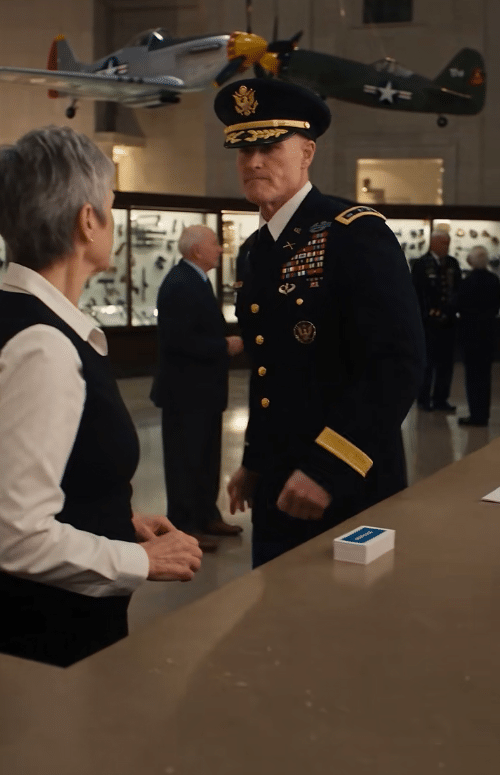
The slap echoed through the military museum like a gunshot.
For one terrible second, nobody moved. Under the suspended aircraft and the cold glow of the museum lights, dozens of donors, veterans, and uniformed officers stared at the same scene: a decorated Army colonel standing behind a coat-check counter, his hand still raised, while a 67-year-old volunteer struggled to steady herself against the marble edge.
Her name was Eleanor Hayes.
She wore a simple black volunteer vest over a white shirt, dark slacks, and flat shoes that had seen better days. Her silver hair was neatly trimmed, and her hands were steady despite the sharp pain spreading across her cheek.
The colonel, Richard Vance, straightened his uniform as if the incident had been nothing more than an unpleasant administrative correction.
Beside him stood Major Daniel Whitmore, his younger aide, who had been the first to complain.
“Sir, she says everyone waits for their ticket number.”
Eleanor finished handing a guest her coat before turning toward the two officers.
“That includes you.”
Her answer was quiet. Almost gentle.
But Colonel Vance heard something else entirely.
He heard a woman he considered beneath him telling him that his rank did not matter.
And Richard Vance had spent thirty years learning to believe that rank was the one thing that always mattered.
He was fifty years old, well connected, wealthy enough to sit on the boards of several military charities, and accustomed to having doors opened before he reached them. At tonight’s fundraiser, people had shaken his hand, praised his service, and laughed at jokes that were not particularly funny.
He had expected the same deference from the woman collecting coats.
Instead, Eleanor had continued serving guests in the order printed on their tickets.
Vance snatched her ticket from the counter and flung it onto the stone floor.
Eleanor did not bend to retrieve it.
She turned back to finish the transaction she had already started.
That was when he stepped forward and struck her across the face.
The sound cut through the elegant hall. Eleanor staggered sideways, catching herself against the counter with one hand. A few guests gasped. Somewhere near the entrance, a glass clinked against a serving tray.
Nobody intervened.
Not immediately.
Vance leaned toward her, his expression twisted with the satisfaction of a man who believed he had restored a natural order.
“Coat girls don’t lecture colonels.”
Eleanor slowly straightened.
Her cheek was red. Her eyes were not.
She bent down, picked up the discarded ticket, and smoothed its folded corner with her thumb. Then she placed it beside the others and returned to her position behind the counter.
She did not apologize.
She did not ask for help.
And she did not look at the colonel again.
For the first time that evening, Major Whitmore seemed uncertain about what he had just witnessed. The officers nearby remained silent, but their eyes followed Vance as he adjusted his cuffs and looked around, apparently expecting someone to congratulate him for putting a volunteer in her place.
Then Eleanor’s sleeve slipped back from her wrist.
An old military watch appeared beneath the fabric.
Its metal case was scratched. Its band had darkened with age. The hands had stopped at a precise minute, and inside the band, beneath years of wear, was a small engraved code.
Across the hall, the museum director stopped speaking in the middle of a sentence.
Retired Colonel Thomas Mercer had spent decades studying military history. He had examined artifacts recovered from battlefields, read classified records that had since been declassified, and interviewed veterans whose names appeared nowhere in official commemorations.
Yet one glimpse of that watch drained the color from his face.
He excused himself without finishing his conversation and began walking toward the coat-check counter.
Because he recognized the engraving.
And he knew that the woman wearing it should never have been standing there, taking coats from strangers.
Act II
To understand why Eleanor Hayes was working behind a coat-check counter, one had to understand what the military museum meant to her.
Most of the guests that evening believed she was a retired schoolteacher volunteering a few hours for a worthy cause. A few had noticed her knowledge of military history, but they assumed she had acquired it through years of reading.
Eleanor never corrected them.
She had learned long ago that people often revealed more about themselves when they believed they were speaking to someone unimportant.
She had arrived at the museum shortly after noon, carrying a small handbag and wearing the same watch she had worn for more than three decades. The volunteer coordinator had been overwhelmed by last-minute cancellations, and Eleanor had offered to help wherever she was needed.
The coat-check station was understaffed.
So she went there.
She could have requested a private tour, joined the senior officers at the head table, or simply called the museum director and asked him to find someone else. She had enough connections to make all three options possible.
But Eleanor had never believed that service became less honorable when nobody was watching.
Years earlier, she had told a young officer that leadership was not measured by how many people stood when you entered a room. It was measured by what happened when you were the only person in the room who could afford to stand up for someone else.
She had seen that officer grow into a capable commander.
She had also seen other men climb the ranks while forgetting every lesson they had once claimed to believe.
Colonel Vance belonged to the second category.
He had a reputation for being efficient, ambitious, and politically skilled. He knew how to speak about sacrifice in front of cameras. He knew which donors to thank by name and which senior officers expected to be consulted before a decision was made.
What he did not know was that Eleanor had helped establish the very museum where he was trying to impress those people.
More importantly, he did not know that she had once worn a uniform bearing three stars.
Eleanor Hayes was a retired three-star general.
She had served in command positions that demanded decisions under extraordinary pressure. She had supervised operations, evaluated senior officers, and spent years fighting to preserve the histories of soldiers whose courage had been forgotten by the institutions they served.
She had stepped away from public life without a ceremony.
No farewell parade. No grand speech. No carefully arranged photograph surrounded by admirers.
She had declined most invitations to appear at military galas because she had grown tired of watching people turn service into a performance.
The museum, however, was different.
She had helped secure early funding for its collection, persuaded veterans to donate personal letters and uniforms, and worked quietly to ensure that the exhibits remembered not only famous commanders but also the people who had never returned home.
The watch on her wrist was connected to that work.
It was not an expensive timepiece. It had no polished gold casing or elaborate decorations. Its value could not be measured by an auction estimate.
The engraving inside the band was a military reference code linked to an old operation whose surviving records had long been incomplete.
The watch had stopped at 02:17.
Eleanor had never repaired it.
She had never wanted it repaired.
At that minute, decades earlier, a group of missing personnel had finally been found after an operation that had nearly disappeared from official memory. The watch had remained with them through the hours when their fate was unknown, and it had become the one physical object Eleanor could never bring herself to leave behind.
She rarely spoke about what had happened.
Even Thomas Mercer, who had once served alongside her, knew only fragments.
But he knew enough to recognize the code.
And as he approached the counter, he began to understand that the evening’s public humiliation had uncovered something far more consequential than an officer’s abuse of authority.
Richard Vance had struck a woman he believed had no power.
He had no idea what her silence was protecting.
Act III
Thomas Mercer reached the counter just as Vance began complaining about the event staff.
The retired colonel did not acknowledge the donors who stepped aside to let him pass. His attention remained fixed on Eleanor’s wrist.
For several seconds, he seemed unable to find the words.
Then he looked at the man who had struck her.
“Colonel… where did she get that watch?”
Vance followed his gaze.
He glanced at the scratched case and the old metal band, then gave a dismissive shrug.
“Probably bought it at an auction.”
The answer came too quickly.
Mercer did not smile.
He moved closer, careful not to touch the watch, and studied the engraving from a few inches away. His jaw tightened as he recognized the final characters.
He had seen that code once before, in a sealed archival folder that had been reopened during the museum’s early planning.
The file had contained contradictory reports, a missing-persons appendix, and references to a recovery that had never been fully explained in the public record. Some pages had been damaged. Others had been removed before the documents entered the museum’s collection.
Mercer had spent years trying to establish what happened during those missing hours.
He had never expected the answer to appear on the wrist of a volunteer.
“Where did you get it?” he asked Eleanor.
For the first time since the slap, she looked directly at him.
Her expression softened for a fraction of a second, but the old watch remained motionless beneath her fingers.
“You still remember the code,” she said.
Mercer swallowed.
“Of course I remember it.”
Vance gave a short, impatient laugh.
“Are we really doing this over an old watch? I have a room full of people waiting for me.”
Neither Eleanor nor Mercer looked at him.
That was the first moment the colonel seemed to realize that something was changing.
Until then, he had controlled the encounter through volume, rank, and the assumption that everyone nearby would accept his version of events. Now the museum director was ignoring him completely, and the elderly volunteer he had humiliated seemed to occupy a different kind of space.
One that did not require anyone’s permission.
Eleanor turned her wrist slightly, revealing the engraved code.
Then she looked down at the stopped hands.
“No,” she said. “It stopped at the exact minute they found us.”
The words were barely louder than the sound of people breathing around them.
But Mercer reacted as if she had spoken the name of someone who had been dead for years.
His eyes closed briefly.
When he opened them, the uncertainty was gone. In its place was a recognition so painful that Vance’s confident expression began to falter.
“They found you?” Mercer whispered.
Eleanor did not answer.
She did not need to.
Mercer remembered the reports that had never aligned, the names that had vanished from the official timeline, and the senior commander whose role in the operation had been disputed for years.
He remembered the unanswered questions that had followed him long after he retired.
And he remembered Eleanor Hayes.
Not the volunteer.
Not the quiet woman in the black vest.
The general who had once refused to sign a report until every missing service member had been accounted for.
Vance noticed the change in Mercer’s face.
“What is this?” he demanded. “What are you two talking about?”
The director finally turned toward him.
“Colonel, I need you to step away from this counter.”
Vance stared at him.
“Excuse me?”
“Step away.”
There was no raised voice, no theatrical threat, and no dramatic gesture.
That made the instruction more unsettling.
Mercer was not trying to win an argument. He was responding to something he had just recognized as real.
Major Whitmore looked from the director to Eleanor. His face had gone pale, and his earlier confidence seemed to have deserted him completely.
He had reported a routine disagreement.
He had watched his commanding officer assault an elderly volunteer.
And now a retired colonel was treating that volunteer as though her appearance had reopened a chapter of military history that nobody in the room had been prepared to discuss.
Vance looked at Eleanor again.
This time, he noticed the way she stood.
Her shoulders were level. Her breathing was controlled. Even with a reddened cheek, she held herself with the quiet precision of someone accustomed to being responsible for far more than a coat-check station.
The black vest had concealed her identity.
It had never concealed her bearing.
And suddenly, the watch seemed less like an antique and more like a warning.
Act IV
The fundraiser did not stop officially.
No announcement was made. No microphone was seized. No one rushed to the stage to explain why the museum director had abandoned his guests.
Yet the room had changed.
Conversations died in small clusters. Donors lowered their glasses. Several veterans who had witnessed the slap moved closer, no longer pretending that the incident was merely an awkward dispute between an officer and a volunteer.
Vance tried to recover his composure.
He adjusted his collar and looked at Mercer with the irritation of a man who believed his evening had been hijacked by unnecessary sentiment.
“Thomas, I don’t know what you think you’ve found here, but this is getting ridiculous.”
Mercer kept his eyes on Eleanor.
“I think I know exactly what I’ve found.”
“Then say it.”
For a moment, Mercer appeared ready to answer.
Instead, he asked Eleanor a question.
“Was the recovery report ever corrected?”
She considered him for a long second.
“No.”
The single word landed harder than an accusation.
Mercer lowered his head.
He had suspected for years that the official account was incomplete. He had known that the surviving documents did not tell the whole story. But suspicion was not proof, and the military institution he had served had been slow to revisit an event that senior officials preferred to leave undisturbed.
Eleanor had never publicly challenged the record.
Not because she lacked the authority to do so.
Because she had spent years trying to protect the people whose names were buried inside it.
She had seen families wait for answers that arrived too late. She had watched survivors struggle with memories they could not explain to people who had never been there. And she had learned that correcting history required more than finding a person to blame.
It required evidence.
It required patience.
And it required someone willing to tell the truth even when the truth threatened a comfortable reputation.
The stopped watch was one piece of that history.
The code inside its band linked it to a specific operation. Its frozen hands marked the minute Eleanor had never forgotten. And the director’s recognition suggested that the event had left traces in records far beyond the watch itself.
But the artifact was not the only thing Vance had misunderstood.
He had mistaken Eleanor’s silence for weakness.
He had mistaken her volunteer vest for proof of insignificance.
And he had mistaken the absence of public recognition for the absence of authority.
Eleanor had not told him who she was because she had never believed that a person’s dignity should depend on a title.
Now, however, the distinction was becoming impossible to ignore.
Mercer straightened and faced the colonel.
“You struck her in front of witnesses,” he said.
Vance’s mouth tightened.
“She was disrespectful.”
“She was following the rules.”
“She was refusing a direct request from a colonel.”
“She was serving another guest.”
Vance glanced around the hall, apparently searching for someone willing to support his interpretation. Several officers looked away. Others watched him without speaking.
Major Whitmore remained beside him, but the younger officer no longer seemed certain that proximity to Vance was an advantage.
“Sir,” Whitmore began quietly, “perhaps we should—”
“Not now, Major.”
The interruption was automatic.
So was the silence that followed.
For years, Whitmore had learned to treat Vance’s impatience as a leadership style. He had mistaken intimidation for decisiveness and compliance for loyalty.
But he had seen the slap.
He had watched an unarmed woman absorb the humiliation without surrendering her composure.
And he had watched his colonel become frightened by a watch that could not even tell time.
For the first time, the major wondered whether the man he had followed so confidently was someone he should have been following at all.
Eleanor finally looked at Vance.
“You were in a hurry,” she said.
Her voice was calm enough that he almost mistook it for forgiveness.
“You wanted everyone here to understand that your time mattered more than theirs.”
Vance said nothing.
“But that watch has been stopped longer than you’ve been wearing your uniform.”
She turned her wrist so that the old engraving caught the light.
“And the people connected to it were never just names in a file.”
Mercer’s face tightened again.
There was grief in his expression, but also something else: the realization that the person standing before him had carried a burden he had never fully understood.
Vance stared at the watch.
He wanted to dismiss it. He wanted to return the evening to something familiar, something that could be controlled with a phone call or a carefully worded complaint.
But the people around him had begun to see him differently.
Not as a powerful colonel who had corrected an insubordinate worker.
As a man who had struck an elderly woman simply because she refused to move another guest ahead of the line.
Whatever the watch meant, that truth could no longer be hidden.
Then Mercer said something that made Vance stop trying to speak.
“I never thought I’d see that watch again.”
Eleanor’s gaze did not waver.
“Neither did I.”
For a moment, the museum seemed to hold its breath.
Because Thomas Mercer had finally recognized the person behind the uniformless exterior.
And Richard Vance was beginning to understand that he had not merely insulted a volunteer.
He had stepped into a history he did not know, challenged a woman whose past he could not imagine, and exposed his own character before an audience he could no longer control.
Yet one question remained.
Why had the watch stopped at that exact minute?
And what had happened to the people who were found?
Act V
Vance looked from Eleanor to Mercer, searching for an explanation that would restore the balance he had lost.
He found none.
Mercer was no longer looking at the colonel as a fellow officer. His attention had returned to the old watch, and the expression on his face carried the weight of a memory he had spent years trying to understand.
Eleanor stood behind the counter with her hands resting lightly on the polished surface.
Her cheek still burned.
She did not pretend otherwise, and she did not attempt to make the room comfortable by minimizing what had happened.
The slap had been real.
The humiliation had been public.
And the silence of the witnesses had been real, too.
But Eleanor was not waiting for someone to rescue her.
She had spent a lifetime learning the difference between needing help and surrendering control. Tonight, she had been struck because she refused to grant a powerful man an undeserved privilege.
She would not allow that act to define her.
Nor would she allow it to disappear beneath the usual excuses.
Mercer turned toward the nearest event coordinator and quietly asked for the names of the witnesses. He made no dramatic promise and offered no instant verdict. He simply began doing what the moment required: preserving an accurate account of what had happened.
The coordinator nodded and moved away.
Major Whitmore watched her go.
For the first time that evening, he understood that the incident would not be erased by a superior officer’s irritation. There were too many witnesses, too many people who had seen the same thing, and too many unanswered questions surrounding the woman Vance had chosen to humiliate.
Vance seemed to recognize the same reality.
His eyes moved toward the donors, then the veterans, then the officers who had watched him strike Eleanor. The people who had praised him earlier were no longer rushing to meet his gaze.
He took a small step backward.
It was not much.
But Eleanor noticed.
“General—” Mercer began.
She raised one hand slightly, stopping him.
Not yet.
There would be time for records, for questions, and for the difficult work of separating memory from official history. There would be time to examine the code, revisit the missing-persons file, and determine why the recovery report had never been corrected.
There would also be time to address what Vance had done.
But Eleanor would not turn the lives connected to that watch into a spectacle simply because the room had finally become interested.
She looked at the guests who had witnessed the assault.
“You don’t have to know my rank to know that was wrong,” she said.
Nobody answered.
Several people lowered their eyes.
The words offered no excuse for their silence. They made it impossible to hide behind it.
Then Eleanor turned back to the counter and resumed arranging the coat tickets.
The ordinary movement was somehow more devastating than a speech.
She had not demanded an apology. She had not threatened Vance with her connections. She had not announced the three stars she had once worn or listed the commands she had held.
She simply returned to her work, refusing to let his cruelty determine what she would do next.
Mercer remained beside the counter.
After a moment, he asked, quietly enough that only she could hear, “Are you ready for them to know?”
Eleanor glanced at the watch.
Its hands remained frozen at 02:17.
“I’ve been ready for years,” she replied. “I just wanted the truth to matter more than my name.”
Across from her, Vance heard enough to understand that the conversation was no longer about a coat ticket.
His confidence had been built on the assumption that status could protect him from consequences. Now the museum director was asking questions, witnesses were remembering what they had seen, and the woman he had struck was standing with the composure of someone who had faced much greater trials than his anger.
He looked at the old watch one last time.
The scratched metal seemed suddenly more important than every polished medal and carefully pressed ribbon in the room.
“What does it mean?” he asked.
Eleanor did not answer immediately.
She studied the stopped hands, and for a moment the years seemed to fall away from her face. There was sorrow in her eyes, but no fear.
“It means,” she said, “that someone finally came looking.”
Vance’s lips parted.
The words reached him before their meaning did.
He looked at Mercer, whose expression had become almost unbearably solemn. Then he looked back toward Eleanor, as if expecting her to explain who had been found, who had been searching, and why a single minute had survived when so much else had been lost.
But she offered him nothing more.
Not because she wanted to frighten him.
Because the story behind that watch belonged first to the people who had lived through it.
The colonel’s voice emerged as little more than a whisper.
“Found you…?”
His eyes widened.
For the first time that night, Richard Vance looked like a man who had run out of authority.
And Eleanor Hayes, the woman he had mistaken for someone beneath him, stood perfectly still beneath the suspended aircraft, wearing an old watch that had not moved in decades.
Outside the museum’s tall windows, the evening continued as usual.
Inside, nothing would ever be quite the same.
The fundraiser had begun as a celebration of military service, complete with polished uniforms, generous donations, and speeches about honor.
It would be remembered for something far simpler.
A powerful man had struck an elderly woman because she refused to put him first.
And in doing so, he had revealed exactly who he was.
The woman he had struck never needed to raise her voice to prove who she was.
The watch had already begun telling that story.
And for the first time in years, someone was finally listening.