Act I — Ten Minutes That Cost Him Everything
“General, she says the line has to stay closed ten more minutes.”
Major Daniel Reeves delivered the message with the kind of irritation reserved for people who believed the world should rearrange itself around their schedules. Behind him, a group of senior officers waited beside their golf carts, expensive clubs resting against polished bags while the morning sun stretched across the immaculate fairway.
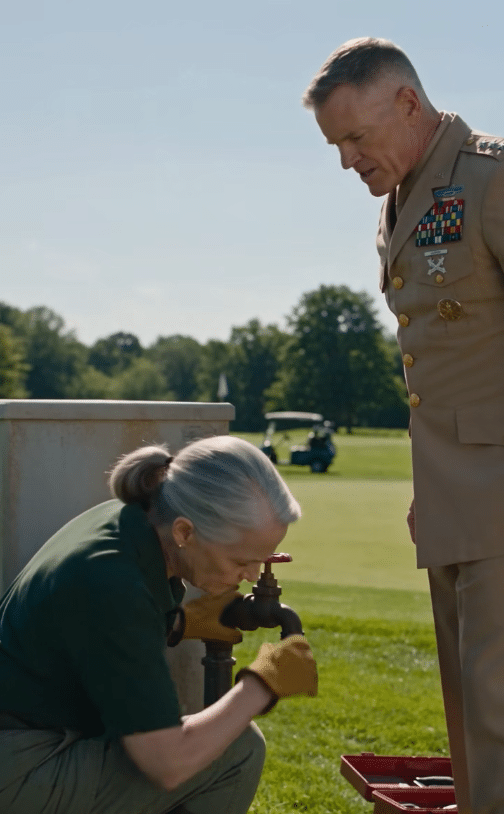
Brigadier General Richard Caldwell, forty-nine, looked toward the maintenance area. His golf shirt carried the club’s military insignia, his watch cost more than most groundskeepers earned in months, and his expression suggested that ten minutes was an insult no one had the right to offer him.
At the edge of the restricted fairway, an older woman knelt beside an open sprinkler valve box. Her silver hair was tied neatly at the back of her head, and her green groundskeeper polo was stained from a morning of work. She wore worn boots, gardening gloves, and the quiet concentration of someone who understood that a small mistake could ruin an entire stretch of carefully maintained turf.
Caldwell approached, expecting an apology.
Instead, the woman continued turning the valve.
“Unless you want the fairway flooded,” she replied.
Her answer was practical. Calm. Completely reasonable.
But Caldwell didn’t hear a warning about water pressure. He heard a woman he considered beneath him refusing to obey.
And in front of his officers, he had no intention of letting that stand.
Act II — The Slap Everyone Heard
“Do you understand who you’re talking to?” Caldwell demanded.
The groundskeeper checked the valve without looking up. The sprinkler line was still under maintenance, and reopening it prematurely could send water surging across the course. She had been asked to keep the section closed until the repair was secure, and that was exactly what she intended to do.
Caldwell kicked her maintenance toolbox aside.
Metal scraped against the ground, sending a wrench skidding toward the golf carts. Several officers turned at the noise. Reeves shifted his weight, but he didn’t step forward.
The woman kept working.
Then Caldwell struck her hard across the face.
The sound cut through the morning air. The groundskeeper staggered and dropped to one knee beside the valve box, one gloved hand catching her weight while the other remained close to the controls. Around them, conversations died instantly. Even the maintenance workers froze.
Caldwell looked down at her as though he had just corrected an employee who had forgotten her place.
“Groundskeepers don’t close courses on generals.”
His words hung in the silence.
The woman pressed her lips together. Pain reddened one cheek, but she didn’t cry, shout, or ask anyone to defend her. She turned the valve one final time, listened as the rushing water subsided, and checked that the line was secure.
Only then did she rise.
She did it without assistance.
At sixty-six, she was older than Caldwell by seventeen years, dressed in work clothes, and standing on a patch of grass he considered his personal domain. Yet when she finally faced him, something in her expression made his satisfaction falter.
There was no fear in her eyes.
Only a cold, controlled disappointment.
For the first time that morning, Caldwell seemed uncertain whether the person standing before him was as powerless as he had assumed.
Act III — The Red Seal Beneath Her Collar
The groundskeeper straightened her green polo. As she rose, the collar shifted, and a small pendant slipped into view against her chest.
It wasn’t large or flashy. There were no diamonds, no polished gold chain designed to impress wealthy club members. The pendant was modest, almost easy to overlook.
But its face carried a recessed red military seal.
A man approaching from the clubhouse path stopped dead.
Club President Thomas Whitaker, a sixty-eight-year-old retired colonel, had spent decades around officers, decorations, and the quiet symbols that carried meanings far beyond their appearance. He had seen the pendant before.
And he knew enough to understand that Caldwell had just made a terrible mistake.
Whitaker’s face lost its color. His eyes fixed on the red seal, then shifted toward the woman wearing it. For a moment, he appeared unable to decide whether to speak or remain silent.
Finally, he addressed the brigadier general.
“General… I wouldn’t push this any further.”
Caldwell turned toward him, visibly offended.
He was accustomed to being the highest-ranking person in a room, or at least the person everyone treated that way. The club president’s warning, delivered in front of junior officers and maintenance staff, felt like another challenge to his authority.
Then he noticed the pendant.
His expression hardened into a mocking smile.
“You’re scared of a necklace?”
Whitaker didn’t smile back.
The retired colonel stood rigidly, his gaze returning to the red seal. He wasn’t looking at a piece of jewelry. He was remembering something—or someone—that Caldwell clearly knew nothing about.
Reeves, who had complained about the ten-minute delay only moments earlier, lowered his eyes. The other officers remained motionless, watching the exchange with growing unease.
The woman, meanwhile, reached up and closed her fingers around the pendant.
She didn’t use it to threaten Caldwell. She didn’t announce a rank or demand an apology. She simply held the small object between her fingers, as though it belonged to a chapter of her life she had never needed to explain to strangers.
Then she spoke.
“He remembers who handed it to me.”
Act IV — The Colonel Knew What the General Didn’t
The sentence changed the atmosphere more completely than the slap had.
Caldwell looked at Whitaker.
The retired colonel said nothing.
That silence was worse than an accusation. Whitaker had spent years around senior commanders, and he was not a man who frightened easily. Yet he now stood before a woman in a groundskeeper’s uniform with the expression of someone watching an old piece of military history return to life.
Caldwell looked at the pendant again.
The red seal was recessed into its surface, deliberately made rather than casually purchased. It bore none of the obvious markings he might have recognized from the decorations displayed in military club cases. Its significance lay in its origin—and in the person who had chosen to give it to her.
But who was that person?
The woman had not identified herself. Whitaker had not explained what he recognized. And nobody had yet said aloud what Caldwell was beginning to suspect: that the uniform, the work boots, and the maintenance toolbox told him almost nothing about the person he had just humiliated.
He tried to recover his composure.
A brigadier general did not ordinarily stand speechless on a golf course because a groundskeeper wore an unfamiliar pendant. He had spent his career surrounded by rank, protocol, and the assumption that people would move when he gave an order.
Yet Whitaker’s reaction suggested that the object represented something more powerful than Caldwell’s current position.
Something connected to a history he had never been important enough to understand.
The woman watched him examine the seal. Her cheek remained red, and one knee bore the faint mark of contact with the ground. She showed no satisfaction at his discomfort, no eagerness to make him suffer.
She had simply finished her work.
That, somehow, made the situation more unsettling.
Caldwell had treated her as a nameless employee whose only purpose was to serve his convenience. Now the retired colonel was warning him to stop, and the woman herself seemed perfectly comfortable allowing the truth to emerge at its own pace.
Whatever the pendant meant, Whitaker knew.
And Caldwell was beginning to understand that the most dangerous mistake he had made that morning might not have been striking her.
It might have been assuming he knew who she was.
Act V — “Who Handed It to Me?”
For several seconds, no one moved.
The sprinkler line remained closed. The fairway was safe from flooding, the maintenance toolbox lay scattered beside the valve box, and the officers who had arrived expecting an ordinary round of golf stood silently beside their carts.
Caldwell glanced once more at Whitaker, searching for an explanation he was no longer confident enough to demand.
The retired colonel’s face remained grave.
The groundskeeper said nothing else. She didn’t pull out identification, recite her service record, or reveal the details of the career she had left behind. She didn’t need to turn the moment into a speech.
The red seal was enough to make a man who had commanded other officers reconsider his next words.
Caldwell’s smile disappeared.
For the first time, his eyes carried something other than anger or contempt. He looked at the pendant as if it had become a message addressed specifically to him—a message whose author he had not yet identified.
Then he looked back at the woman.
Her posture was steady. Her breathing had settled. She stood beside the repaired sprinkler valve with the same quiet composure she had possessed before he approached her.
He had tried to force her to open a water line because he didn’t want to wait ten minutes.
He had knocked aside her tools, struck her in front of witnesses, and mocked the only clue that might have told him he was crossing a line he couldn’t afford to cross.
Now even the club president seemed reluctant to explain what the pendant meant.
Caldwell swallowed.
His voice, once loud enough to dominate the entire group, dropped to a strained whisper.
“Who handed it…?”
The question remained unfinished.
The camera stayed on his face as the color drained from it, his eyes widening while the green fairway blurred behind him.
For the first time that morning, Brigadier General Richard Caldwell looked less like a man accustomed to giving orders and more like someone who had just realized he might have insulted a legend.
And the woman in the green groundskeeper’s polo still hadn’t told him her name.