Act I
“Sir, I need your license and registration.”
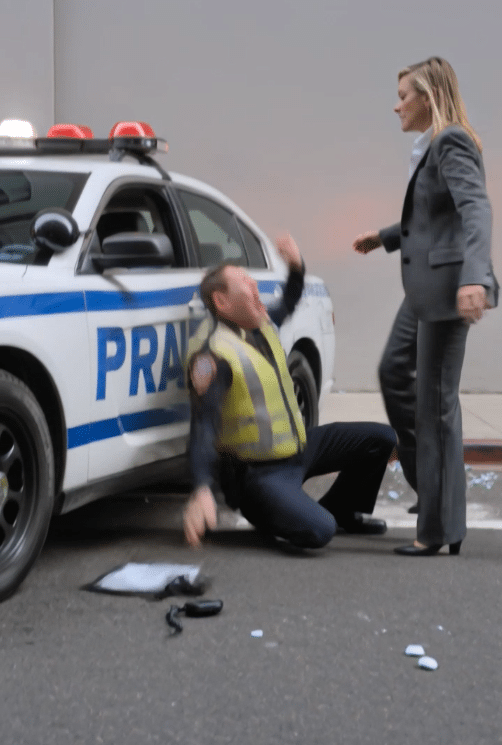
Officer Daniel Mercer stood beside a luxury SUV pulled crooked against the curb, his citation pad in hand and his body camera recording the aftermath of a minor collision. A small scratch marked the SUV’s bumper. A few glittering specks of broken glass lay near the tire, and traffic cones separated the scene from the passing cars.
The driver, Richard Vale, looked at Daniel as though the officer had just insulted him.
Then Richard attacked.
His polished shoe slammed into Daniel’s chest with brutal force, throwing the officer backward against the side of his patrol car. Daniel hit the pavement hard. His citation pad flew from his hand, his radio skidded across the street, and his elbow struck the edge of the car door.
For a moment, the traffic seemed to disappear beneath the shock of the impact.
Daniel struggled to draw a full breath. Pain spread through his chest as he curled instinctively around the injured area, one hand hovering near his body camera. A thin trace of blood appeared where his elbow had struck the metal.
Around them, drivers stopped. Pedestrians turned. Someone covered their mouth, while another witness took a frightened step away from the curb.
Richard didn’t step back.
He stood over the fallen officer, his expensive gray suit barely disturbed, his luxury watch catching the cold late-afternoon light. He looked less like a man who had just committed an act of violence than someone irritated that a routine inconvenience had taken too long.
Daniel forced himself to look up.
“Sir, I need your license and registration.”
His voice was strained, but he was still trying to follow procedure.
Richard gave a short, contemptuous laugh.
“Trash. I know people above you.”
He stepped over Daniel and delivered two more forceful kicks, one into the officer’s back and another into his side. Daniel recoiled against the pavement, fighting to protect himself as the pain intensified.
The witnesses gasped again.
Nobody rushed forward. Nobody wanted to become Richard’s next target.
Daniel tried to gather himself, his breathing shallow and uneven. His uniform was scuffed, his citation pad lay several feet away, and his radio had come to rest near the curb.
Richard looked down at him with open disgust.
“You just ended your career.”
He said it as though the outcome had already been decided.
In Richard’s mind, the collision had never really been about a scratched bumper. It was about being inconvenienced by someone he considered beneath him—and about making sure that person understood the price of challenging him.
But Richard had made one dangerous assumption.
He believed that everyone standing on that street could be intimidated, bought, or dismissed.
He had no idea who was about to arrive.
Act II
Richard Vale had spent years cultivating the kind of reputation that made people reconsider whether an argument was worth having.
At forty-seven, he was a successful businessman with an expensive home, a luxury SUV, and a network of professional relationships he frequently described as proof of his importance. He wore tailored suits even for ordinary errands and treated delays as personal insults.
To people who worked for him, his temper was familiar.
To strangers, it was often confusing. Richard could speak pleasantly when he wanted something, but the moment someone told him no, his courtesy vanished. He had a talent for turning ordinary boundaries into apparent acts of disrespect.
A traffic officer asking for identification was, to Richard, an intolerable challenge.
The collision itself had been minor. There was no dramatic wreckage, no overturned vehicle, no emergency unfolding across the road. There was simply a damaged bumper and a standard procedure to complete.
But Daniel had asked for his license and registration, and Richard had heard something else entirely.
He heard someone refusing to recognize his status.
Daniel Mercer had been on the job long enough to understand that some people mistook calmness for weakness. At thirty-four, he had learned that raising his voice rarely improved a difficult encounter. He wore his uniform carefully, followed procedure, and tried to give people every reasonable opportunity to cooperate.
That approach had not protected him from Richard’s attack.
Now Daniel lay on the street, fighting through the pain while Richard continued to stand over him.
The officer could hear the distant rumble of traffic and the uneasy movement of people around the scene. He could also hear Richard’s voice, still full of confidence, still carrying the certainty that no one would dare hold him accountable.
“You just ended your career.”
The words were meant to do more than threaten Daniel’s job. Richard wanted the officer to believe that resisting him was pointless, that the rules applied to ordinary people but stopped at the edge of his influence.
Daniel had no way of knowing whether Richard actually had the connections he claimed.
But the body camera on his chest had recorded the encounter, and the witnesses had seen what happened.
The attack had not been hidden in an alley or lost in a moment of confusion. It had unfolded in full view of a city street, after a routine request for identification.
Richard glanced toward the bystanders.
Their silence seemed to reassure him.
He had frightened them into standing back, and he mistook their fear for agreement. Nobody was challenging him. Nobody was telling him that what he had done was unacceptable.
So he remained where he was, convinced that he had already won.
Then the sound of hard braking cut through the traffic noise.
A senior police convoy had arrived behind the patrol car.
Richard turned toward it, irritation crossing his face. He seemed to expect another officer, perhaps someone who would listen to his explanation and understand the importance of his connections.
Instead, several doors opened in quick succession.
And the man who stepped out was not someone Richard could intimidate with a name-drop.
Act III
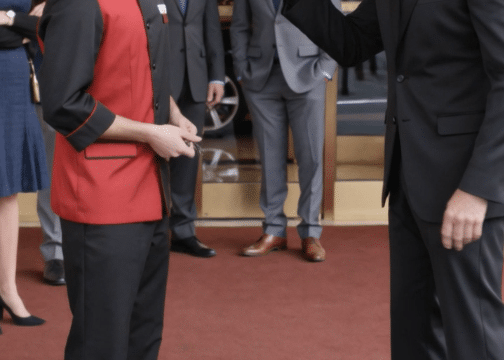
Chief Marcus Hale emerged from the lead vehicle in a formal dark uniform, a silver badge catching the light beneath his command coat.
Two ranking officers followed him. A legal aide stepped out behind them, carrying a folder and scanning the scene with immediate concern.
The convoy had stopped hard enough to draw every eye on the street.
A moment earlier, the witnesses had been frozen by the sight of an injured officer and a man standing over him. Now they watched as the senior team moved directly toward the patrol car.
Chief Hale did not begin by asking Richard for his version of events.
He did not pause to admire the luxury SUV or acknowledge the driver’s expensive clothes.
His first priority was Daniel.
The two ranking officers moved into position between Richard and the injured traffic officer, establishing a clear boundary. The chief took control of the space around Daniel while the legal aide moved to retrieve the citation pad from the pavement.
The change was immediate.
Richard, who had spent the previous moments behaving as though he owned the street, suddenly found himself separated from the person he had attacked. The officers did not crowd him theatrically or exchange angry remarks. They simply positioned themselves with calm, unmistakable purpose.
Chief Hale looked toward Daniel.
The officer was still on the ground, breathing hard and trying to remain composed. His uniform was scuffed, and the pain on his face was difficult to miss.
The chief’s expression tightened, but his voice remained controlled.
He had arrived at a scene where a routine traffic stop had become an assault. The injured officer needed protection, the immediate area needed to be controlled, and the situation could not be allowed to deteriorate further.
Only after the ranking officers had secured the space around Daniel did the chief turn his attention to Richard.
The businessman straightened his jacket.
It was a small, almost automatic gesture. Richard had spent years using appearance and confidence to regain control of conversations. He adjusted his clothing as though this were a meeting that had gone slightly off schedule rather than a public confrontation following a violent attack.
He looked at Chief Hale and waited for the introduction, the explanation, or the first sign that his influence might matter.
He was about to discover that the chief was not there to negotiate with him.
The legal aide picked up Daniel’s citation pad. The ranking officers remained between Richard and the injured man.
Chief Hale stood facing Richard, his expression cold and composed.
Then he spoke.
“Good. Then call them.”
For the first time, Richard did not immediately respond.
The words were simple, but they carried a meaning he could not comfortably dismiss. Richard had just told a uniformed officer that he knew people above him and threatened that the officer had ended his career.
Chief Hale had heard the claim and offered him the opportunity to prove it.
There was no anger in the chief’s voice. No attempt to compete with Richard’s arrogance. No need to shout.
That calmness unsettled Richard more than a furious response might have.
He looked from the chief to the officers standing behind him, searching for some indication that the situation was not what it appeared to be.
He found none.
Act IV
The street had changed in the space of seconds.
The luxury SUV still sat crooked near the curb, its scratched bumper a reminder of the minor collision that had started the encounter. The traffic cones remained in place, and the patrol car’s lights continued to flash against the cold pavement.
But the balance of power had shifted completely.
Richard had begun the afternoon believing that the uniform in front of him was an obstacle he could simply overpower. When Daniel asked for his documents, Richard responded with contempt. When the officer continued to do his job, Richard used violence to silence him.
And when Daniel fell, Richard had made the mistake of believing that the assault itself would prove his superiority.
“You just ended your career.”
The threat had sounded final when he delivered it.
Now the chief was standing in front of him, unshaken by the claim of powerful connections. Two ranking officers had positioned themselves between Richard and Daniel, and the legal aide was recovering the scattered materials from the street.
Nobody was asking Richard how important he was.
Nobody was stepping aside because of his suit, his watch, or the vehicle he drove.
The people who had watched the assault were still keeping their distance. Their expressions had changed, though. The fear that had held them motionless was now mixed with disbelief as they watched the man who had dominated the scene begin to lose his composure.
Daniel remained on the pavement.
The chief had not forgotten him in order to confront Richard. Protecting the injured officer had come first, and the officers around him continued to maintain that separation.
Richard noticed it.
He could no longer stand directly over Daniel. He could no longer dictate the distance between them or use his physical presence to control the encounter.
For the first time, the space around the injured officer was being controlled by people Richard could not simply order away.
Chief Hale held his gaze.
Richard had invoked unseen authority as though the mere existence of influential acquaintances made him untouchable. He had not offered a name or explained who would supposedly protect him. He had simply expected the threat to be enough.
The chief’s response had stripped that threat of its power.
“Good. Then call them.”
Richard’s jaw tightened.
He looked toward the senior officers, then back at the chief. He seemed to be waiting for someone to explain why the convoy had arrived, why the chief was addressing him directly, or why his usual confidence had failed to change the atmosphere around him.
No one offered him an escape from the moment.
The patrol lights pulsed across his face, catching the faint movement in his expression as confidence gave way to uncertainty.
He had expected his words to frighten Daniel.
Instead, they had brought him face-to-face with an authority figure who did not appear intimidated at all.
Richard swallowed.
For the first time since the collision, he seemed to realize that the people on the street were no longer watching him as the man in charge.
They were watching him as the man who had attacked a police officer.
And he still did not know how much the chief already understood.
Act V
Richard stared at Chief Hale.
The command coat, the silver badge, the ranking officers, and the legal aide formed a picture he could no longer explain away as an ordinary traffic stop. The senior team had arrived, taken control of the space around Daniel, and placed themselves between the injured officer and the man who had attacked him.
The chief had not raised his voice.
He had not threatened Richard with his own connections or tried to win a contest of status. He had simply listened to Richard’s claim that he knew people above Daniel—and invited him to make the call.
“Good. Then call them.”
Richard’s face tightened.
His mouth opened slightly, but no answer came. His eyes moved across the scene, searching for something that would restore the certainty he had possessed only moments earlier.
Behind him, the luxury SUV sat abandoned at an angle near the curb. The scratch on its bumper was still small, the original damage still minor. Nothing about the collision itself could explain the violence that followed.
Daniel’s citation pad had been recovered. His radio lay near the curb, and the body camera on his chest had recorded the encounter that began with a request for license and registration.
The officer had been following procedure.
Richard had chosen to attack him.
Now Chief Hale stood before him, composed and unafraid, while the ranking officers maintained the boundary around Daniel.
The witnesses said nothing. Their silence was no longer the same silence that had surrounded Richard’s threats. They were watching the moment his certainty began to collapse.
Richard had told Daniel that he knew people above him.
He had announced that the officer had ended his career.
And when the senior police convoy arrived, Richard had discovered that intimidation did not automatically make him powerful.
Chief Hale waited.
Richard’s expensive suit could not answer for him. His luxury watch could not alter what the witnesses had seen. His confidence could not turn the attack into a minor disagreement.
He looked directly at the chief.
“Call who?”
The question came out differently from his earlier threats. The arrogance was still there, but it had cracked, leaving confusion and the first unmistakable hint of fear.
His expression tightened beneath the flashing patrol lights.
For once, Richard Vale did not seem to know who he could call to make the problem disappear.
Hard cut.