Act I
“Please… my child needs that milk.”
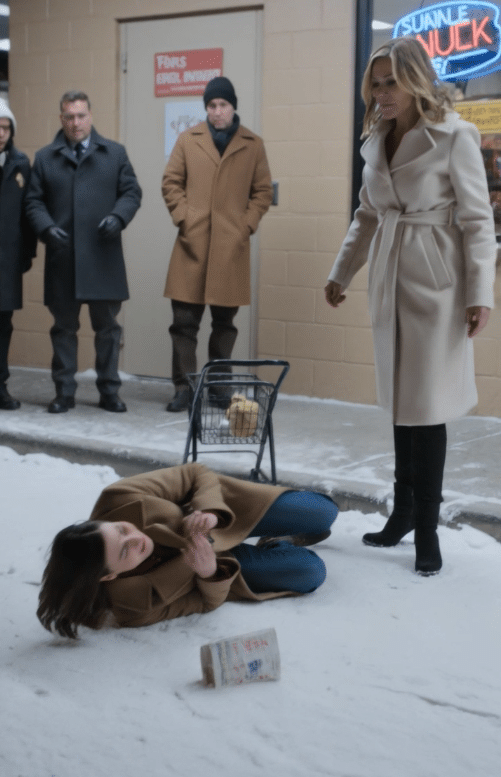
The woman’s voice barely rose above the wind sweeping across the grocery store entrance. Snow collected on her faded coat and tangled in her hair as she reached toward the milk carton lying near the bottom step. Her hands trembled, not only from the cold, but from the pain that had stolen her breath.
The wealthy woman standing over her looked down as if she had discovered something unpleasant on the pavement.
“Trash. Feed your child cheaper.”
Then she kicked the mother in the chest.
The impact knocked the thirty-five-year-old woman backward onto the snowy sidewalk. The milk carton flew from her hands, struck the ground, and slid toward the curb, leaving a crooked trail through the fresh snow. Her forearm hit the edge of the grocery store step, and a thin trace of blood appeared against her pale skin.
For a moment, she could not move.
She curled onto her side, grimacing as she struggled to draw air into her lungs. Her eyes watered from the pain, but when she spotted the milk, she reached for it anyway.
That was the part the wealthy woman seemed to find most offensive.
The mother was still trying to retrieve something she needed.
Her name was Laura Bennett. She had spent the last hour walking through the snow to find a grocery store that was still open, counting the few dollars in her pocket before every purchase. The milk was the last thing she could afford that her six-year-old daughter, Sophie, had asked for that evening.
At home, there was half a loaf of bread and little else.
Laura had promised Sophie that she would bring something back. She had made that promise while wrapping an extra blanket around her daughter’s shoulders and pretending the cold apartment wasn’t as cold as it really was.
Now, on the sidewalk, she was trying to keep that promise with a bruised chest and shaking hands.
The woman in the expensive white coat stepped closer.
She was thirty-nine, impeccably dressed, with high heels that sank slightly into the snow and a designer handbag resting against her hip. Her name was Vanessa Whitmore, and she had grown accustomed to the world rearranging itself whenever she entered a room.
People moved aside for her. Employees anticipated her demands. Strangers apologized when she bumped into them.
Laura had done none of those things.
She had simply been standing near the entrance, holding a carton of milk, when Vanessa decided she was in the way.
As Laura stretched toward the carton, Vanessa delivered two more forceful kicks, one into her back and another into her side. Laura recoiled with a sharp gasp, folding around herself as pain spread through her body. Her fingers scraped uselessly across the snow.
Around them, late-night shoppers froze beneath the cold neon sign.
A man carrying groceries covered his mouth. A young woman took a step backward, nearly slipping on the icy pavement. Someone behind the store windows stared through the glass, one hand pressed against the display.
Nobody moved toward Laura.
Vanessa straightened her coat.
“Poverty is not my problem.”
The words landed more coldly than the snow.
Laura looked up at her. For one terrible second, she seemed ready to apologize. The instinct had been beaten into her by years of struggling, years of being treated as though needing anything was a personal failure.
But then she looked at the milk.
Her daughter was waiting at home.
And Laura, despite the pain, began reaching for it again.
That was when the sound of tires crushing snow cut through the silence.
A black SUV braked hard in front of the grocery entrance.
The driver’s door opened.
And the man who stepped out was about to discover exactly what kind of person Vanessa Whitmore really was.
Act II
The man wore a black cashmere coat that fell neatly over his shoulders. He was in his early sixties, silver-haired, composed, and unmistakably accustomed to being obeyed.
He did not shout when he saw the scene.
He did not demand an explanation from the crowd or ask why nobody had intervened. His gaze moved from Laura’s shaking body to the milk carton near the curb, then to Vanessa standing above her.
Something in his expression changed.
He crossed the sidewalk, bent down, and picked up the carton first.
The cap had been knocked crooked, but the container was still mostly intact. He held it carefully, as though the small object mattered far more than its price suggested.
Then he stepped between Laura and Vanessa.
The distance was only a few feet, but the shift in the atmosphere was immediate. Vanessa’s chin lifted, ready to deliver another cutting remark. Instead, she found herself looking at a man who seemed entirely uninterested in her appearance, her money, or her opinion of herself.
He turned slightly toward his driver.
“Get medical help,” he said quietly.
The driver moved at once.
Only then did the older man crouch beside Laura, keeping himself between her and the woman who had attacked her. He placed the milk where she could see it and offered his arm without pulling her upright.
“Don’t try to stand yet,” he told her. “Help is coming.”
Laura stared at him through tears.
“I didn’t do anything,” she whispered.
“I know.”
Those two words nearly broke her.
She had been prepared to explain herself. She had been prepared to apologize for blocking the entrance, for being poor, for making a scene, for bleeding on the sidewalk. She had spent so much of her life defending her right to occupy a small amount of space that kindness felt almost impossible to understand.
The man did not ask how much the milk cost.
He did not ask whether she could pay for the medical help.
He looked toward the store entrance, where the manager had finally appeared, pale and uncertain. The man gave a small gesture toward the building.
“Charge everything to my account.”
The manager’s face changed.
He knew that voice.
Vanessa heard it too, although she did not immediately understand why the manager suddenly stood straighter. She glanced at the SUV, then at the driver, then back at the older man. Her expression carried the first faint suggestion that the situation might not be as simple as she had imagined.
She had expected the stranger to be another customer. Perhaps a concerned passerby. Someone who might complain, make a show of sympathy, and eventually leave her to the consequences she considered appropriate for everyone else.
Instead, the manager hurried inside to make a call.
The older man remained beside Laura.
Behind him, the witnesses parted without being asked. The man with the grocery bags lowered his eyes. The young woman who had covered her mouth now watched Vanessa with a different expression—not merely shock, but disbelief that someone could behave so cruelly in front of an entire crowd.
Laura looked down at her injured arm.
“I only wanted to get home,” she said.
The man glanced at the milk carton.
“Then we’ll make sure you get home.”
Vanessa gave a short, incredulous laugh.
She was still trying to recover control of the scene. People like her could tolerate anger from strangers; anger could be dismissed as jealousy, ignorance, or bad manners. What she could not tolerate was being ignored.
“Excuse me,” she said sharply. “This woman was standing in the way.”
The older man did not turn around.
“Stay where you are.”
It was not loud. It did not need to be.
For the first time that night, Vanessa hesitated.
And then the grocery store manager came back outside, looking as though he had just realized that the person he was speaking to could change far more than the price of a carton of milk.
Act III
The manager stopped beside the entrance, clutching his phone.
“Mr. Callahan,” he said, his voice suddenly formal. “I’ve contacted the regional office. They’re asking whether you want the incident report handled through corporate security or directly through your office.”
Vanessa’s smile disappeared.
Callahan.
She knew that name.
Everyone who moved through the upper levels of the city’s business and charitable circles knew it. Thomas Callahan was the founder of Callahan Holdings, a private investment group with interests in commercial property, logistics, and neighborhood redevelopment. His name appeared on hospital wings, scholarship programs, and the plaques outside community centers.
More importantly, his company had recently acquired the property group that controlled several retail locations across the city.
Including the building that housed this grocery store.
Vanessa stared at him.
It was impossible, she thought. Men like Thomas Callahan did not stop in the snow outside ordinary grocery stores. They did not crouch beside injured women in worn-out coats. They did not interrupt their evenings to rescue strangers over something as insignificant as milk.
Yet there he stood, his expensive coat dusted with snow, protecting a woman Vanessa had treated as disposable.
Callahan finally looked at her.
“Did you kick her?”
Vanessa’s lips parted.
“She was in my way.”
“That wasn’t my question.”
The witnesses had gone completely silent.
Vanessa glanced toward the store windows. A few minutes earlier, the crowd had seemed like a collection of frightened strangers who would forget everything once they reached their cars. Now they were watching her as if they had finally been given permission to see what she had done.
“I barely touched her,” she said.
Laura flinched at the lie.
Callahan noticed.
His jaw tightened, but his voice remained controlled.
“My driver witnessed the last part. The store has cameras covering the entrance. And judging by the number of people standing here, I doubt the truth will be difficult to establish.”
Vanessa looked toward the ceiling-mounted security camera above the door.
For the first time, she seemed to understand that the incident might survive beyond the snow and the passing crowd. There would be a record. There would be names. There might be consequences that could not be erased by a phone call or a carefully worded apology.
She adjusted the strap of her handbag.
“I’m sure we can resolve this privately.”
Callahan looked at her for a long moment.
“Privately?”
He turned toward the manager.
“Preserve the footage. Get the witness statements. Make sure the medical responders receive the full account of what happened.”
The manager nodded quickly.
Vanessa’s cheeks reddened.
“You can’t just order people around because you have money.”
“No,” Callahan replied. “But I can ask them to document an assault that happened outside a property my company manages.”
He paused, looking back at Laura.
“And I can make sure the person who was hurt isn’t left alone in the snow.”
A siren sounded in the distance.
Laura had stopped trying to reach for the milk. She was shivering so hard that her teeth clicked together, and every breath still seemed to hurt. Callahan’s driver returned with a blanket from the SUV and draped it around her shoulders while keeping enough distance not to cause her more pain.
Laura clutched the edges of the blanket.
“Is my daughter going to be all right?” she asked suddenly.
The question seemed to surprise everyone except Callahan.
“She hasn’t eaten much today,” Laura continued, embarrassed by the confession. “I told her I’d bring this home. She thinks I’m coming back with dinner.”
Callahan looked at the carton beside him.
Then he looked toward the store.
“Let’s take care of that.”
He turned to the manager again.
“Every essential item she needs tonight. Food, warm clothing, whatever is necessary for her child. Put it on my account. Arrange a safe ride to their home, and have someone contact the appropriate support services tomorrow so this family doesn’t have to face the next emergency alone.”
The manager nodded.
Vanessa gave a sharp, disbelieving breath.
It was one thing to pay for a woman’s groceries. It was another to speak as if her entire life mattered.
And that, more than anything, seemed to offend Vanessa.
She had spent years measuring people by what they could offer her. Now she was watching a stranger offer help without asking Laura to prove that she deserved it.
But Callahan was not finished.
He had recognized something in the way the manager addressed him, and he knew the incident could not end with a receipt and a ride home.
Because the store was only the beginning of what his account could reach.
Act IV
By the time the emergency responders arrived, the snow had thickened.
They examined Laura where she lay, asking careful questions and explaining each movement before helping her onto a stretcher. She winced when they supported her injured side, then pressed her lips together, fighting the urge to cry.
Callahan stayed near her until the responders confirmed they could take over.
He did not promise that everything would be easy. He did not tell her that one kind stranger could erase years of hardship. Instead, he made sure she had a warm blanket, that the milk was placed safely with her belongings, and that the driver knew where she needed to go once the medical team cleared her.
Small things.
The kind of things Laura had learned never to expect.
Across the sidewalk, Vanessa’s confidence was collapsing by degrees. She had stopped speaking to the witnesses. Her phone was in her hand, but she seemed unsure whom to call. Every possible explanation she could construct now collided with the same inconvenient facts: the camera, the witnesses, the manager, and the man who had stepped between her and her victim without raising his voice.
She finally approached Callahan.
“Mr. Callahan, I think you’ve misunderstood what happened.”
He turned to face her.
“Then tell me what I misunderstood.”
Vanessa hesitated.
“She was blocking the exit. I was already late, and she refused to move.”
“She was standing outside the door holding groceries.”
“She could have moved.”
“And that gave you the right to kick her?”
Vanessa looked away.
Callahan waited.
The silence forced her to hear the question she had been trying to avoid. She had an explanation for her impatience, a story about being inconvenienced, a list of reasons she believed other people should accommodate her.
What she did not have was a reason that could make her actions acceptable.
“I didn’t know who she was,” Vanessa finally said.
Callahan’s expression hardened.
“That is what concerns me most.”
She looked up.
“If you’d known she was someone important, would you have treated her differently? If she’d been wearing an expensive coat, would you have left her standing? If her car had been waiting outside, would you have apologized instead of attacking her?”
Vanessa’s mouth tightened.
“You’re making this sound worse than it was.”
“No. I’m asking why you believe a person’s worth changes with the clothes they wear.”
The words carried across the entrance, reaching the people who were still waiting to speak with the responding officers. Nobody laughed or applauded. The moment was too uncomfortable for that.
Vanessa looked toward Laura’s stretcher.
For an instant, something like regret crossed her face. But it vanished as quickly as it had appeared, replaced by the familiar instinct to protect herself.
“I can pay for her expenses,” she said. “Whatever she needs. There doesn’t have to be a scene.”
Callahan studied her.
“You think this is about the price of milk?”
He gestured toward the store entrance, the camera above it, and the people who had watched a vulnerable woman be attacked while snow gathered around her.
“You didn’t simply hurt her. You decided that her poverty made her safe to hurt. You expected everyone here to look away because you believed no one would risk challenging you.”
Vanessa swallowed.
Callahan turned to the manager.
“Make sure the footage is preserved and the report is complete. My office will cooperate with the authorities, but nobody is to interfere with the investigation. And the support we’re arranging for Ms. Bennett and her daughter is not conditional on what happens to the person responsible.”
The manager nodded again.
That last sentence mattered.
Laura would not have to forgive Vanessa to receive help. She would not have to accept an apology, agree to silence, or exchange her dignity for groceries. Whatever happened next, the support was hers because she needed it—not because she owed anyone a performance of gratitude.
The responders began preparing to transport her for further evaluation.
Laura looked toward Callahan, her face pale beneath the blanket.
“I don’t know how to thank you.”
“You don’t have to,” he said. “Just focus on getting better and getting home to your daughter.”
She nodded, fighting tears.
As the stretcher moved toward the ambulance, the driver gathered Laura’s belongings. The milk carton, its cap still crooked, was placed carefully inside a grocery bag with the other items the store had begun preparing.
Vanessa watched the bag disappear into the ambulance.
She had wanted the woman gone from her path.
Now the entire sidewalk was looking at Vanessa as the person who had turned an ordinary winter evening into a record of cruelty that would not be easy to escape.
And the man standing before her had not yet explained why a single command from him had made the store manager move so quickly.
Act V
The ambulance doors closed, and red light swept across the snowy storefront.
Thomas Callahan watched until the vehicle pulled away. Only then did he turn toward the manager, who was waiting near the entrance with the phone still in his hand.
“Have my office arrange the account,” Callahan said. “Groceries, emergency supplies, transportation, and whatever immediate support the family needs. I want it handled tonight.”
“Yes, sir.”
“And tomorrow, I want the regional team to review how this store responds when someone is threatened or injured outside its doors. The staff should know who to call, what to preserve, and how to get help without putting themselves in danger.”
The manager nodded, his expression grave.
Callahan was not pretending that a corporate review could undo what had happened. Nor was he using Laura’s suffering as an excuse for a grand speech. He was making sure that the next person who found themselves alone on a freezing sidewalk would have a better chance of being protected.
Then he looked at Vanessa.
“You’ll have the opportunity to explain yourself to the authorities. My office will provide what it witnessed and what the cameras recorded.”
Vanessa’s eyes widened.
“Your office?”
“Yes.”
She tried to recover her composure, smoothing the front of her white coat as though the gesture could restore the world she understood.
“Mr. Callahan, surely you don’t intend to turn this into some kind of campaign against me.”
“This isn’t a campaign.”
“Then what is it?”
“An account of what happened.”
He let the words settle between them.
Vanessa had built her confidence on the assumption that money could turn almost any problem into a negotiation. She could pay for inconvenience, purchase access, and persuade people to describe ugly moments in softer language.
But an account was different.
An account recorded what had been taken, what had been done, and who was responsible. It did not care whether the person responsible wore a designer coat. It did not change because she disliked the witnesses or regretted the camera.
And Thomas Callahan’s account would not be limited to the groceries Laura needed that night.
The manager stepped forward, holding the phone out slightly.
“Mr. Callahan, the regional office is ready to confirm the charge authorization.”
Callahan gave a brief nod.
“Charge everything to my account.”
The words were quiet, but the manager responded immediately, turning back toward the store to carry out the instruction.
Vanessa stared after him.
She had spent the evening believing that money made her untouchable. Now the same word she had used to measure everyone else—money—had become the one thing she could no longer use to control the situation.
She glanced at the black SUV. Its headlights cut through the falling snow, illuminating the wet pavement and the footprints around the entrance. The witnesses had begun speaking with the officers. The store manager was preserving the footage. Laura was on her way to receive medical care, and her daughter would not be left waiting for an empty promise.
Vanessa’s handbag suddenly felt heavy against her side.
She looked back at Callahan, searching his face for a hint that this was all a misunderstanding, that she could still laugh it off, that her status might somehow rescue her from the consequences of what she had done.
He offered no such reassurance.
For the first time that night, Vanessa understood that she was not the most powerful person on the sidewalk.
And she had no idea what that would mean for her.
Her expression tightened. The arrogance remained, but a crack had opened beneath it, revealing the suspicion she could no longer hide.
She stared at the older man, then at the grocery entrance, where her assumptions about the world had begun to collapse.
“Your account?”