Act I
“Sleep in your shame somewhere else.”
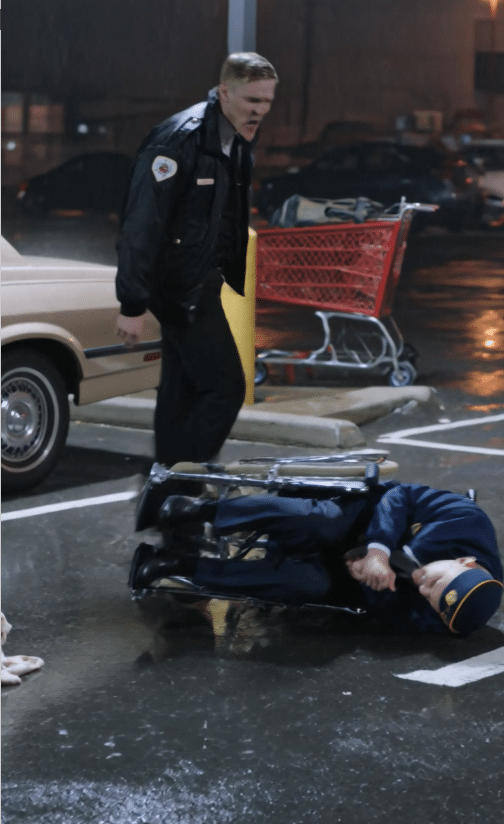
The parking lot manager stood over the seventy-four-year-old veteran as rain hammered the asphalt, his flashlight cutting a harsh white beam across the old man’s face.
A few feet away, a thin blanket lay soaking in a puddle. A small bag had burst open, spilling a change of clothes, a photograph, and the handful of personal belongings the veteran had managed to keep after losing almost everything else.
The old man tried to reach for them.
His name was Daniel Hayes. He wore a faded navy jacket and a battered veteran’s cap, and his wheelchair sat crooked beside an aging sedan that had become his only shelter. His legs no longer worked, and the cold rain had already soaked through his sleeves.
The manager, a forty-four-year-old man named Brent Lawson, looked at the scene with open disgust.
“Trash. This is not a shelter.”
Daniel swallowed hard.
“I just need one dry night.”
Brent laughed without a trace of humor.
“Then find somewhere else.”
Daniel tried to explain that he had nowhere to go, but Brent was no longer interested in listening. He had already decided that the old car, the worn blanket, and the elderly man beside it were an embarrassment to the supermarket he was supposed to protect.
He grabbed the small bag from the car door and hurled it onto the wet asphalt.
Then, with deliberate force, he kicked the back of Daniel’s wheelchair.
The chair shot sideways.
Daniel was thrown onto the rain-slick ground, his shoulder striking the asphalt as his remaining strength failed him. His bag fell open, and the blanket slid into a shallow puddle, turning dark as water soaked through the fabric.
A sharp cry escaped his mouth.
His forearm scraped against the rough pavement, leaving a thin streak of blood. He grimaced and struggled to breathe through the pain, instinctively reaching toward the blanket that had once kept him warm.
Brent stepped closer.
He kicked Daniel twice more while the old man lay helpless on the ground.
A woman standing beside a shopping cart covered her mouth. A young couple froze near the supermarket entrance, watching through the rain. One man started forward, then hesitated when Brent swung his flashlight toward the gathering crowd.
“What’s everybody staring at?” Brent shouted. “Move along!”
Nobody spoke.
Daniel turned his face away, trying to hide the humiliation burning hotter than the cold water soaking his clothes.
He had spent years learning to endure pain without asking anyone to notice. He had learned to smile when people stared at his wheelchair and to say he was fine when he was anything but fine.
But there was something unbearable about lying in a puddle while a stranger threw away the few possessions that made his life feel remotely his own.
“Please,” Daniel whispered. “That’s all I have.”
Brent bent closer.
“Then you should have taken better care of your life.”
The words struck Daniel harder than the fall.
He looked toward his old sedan. Its paint was peeling, one rear light was cracked, and the passenger window had a plastic covering held in place with tape. Yet inside that car, he had a pillow, a photograph of his late wife, and a little space where he could close his eyes without having to explain himself to anyone.
It was not a home.
But it was the closest thing he had.
Brent seized the edge of the blanket and dragged it farther from the car.
“I’m not telling you again. Get off this property.”
Daniel’s eyes followed the blanket into the water.
Then a pair of headlights swept across the parking lot.
A black SUV came around the entrance at speed, its tires sending a sheet of rainwater across the asphalt before it braked sharply beside the old sedan.
The rear door opened.
A man in a long black coat stepped out, followed by an executive assistant and two senior security officers.
He took three steps toward the commotion, saw Daniel lying on the ground, and stopped.
His face changed.
He moved immediately to the veteran, crouched beside him, and placed himself between Daniel and the man holding the flashlight.
“Are you hurt?” he asked Daniel.
Daniel tried to sit up.
“I’ll be all right.”
“Don’t try to move yet. Let’s get someone to assess you.”
The stranger glanced toward the soaked blanket, the scattered belongings, and the wheelchair lying on its side. His expression grew colder with every passing second.
Then he turned to his executive assistant.
“Give him my executive suite key.”
The assistant stared at him for a moment before reaching into a leather case.
Brent’s flashlight dipped.
He looked from the assistant to the man in the black coat, suddenly uncertain whether he had misunderstood what he had heard.
“Your suite?”
The stranger didn’t answer him.
Instead, he watched as one of the security officers moved to shield Daniel from the rain while the other blocked Brent’s path.
For the first time that night, the parking lot manager had no idea what to say.
Because the man he had just watched kneel beside a homeless veteran was not another shopper, a concerned stranger, or a passing employee.
He was the owner of the entire supermarket chain.
And Brent had just made the worst mistake of his life.
Act II
Daniel Hayes had not always lived in a car.
There had been a time when he owned a small house with a white fence, a garage that smelled of motor oil, and a kitchen where his wife, Margaret, insisted on keeping fresh flowers even when money was tight.
Daniel had served in the United States military when he was young. He rarely spoke about the difficult parts of his service, but he carried the memories of his fellow soldiers with him long after returning home.
He believed in showing up when people needed him.
That belief shaped his marriage, his work, and the way he raised his daughter, Emily.
For most of his adult life, Daniel worked as a mechanic. He could diagnose an engine by listening to it, identify a worn belt by its sound, and coax another year of life out of a vehicle everyone else had given up on.
He liked fixing things because the rules were simple.
If something broke, you studied the problem, found the cause, and did whatever you could to make it work again.
People were more complicated.
After his military service, Daniel spent decades building a quiet, ordinary life. He paid his bills, volunteered at local events, and helped neighbors repair their cars when they couldn’t afford a mechanic.
He never became wealthy, but he had never considered himself poor.
He had a roof over his head, food in the refrigerator, and someone waiting for him at the end of the day.
Then, in his late fifties, a medical emergency changed everything.
The damage to his spine left him paralyzed from the waist down. His recovery involved months of treatment, rehabilitation, and difficult adjustments to a body that no longer responded the way it once had.
Margaret stayed beside him through it all.
She learned how to help him transfer from his wheelchair, how to rearrange their home so he could move around safely, and how to make him laugh on the days when he wanted nothing more than to pull the curtains shut.
“You’re still Daniel,” she told him one afternoon when he struggled to button his shirt.
He stared at the buttons in frustration.
“Doesn’t feel like it.”
She took his hand.
“Then we’ll figure out how to make it feel that way again.”
For a while, they did.
But the medical bills continued, and Daniel could no longer work as a mechanic. Margaret picked up extra hours wherever she could, while Daniel tried to stretch their savings and manage the expenses that insurance did not cover.
They sold the house after a series of financial setbacks made it impossible to keep up with the mortgage.
Margaret hated leaving the kitchen where she had spent so many years cooking for their family.
Daniel hated watching her pretend it didn’t matter.
They moved into a small rental apartment, telling themselves it was temporary.
Then Margaret became ill.
Her treatment consumed what remained of their savings, and Daniel spent nearly every available dollar trying to give her the care she needed. He never regretted that decision, not even later when he found himself counting coins before buying groceries.
Margaret died three years after the house was sold.
After her funeral, Daniel returned to the apartment and sat beside the window for hours, listening to traffic move through the streets below.
The rooms were full of memories.
Her favorite mug still sat in the cupboard. Her reading glasses rested on the nightstand. A photograph of the two of them stood beside the bed, taken years earlier at a small lakeside park.
Daniel couldn’t bring himself to pack everything away.
But grief did not stop the rent from coming due.
When he fell behind, the landlord gave him time. Daniel sold tools, furniture, and the few valuable possessions he had kept from his working years. He tried to find part-time work that he could manage from a wheelchair, but his options were limited.
Eventually, he lost the apartment.
His daughter, Emily, had moved across the country for work. Their relationship had become strained over the years, partly because Daniel hated discussing his finances and partly because Emily believed her father would always tell her if he truly needed help.
He never did.
He told her he was managing.
He told her he had a place to stay.
He told her not to worry.
By the time she realized how bad things had become, Daniel had already started sleeping in his old sedan.
He had purchased the car years earlier, before his disability worsened. It was not designed for someone in a wheelchair, but Daniel had modified the interior as best he could and learned to manage the difficult transfers.
The car was uncomfortable, cramped, and cold in winter.
Still, it gave him a measure of privacy.
He could keep Margaret’s photograph on the dashboard, fold his blanket beneath him, and close the doors when he wanted the world to leave him alone.
During the day, Daniel visited public buildings where he could stay warm, looked for affordable food, and used the little money he received to keep the car running.
At night, he parked where he believed he would not bother anyone.
The supermarket had become one of those places.
The parking lot was generally quiet after midnight, and the store’s security lights gave him enough visibility to manage his wheelchair. He did not block entrances, leave trash behind, or approach customers for money.
He bought what he could when he had money.
When he didn’t, he stayed out of the way.
Daniel understood that sleeping in a car was not what the property owner intended. He was not trying to claim the parking lot as his own.
He simply needed somewhere to close his eyes.
Brent Lawson saw none of this.
To Brent, the parking lot was an extension of the store’s image. The asphalt had to be clean, the carts had to be returned, and anything that might prompt a customer to complain needed to disappear.
He had worked in retail security for years and had developed a habit of confusing authority with personal importance.
He liked giving orders.
He liked watching people obey them.
And he particularly disliked people he believed had no power to challenge him.
Daniel’s old car had caught his attention weeks earlier.
At first, Brent had simply driven past it and frowned. Then he noticed Daniel sitting beside it in his wheelchair. Soon, the veteran’s presence became an irritation Brent carried through his shifts.
He told himself the car made the store look bad.
He told himself customers would complain.
He told himself that if he allowed one person to remain overnight, others would follow.
He never considered asking management about an approved way to handle the situation.
He never checked whether Daniel had access to veteran housing services.
He never wondered why an elderly disabled man would choose to spend a winter night in a vehicle rather than somewhere warm.
He wanted the problem gone.
And on the night he finally confronted Daniel, he decided that making the veteran afraid would be faster than treating him like a human being.
What Brent didn’t know was that the supermarket chain’s owner had spent the past year investigating a problem that had nothing to do with appearances.
The owner had been quietly reviewing how his stores treated vulnerable people.
And the parking lot outside this particular supermarket was about to become the place where everything came to light.
Act III
The man in the black coat was Richard Bennett, the sixty-three-year-old founder and majority owner of Bennett Markets, a supermarket chain with stores across several American states.
Richard had built the business over nearly four decades.
He started with a small neighborhood grocery store inherited from his father, a man who believed that a local shop should be useful to the people who lived around it. The original store carried affordable produce, basic household supplies, and groceries for families who needed to stretch every dollar.
Richard grew the company slowly.
He opened new locations, invested in distribution, and insisted that managers understand the communities they served. As the business expanded, he established an employee assistance fund and supported food banks in neighborhoods where the chain operated.
But Richard was aware that a company’s values could disappear somewhere between the executive office and the people wearing uniforms on the floor.
Policies could look compassionate on paper while employees acted very differently in practice.
Customer service training could emphasize respect while a manager humiliated an elderly person in a parking lot.
A charitable donation could make a company look generous while someone struggling outside one of its stores was treated as an inconvenience.
Richard had begun conducting unannounced visits to different locations after receiving complaints about how security personnel handled homeless people.
Some complaints involved unnecessary confrontations. Others described employees throwing away belongings, threatening people who asked to use public facilities, or treating disabled visitors as though they were deliberately causing trouble.
The company had already introduced updated guidance for its security teams.
But Richard wanted to know whether the guidance was being followed.
That night, he had been returning from a meeting with regional managers when his driver suggested stopping at the store to review a delayed maintenance report.
Richard agreed.
He had expected to spend fifteen minutes looking over the paperwork before continuing home.
Instead, his headlights illuminated an old sedan beside the far edge of the parking lot.
Then he saw the wheelchair.
At first, he thought the man beside it might have fallen while trying to transfer from the car. He instructed the driver to stop.
By the time Richard stepped out, he had seen Brent kick the wheelchair and throw Daniel onto the wet asphalt.
Richard had watched the final seconds of the assault with a feeling of disbelief so intense that, for a moment, he could barely speak.
He had spent years talking about dignity in customer service meetings.
Now he was watching one of his own employees deliberately strip it away from a helpless man.
Richard reached Daniel first.
He did not ask whether the veteran had been trespassing. He did not ask whether he had permission to sleep in the car.
He asked whether Daniel was hurt.
That was the only question that mattered in the moment.
After instructing his assistant to arrange a safe place for the veteran, Richard looked toward the old car.
“Has anyone called for medical assistance?”
His security officer immediately contacted emergency services.
Richard then asked his assistant to contact the regional operations director and preserve the store’s security footage. He wanted a complete record of what had happened, including the events leading up to the assault.
Only then did he address Brent.
“Step away from him.”
Brent’s face tightened.
“Sir, you don’t understand. This man has been sleeping here. I’ve warned him repeatedly.”
Richard held his gaze.
“Did he threaten anyone?”
“No.”
“Did he damage the store?”
“Not that I know of.”
“Did he attack you?”
Brent hesitated.
“No, but—”
“Then explain why he’s lying on the ground.”
Brent looked toward the gathering shoppers.
“He refused to leave.”
Richard glanced at the soaked blanket.
“So you threw his belongings into the rain and kicked his wheelchair?”
“I was trying to enforce the property rules.”
“Property rules do not authorize assault.”
Brent’s expression shifted. He seemed to realize that the conversation was not going the way he expected.
“You can’t just take his side without knowing the whole story.”
Richard’s voice remained level.
“I watched you put him on the ground.”
The security officers moved into position, preventing Brent from approaching Daniel again.
Richard turned to his assistant.
“Give him my executive suite key.”
The assistant knew exactly what he meant.
Richard maintained a private executive suite in a nearby business hotel, used when late meetings or severe weather made it impractical to return home. The arrangement was part of his company’s travel policy, and he rarely used the room for more than a few hours.
It had a proper accessible bathroom, a wide entrance, a comfortable bed, and enough space for someone using a wheelchair to move safely.
Richard could have arranged an ordinary hotel room.
But he had seen Daniel’s condition, the rain, and the state of the car. He wanted a place where the veteran could get out of the cold immediately, receive medical attention, and rest without having to navigate a complicated intake process in the middle of the night.
The executive suite was available.
Richard intended to use it.
His assistant opened a tablet to contact the hotel and confirm that the room was ready. She also began coordinating accessible transportation and making arrangements for Daniel’s belongings to be secured.
Brent watched her work.
“Wait,” he said. “You’re giving him your suite?”
Richard turned toward him.
“Yes.”
“Because he’s sleeping in his car?”
“Because he needs somewhere safe to stay tonight.”
Brent shook his head in disbelief.
“Sir, with all due respect, this is a supermarket parking lot. We can’t just let people do whatever they want.”
Richard’s expression hardened.
“No one said you had to let anyone do whatever they want. But there is a difference between enforcing a rule and abusing someone because you think he doesn’t matter.”
He glanced toward Daniel.
The veteran was still on the ground, shivering beneath the security officer’s coat while the rain ran off the brim of his cap.
Richard lowered his voice.
“Get him medical care. Get him somewhere warm. Then we can discuss the property rules.”
The assistant nodded.
A few shoppers had gathered near their carts. One woman wiped tears from her face. Another quietly offered to help retrieve Daniel’s belongings, but the security officer asked her to give the responders room.
Brent looked around at the people watching him.
Moments earlier, he had been the person giving orders.
Now he stood alone, with two senior security officers blocking his path and the company’s owner personally overseeing the response.
He had believed Daniel’s poverty made him powerless.
He had mistaken Richard’s quiet authority for an opportunity to argue.
And he had no idea how much evidence the company was about to uncover.
Act IV
The ambulance arrived shortly afterward.
Daniel was examined at the scene and taken for further evaluation because of the force of the fall and the pain in his chest and back. His injuries were not something to dismiss simply because he was an older man who had learned to hide discomfort.
Before the responders left, Richard approached him.
“Mr. Hayes, I’m Richard Bennett. I own the company that operates this store.”
Daniel’s expression changed.
“I’m sorry about all this.”
Richard stared at him.
“Why are you apologizing?”
Daniel looked toward the old car.
“I didn’t mean to cause trouble.”
Richard took a breath, struggling to keep his anger from showing.
“You didn’t cause this trouble. You were hurt. We need to make sure you’re safe.”
Daniel looked away.
For years, he had learned to anticipate irritation whenever his needs became visible. He was accustomed to explaining himself before anyone had even asked a question.
Richard recognized that habit.
He had seen it in customers who apologized for using mobility assistance, employees who were afraid to request time off for medical appointments, and families who hesitated before asking for help they clearly needed.
It was one of the reasons he had begun visiting his stores without an entourage.
He wanted to know what happened when people believed nobody important was watching.
Now he knew.
Richard turned to his assistant.
“Confirm the suite. Make sure it’s accessible and ready before he arrives.”
She nodded.
“Do you want the hotel manager to meet him?”
“Yes, but keep it simple. No publicity. No photographs. He needs a place to rest, not an event.”
Daniel looked startled.
“You don’t have to do all that for me.”
Richard crouched slightly so they were speaking at eye level.
“I know I don’t have to. I want to.”
Then he added, “You can decide what help you want after you’ve had a chance to rest.”
That was the first time all night anyone had offered Daniel a choice without attaching a demand to it.
He nodded, unable to find the words to answer.
While the medical team cared for Daniel, Richard returned to the parking lot office with the regional operations director on the phone.
He requested the security footage, the incident logs, and a copy of any previous reports involving Daniel or the old sedan.
The records revealed that Brent had complained about the veteran several times.
But there was no documentation of threats, damage, or dangerous behavior. There was no record of an approved removal process, no evidence that Brent had consulted his supervisors, and no indication that anyone had tried to connect Daniel with available services.
There were only terse notes describing the veteran as an ongoing problem.
Richard read them twice.
“Who reviewed these?”
The regional director named a supervisor who had received the reports.
“And what action did they take?”
“They assumed the situation was being handled locally.”
Richard closed the file.
“That is not an answer.”
The investigation expanded.
Management reviewed the footage from the parking lot and interviewed the employees who had been on duty. Several workers said Brent had repeatedly spoken about the veteran in degrading terms. One employee admitted that she had been afraid to challenge him because he controlled the schedule and had previously retaliated against staff who questioned his decisions.
Another said Brent had threatened to write her up after she suggested contacting a local outreach organization.
The picture became clearer.
This was not simply a manager who had lost his temper once.
It was a workplace where people had become afraid to question someone who used his authority to intimidate others.
Richard ordered Brent removed from duty while the company conducted a formal investigation. The decision was not announced as a public spectacle, and no one was instructed to humiliate him in return.
The company documented the evidence, followed its employment procedures, and referred the assault to the appropriate authorities.
Richard also directed the regional team to review its policies for handling vulnerable people on store property.
Employees would receive additional training on de-escalation, disability awareness, and the difference between a legitimate property concern and an emergency requiring medical assistance.
The company would also establish clearer procedures for contacting local outreach services when people sought temporary shelter near its stores.
None of those changes meant that a parking lot could automatically become a permanent shelter.
It meant that employees had to handle difficult situations lawfully, safely, and with basic humanity.
When Brent was informed that he would not be returning to his shift while the investigation proceeded, he demanded to speak with Richard.
“This is ridiculous,” he said. “I’ve worked here for years. You’re throwing away my career because I moved a man who shouldn’t have been here.”
Richard looked at him steadily.
“You kicked a disabled man out of his wheelchair.”
“He was trespassing.”
“Then you should have followed the proper procedure.”
Brent’s jaw tightened.
“So that’s it? You’re giving him your suite and taking my job?”
Richard paused.
“No. I’m giving him a safe place to recover because he was hurt. Your employment status will be determined by the investigation and the evidence.”
He leaned forward slightly.
“You are responsible for what you did. Mr. Hayes is not responsible for your decision to hurt him.”
Brent looked toward the door.
For the first time, he seemed to understand that his version of the story would not erase what the cameras had recorded.
Richard then turned back to the regional director.
“I want a review of every complaint involving the treatment of vulnerable people at our locations. Not because we need to protect the company’s image, but because I need to know whether this has happened elsewhere.”
The director agreed.
Richard continued.
“We will not solve homelessness through a security policy. But we can make sure our employees don’t turn a difficult situation into a dangerous one.”
That became the foundation of the company’s response.
The store would review how it handled overnight parking concerns. Managers would be required to document incidents accurately, and security personnel would be prohibited from using force to remove people except where legally justified and necessary to protect safety.
The company would also partner with local service providers to create a clearer referral process for people in immediate need.
Richard knew that no corporate policy could solve every problem Daniel faced.
But a policy could prevent an employee from treating another person’s hardship as permission to be cruel.
That night, the executive suite key represented more than a luxurious room.
It represented a decision about what kind of power Richard wanted his company to exercise.
Brent had used his authority to make a vulnerable man feel smaller.
Richard intended to use his authority to make sure that no one else could do the same so easily.
Act V
The executive suite was quiet when Daniel arrived.
The rain had softened to a steady patter against the windows, and the city lights blurred into long reflections across the wet streets below.
A hotel employee met the medical transport at the entrance and guided Daniel to the accessible room Richard had arranged. The bathroom had grab bars, the doorway was wide enough for his wheelchair, and the bed could be approached without moving furniture out of the way.
For several seconds, Daniel simply sat there.
He looked at the clean sheets.
The folded towels.
The small lamp beside the bed.
He could smell fresh coffee from a tray on the table, and a warm meal had been placed nearby for whenever he felt ready to eat.
It was more comfort than he had experienced in months.
And he didn’t know what to do with it.
A staff member asked whether he needed anything else.
Daniel almost said no automatically.
Then he stopped himself.
“Could someone help me get my blanket dry?”
“Of course.”
The blanket was not expensive. Its edges were frayed, and one corner had been repaired with mismatched thread. But it was the blanket Margaret had bought him during their first winter together.
It had traveled with him through hospital rooms, temporary apartments, and the back seat of his car.
He had watched Brent throw it into the rain, and for one terrible moment, he had thought he had lost the last ordinary piece of his former life.
The hotel staff carefully dried it and returned it to him.
Daniel held it against his chest.
He did not cry loudly. He simply lowered his head and allowed the tears to come.
For the first time that night, nobody was staring at him with disgust.
Nobody was telling him to move faster.
Nobody was demanding that he prove he deserved to be there.
He was allowed to be an exhausted old man who had been hurt and needed somewhere safe to sleep.
The next morning, Richard visited after confirming that Daniel had received medical care.
He brought no cameras and made no announcement. He sat in a chair near the window and asked Daniel how he was feeling.
“Better,” Daniel replied. “Still sore.”
“I’m glad you’re somewhere warm.”
Daniel glanced around the room.
“I don’t know how to thank you for this.”
“You don’t owe me a thank-you.”
Richard smiled faintly.
“But if you want to tell me something, tell me what would make the next few weeks easier.”
Daniel was silent for a long time.
He had become skilled at surviving one day at a time. Planning beyond the next meal, the next place to park, or the next bill felt almost impossible.
Finally, he admitted that the car was no longer reliable. The engine had been struggling for weeks, and the cold made it harder to start. If the car stopped running completely, he would lose the last place where he could keep his belongings.
He also admitted that he had not spoken honestly with his daughter about his circumstances.
Richard listened without interrupting.
Then he explained that his company could connect Daniel with local veteran support services and housing specialists. The foundation supported several organizations that helped older veterans navigate benefits, accessible accommodation, and emergency assistance.
He would make the introductions, but Daniel would decide which services he wanted to use.
There would be no obligation to tell his story publicly.
Daniel looked down at his hands.
“I’ve spent a long time trying not to be a burden.”
Richard answered quietly.
“Needing help doesn’t make you a burden.”
It was a simple sentence.
But Daniel carried it with him after Richard left.
Over the next several weeks, a veteran services coordinator helped Daniel review his benefits, locate accessible temporary housing, and understand what assistance might be available to him. A housing specialist worked with him on a longer-term plan that would not depend on an unreliable car.
The process was not effortless.
There were forms to complete, appointments to attend, and decisions Daniel had postponed for months because he was too exhausted to face them.
But this time, he did not have to navigate everything alone.
He eventually reached out to Emily.
Their first conversation was awkward. Daniel tried to make light of his situation, while Emily struggled to contain her anger that he had kept so much from her.
Then she asked him a question he could not evade.
“Dad, why didn’t you tell me?”
Daniel looked toward the window.
“Because I wanted you to believe I was still managing.”
“You didn’t have to pretend with me.”
“I know that now.”
There were no instant solutions to the years of distance between them. But they began speaking more regularly, and Emily helped him sort through the practical decisions he had been too overwhelmed to make.
The supermarket chain’s response continued as well.
Brent’s case proceeded through the appropriate employment and legal processes. The company reviewed the footage, interviewed witnesses, and examined the failures that had allowed his conduct to go unchallenged.
He was not allowed to return to his former position while the investigation was underway, and the evidence was provided to the appropriate authorities.
Richard refused to turn the matter into a revenge campaign.
He did not publish Brent’s personal information or encourage people to harass him. He wanted accountability, not a second act of cruelty.
The company’s review led to new procedures for reporting mistreatment, clearer escalation rules for security staff, and stronger guidance on assisting people with disabilities or those experiencing homelessness.
Regional managers were required to verify that the new policies were being followed rather than simply signing off on training documents.
Richard also authorized a partnership with local outreach organizations to help connect vulnerable people near the stores with emergency services.
The work was less dramatic than a public confrontation.
It was also more likely to make a lasting difference.
Months later, Daniel returned to the supermarket.
He no longer needed to sleep in his car every night, and he had a more stable place to stay while continuing to work through his housing arrangements.
He entered the store wearing his faded navy jacket and veteran cap.
For a brief moment, he remembered the rain, the flashlight, and the sound of his belongings hitting the asphalt.
Then he saw a young employee helping an older customer navigate the entrance with a shopping cart.
Near the service desk, another worker was speaking with a local outreach representative about available resources.
The changes were not perfect, and they did not solve every problem in the neighborhood.
But they were visible.
Richard happened to be visiting that morning.
When he saw Daniel, he walked over and shook his hand.
“How are you doing, Mr. Hayes?”
Daniel smiled.
“I’m doing better.”
Richard nodded.
“Good.”
Daniel looked toward the parking lot through the glass doors.
“Funny thing,” he said. “I used to think the hardest part of losing my home was losing the roof.”
Richard waited.
“Turns out, it was getting used to the way people looked at me afterward. Like I had become something they needed to move out of sight.”
Richard’s expression grew serious.
“You should never have been treated that way.”
Daniel looked down at his wheelchair, then back at the store owner.
“I can’t change what happened. But I can remember that someone stopped.”
Richard shook his head.
“You deserved help before I arrived.”
Those words stayed with Daniel long after their conversation ended.
Because that was the truth he had needed to hear from the beginning.
He had not deserved a warm room because the owner of a supermarket chain happened to witness his suffering.
He had not deserved kindness because he was a veteran, or because he had lost the use of his legs, or because his story moved someone powerful enough to change the rules.
He deserved dignity because he was a human being.
The suite key had given him one dry night.
The help that followed gave him a chance to build something more stable.
And the changes inside the supermarket helped ensure that the next person who needed assistance might encounter a different kind of authority—one that knew how to enforce rules without destroying a person’s dignity.
Brent had looked at an old car, a worn blanket, and a disabled veteran and seen an eyesore.
Richard had looked at the same scene and seen a man who needed help.
The difference was never the car.
It was never the blanket.
And it was never the veteran’s ability to stand on his own two feet.
It was the choice each man made when he encountered someone who had less power than himself.
One chose humiliation.
The other chose responsibility.
And on a cold, rain-soaked night in a supermarket parking lot, that choice changed the course of Daniel Hayes’s life.
Because a person’s worth does not disappear when their home becomes a car, when their body can no longer do what it once could, or when the world stops noticing their struggle. Sometimes, all it takes to change a life is for one person to stop looking away—and remember that dignity is not something we grant to the fortunate. It is something every human being deserves.