Act I
“Trash. Old medals don’t clear the way.”
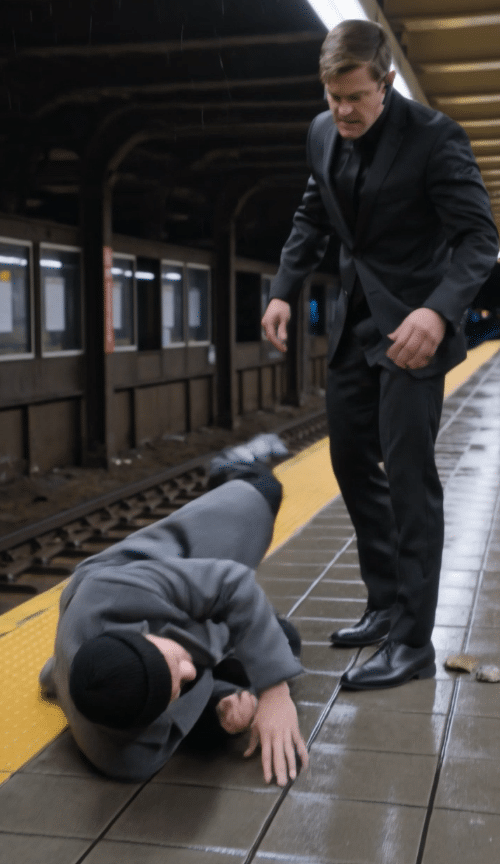
The words cut through the late-night subway station just as the old man reached desperately for the medal skidding across the wet tile.
He was seventy-six, dressed in a worn gray coat that hung loosely from his narrow shoulders, with a black knit cap pulled low over his head. One eye was clouded by an old injury, and his movements carried the careful hesitation of someone who had spent years learning how to live with pain. In his trembling hand, he had been holding a small military medal, its tarnished surface catching the fluorescent lights as it spun toward the yellow platform line.
The man in the black suit barely glanced at it.
He had wireless earbuds in his ears, an expensive watch beneath his cuff, and the impatient expression of someone who believed every delay in his life was somebody else’s fault. When the veteran moved too slowly near the station exit, the businessman deliberately slammed his shoulder into him.
The medal fell.
It struck the tile with a tiny metallic click.
For a moment, the veteran seemed to forget the crowded station around him. He stared at the medal as if something far more precious than a piece of metal had just slipped beyond his reach.
“Please… that medal is mine.”
The businessman looked down at him, irritated rather than apologetic.
Then he kicked him hard in the chest.
The veteran crashed onto the wet floor near the yellow line. His black knit cap rolled away, and the impact knocked the breath from his lungs. His elbow scraped against the tile, leaving a thin trace of blood as he instinctively curled inward, trying to protect himself from another blow.
The medal slid farther away.
A woman near the ticket machines gasped. Two commuters stepped backward. Someone raised a phone, but nobody moved toward the old man.
The businessman stood over him, adjusting his jacket as though the assault had been an inconvenient interruption.
“Get out of the way,” he snapped.
The veteran struggled to lift his head. His remaining eye watered with pain, but he was not looking at the man who had attacked him. He was watching the medal near the platform line.
It was the only thing he had been unwilling to leave behind that night.
The businessman followed his gaze, then deliberately stepped toward him again.
Two more kicks landed against the veteran’s back and side. The old man recoiled, his fingers scraping helplessly across the floor. A strained sound escaped him as he tried to draw a full breath.
Nobody intervened.
The station announcements continued overhead. Somewhere beyond the entrance, rain hammered the pavement, sending cold air through the open stairwell. Trains came and went, carrying strangers past a man who had suddenly become invisible to everyone except the person hurting him.
The businessman crouched just enough to make sure the veteran could hear him.
“Your honor ended years ago.”
The old man swallowed against the pain.
He had heard insults before. He had endured the awkward stares, the whispered assumptions, the pity that always seemed to arrive with a hidden accusation. But this was different. The stranger had not merely knocked him down. He had looked at the one thing the veteran was trying to save and decided it was worthless.
Then a heavy door opened behind them.
The VIP corridor door slammed against its stop, and the sound carried across the platform.
A federal judge in a long black coat stepped into view, accompanied by an assistant and two transit police officers. He was sixty-four, silver beginning to show at his temples, and his expression was controlled enough to make the officers beside him straighten instinctively.
He did not look first at the businessman.
He looked at the medal.
Then he looked at the old man lying on the floor.
And the entire station was about to learn why those two things mattered.
Act II
“Hand me that medal.”
The judge’s voice was quiet, but it carried a weight the businessman had not anticipated.
One transit officer immediately moved between the veteran and the man in the black suit. The second officer knelt near the old man, keeping his movements careful and his hands visible while asking whether he could hear him. The judge stepped toward the medal, stopping well short of the yellow line.
For the first time that night, the businessman seemed uncertain.
He pulled one wireless earbud from his ear and stared at the judge as if trying to decide whether this was a misunderstanding he could talk his way out of.
The judge did not give him the opportunity.
“Officer, secure the scene. Get medical assistance for this gentleman. No one touches that medal until it’s documented.”
The old veteran looked up at him.
There was fear in his face, but beneath it lay something else: a flicker of recognition, quickly buried under exhaustion. He tried to push himself upright and failed, his arm shaking from the effort.
“Easy,” the officer beside him said. “Don’t try to get up yet.”
“I need the medal,” the veteran whispered.
“I know,” the judge replied.
Those two words changed the expression on the old man’s face.
Not because they explained anything, but because the judge had said them as though he understood. As though the medal was not a curiosity or a sentimental trinket. As though he knew that sometimes the smallest object a person carries contains the largest part of a life.
The businessman gave a short, dismissive laugh.
“Are we really doing all this over a piece of junk?”
The judge finally turned toward him.
“What is your name?”
The question was ordinary. The tone was not.
The businessman hesitated, then answered with the confidence of someone accustomed to introducing himself in rooms where people cared about titles.
“Grant Mercer.”
“Do you understand why these officers are here?”
“Because this man fell down?”
One of the witnesses made a disbelieving sound.
Grant shot her a hostile look. “You saw him standing in the middle of the exit. I was trying to get through.”
“You struck him,” the judge said.
“He was in the way.”
“And then you kicked him while he was on the ground.”
Grant’s jaw tightened.
For the first time, the surrounding commuters were no longer looking away. The same people who had retreated from the violence now watched the businessman with a new, uneasy attention. Some seemed ashamed. Others appeared relieved that someone with authority had finally said aloud what they had witnessed.
Grant noticed the shift and tried to reclaim the room.
“Look, I don’t know who you are, but I’m late. This is a subway platform, not a courtroom.”
The judge’s face remained unreadable.
“No,” he said. “But your actions may have consequences in one.”
The words landed harder than a shout.
Grant glanced toward the VIP corridor. He had seen the officers come out of it, and he understood that the judge had been using a restricted passage. What he did not understand was why the older man seemed more interested in the fallen medal than in Grant’s expensive suit, his watch, or his increasingly desperate attempts to explain himself.
The judge lowered himself slightly, keeping his eyes on the veteran.
“Can you tell me your name?”
The old man hesitated.
“Samuel Brooks.”
“Mr. Brooks, I’m going to make sure you’re examined. Then we’re going to recover your medal.”
Samuel’s remaining eye glistened.
He had spent years learning not to expect anything from strangers. Help, when it came, usually arrived with forms to complete, questions to answer, and a quiet suspicion that he had somehow caused the trouble himself.
This man had offered none of that.
But when the judge repeated the name “Samuel Brooks,” his expression changed almost imperceptibly.
He looked again at the medal.
Then, almost under his breath, he asked, “Did you ever serve with the Ninth Medical Evacuation Unit?”
Samuel went still.
The question seemed to drain the remaining color from his face.
“How do you know that?” he whispered.
The judge did not answer immediately.
Instead, he looked at the medal’s worn ribbon, at the small engraving along its edge, and at a detail so easily overlooked that Grant Mercer had never bothered to notice it.
The judge had not recognized a piece of metal.
He had recognized a name from a story he thought he would never hear again.
And the story began nearly forty years earlier.
Act III
Samuel Brooks had never imagined that a medal could become the last possession connecting him to the man he used to be.
In his younger years, he had been a combat medic, the sort of soldier who ran toward danger while everyone else searched for cover. He had learned to recognize shock in a man’s eyes, to apply pressure with shaking hands, and to keep talking to the wounded even when he had no idea whether they could hear him.
He had also learned that survival did not always look like victory.
During a deployment overseas, Samuel’s unit had been caught in an attack that scattered men across a ruined stretch of road. Smoke obscured the vehicles, communications failed, and the evacuation route became a place where every second mattered.
Samuel had been ordered to withdraw with the remaining personnel.
Instead, he went back.
One of the men trapped behind the wreckage was a young lieutenant whose leg had been pinned beneath twisted metal. The lieutenant was barely conscious, and the vehicle around him was becoming increasingly dangerous. Samuel dragged him far enough to reach cover, then stayed with him until another team arrived.
The lieutenant survived.
Samuel lost the sight in one eye during the operation and carried lasting injuries from the same day. The medal came later, presented at a ceremony he remembered less for the applause than for the faces of the men who had returned without all their friends.
He kept it for a reason he rarely explained.
The medal had belonged, in a sense, to everyone who had not come home.
For decades, Samuel kept it in a small wooden box beside his bed. His wife, Eleanor, would polish it gently once a year, then return it to the box without ever asking him to tell the story again. She had heard enough of his nightmares to understand that remembrance did not always require words.
When Eleanor died, the house became unbearably quiet.
Samuel tried to keep it. He sold his truck, cut back on everything he could, and worked part-time at a hardware store until his health made the long hours impossible. He never asked his daughter, Rebecca, to rescue him. Their relationship had grown strained over years of misunderstandings, his stubborn pride, and the distance that had accumulated between a father who could not explain his silence and a daughter who mistook it for indifference.
Then came the bills.
A medical expense he thought insurance would cover. A missed payment. A loan he should never have signed. One problem became three, and three became a letter warning that the house could no longer be saved.
By the time he finally admitted he needed help, he had already lost the place where he and Eleanor had raised their daughter.
He moved into a small rented room, then a cheaper one farther from the city. Eventually, a landlord sold the building, and Samuel found himself trying to stretch his pension across a rental market that seemed to have no room for someone his age with his medical needs.
He applied for assistance. He waited for appointments. He filled out forms until the words blurred before his remaining eye.
Somewhere along the way, his military records became tangled in an administrative dispute. A benefits review was delayed while officials tried to reconcile an old service record with a more recent medical assessment. None of the problems was impossible to solve, but each required time, transportation, and a stable address—three things Samuel increasingly lacked.
He had become homeless not because he had stopped trying, but because every door seemed to require something he no longer possessed.
He slept in shelters when he could get a bed. On other nights, he stayed in late-opening public places, careful not to draw attention. He learned which stations were warmest, which security guards would leave him alone, and how to keep his belongings close enough that nobody could take them while he rested.
The medal went everywhere with him.
It was the one object he never pawned, traded, or abandoned. When the rest of his life had been reduced to a coat, a small bag, and a few folded papers, he still had the medal Eleanor had once held in her palm.
“Keep it,” she had told him years before, when he considered putting it away in a bank box. “Not because you need to prove anything. Because one day you might forget what you survived.”
Samuel had laughed then.
Now he understood.
The man who had asked about his unit was Judge Adrian Cole, a federal judge who had spent the last decade presiding over cases involving government contracting, public corruption, and civil rights. He was not a man who usually discussed his private life in public. He had learned to separate emotion from judgment, and personal history from the evidence before him.
But the Ninth Medical Evacuation Unit was not merely a name from an old file.
It was the unit that had brought his father home alive.
Adrian had been nine when his father returned from overseas, carrying a scar across his shoulder and a silence that sometimes lasted for days. The family was told that a medic named Samuel Brooks had refused to leave him behind. Years later, Adrian’s father kept a letter from that medic in a desk drawer, folded and unfolded until the paper softened along its creases.
The letter was brief.
It said that his father had been brave, that he had fought hard, and that he should spend the rest of his life remembering the people who helped him survive.
Adrian had read those words after his father’s death.
He had spent years wondering whether the medic had ever received the recognition he deserved.
Now the man was lying on a subway platform, injured and humiliated, while a stranger called him trash.
The judge felt something cold settle behind his ribs.
He had no intention of allowing the coincidence to decide what happened to Grant Mercer. The assault would be investigated on its own facts, and every witness would be treated fairly. But Samuel’s identity made the moment personal in a way Adrian could neither deny nor ignore.
He looked at the medal again.
Then he noticed the inscription along its edge: a name, a unit designation, and a date that matched the letter his father had preserved.
Adrian straightened.
“Mr. Brooks,” he said, “my father told me about you.”
Samuel stared at him.
For the first time since the attack, he seemed to forget the pain in his chest.
“Your father?”
“Lieutenant Daniel Cole.”
Samuel’s lips parted, but no words came.
He remembered the young lieutenant beneath the wreckage, the desperate grip on his sleeve, and the promise he had made while trying to keep the man conscious.
“You’re going to see your family again,” Samuel had told him. “You just have to stay with me.”
For years, Samuel had wondered what became of the man he saved.
Now that man’s son was standing before him, wearing a judge’s black coat and looking at him as though the past had just opened a door neither of them expected.
But the revelation was not the end of the story.
Because Grant Mercer had no idea whose life he had just tried to erase.
Act IV
“Hand me that medal,” Adrian repeated, this time with the quiet precision of someone who had already made up his mind.
A transit officer carefully retrieved it from the tile after the area was secured, documenting its location before placing it in a protective evidence pouch. Adrian watched the process, then asked the officer to ensure that the medal would be returned to Samuel once the necessary documentation was complete.
Only after Samuel had been shielded from the crowd and medical assistance had arrived did Adrian turn his full attention to Grant.
Grant had recovered some of his confidence.
He straightened his tie and gave the judge a thin smile.
“I’m sorry this got out of hand. The old man was blocking the passage, and I reacted badly. We can settle this without turning it into a spectacle.”
“You assaulted him,” Adrian said.
“I barely touched him before he fell.”
Three witnesses spoke almost simultaneously.
“He kicked him.”
“He did it more than once.”
“He was already on the ground.”
Grant’s smile disappeared.
The transit officers separated the witnesses and began taking statements. One commuter admitted that she had filmed part of the attack but had initially been afraid to come forward. Another said he had heard Grant’s insults clearly. The station’s security cameras would provide additional evidence, and the officers began preserving the relevant footage.
Grant glanced at the cameras mounted above the platform.
For the first time, he seemed to understand that the night had left a record.
“Do you know who I am?” he demanded.
Adrian’s expression did not change.
“No. And at the moment, that is not relevant.”
Grant blinked.
He was accustomed to people asking about his work, his connections, and the company he represented. His career had taught him that the right name could open doors, soften accusations, and turn an uncomfortable conversation into a private meeting.
He had spent years cultivating the impression that rules were obstacles for other people.
“I have an important position,” he said. “There are people who will want to hear about how I’m being treated.”
“Then they can hear an accurate account of what happened.”
Adrian turned toward the officers.
“Preserve every available recording. Obtain the witnesses’ statements. Make sure the medical team documents Mr. Brooks’s injuries, and do not allow anyone to interfere with the investigation.”
The instructions were measured and ordinary. That was what made them frightening to Grant. The judge was not threatening him, negotiating with him, or offering him a way to save face.
He was ensuring that the facts would survive the night.
Grant lowered his voice.
“Look, Judge, right? I understand that you want to make a point. But this man is a stranger to you. You don’t know what happened before you arrived.”
Adrian looked at him for several seconds.
“You are correct about one thing. I did not witness the beginning of the incident.”
Grant’s shoulders relaxed slightly.
“Exactly.”
“But I witnessed what happened after I arrived. The officers have witnesses to the earlier events, and the cameras may have recorded them. The investigation will determine the facts.”
The relief vanished from Grant’s face.
He had expected the judge to use his authority to make an example of him. Instead, Adrian was doing something much harder to undermine: allowing evidence to speak.
A senior transit officer approached and informed Grant that he needed to remain at the scene while they investigated the alleged assault. Grant objected, demanded to speak to a supervisor, and threatened to make calls that would end careers.
None of it changed the officers’ instructions.
Meanwhile, Samuel was being examined by medical personnel. He kept trying to look past them toward the evidence pouch containing his medal. His hands trembled, not only from pain but from the strain of seeing an object that had survived a lifetime of loss nearly disappear beneath the feet of a stranger.
Adrian moved closer to him.
“It’s safe,” he said. “They have it.”
Samuel’s eye filled with tears.
“I thought I’d lost it.”
“You haven’t.”
The judge paused, then added, “My father never forgot what you did for him.”
Samuel looked down at his scraped elbow.
“I was just doing my job.”
“My father said the same thing about the men who helped him. He never believed that doing the right thing made someone extraordinary. He believed it made them responsible for the next person who needed help.”
Samuel closed his eyes.
For a moment, the station’s harsh lighting seemed to fade behind the memory of a younger man standing beside a hospital bed, telling a frightened soldier that he would see his family again.
He had kept that promise.
Now, nearly four decades later, the son of that soldier was keeping a different one.
Adrian asked the medical team to ensure Samuel received proper care. He also arranged for a transit liaison to help secure a safe place for him while his immediate needs were assessed. He did not promise that a personal connection could erase every obstacle in Samuel’s life, nor did he suggest that his position could dictate the outcome of the criminal investigation.
He offered something more useful.
A clear next step.
Grant watched the exchange from several feet away. His face had lost its color, but his contempt had not entirely disappeared.
He looked from the old veteran to the judge, then toward the evidence pouch.
A bitter laugh escaped him.
“That old medal?”
He said it as if the words could make the object small again.
But the judge had heard them.
So had the witnesses.
And for the first time that night, Grant understood that the most damaging thing about his cruelty might not be the person he had attacked.
It might be the story he had revealed about himself.
Act V
The case did not end with a dramatic speech in the subway station.
It ended the way real accountability often begins: with records, statements, medical documentation, and a series of decisions that could no longer be brushed aside.
The transit police preserved the footage and collected the witnesses’ accounts. Samuel received medical attention for his injuries, and the investigation proceeded according to the available evidence and applicable law. Grant’s threats and professional connections did not prevent the authorities from examining what had happened.
The judge did not direct the officers to treat Grant more harshly because he had insulted a veteran. Nor did he ask them to overlook the ordinary protections owed to any person under investigation.
He made one thing clear: Samuel’s dignity did not depend on his medal, his military service, or his connection to a federal judge.
The assault mattered because Samuel was a human being who had been attacked.
Everything else explained why the night had become unforgettable.
In the days that followed, Adrian visited Samuel after receiving permission from the appropriate medical staff. He brought a copy of his father’s old letter, sealed in a protective sleeve, and placed it on the small table beside Samuel’s chair.
Samuel recognized the handwriting immediately.
The paper was worn at the folds. The ink had faded in places, but the words remained legible. Adrian’s father had thanked him for refusing to leave him behind, then written that he hoped Samuel would someday find peace with the memories he carried.
At the bottom was a final sentence.
If I ever get the chance, I want my family to know the man who brought me home.
Samuel read it twice.
Then he pressed the letter against his chest and began to cry.
He had spent years believing that the most important things he had done belonged to a past nobody remembered. The men he had treated were scattered across the country, and many of them were gone. His own life had become a succession of losses, each one making the previous chapter seem more distant.
But someone had remembered.
Someone had told the story.
And now the son of the man he saved was sitting beside him, listening as Samuel spoke about the road, the wreckage, the terrible uncertainty of those minutes, and the promise he had made to a young lieutenant who was afraid he would never see home again.
For the first time in years, Samuel did not feel that he had to defend the life he had lived.
Adrian helped connect him with veteran support services and housing assistance. The process was not instant, and the judge did not pretend it would be. There were applications, assessments, appointments, and difficult conversations about the years Samuel had spent hiding his struggles from his daughter.
But this time, he did not have to navigate every step alone.
A caseworker helped him reconstruct the missing pieces of his benefits file. A veterans’ organization arranged temporary accommodation while longer-term housing was reviewed. Medical professionals assessed his injuries and helped him plan for the care he would need.
Eventually, Samuel agreed to contact Rebecca.
Their first conversation was awkward. She had spent years believing her father preferred silence to family, and he had spent those same years convincing himself that asking for help would only burden her. Neither could undo the distance between them with a single apology.
But when Rebecca learned what had happened at the station, anger gave way to something more complicated.
She was furious that a stranger had hurt him. She was ashamed that she had not known how difficult his life had become. Most of all, she was devastated to realize that her father had been carrying his struggles alone because he believed that needing help made him a failure.
When she visited him, Samuel did not ask her to forgive him.
He simply held out his hand.
Rebecca took it.
They began with small things. A meal together. A phone call the following morning. An appointment she offered to attend with him. There were still painful memories to confront, but the silence between them no longer felt permanent.
The medal was returned after the necessary documentation was completed.
Samuel held it in his palm for a long time, turning it gently beneath the light. The surface was still scratched, and the ribbon had darkened with age. Nothing about it looked impressive to someone who judged worth by price or appearance.
But Samuel knew what it contained.
He thought of the men who had not made it home. He thought of Eleanor, who had held the medal and understood why he could never throw it away. He thought of Daniel Cole, a young lieutenant who had survived because someone had refused to abandon him.
Then he thought of the subway platform.
For a brief moment, he wondered whether the businessman had seen anything at all when he looked at him. Not a veteran. Not an old man. Not even an inconvenience with a history.
Just an obstacle.
Samuel could have allowed that moment to define the rest of his life. He could have remembered only the kicks, the laughter, and the strangers who had stepped away while he lay on the floor.
Instead, he chose to remember the officer who knelt beside him, the witnesses who eventually spoke, and the judge who had stopped the scene from becoming another story no one wanted to hear.
Grant Mercer faced the consequences of the investigation through the proper legal process. His professional standing did not shield him from scrutiny, and his attempts to dismiss the incident as a misunderstanding could not erase the recorded evidence or the testimony of those who had watched him attack a defenseless man.
The case did not become a fairy tale in which one powerful person could repair every injustice with a single order. It became a reminder that accountability depends on evidence, that dignity must not be reserved for people with influential friends, and that public cruelty becomes easier when everyone nearby assumes someone else will intervene.
Weeks later, Samuel returned to the subway station with Rebecca.
The rain had stopped. The tiles had been cleaned, the yellow platform line shone beneath the overhead lights, and commuters hurried past with their eyes fixed on their destinations. The city had moved on, as cities always do.
Samuel paused near the spot where the medal had fallen.
Rebecca stood beside him, her arm lightly linked through his.
“You don’t have to come back here,” she said.
“I know.”
“Then why did you want to?”
He looked toward the platform, remembering how small the world had felt when he lay on the floor. He remembered the insult that had struck deeper than the kicks, the awful conviction that the life he had lived no longer counted for anything.
Then he looked down at the medal in his hand.
“Because I don’t want that to be the last thing I remember about this place.”
Rebecca squeezed his arm.
They stood together for another moment before walking toward the exit.
Samuel did not wear the medal to prove that he deserved respect. He had deserved it long before anyone saw the ribbon, before anyone learned his unit, and before a federal judge recognized his name.
The medal was only evidence of a life already lived.
The truth was simpler.
A man who had once risked his life to save a stranger had found himself alone, injured, and humiliated by someone who mistook vulnerability for worthlessness. And when the world seemed content to keep walking, another stranger remembered what Samuel had done—and chose not to walk away.
That was what Grant Mercer had failed to understand.
Honor does not expire when a uniform is put away. Courage does not vanish when age slows a person’s steps. And a person’s value cannot be measured by how quickly they move through a crowded station.
Sometimes, the most important thing in a room is the object everyone else thinks is worthless.
Sometimes, the person everyone ignores is the one who once carried another human being out of the darkness.
And sometimes, the moment that changes everything begins with a quiet voice refusing to let the world forget.