Act I
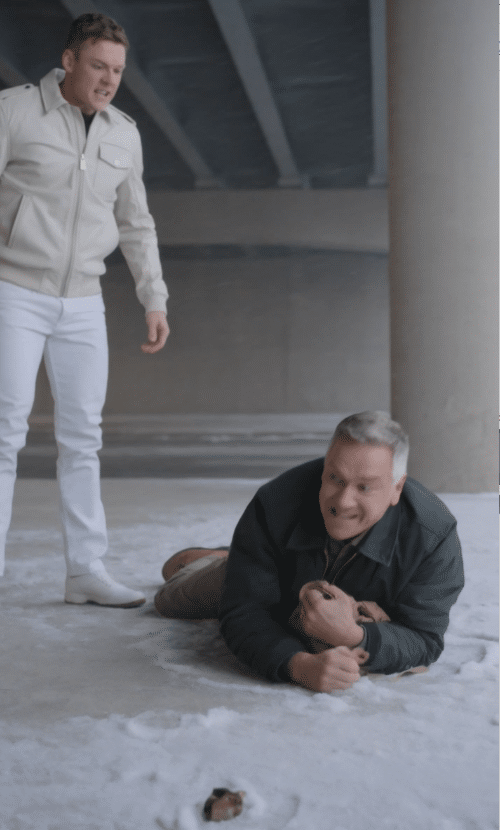
The old man had barely reached the bag when the young man in the expensive white jacket kicked it again.
The small canvas bag skidded across the snow beneath the bridge, struck a concrete column, and spilled its contents onto the frozen ground. A tarnished military insignia, two faded photographs, a cracked metal tag, and several folded scraps of paper scattered beneath the boots of the people who had gathered to watch.
“Please,” the old man whispered.
He was sixty-nine, wearing a heavy coat that had lost most of its buttons and combat boots so torn that snow had worked its way inside. His hands trembled as he bent down, not because he was afraid of the young man, but because he was desperate to collect what little remained of his past.
“These are all I brought back.”
For a moment, the young man looked at him as though he had said something funny.
Then he glanced at the smartphone held by one of his friends and smiled.
“Trash. Your war story is ruining my shot.”
A few people nearby gasped. Someone muttered that the young man should leave him alone, but no one stepped forward. The bridge swallowed their voices, leaving only the wind and the steady crunch of snow beneath expensive shoes.
The young man was twenty-three, a rising prank creator whose online persona depended on making strangers uncomfortable. His videos featured staged arguments, public embarrassments, and unsuspecting people pushed into situations they had never agreed to enter.
That night, he had decided the homeless veteran would make perfect content.
The old man had been sitting beneath the bridge to escape the worst of the wind. He had arranged his belongings beside a concrete column and kept the little bag tucked close to his body. He had asked only that the group stop filming him.
Instead, they had decided to make him the joke.
When the veteran reached for the tarnished insignia, the young man drove a boot into his back.
The old man fell face-first onto the cold concrete. His battered boots scraped across the snow, and the keepsakes scattered farther from his hands. His elbow struck the ground, leaving a thin trace of blood against his sleeve.
He sucked in a sharp breath and curled instinctively around himself, one hand still reaching toward the photograph nearest his fingers.
The young man stepped closer.
“Come on,” he said to the phone camera. “This is the part people want to see.”
Then he kicked the veteran twice more, once in the back and once in the side.
The old man grimaced, struggling to draw a full breath. His face tightened with pain, but the humiliation seemed almost worse. He looked toward the scattered objects as though the entire world had been reduced to those few inches of frozen concrete.
“Smile for the prank, soldier.”
One of the young man’s friends laughed nervously. Another lowered his phone for a moment, then raised it again when the creator shot him an irritated glance.
The witnesses had stopped pretending this was harmless entertainment. A woman covered her mouth. An older man took half a step forward, then froze when the bully turned toward him.
No one knew who would be next.
Then headlights swept across the bridge columns.
An unmarked news vehicle braked hard beside the curb, its tires cutting through slush. Before the young man could turn back to the veteran, the sliding door opened and a man in a black coat stepped into the snow.
A camera operator followed him, already lifting a professional lens.
The newcomer didn’t look at the young man first.
He went straight to the veteran.
And when he saw the scattered keepsakes, his expression changed.
“Keep the camera on him,” he said.
The words were quiet, but something in his voice made every laugh disappear.
For the first time that night, the young man in the white jacket wasn’t the person controlling the scene.
He was the person being watched.
And he had no idea who had just arrived.
Act II
The reporter’s name was David Mercer, and for nearly three decades, he had built a reputation on exposing the people who believed their money, influence, or public image placed them beyond accountability.
He had uncovered police corruption, followed public funds through shell companies, and reported on powerful executives who had quietly ruined lives while issuing carefully polished statements about their values.
His investigations had earned him national recognition, a loyal audience, and more enemies than he cared to count.
But David had never believed the most important stories were necessarily the ones involving politicians or billion-dollar scandals. Sometimes, he said, the most revealing story in a city was the one everyone had learned to walk past.
That belief had brought him beneath the bridge that night.
His team had been investigating the growing number of homeless veterans sleeping in makeshift camps around the city. David had spent the afternoon interviewing outreach workers and reviewing complaints about shelters that were turning people away during severe weather.
He had not expected to witness an assault.
He certainly had not expected the victim to be a man whose face he recognized.
The veteran was named Samuel Reed.
Twenty-seven years earlier, David had met Samuel during a local memorial ceremony honoring service members who had returned home carrying injuries that were not always visible. Samuel had been younger then, broad-shouldered and uncomfortable with attention, standing near the back of the crowd in a clean uniform.
He had spoken briefly about the men he had served with. He had refused to describe himself as a hero.
“The ones who deserve that word,” Samuel had told David, “aren’t always the ones who get to come home.”
David had remembered the sentence long after the interview ended.
He had tried to contact Samuel years later for a follow-up story, only to discover that the man’s address was no longer valid. Messages went unanswered. A former military contact said Samuel had withdrawn from public life after several difficult losses.
Eventually, David had assumed the veteran simply wanted privacy.
Now Samuel was lying beneath a bridge, trying to gather pieces of his life while strangers filmed him being kicked.
David crouched beside him.
“Mr. Reed, it’s David Mercer. Can you hear me?”
Samuel’s eyes moved toward him. Recognition came slowly, obscured by pain and disbelief.
“David?”
“I’m here. Don’t try to get up yet.”
David removed his own coat and placed it around Samuel’s shoulders. He asked the camera operator to capture the scattered belongings without crowding the veteran, then called for emergency medical assistance.
Samuel immediately reached for the nearest photograph.
“Please. That one.”
David picked it up carefully.
The image showed a group of young soldiers standing beside a transport vehicle, their faces sunburned and exhausted. One had an arm around Samuel’s shoulders. Another was holding up a battered tin cup, grinning at whoever had taken the picture.
On the back, someone had written six names in faded blue ink.
David recognized none of them.
Samuel, however, looked at the photograph as if he were looking through a window into another life.
“I can’t lose them,” he murmured.
“You haven’t lost them,” David replied.
Samuel shook his head.
“You don’t understand.”
He tried to sit up, winced, and pressed a hand against his ribs. David steadied him without forcing him to move.
“That bag is all I have left of them,” Samuel said. “Everything else is gone.”
Behind them, the young creator had begun backing away from the scene. His friends followed, avoiding David’s eyes and whispering urgently among themselves.
The camera operator kept filming.
David didn’t chase them. He didn’t need to.
The young man’s face, his clothing, his companions, and the sequence of the assault had already been recorded. So had the moment when Samuel begged him to stop.
And unlike the creator’s prank videos, this footage had not been edited to make cruelty look entertaining.
When emergency responders arrived, David gave them room to examine Samuel. He helped retrieve the keepsakes, placing each item in a clean evidence bag so the fragile papers would not be damaged further.
There was something unusual about the metal tag.
It wasn’t a standard military identification tag. It was an old unit marker, worn smooth along one edge, with a series of numbers stamped into its surface.
David turned it over.
The numbers were faint, but still legible.
He looked at Samuel.
“Where did you get this?”
Samuel’s expression changed.
For the first time since the attack, his fear gave way to something more complicated.
“From a man who never made it home,” he answered.
Then he closed his eyes.
And David realized the assault beneath the bridge had exposed a story far older than the young man’s cruelty.
Act III
Samuel was taken to the hospital, where doctors examined his injuries and kept him under observation. His condition was serious enough to require care, but he remained conscious and repeatedly asked whether his belongings had been recovered.
David assured him they had.
He also made a promise.
“I won’t publish anything about your military history without speaking to you first,” he said. “But what happened tonight cannot simply disappear.”
Samuel stared at the ceiling.
“People see what they want to see,” he replied. “A man sleeping under a bridge. A dirty coat. A bag of junk. They decide the rest before you open your mouth.”
David had no easy answer.
The next morning, he returned with coffee and a clean pair of boots purchased through a local veteran outreach organization. Samuel accepted the coffee but looked uncomfortable when David mentioned the boots.
“I didn’t ask anyone to rescue me.”
“I know.”
“I don’t want a charity story.”
“Then it won’t be a charity story.”
Samuel studied him for a long moment, searching for the familiar expression of someone preparing to turn another person’s suffering into a headline.
“What kind of story will it be?”
“The truth,” David said. “Starting with the man who thought he could hurt you for entertainment.”
Samuel looked away.
“The truth is a dangerous thing when you don’t have much left to protect yourself with.”
David understood the warning. His reporting had taught him that people who had suffered in silence often had reasons for doing so. Sometimes those reasons were shame. Sometimes they were exhaustion. And sometimes they were protecting someone else’s memory.
He waited.
Eventually, Samuel told him about the men in the photograph.
During his military service, Samuel had worked with a small transport and recovery team responsible for moving injured personnel away from dangerous areas. Their work was rarely glamorous. They carried stretchers, repaired damaged equipment, searched for missing men, and returned to places other people were desperate to leave.
Samuel remembered the names, the jokes, and the arguments over terrible coffee.
He remembered a young medic named Thomas Bell who always carried extra bandages, even when supplies were short. He remembered Corporal James Ellis, who wrote letters home for men who struggled to find the right words. He remembered a quiet driver named Peter Lawson who had once turned back through dangerous terrain because he refused to leave another soldier behind.
Samuel had survived the operation that scattered their team.
Some of the men had returned home. Others had died. One had disappeared during the confusion of an evacuation, leaving behind no confirmed account of what had happened to him.
Samuel had spent years trying to establish what became of that man.
The military records were incomplete. Names had been entered incorrectly, documents had gone missing, and the official account of the operation had been revised more than once. Samuel wrote letters, contacted former units, and searched public archives, but every promising lead eventually ended at another locked door.
Then his wife became ill.
Samuel put the search aside to care for her. After she died, the apartment they had shared became impossible to maintain on his limited income. Medical bills, missed payments, and a dispute over his lease pushed him from one temporary arrangement to another.
By the time he finally found himself beneath the bridge, the box containing his letters and documents had been lost during a move.
The small canvas bag was all he had managed to save.
“I kept telling myself I’d find the rest,” he said. “Then I realized the rest might be gone forever.”
David listened without interrupting.
When Samuel finished, he brought out the photograph and the metal marker.
The number stamped into the tag matched a reference in an old military archive David’s researcher located later that afternoon. It belonged to a transport unit involved in a poorly documented evacuation decades earlier.
More surprising, one of the names connected to the unit appeared in a collection of records that had never been fully reconciled with the official casualty list.
The missing man was Thomas Bell.
His family had spent years believing he had been killed during the evacuation. Yet the surviving documents suggested that Thomas might have been moved through a temporary medical station before his final status was recorded.
Someone had signed for his transfer.
The signature was incomplete, but a copy of the document survived in a private archive maintained by a retired military historian.
David contacted the historian.
Then he made a discovery that changed the entire investigation.
The retired historian had been trying to identify the same missing record for years. And he believed the one person who could explain the discrepancy was Samuel Reed.
Not because Samuel was a famous officer.
Not because he had held a high rank.
But because he had been there.
There was one more complication. A veteran who had once worked beside Samuel had publicly disputed the official account, claiming that paperwork had been altered after the evacuation. His allegation had never been substantiated, and he had died before anyone could properly investigate it.
The surviving record bore the initials of an administrator who later became a senior figure in a private defense contractor.
The contractor had spent years promoting its history of military service and public responsibility.
Its archived documents, however, told a less comfortable story.
David could not yet prove deliberate wrongdoing. A missing signature was not proof of a cover-up, and a contradictory record was not proof of fraud.
But he now had a witness, a surviving marker, and a paper trail that led somewhere powerful.
The prank creator had wanted a few thousand views.
Without knowing it, he had put a camera on the first scene of an investigation that could reach far beyond his own humiliation.
And David Mercer was beginning to understand why Samuel had guarded that little bag as if it contained the last piece of the world.
Act IV
By the time the young creator woke the following morning, a short clip from beneath the bridge was spreading across social media.
The video showed his white jacket, his smirk, and his boot striking the veteran’s bag. Another angle captured the assault itself, followed by the arrival of the news vehicle.
The final moments were the ones people watched repeatedly.
The camera remained on the creator as David’s voice came from outside the frame.
“Keep the camera on him.”
For a few seconds, the young man appeared confused. Then his confidence collapsed.
“How long have you been recording?”
The question was no longer a punchline.
It sounded like a man discovering that the world had finally seen him clearly.
His name was Tyler Grant. He had built a modest online following by pushing the boundaries of public pranks, but the response to the footage was unlike anything he had experienced.
People who had previously shared his videos began asking whether his other encounters had been staged. Former collaborators distanced themselves. A sponsor suspended a planned promotion while reviewing the footage, and the platform received a flood of complaints.
Tyler’s first response was to claim the incident had been misunderstood.
He said the veteran had been part of a prank. He suggested that the kicks had looked worse on camera. He insisted that his intention had been to create an entertaining moment, not to cause serious harm.
But the footage contained no agreement, no staged reaction, and no moment when Samuel had consented to be involved.
It showed an old man trying to recover his belongings.
It showed Tyler attacking him.
And it showed Tyler continuing after the witnesses had begun to recoil.
David’s report did not rely on insults or speculation. It included the original footage, statements from witnesses, and confirmation that Samuel was receiving medical care. It also explained the broader problem facing veterans who had fallen into homelessness and the gaps that often separated military service from long-term support.
The report did not identify Samuel’s private medical details or portray him as helpless. Instead, it gave him room to explain his own life in his own words.
When the broadcast aired, the public response shifted from outrage over one assault to questions about the systems that had allowed Samuel to disappear from view.
But David’s investigation was moving in a different direction.
The historian’s archive contained copies of transfer records, unit correspondence, and an old letter written by Thomas Bell. The letter had been sent to a military office shortly after the evacuation, but no surviving document confirmed that it had reached its intended destination.
A reference number on the letter matched the metal marker from Samuel’s bag.
The historian believed the documents could help establish what had happened to Thomas after he was separated from his team. David arranged for an independent military records specialist to examine them, ensuring that no single interpretation was treated as established fact.
The specialist found that the official timeline contained a gap.
The transfer document listed Thomas as arriving at a temporary medical station, but the final casualty record treated him as missing from the moment of the evacuation. The two records had never been reconciled.
A faded notation in the margin referred to a second register.
That register was missing from the public archive.
David’s team tracked down a retired records clerk who had worked with a related collection decades earlier. The clerk remembered a box of unindexed documents transferred during an administrative consolidation. He did not know what had happened to it afterward, but he remembered the receiving institution.
It was a private foundation connected to the same defense contractor whose former executive had signed the disputed paperwork.
The discovery was not proof that the contractor had concealed Thomas Bell’s fate. It was, however, enough to justify a formal request for access to the foundation’s records.
The foundation declined to comment.
Then, two days later, it announced that it had begun reviewing its historical archive.
David knew what that meant. Someone had realized the old documents might no longer remain buried.
Meanwhile, Tyler’s attempts to control the narrative were failing. Witnesses came forward with their own accounts of the assault, and investigators began reviewing the available evidence. The question of legal responsibility would be determined through the appropriate process, but the footage had made one thing impossible to deny: the attack had happened.
Tyler’s friends, who had laughed beneath the bridge, were now being asked why they had stood by.
One of them eventually contacted David’s newsroom.
He claimed Tyler had chosen Samuel specifically because he appeared isolated and unlikely to fight back. The group had expected the veteran to shout or leave. Tyler had wanted a reaction that could be edited into a viral clip.
When Samuel tried to protect the bag, Tyler became angrier because the old man was not behaving the way he wanted.
The friend provided messages sent before the group arrived beneath the bridge.
They showed that the encounter had been planned.
Tyler had not simply lost his temper in an unpredictable moment. He had selected a vulnerable stranger and intended to make him the centerpiece of a public humiliation.
The messages became part of the investigation, subject to verification and the authorities’ review.
For David, they confirmed the moral truth of what the camera had captured. The veteran had never been a willing participant. His pain had been the point.
But the more important revelation was still waiting inside the missing records.
When the private foundation finally agreed to cooperate with an independent archival review, one box arrived at the historian’s office.
Inside was a second register.
And on a page yellowed by time was the name everyone had been searching for.
Thomas Bell.
Act V
The register did not solve every mystery, but it changed the story.
Thomas Bell had been transferred to a medical station after the evacuation. A later notation indicated that he had been moved again, this time to a facility operating under a different administrative command.
The trail grew thin after that.
There was no single document that established every detail of his final days, and the investigators refused to turn uncertainty into a convenient conclusion. But the newly recovered records proved that the original account was incomplete.
For the first time in decades, Thomas’s family had a credible lead about what had happened to him after he disappeared from the unit’s records.
The foundation commissioned an independent review of the archive. The defense contractor announced that it would cooperate with the examination and make relevant historical documents available to qualified researchers. Whether the inconsistencies resulted from negligence, administrative failure, or something more deliberate remained a question for the review.
David reported the findings carefully.
He did not call Samuel a miracle witness or promise a revelation the documents could not support. He showed how one battered object, kept by a man most of the city had stopped noticing, had helped reopen a chapter of military history that deserved a proper accounting.
The story was no longer about a prank creator’s downfall.
It was about a missing soldier, a family left without answers, and a veteran who had carried their memory long after the official records had failed them.
Samuel watched the broadcast from a small room at a transitional housing center. The outreach organization had helped him secure temporary accommodation while social workers assisted with his benefits, medical follow-up, and longer-term housing options.
The room was simple. It had a narrow bed, a small table, a radiator that clicked whenever it warmed, and a window facing a quiet street.
But the door locked.
For the first time in months, Samuel could sleep without listening for footsteps approaching his belongings.
His keepsakes rested on the table beside him, each one carefully cleaned and placed in a protective sleeve. The photograph of his old unit had been restored by an archivist, who preserved the faded faces rather than attempting to make them look new.
Samuel insisted on keeping the original.
“It’s supposed to look old,” he explained. “That’s how I remember it.”
A week later, David brought him an envelope.
Inside was a letter from Thomas Bell’s grandson, Michael.
Michael had read the report and recognized his grandfather’s name. His family had grown up with only fragments of the story: a young man who left for service, a brief message about a missing transfer, and years of unanswered inquiries.
He had never expected to hear from someone who had served beside Thomas.
Samuel read the letter twice.
Then he placed it on the table and sat very still.
“His family kept looking,” he whispered.
David nodded.
“So did you.”
Samuel pressed his thumb against the edge of the photograph. For years, he had believed that losing his home and documents meant he had failed the men he remembered. He had carried that shame quietly, as though the passage of time had turned their unfinished story into a debt he could never repay.
Now, a member of Thomas’s family knew that someone had remembered him.
Michael asked to meet.
They arranged the meeting at a small military history museum, where an archivist had offered to display the photograph and explain the recovered records. Samuel arrived in clean clothes and the new boots, carrying the same canvas bag that had been kicked into the snow beneath the bridge.
He paused at the entrance.
“I haven’t been in a place like this for a long time,” he admitted.
David walked beside him.
“You belong here.”
Samuel didn’t answer immediately. Then he lifted his chin and stepped inside.
Michael was waiting near a display case. He was in his forties, with a solemn expression and a photograph of his grandfather tucked into a folder beneath his arm.
When Samuel approached, Michael did not reach for a handshake immediately. He seemed to understand that this was not an ordinary introduction.
“My family has been trying to find out what happened to him for most of my life,” he said.
Samuel swallowed.
“I wish I had more answers.”
Michael looked at the old photograph in Samuel’s hands.
“You remembered his name. That’s more than we had.”
The words broke through the last of Samuel’s composure.
He turned away, pressed the photograph against his chest, and wept—not with the desperate shame he had felt beneath the bridge, but with the exhaustion of someone who had spent decades carrying a weight alone.
Michael stood beside him until he was ready to speak.
They spent the afternoon comparing family photographs and reading the names in the recovered records. The museum’s archivist explained which details had been confirmed and which remained uncertain. Samuel supplied memories that no document could preserve: Thomas’s terrible singing, his habit of saving the last piece of chocolate for someone else, and the way he always checked that everyone had been counted before a vehicle moved out.
Those details would never appear in a military ledger.
But now they would be recorded somewhere.
The museum announced a new exhibit devoted to the transport and recovery teams whose work had been overlooked in the original historical accounts. Samuel was invited to help identify the men in the photograph and review the captions before the exhibit opened.
He did not become a celebrity. He did not suddenly recover every possession he had lost or erase the years of hardship that had brought him beneath the bridge.
What changed was more modest—and more meaningful.
He was given a safe place to live while his housing case continued. His medical needs were being addressed. He had people who called to ask how he was doing, not because they needed footage or a dramatic quote, but because they wanted him to be there the next time they visited.
And the men whose names he had carried were no longer merely ghosts in a fading photograph.
Their service was being examined, their records corrected where the evidence supported it, and their families were finally being invited into a history that had too long left them outside.
As for Tyler Grant, the consequences continued after the online outrage moved on to other stories. His sponsors did not restore the suspended campaign, and the incident remained part of the public record as the legal process proceeded. The footage would not allow him to recast the assault as a misunderstanding, though what accountability ultimately required would be determined through the appropriate channels.
Months later, Samuel returned to the bridge with David.
The snow was gone. Traffic thundered overhead, and sunlight fell between the concrete columns. The place looked ordinary again, almost unremarkable—the kind of location people passed every day without thinking about who might be sheltering there.
Samuel stood for a long moment, holding the canvas bag.
Then he looked at David.
“I used to think those were the last things I had,” he said.
David glanced at the bag.
“The keepsakes?”
Samuel shook his head.
“The proof.”
He opened the bag and took out the restored photograph. The faces were still faded, the corners still worn, and the names on the back still written in the same uneven blue ink.
“I thought if I lost this, nobody would remember them.”
David waited.
Samuel looked toward the street, where strangers moved past one another without stopping.
“But they weren’t waiting for a bag to remember them,” he continued. “They were waiting for someone to tell the truth.”
For years, people had looked at Samuel and seen only a homeless man beneath a bridge. Tyler had seen a prop for a prank. The witnesses had seen a frightening scene and hoped someone else would intervene. Even the official records had reduced the men Samuel remembered to incomplete entries and unanswered questions.
But a camera had captured the cruelty that night—and, because David Mercer had chosen to keep filming, it had also captured the moment the cruelty stopped being invisible.
The young man had wanted the world to laugh at an old veteran.
Instead, the world had been forced to look.
Samuel placed the photograph back in his bag and zipped it shut. Then he turned away from the bridge and walked toward the street, his steps slow but steady.
He was not leaving his past behind.
He was finally carrying it somewhere it could be remembered.
And for the first time in a very long time, the man who had once begged strangers not to destroy the last pieces of his life no longer had to beg anyone to see his worth.