Act I
The newspaper bag hit the puddle first.
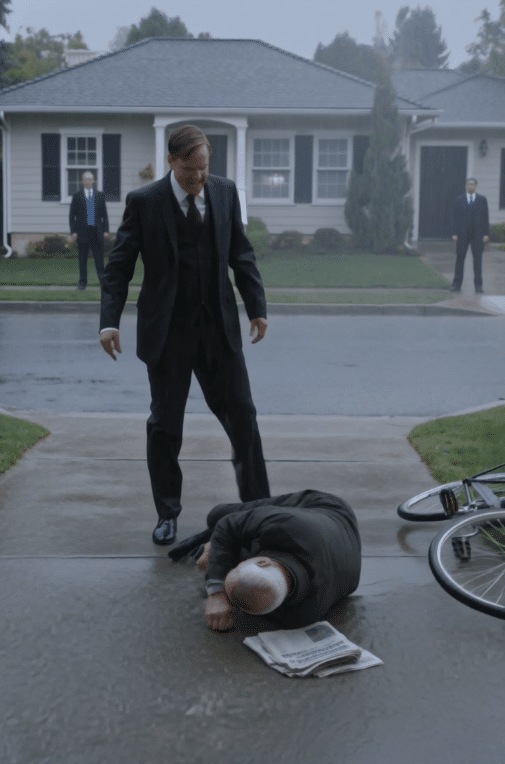
The wealthy homeowner hurled it off the driveway with enough force to send wet newspapers sliding across the rain-soaked pavement. Headlines blurred beneath the water. Bundles came apart. The old bicycle beside them tipped sideways, its front wheel spinning uselessly in the predawn darkness.
The seventy-one-year-old man standing beside it stared at the mess.
“Sir, please. I delivered every house before dawn.”
He wore an old yellow raincoat, a gray knit cap, and boots so worn that water had seeped through the soles. One sleeve of his coat hung empty where his left arm had been lost during military service. His remaining hand trembled as he reached for the newspapers he had spent hours delivering through the storm.
The homeowner, a forty-six-year-old man named Gregory Whitmore, stood beneath the overhang of his enormous house in an expensive robe. His hair was perfectly arranged, his slippers untouched by the puddles, and his expression suggested that the rain itself had personally offended him.
“My paper is soaked!” Gregory shouted. “Do you have any idea what I pay for this service?”
The veteran tried to explain that the rain had intensified just before he reached the property. He had covered the newspapers as best he could, but the wind had torn open the protective flap on his delivery bag.
Gregory wasn’t interested.
He had spent years believing that money entitled him to immediate obedience. He expected his neighbors to admire his house, his guests to praise his success, and every person who entered his driveway to understand that their time mattered less than his comfort.
The old delivery worker was simply another person he believed he could order around.
“Trash. Even your papers are useless.”
The veteran lowered his eyes and reached for the nearest bundle.
Then Gregory kicked him hard in the chest.
The old man fell backward beside the bicycle, striking the wet driveway with a startled gasp. His elbow scraped against the concrete, leaving a thin trace of blood beneath his soaked sleeve. The bicycle rattled against the pavement, and the front wheel spun as loose newspapers floated through the puddles.
For a moment, the veteran couldn’t seem to understand what had happened.
Then he tried to sit up.
His face tightened with pain. He drew a shallow breath and reached toward the papers with his one remaining hand, desperately trying to keep them from washing toward the street.
Gregory stepped closer.
Instead of backing away, he kicked the fallen man twice more, striking his back and side as the veteran curled instinctively to protect himself.
A neighbor watching from behind a partly opened curtain gasped. Another resident stepped onto a porch, then froze at the sight of Gregory standing over the old man.
Nobody had expected a complaint about a wet newspaper to become this.
The veteran’s cap had fallen into a puddle. Rain ran down his face, mixing with the tears he was trying not to shed. He looked at the scattered papers, then at the bicycle that had carried him through countless cold mornings.
“I did everything I could,” he whispered.
Gregory gave a bitter laugh.
“Find work you can do with one arm.”
The words seemed to hurt the veteran more deeply than the rain or the blows. He had heard variations of that sentence before, from people who saw his missing arm before they saw the person who remained.
He had learned to swallow his anger, keep his head down, and finish the job.
But he had never expected to be attacked for doing it.
Then headlights swept across the driveway.
A black sedan braked hard at the curb, sending water spraying beneath its tires. The rear door opened, and a tall man in a long black coat stepped into the storm.
He looked first at the veteran on the ground.
Then at the newspapers floating through the puddles.
The man’s face tightened.
He crossed the driveway, removed his coat, and draped it over the old man’s shoulders while his driver moved between Gregory and the fallen veteran.
“Don’t come any closer,” the driver warned.
Gregory stopped, visibly offended by the interruption.
The newcomer crouched beside the delivery worker.
“Can you hear me? What’s your name?”
“Frank,” the veteran answered weakly. “Frank Miller.”
The man nodded to his driver, who immediately called for medical assistance.
Then he rose, turned toward Gregory’s house, and spoke with a calmness that made the neighbors fall silent.
“Print his story on the front page.”
Gregory blinked.
The man in the black coat had not threatened to call the police. He had not shouted about revenge. He had simply issued an instruction that sounded less like a suggestion than the beginning of a decision already made.
Gregory looked at the black sedan, then at the driver standing between him and Frank.
He recognized the face of the man in the coat.
Everyone who read the local newspaper recognized it.
It belonged to Martin Hale, the sixty-two-year-old owner of the newspaper Gregory had just complained about.
And Gregory was about to discover that the man whose paper he considered worthless had the power to tell a story he could not buy his way out of.
Act II
Martin Hale had not become one of the wealthiest men in the region by inheriting a newspaper empire.
He had started as a junior reporter at a struggling local publication, working overnight shifts and writing stories about school board disputes, factory closures, and families fighting to keep their homes. He knew the unglamorous details of a community: which streets flooded every winter, which hospitals were understaffed, and which families quietly went hungry while public officials congratulated themselves on economic growth.
When the newspaper nearly collapsed, Martin helped rebuild it. He invested in its reporting staff, expanded its investigations team, and refused several lucrative offers to turn the publication into a mouthpiece for wealthy advertisers.
Over time, the newspaper became one of the region’s most respected independent news organizations.
Martin could have moved into national media, but he remained local because he believed the stories closest to home were often the ones most likely to be ignored.
He had been driving through the suburb that morning after an early meeting with his editor. The rain was severe, and he had noticed a lone cyclist delivering newspapers along the road.
At first, the sight had seemed ordinary.
Then he saw the homeowner throw the delivery bag into the puddle.
His driver had barely stopped the car before Martin witnessed the attack.
Now, standing beside Frank Miller, Martin felt a familiar anger rise beneath his calm exterior. It wasn’t only anger at Gregory’s violence. It was anger at the ease with which the man had decided that another person’s labor, body, and dignity were disposable.
Martin had seen that attitude in corporate boardrooms and political offices. He had watched powerful people describe workers as expenses, elderly residents as burdens, and struggling families as unfortunate statistics.
Gregory had expressed the same belief in the middle of his driveway.
He simply hadn’t expected anyone important to be watching.
As paramedics arrived, Martin stayed beside Frank while they assessed his injuries. The veteran tried repeatedly to apologize for the mess, explaining that he would need to collect the undamaged papers before the morning deliveries were considered complete.
Martin shook his head.
“You’re not going back out in this weather.”
“But the houses on the next street—”
“Someone else can handle the route.”
Frank looked uncomfortable.
“I don’t want to lose the job.”
That sentence revealed more than Martin expected.
Frank wasn’t simply a retired veteran doing occasional work to fill his mornings. He depended on the delivery income to pay for groceries, utilities, and the small room he rented on the other side of town.
His military pension covered some expenses, but not enough to provide security. Medical costs had increased as he grew older, and his limited mobility made many jobs difficult to obtain. Newspaper delivery had offered him something he valued as much as the money: a reason to get up before dawn and feel useful.
He had lost his left arm during a deployment decades earlier. After returning home, he had tried several jobs, only to discover that employers often praised his service before quietly deciding he was too much trouble to accommodate.
For years, Frank had refused to let that define him.
He learned to balance bundles with one hand, secure the bag to his bicycle, and memorize the route so thoroughly that he could deliver papers in the dark without stopping to check addresses.
He rarely complained.
When the weather turned bad, he simply started earlier.
Martin listened as Frank explained that the delivery company had recently reduced its staffing. Older workers who could still manage their routes had been encouraged to keep working, but there was little flexibility when equipment failed or conditions became dangerous.
Frank had taken extra deliveries to cover for a younger coworker who was recovering from surgery. He had not wanted to leave anyone else struggling.
And he had been determined to finish before sunrise.
Martin glanced toward the ruined newspapers.
“You did your job,” he said. “The rain wasn’t your fault.”
Frank’s eyes moved to the driveway.
“I know that in my head.”
He paused.
“It’s just hard to remember when someone talks to you like you’re nothing.”
Martin didn’t answer immediately.
He had heard the sentence before, but rarely from someone who was still apologizing for being hurt.
Across the driveway, Gregory was pacing beneath the overhang, insisting to his wife that the incident was being exaggerated. He claimed the veteran had been careless, that the newspapers were unacceptable, and that Martin was turning a private disagreement into a spectacle.
He seemed genuinely unable to understand why anyone would object to his behavior.
Martin’s driver returned from speaking with the paramedics.
“Frank is going to be checked out,” he reported. “They’ve also taken statements from the neighbors.”
Martin nodded.
Then he turned toward his editor, who had answered his call and was listening from the other end of the phone.
“I want the original photographs preserved,” Martin said. “Get a reporter to verify the details. Speak to the witnesses. Find out who employs Frank and what happened here.”
He paused, looking at the veteran beneath his coat.
“And make sure he gets to tell his own story.”
The editor agreed.
Gregory overheard enough to realize that the incident would not disappear with the rain. He stepped forward, his expression shifting from outrage to a forced smile.
“Mr. Hale, surely we can resolve this privately.”
Martin turned toward him.
For the first time, Gregory seemed to understand that the newspaper owner wasn’t simply an influential man passing through the neighborhood.
He was the person who had just witnessed the assault.
And he had no intention of allowing Gregory to dictate how it would be remembered.
Act III
By late morning, the rain had eased, but the story had already begun to take shape.
Martin’s newsroom verified the sequence of events with the neighbors who had witnessed the attack. His driver provided a statement, and the team preserved the available photographs and recordings. The newsroom contacted the delivery company to confirm Frank’s employment and obtain its account of the damaged newspapers.
Martin insisted on a distinction that frustrated several people around him.
The article would not be a revenge piece.
It would not exaggerate Frank’s injuries, speculate about Gregory’s motives beyond the evidence, or portray the veteran as a helpless symbol. It would explain what happened, identify the people involved when legally appropriate, and give Frank space to describe the circumstances that had brought him to that driveway.
Most importantly, it would investigate why a man who had served his country was still forced to work a physically demanding job in dangerous weather simply to keep his life afloat.
When a reporter interviewed Frank later that afternoon, he answered questions carefully. He didn’t call Gregory a monster. He didn’t demand that the newspaper destroy the man’s reputation.
He spoke about his route.
He spoke about the customers who left porch lights on for him during winter mornings, and the woman who sometimes placed a thermos of coffee near her mailbox when the temperature fell below freezing. He described how he had learned to handle the bicycle with one arm and how he measured each morning by the number of houses remaining on his list.
When asked about the attack, he fell silent.
“I didn’t understand it at first,” he finally said. “I thought maybe he wanted me to move the bag. Then he kicked me.”
The reporter waited.
“I’ve been shouted at before. People complain when their papers are late or wet. That’s part of the job. But I didn’t think he could look at me on the ground and still want to hurt me.”
The interviewer’s expression tightened.
“What did you think when he told you to find work you could do with one arm?”
Frank looked down at his hands.
“I thought about all the jobs I tried before this one.”
He took a breath.
“I thought about how many times someone said they respected veterans, then found a reason not to hire me. And I wondered whether I’d spent all these years trying to prove something to people who had already decided I couldn’t.”
The newsroom fell quiet.
Martin, listening to the recorded interview in his office, removed his glasses and rubbed his eyes.
He had expected a story about cruelty. He had not expected Frank to reveal how much of his life had been shaped by smaller, quieter humiliations that had never made the news.
The investigation uncovered another troubling detail.
Frank’s delivery company had received complaints about unsafe equipment and inadequate weather protection. Several workers had asked for better bags and more flexible routes during severe storms. The company had made some changes, but older contractors remained responsible for much of their own equipment.
The company denied that its policies had contributed to the driveway incident. That was fair as far as the direct assault was concerned: Gregory had chosen to attack Frank, and responsibility for that choice belonged to him.
But the working conditions raised a separate question.
How many people like Frank were expected to absorb the risks of a job because they had few alternatives?
Martin instructed his team to examine the issue independently of Gregory’s conduct. They contacted labor advocates, veterans’ support groups, and other delivery workers. Their reporting found that some older contractors were struggling to balance fixed routes, unpredictable weather, and limited access to affordable transportation.
Frank’s story had opened a door to a broader investigation.
Then Martin received a call from the newspaper’s commercial director.
Gregory Whitmore was not just a wealthy homeowner. He was a major advertiser through his real estate development company, which had purchased prominent advertising space in several local publications. His company also sponsored community events and had recently discussed a long-term advertising agreement with the newspaper.
The commercial director did not directly ask Martin to suppress the story.
He didn’t need to.
He spoke about the value of the relationship, the size of the contract, and the financial pressure facing the newspaper’s regional edition. He suggested that the incident could be handled as a private dispute and that publishing Gregory’s name might expose the organization to unnecessary complications.
Martin listened without interrupting.
When the call ended, he sat alone for several minutes.
He understood the business realities. A local newspaper could not survive on principle alone. It needed subscribers, advertisers, and enough revenue to pay the reporters who uncovered stories the public needed to hear.
But if the paper softened its reporting whenever a powerful advertiser behaved badly, what exactly was it protecting?
Its finances?
Or the people who could afford to threaten them?
Martin called the editor back.
“Verify every detail,” he said. “Give Gregory an opportunity to respond. Don’t print anything we can’t support.”
“And the commercial agreement?”
“Keep it out of the newsroom.”
He looked through the rain-streaked window toward the street where his sedan had stopped that morning.
“Print the story because it’s true. Not because it will hurt him.”
There was one more discovery waiting in the reporting file.
A neighbor had supplied a photograph taken months earlier, showing Frank standing beside his bicycle after delivering a replacement newspaper to the same house. The homeowner had left a note on the porch complaining that the paper had arrived late.
The image did not prove a pattern of violence, and the newsroom would not present it as one. But the note helped establish that Gregory had complained about Frank’s deliveries before.
When the reporter contacted Gregory for comment, he refused to discuss the assault in detail. He insisted that the newspaper was trying to exploit a misunderstanding and warned that he would take action if the coverage damaged his business.
Martin read the response twice.
Then he made a decision that would cost the newspaper a valuable advertiser.
The front page would not be an accusation dressed up as a headline.
It would be a carefully verified account of what happened on the driveway, accompanied by Frank’s own words and a separate examination of the working conditions that had kept him delivering papers through the storm.
The story would be published whether Gregory liked it or not.
But before the presses rolled, Martin wanted to speak with Frank one more time.
Because the man who had been humiliated in the rain deserved to know that his story would not be used without his consent.
And what Frank asked for next surprised him.
Act IV
Frank did not ask Martin to ruin Gregory.
He didn’t ask for a large payment, a television appearance, or a public apology delivered beneath flashing cameras. When Martin explained the planned article and asked whether Frank was comfortable being identified, the veteran thought for a long time.
“Will people read it and just feel sorry for me?” he asked.
Martin answered honestly.
“Some might.”
Frank looked toward the window.
“Then I don’t want that to be the whole story.”
He explained that he had never wanted people to treat him as extraordinary simply because he had lost an arm. He had wanted a fair chance to work, a safe way to earn money, and the freedom to do a job without being treated as less of a person.
“If you write about me,” he said, “tell them I was trying to finish my route. I wasn’t asking that man for anything.”
Martin nodded.
“I will.”
Frank hesitated, then added something else.
“Tell them about the other workers, too. The ones who can’t afford to stop when the weather gets bad. The ones who keep going because the bills don’t stop.”
That became the center of the story.
The article opened with the attack, but it did not end with Gregory’s cruelty. It followed Frank through his predawn route, documented the realities of his work, and examined the gap between public praise for veterans and the practical support available to those struggling after service.
The reporting team verified the details and included Gregory’s response. It also made clear that the broader labor concerns were separate from the evidence establishing what had happened in the driveway.
The front page carried a photograph of Frank standing beside his old bicycle, his yellow raincoat hanging from his shoulders.
The headline was direct:
HE DELIVERED EVERY HOUSE BEFORE DAWN. ONE HOMEOWNER REPAID HIM WITH VIOLENCE.
Below it, the article explained that Frank had been attacked after delivering a newspaper that became soaked in heavy rain. Witness accounts described Gregory throwing the delivery bag into a puddle and kicking the veteran while he attempted to recover the papers.
The story included Frank’s account in his own words.
It also documented his service, his work history, and the obstacles he had faced while trying to remain financially independent.
The article went to press before sunrise the following day.
By breakfast, copies were being picked up from newspaper boxes across the city. The digital version spread even faster, shared by veterans’ organizations, neighborhood groups, and readers who recognized something familiar in Frank’s quiet determination.
The response was not simply anger at Gregory.
People wanted to know how they could support Frank without turning him into a spectacle. Others asked about the delivery company’s weather policies and the availability of employment support for disabled veterans.
A local veterans’ organization contacted Frank with an offer to review his benefits and housing situation. Another group offered to help him replace his damaged bicycle and acquire equipment better suited to deliveries in severe weather.
Martin made sure the assistance was coordinated through the organizations rather than arranged as a publicity event.
Frank accepted practical help but declined several invitations to appear on television. He was grateful for the attention, yet uncomfortable with the idea that he should spend his remaining energy explaining why he deserved basic respect.
“I’ve told the story once,” he said. “I don’t need to keep proving it happened.”
Martin understood.
Meanwhile, Gregory’s world began to change.
The article reached his business partners before his morning meetings began. Several contacted him for an explanation. One local organization reviewed his role as a sponsor, while his real estate company received questions from clients who wanted to know whether the incident reflected his conduct outside the workplace.
The newspaper’s commercial agreement with Gregory’s company was suspended pending a review, and the commercial team made it clear that editorial coverage would not be withdrawn in exchange for advertising revenue.
Gregory responded with anger.
He accused Martin of using the newspaper to settle a personal score. He threatened legal action and insisted that the article had damaged his reputation by making him look cruel.
But the reporting had been checked carefully. Witnesses stood by their accounts, and the evidence of the assault was preserved for the authorities.
The newspaper did not need to embellish the facts.
What Gregory had done was already enough.
His company eventually issued a statement acknowledging the incident and confirming that the matter was being reviewed. Gregory himself did not offer a meaningful apology to Frank, and the legal consequences would be determined through the proper process.
Martin refused to turn the newsroom into a campaign for punishment.
“We report what happened,” he told his editor. “We don’t get to decide the legal outcome.”
Still, he knew the story had changed something.
For years, Gregory had treated public reputation as another asset he could manage. He believed that if he controlled the explanation, he could control the consequences.
This time, the facts were not his to arrange.
A few days after publication, Martin returned to Frank’s small rented room. The veteran had placed the newspaper’s front page on a table beside a photograph of himself taken during his military service.
He had not framed it.
He had simply folded the paper carefully and set it aside.
Martin noticed a new bicycle leaning against the wall. The veterans’ organization had arranged for it, along with weatherproof delivery bags and equipment that would make the route safer.
“You’re going back to work?” Martin asked.
Frank smiled faintly.
“Not in this weather.”
“Good.”
“But I think I’ll keep the route when the conditions are reasonable.”
Martin sat across from him.
“You don’t owe anyone that.”
“I know,” Frank said. “That’s why I can choose it.”
For the first time since the attack, he sounded entirely at ease.
Then Frank tapped the folded newspaper.
“You printed the story.”
“We did.”
“And you told them about the other workers.”
“We did that, too.”
Frank nodded slowly.
“Then something good came out of it.”
Martin looked at him.
“Even after what happened?”
Frank’s expression grew thoughtful.
“What happened to me was wrong. I won’t pretend otherwise. But if the story makes someone think twice before treating the next person that way, then at least it didn’t end in that driveway.”
Martin said nothing.
He had come expecting gratitude, perhaps even relief. Instead, Frank had reminded him why journalism mattered in the first place.
Not because a powerful man could be embarrassed.
Because a person who had been ignored could finally be heard.
And Gregory Whitmore had not yet understood that the front page was only the beginning.
Act V
The weeks that followed brought changes neither Frank nor Martin could have arranged alone.
The delivery company revised its severe-weather procedures and began reviewing the equipment provided to contractors who worked early-morning routes. The changes were not presented as a complete solution to every problem faced by older or disabled workers, but they created a formal process for reporting unsafe conditions and requesting adjustments.
The veterans’ organization helped Frank review his benefits, medical expenses, and housing options. With its assistance, he found a more stable living arrangement and developed a plan to reduce his reliance on delivery work.
He continued working part-time for a while, but no longer felt that he had to ride through every storm to prove he was useful.
That was the difference he had wanted.
Not a life without challenges.
A life in which he had some choices.
The newspaper continued reporting on the issues raised by the case. Its follow-up articles examined the employment conditions of older delivery workers, the challenges disabled veterans faced when seeking work, and the practical differences between celebrating military service and supporting veterans after they returned home.
Martin also made sure the paper reported on the responses from local organizations and public agencies. He wanted readers to see what changed after the headlines faded, not merely what had gone wrong.
Gregory’s story continued on a different path.
The assault remained under review by the appropriate authorities, and his company’s reputation suffered as clients reconsidered their relationships with him. His threats against the newspaper produced no retraction because the paper had verified its reporting and stood behind its evidence.
Eventually, Gregory issued a public statement expressing regret for his conduct.
It was carefully worded, emphasizing that the incident had occurred during a stressful morning and that he had acted in a way he regretted. It did not erase the witnesses’ accounts, and it did not undo the harm Frank had suffered.
Frank read the statement once.
Then he folded it and placed it aside.
“Do you believe him?” Martin asked when they spoke later.
Frank considered the question.
“I don’t know what he believes.”
He glanced toward the window, where rain had begun to fall again.
“I know what he did.”
Martin nodded.
Frank had no obligation to provide Gregory with forgiveness simply because an apology had been issued. He could decide for himself whether to accept it, ignore it, or wait to see whether Gregory’s behavior changed.
For Frank, the important thing was that the truth had been documented.
He no longer needed to convince himself that the attack was somehow his fault because the papers were wet or the delivery had taken too long.
The rain had been outside his control.
The violence had been Gregory’s choice.
One clear morning, several months later, Frank rode his replacement bicycle along the same suburban street. The houses stood behind clipped hedges and wide driveways. Sprinklers clicked across lawns, and delivery trucks moved quietly through the neighborhood.
He no longer carried as many newspapers as he once had.
He had reduced his route and adjusted his hours, following advice from his doctor and the veterans’ organization. He still liked the quiet of early mornings, when the streets belonged to people who worked before the rest of the world woke up.
As he approached Gregory’s house, Frank slowed.
The driveway was empty.
For a moment, he remembered the soaked papers, the spinning bicycle wheel, and the shock of falling backward onto the concrete. He remembered Gregory’s voice telling him to find work he could do with one arm.
The memory still hurt.
But it no longer defined the entire street, or the work he had done, or the man he had become.
Frank delivered the paper to the mailbox and continued down the road.
He did not stop to look at the house again.
Later that week, Martin invited him to the newspaper’s offices. The newsroom had been preparing a special edition about the people whose work began before dawn and ended long before most residents noticed their efforts.
Frank initially declined the invitation. He didn’t consider himself a public speaker, and the idea of standing in front of a room full of reporters made him uncomfortable.
Martin assured him that no speech was required.
“You can come in, look around, and leave whenever you want.”
So Frank came.
He walked through the newsroom, past desks covered with notebooks and photographs, and stopped beside a wall displaying several front pages from the newspaper’s history.
His own story had been added to the collection.
Not as a trophy, Martin explained, and not as an example of the newspaper defeating a wealthy man. It had been included because it represented the kind of reporting the newsroom wanted to keep doing: stories that examined what happened to people who lacked the power to demand attention.
Frank looked at the page for a long time.
“That’s a strange feeling,” he admitted.
“What is?”
“Seeing your life printed like that.”
Martin waited.
Frank smiled a little.
“I spent years delivering these papers to people’s doors. I never thought I’d be the one inside one.”
A few reporters laughed softly, and Frank joined them.
The moment was small, almost ordinary. There were no flashing cameras or dramatic speeches. Nobody asked him to describe the assault again.
For once, he was allowed to be a man visiting a newsroom, not a symbol of what had happened to him.
Before he left, Martin walked him to the entrance.
“I meant what I said that morning,” Martin told him. “Your story deserved to be heard.”
Frank adjusted his gray knit cap.
“Thank you for listening.”
He paused, then added, “But don’t stop with me.”
Martin smiled.
“We won’t.”
Frank stepped outside into the clear morning air. His bicycle waited near the curb, the new delivery bag secured over the rear wheel. He placed one hand on the handlebars and looked down the street.
For years, he had measured his mornings by the number of houses still waiting for a newspaper. He had measured his value by whether he could finish the route, keep the job, and avoid becoming a burden to anyone.
Now he understood that the work had mattered, but it had never been the price of his dignity.
He had been worthy of respect before the front page.
Before Martin Hale arrived in his black sedan.
Before anyone learned that he was a veteran.
Before a single person offered to help.
Gregory Whitmore had seen a one-armed old man in a yellow raincoat and assumed he could treat him as carelessly as the wet newspaper in his hands.
Martin had seen the same man and recognized someone whose story deserved attention.
The difference was never wealth, status, or influence.
It was the choice to see another human being clearly.
Frank pushed off from the curb and rode into the morning. Sunlight caught the edge of his raincoat, and the bicycle moved steadily beneath him.
Behind him, the newspaper building stood with its presses turning and its reporters already working on the next story.
Ahead of him, the street opened into the waking city.
And for the first time in a long while, Frank Miller wasn’t riding to prove he deserved a place in the world.
He was simply going where he had chosen to go.