Act I
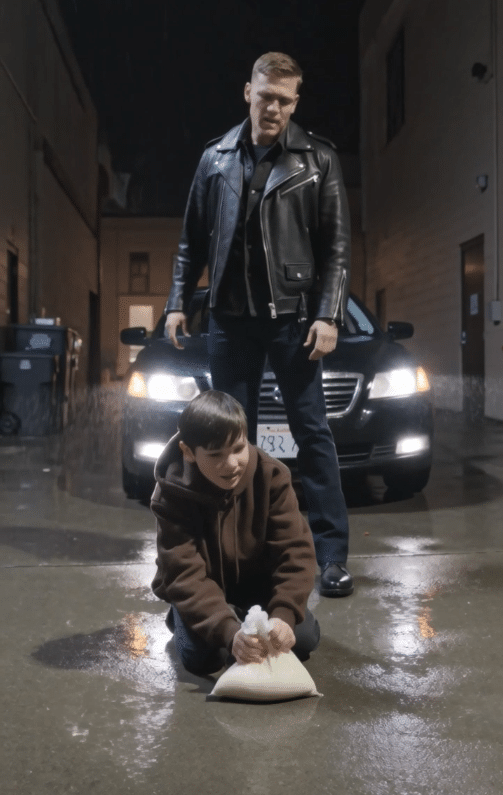
The bag of porridge hit the pavement, split at the corner, and spilled its warmth into the cold rain.
Fourteen-year-old Daniel Carter dropped to his knees, clutching the torn bag against his chest as if he could somehow save what remained. Water ran down his oversized brown hoodie. His thin jacket offered almost no protection against the weather, and his fingers trembled as he tried to gather the food before it washed into the gutter.
“Please,” he whispered. “My grandma is sick.”
The man standing over him barely glanced at the mess.
His name was Travis Cole, a thirty-four-year-old regular at the upscale restaurant whose back alley they occupied. He wore a black leather jacket, expensive sneakers, and the smug expression of someone who had rarely been told that his behavior was unacceptable.
He had seen Daniel waiting near the kitchen door and decided the boy was making the restaurant look bad.
When a kitchen worker had quietly given Daniel a bag of leftover porridge, Travis had snatched it from his hands and thrown it onto the ground.
Now, watching the boy bend over it, Travis seemed almost entertained.
“Trash,” he said. “Sick people eat trash too.”
Daniel looked up, stunned.
He wanted to explain that the porridge wasn’t for him. He wanted to tell the man that his grandmother had been burning with fever since the previous night, that she had barely touched the stale bread he had brought home earlier, and that he had promised to find something warm for her to eat.
Instead, he lowered his head and tried to rescue the bag.
Travis kicked him hard in the back.
Daniel fell face-first onto the wet concrete. The bag slipped from his arms, tearing a little farther as warm porridge mixed with rainwater. His elbow scraped the pavement, leaving a thin red mark, and for a moment he could only lie there, struggling to catch his breath.
The restaurant’s back door stood a few feet away.
Several kitchen workers had witnessed the attack through the open doorway. One covered her mouth. Another froze with a metal tray in his hands. A dishwasher took a step forward, but the manager’s sudden appearance behind the staff made everyone hesitate.
Nobody wanted to lose their job.
Travis stepped closer to Daniel.
Then he kicked him twice more, once in the back and once in the side.
Daniel curled instinctively, protecting his stomach with his arms. His face tightened with pain, and rainwater streamed across his cheeks. He looked less frightened of the man standing above him than of the thought that the food would be ruined before he could take it home.
“My grandma,” he gasped. “Please. She’s waiting for me.”
Travis leaned down just enough to make sure the boy could hear him.
“Let her wait hungry.”
The words struck harder than the kicks.
Daniel had heard cruel things before. At school, children had called him a charity case. Adults had asked why he didn’t live with a “real family.” Landlords had looked at the worn clothes he shared with his grandmother and suddenly decided their rooms were no longer available.
But he had never understood how someone could hear about a sick old woman and find the idea of her going hungry funny.
He pressed his lips together, fighting tears.
At home, his grandmother had told him that being poor was not something to be ashamed of. She had said that a person’s worth could not be measured by the clothes they wore or the money in their pockets.
Daniel wanted to believe her.
But on that rain-soaked pavement, with strangers watching and his grandmother waiting for him, it was getting harder.
Then headlights swept across the alley.
A black car braked sharply at the entrance, throwing water against the trash bins. Its rear door opened, and a tall man in a black suit and long coat stepped into the rain. The restaurant manager hurried behind him, struggling to keep up.
The newcomer didn’t look at Travis first.
He looked at Daniel.
He saw the boy on the ground, the torn bag, and the food disappearing into the gutter. His expression changed, but his voice remained controlled as he crossed the alley and crouched beside Daniel.
“Don’t try to stand yet,” he said gently. “Let someone check you first.”
He removed his coat and placed it around the boy’s shoulders.
Then he looked toward the kitchen door.
“Open the kitchen for him.”
The workers stared at him.
The manager’s face went pale.
Travis straightened, annoyed that someone had interrupted him. He was preparing to complain when he finally recognized the man standing between him and the boy.
It was Richard Bennett, the fifty-eight-year-old owner of the restaurant.
Richard didn’t raise his voice. He didn’t need to.
He remained beside Daniel, shielding him from the rain while the manager rushed to obey.
Travis stared in disbelief.
“For him?”
Richard turned his head slowly.
And the look on his face made it clear that the ruined bag of porridge was about to become the least of Travis Cole’s problems.
Act II
Daniel had learned to recognize the sound of an empty stomach before he learned to understand why some people had so much food that they could throw it away.
He lived with his grandmother, Evelyn Carter, in a small apartment above a closed laundromat on the other side of the city. The building was old, the windows rattled whenever trucks passed, and the heating system worked only when it felt like it.
But it was home.
Evelyn had raised Daniel since he was three years old, after his mother died from complications following an illness. His father had disappeared from their lives long before that, leaving behind no reliable address and no explanation that a child could understand.
Evelyn never allowed Daniel to believe that he had been abandoned because he wasn’t worth staying for.
She told him that adults sometimes made choices they could never repair, but that their failures did not have to become the children’s future.
For years, she had worked as a seamstress, repairing clothes for neighbors and hemming trousers for customers who paid in cash. Her fingers were crooked from decades of sewing, and her eyesight had gradually weakened, but she continued working long after most people would have retired.
She had saved every dollar she could.
When Daniel started school, she bought his supplies secondhand and covered his notebooks with brown paper. When his shoes became too small, she stitched the torn sides until they could no longer be repaired.
She never complained about what they lacked.
Instead, she made their little apartment feel warm. She cooked soup from inexpensive vegetables, told stories about the neighborhood before the new buildings arrived, and kept a jar of coins on the kitchen shelf for emergencies.
Daniel called it their “storm jar.”
Whenever she had a good week, she dropped a few coins inside. Whenever Daniel found a coin on the sidewalk, he added it to the jar and pretended he was contributing to a fortune.
They had laughed about it together.
Then Evelyn became ill.
At first, it seemed like a stubborn winter cold. She coughed through the night and complained of aching joints, but she insisted she would recover if she rested. Daniel missed school one morning to stay with her, and she scolded him gently until he promised to return the next day.
By the end of the week, she could barely get out of bed.
The clinic advised her to seek further medical attention if the fever persisted, but she worried about the cost and kept telling Daniel she felt better. He knew she was trying to protect him from fear.
He also knew there was almost nothing left in the refrigerator.
The storm jar contained a handful of coins. Their electricity bill was overdue, and Evelyn’s last small sewing order had been delayed because her hands were too weak to finish it.
Daniel had tried asking a neighborhood grocery store for work, but the owner told him he was too young. He offered to carry boxes at a market, only to be sent away when the sellers realized he had no adult with him.
That evening, he remembered the restaurant.
He had passed it several times while walking home from school. The place was known for its expensive dinners, polished windows, and long black cars waiting outside. From the sidewalk, Daniel could sometimes see plates of food being carried away from tables after customers had barely touched them.
He hated the thought of begging.
But he hated the thought of Evelyn lying in bed hungry even more.
So he waited until the dinner rush began to fade and approached the back entrance. He stood away from the delivery trucks, careful not to block anyone’s path, and asked whether the kitchen had anything they could spare.
The first worker shook his head.
The second told him to wait.
Eventually, a young cook named Maria slipped outside with a small bag of warm porridge. She had seen Daniel around the neighborhood and recognized the exhausted look in his eyes.
“It’s not much,” she said. “But it’s warm.”
Daniel accepted it with both hands.
“Thank you,” he whispered.
Maria watched him tuck the bag inside his jacket.
“Is it for you?”
He shook his head.
“My grandma. She’s sick.”
Before Maria could ask anything else, Travis appeared at the back door.
He had been dining inside with two friends and had come out to smoke. Seeing Daniel near the kitchen entrance offended him in a way that seemed completely out of proportion to the situation.
He complained that the boy was loitering near the restaurant. Maria tried to explain that she had given Daniel food that would otherwise have been discarded, but Travis brushed her aside.
He claimed the boy was encouraging others to beg. He said the restaurant had standards. He suggested that people who couldn’t afford to eat there had no business standing near its doors.
Then he snatched the bag.
Daniel reached for it, but Travis threw it onto the wet pavement.
Everything that followed happened with horrifying speed.
Now, as Richard Bennett stood in the alley with his coat around Daniel’s shoulders, the boy struggled to understand why a stranger was treating him with such care.
Richard’s manager knelt nearby and asked the kitchen to prepare fresh food. Another employee brought a clean towel. Maria hurried out, her face tight with worry.
Richard looked at Daniel.
“What is your name?”
“Daniel.”
“Daniel, is there someone we should call for you?”
“My grandma,” he answered immediately. “She’s sick. I need to get home.”
Richard nodded, but his eyes moved to the ruined food.
“How far away does she live?”
“Twenty minutes if I walk fast.”
“You’re not walking there alone in this condition.”
Daniel stiffened.
He had learned that offers of help often came with questions he couldn’t answer or promises that disappeared when the person offering them became busy. He didn’t want anyone calling the authorities and separating him from Evelyn. He didn’t want to be sent somewhere unfamiliar. Most of all, he didn’t want his grandmother to wake up and discover that he had failed to come home.
Richard seemed to understand the fear behind his silence.
“No one is taking you away from your grandmother,” he said. “We’re going to make sure you’re safe, and then we’re going to help her.”
Daniel studied his face.
“Promise?”
Richard paused, aware of the weight the boy had placed on that single word.
“I promise we won’t leave either of you to handle this alone.”
Behind them, Travis scoffed.
“This is ridiculous. You can’t turn the kitchen into a charity shelter every time someone shows up.”
Richard rose.
For the first time, he looked directly at Travis.
“Then it’s a good thing you don’t run my kitchen.”
Travis’s expression hardened.
He had expected the restaurant owner to be embarrassed by the scene, perhaps worried about witnesses or the possibility of a scandal. He had assumed that a man with a successful business would prefer to make trouble disappear quietly.
But Richard wasn’t looking for a quiet exit.
He was looking at the boy he had found on the ground, and he was beginning to suspect that what had happened in the alley was connected to a much larger failure.
One that his own restaurant might have helped conceal.
Act III
Richard Bennett had spent twenty-five years building his restaurant group.
He had started with a small neighborhood diner inherited from his father, a place with chipped mugs, uneven tables, and a kitchen that never seemed to have enough room. His father had believed that a restaurant’s reputation depended on two things: whether the food was good and whether people felt welcome.
Richard had carried that philosophy into every expansion.
His restaurants became known for excellent service and generous portions. He supported food drives during the holidays, donated meals to local shelters, and funded a program that provided free dinners to families referred by community organizations.
The program was important to him for a personal reason.
When Richard was eleven, his own family had gone through a period of severe financial hardship. His father became ill, and the diner nearly closed. There had been nights when Richard pretended he wasn’t hungry because he knew there wasn’t enough food for everyone.
A neighboring restaurant owner had quietly sent meals to their home.
Richard had never forgotten it.
Years later, when he finally had the means to help others, he created a policy across his restaurants: food that was safe to eat and otherwise destined to be discarded should be offered through approved donation channels or made available to people in need.
No one was supposed to be humiliated for accepting it.
That policy was written into the staff handbook. Managers received instructions on how to handle requests for assistance, and the company partnered with local organizations to distribute surplus meals.
But policies on paper did not always survive contact with people who valued appearances more than principles.
Richard looked toward the manager, Thomas Reed.
“Why was this boy treated as a problem instead of a person?”
Thomas shifted uncomfortably.
“Mr. Bennett, I wasn’t here when it started. I only came outside after—”
“I’m not asking when you arrived. I’m asking why no one intervened.”
Thomas glanced at the kitchen staff.
Several workers lowered their eyes.
Maria finally spoke.
“I tried to stop him.”
Richard turned toward her.
“Tell me what happened.”
Maria explained that she had given Daniel the porridge because the kitchen was closing and the food could not be saved for the next service. Travis had complained that she was encouraging begging. Thomas, worried about upsetting a customer who had spent a considerable amount of money inside, had told her to take the boy away from the entrance.
Maria had obeyed the instruction to avoid a confrontation, but she had not expected Travis to attack Daniel.
Thomas began to protest.
“I was trying to keep the situation from escalating.”
Richard looked at him steadily.
“By moving the child out of sight?”
Thomas said nothing.
The answer was already there.
Richard turned back to Daniel, who was sitting on a low chair near the kitchen entrance while an employee checked his scraped elbow. The boy kept looking toward the alley, as though he still expected someone to tell him that the food had to be paid for.
Richard crouched beside him.
“Daniel, I’m going to ask you something, and you can tell me if you don’t want to answer. Has anyone at this restaurant ever treated you badly before?”
Daniel hesitated.
“Not Maria.”
“What about anyone else?”
The boy glanced at Thomas, then looked away.
“Sometimes they tell me to leave before customers see me.”
Richard felt the words settle heavily in his chest.
“How often?”
Daniel shrugged.
“Whenever I ask for food.”
The manager’s face tightened.
Richard knew the restaurant had been receiving strong reviews. Its dining room was full most nights, and the company had recently celebrated another profitable quarter. Yet behind the building, a child had learned to hide his need because adults were more concerned about what customers might see.
Richard asked the manager to bring him the restaurant’s donation records and the staff reports concerning requests for leftover food.
Then he made another call.
A community coordinator who worked with the restaurant’s food program answered on the second ring. Richard explained the situation and asked whether anyone had been referred to the program from the neighborhood where Daniel lived.
The coordinator checked the records.
There was no referral for Daniel or Evelyn.
Richard asked about the restaurant’s donation procedures.
The coordinator paused.
“We’ve received fewer meals from that location recently,” she said. “The reports say the kitchen has had less surplus than usual.”
Richard looked through the back door toward the kitchen.
That made little sense. The restaurant was busier than ever, and the portions had not changed.
He asked the coordinator to send the latest records. Then he told Thomas to preserve the kitchen logs and donation paperwork while the company reviewed what had happened.
Travis laughed from the other side of the alley.
“You’re conducting an investigation because someone gave a kid porridge?”
Richard ignored him.
He was beginning to see that the incident wasn’t only about one cruel man. It was also about the quiet decisions made by people who thought avoiding conflict was more important than protecting someone vulnerable.
But he still didn’t know the full story.
The following morning, the company accountant found discrepancies between the kitchen’s surplus records and the donations recorded by the community program. Some meals listed as donated had no matching collection receipt. Other entries were incomplete, with no explanation of where the food had gone.
The discrepancies did not, by themselves, establish wrongdoing. Records could be missing, and staff could make mistakes during busy shifts. Richard instructed the accountant to conduct a proper audit before reaching any conclusions.
Then Maria came forward with something she had been afraid to mention.
Several weeks earlier, she had seen Thomas order staff to dispose of sealed surplus meals rather than make them available through the restaurant’s assistance program. When she questioned him, he told her that the company wanted fewer people gathering near the back entrance.
He had said it was better for the restaurant’s image.
Maria had kept quiet because she needed the job.
Richard read her statement twice.
He remembered his father’s diner, where struggling neighbors had been allowed to sit at the counter even when they could afford nothing more than a cup of soup. He remembered the meals sent to his family when they had been too proud to ask for help.
And he thought of Daniel, lying in the rain with a torn bag of porridge.
The boy had not simply been unlucky enough to meet a cruel stranger.
He had walked into a place that publicly celebrated generosity while, at least in one location, the people responsible for carrying out that promise had allowed fear and appearances to take its place.
Richard closed the file.
“Get the audit completed,” he told the accountant. “No assumptions. No cover-ups. I want to know exactly what happened.”
Then he turned to his manager.
“And until we know more, the kitchen stays open to Daniel and his grandmother.”
Thomas looked startled.
“Mr. Bennett, you can’t make exceptions every time someone asks.”
Richard’s expression hardened.
“This isn’t an exception. It’s the reason the policy exists.”
Across the room, the restaurant staff stood in silence.
Richard had protected Daniel from Travis.
Now he was determined to find out who had failed the boy before Travis ever arrived.
And the answer would force him to make a decision about his own company.
Act IV
Daniel sat in a quiet booth near the restaurant’s kitchen, wrapped in a clean blanket while a doctor arranged to examine him.
He had been reluctant to leave the alley at first. The fear of being separated from Evelyn had been stronger than his pain, and he had asked repeatedly whether someone could bring the food to her.
Richard made sure the boy understood that help would not come at the cost of losing his grandmother.
A staff member prepared a fresh container of porridge, along with soup, bread, and several portions that could be reheated at home. Richard also arranged for a trusted employee to accompany Daniel to the apartment and check on Evelyn while medical assistance was contacted.
When the boy saw the food, his eyes filled with tears.
“Is this really for us?”
“Yes,” Richard said. “And there will be more tomorrow if you need it.”
Daniel looked down at the table.
“I don’t know how to pay you back.”
“You don’t have to.”
“But—”
“Daniel.” Richard waited until the boy looked up. “You don’t owe us anything for being hungry.”
The sentence seemed to leave Daniel without an answer.
He had spent so long treating every small kindness like a debt that he didn’t know what to do when someone refused to collect.
Before they left, Richard placed a card in Daniel’s hand with the restaurant’s direct number and his own office contact. He told him to call if Evelyn’s condition worsened or if they needed help arranging food or transportation.
Daniel tucked the card carefully into his jacket pocket.
Then he asked the question that had been bothering him since Richard arrived.
“Are you going to get in trouble for helping us?”
Richard frowned.
“Why would you think that?”
“Because people said I shouldn’t be here.”
Richard looked toward the back door.
“People can be wrong.”
It was a simple answer, but Daniel watched him as though he were trying to determine whether it was safe to believe it.
By the time Daniel and the employee reached the apartment, Evelyn’s fever had worsened. The employee called for medical help, and Evelyn was taken for evaluation. Doctors determined that she needed treatment and close monitoring, but with timely care, she was expected to recover.
Daniel stayed beside her until she was settled.
When he finally explained what had happened in the alley, Evelyn’s face changed.
She listened without interrupting, her thin hand resting over his.
“You went looking for food because of me?”
Daniel nodded.
“I said I’d bring something warm.”
“Oh, sweetheart.”
Her voice trembled.
“You should never have had to fight for a meal.”
Daniel tried to smile.
“I didn’t fight. I just tried to get it back.”
Evelyn pulled him closer.
For the first time that night, Daniel allowed himself to cry. He cried for the food he had lost, for the fear he had swallowed in the alley, and for the terrible feeling that he had failed the one person who had never failed him.
Evelyn held him until his breathing settled.
“You did not fail me,” she whispered. “You came home. That’s what matters.”
Across the city, Richard received the first findings from the restaurant’s audit.
The review showed that surplus meal records had been handled inconsistently. Some donations had been recorded without complete documentation, and several scheduled collections had been canceled without a clear explanation. The evidence pointed to serious management failures, but the team had not yet established whether food had been deliberately diverted or whether the discrepancies resulted from poor recordkeeping.
Richard ordered an independent review and temporarily removed Thomas from operational duties while the facts were examined. He also suspended the local manager’s authority over the donation program and required every location to document surplus food, disposal, and donations.
The restaurant would no longer rely on informal promises.
A written procedure would specify who was responsible for each collection, how staff could report concerns, and how requests for assistance should be handled without humiliating the person asking.
When Thomas protested that the changes would create more work, Richard gave him a cold look.
“Then we will do more work.”
He also met privately with Maria.
She expected to be reprimanded for speaking up, but Richard thanked her for telling the truth. He assured her that retaliation against staff who raised concerns would not be tolerated.
Maria’s eyes filled with tears.
“I should have done more for Daniel.”
“You tried to help him,” Richard replied. “The people with authority should have made it easier, not harder.”
Meanwhile, Travis discovered that the incident had not disappeared.
A witness had provided a statement about the attack, and the restaurant preserved the available security footage. The matter was referred to the appropriate authorities, who would determine the legal consequences based on the evidence.
Richard did not threaten Travis or arrange a public spectacle. He made it clear that the restaurant would cooperate fully with any investigation and that Travis would not be welcomed back while the matter was pending.
Travis initially responded with outrage.
He complained that he had been singled out, accused the staff of exaggerating, and insisted that Daniel had provoked the confrontation by begging near the kitchen.
But the evidence did not support his attempt to shift responsibility onto the child.
His own words had been witnessed. His actions had been seen. The torn food bag and Daniel’s injuries were no longer details he could dismiss with a shrug.
For the first time, Travis faced consequences that could not be negotiated away simply by being louder than everyone else.
When he tried to contact Richard directly, the restaurant owner refused to discuss the matter privately.
“If you have something to say about what happened,” Richard told him, “say it through the proper process. I won’t ask that boy to carry the burden of your choices.”
Then he ended the call.
A few days later, Richard visited Evelyn and Daniel with the community coordinator. He brought groceries, information about assistance programs, and a plan for ongoing support while Evelyn recovered.
He did not arrive with photographers or ask the family to pose for publicity.
He sat at their small kitchen table and listened as Evelyn explained the bills that had accumulated during her illness. The coordinator helped her identify programs she qualified for, while Richard arranged for the restaurant’s community fund to cover immediate food needs.
Evelyn was grateful, but she remained cautious.
“We don’t want anyone thinking we’re asking for special treatment,” she said.
Richard looked at Daniel, who was sitting quietly beside her.
“Your grandson asked for a meal. He was hurt for it. Helping you now isn’t special treatment.”
He paused.
“It’s correcting what should never have happened.”
Evelyn’s eyes glistened.
For years, she had tried to protect Daniel from the world’s indifference by teaching him to be patient, polite, and resilient. She had never imagined that the most painful lesson would come when he followed those rules and still found himself on the ground.
Now she watched Richard speak to her grandson as though his fear mattered, his questions deserved answers, and his future was worth protecting.
Something in her expression softened.
But Richard had one final decision to make.
He could treat the incident as an isolated failure, discipline a few employees, and return to business as usual.
Or he could change the way his entire restaurant group treated people who arrived at the back door with empty hands.
He chose the harder path.
Act V
Three months later, the restaurant’s back entrance looked much the same.
The concrete was still darkened by rain. The delivery trucks still arrived before dawn, and kitchen staff still moved between the storage room and the ovens with trays balanced in their hands.
But a small sign now hung beside the door.
If you need a meal, please ask. You will be treated with respect.
It wasn’t a marketing slogan.
Behind the sign was a formal program connecting the restaurant with local food charities and neighborhood support organizations. Safe surplus meals were tracked and distributed through documented collections. Staff had clear instructions for handling requests from people who needed food immediately, and managers were required to report problems instead of quietly pushing them out of sight.
The independent review confirmed significant weaknesses in the location’s donation procedures and management oversight. Some records could not be reconciled, and the company strengthened its controls to prevent similar failures. The findings were shared with the appropriate oversight team, and the restaurant made further changes to ensure that donations were documented accurately.
Thomas was ultimately removed from his management position after the review found that he had failed to follow company procedures and had discouraged staff from carrying out parts of the assistance program. Richard did not describe the decision as revenge. It was a consequence of responsibilities Thomas had been entrusted to fulfill.
Maria remained at the restaurant and became one of the staff members responsible for coordinating meal donations. She also helped train employees on how to respond when someone came to the back entrance in need.
She never forgot the sight of Daniel kneeling in the rain.
Neither did Richard.
Travis’s case proceeded through the proper legal channels. The outcome was determined by the authorities, not by the newspaper, the restaurant, or public outrage. Whatever he might have told himself about the incident, he could no longer pretend that his behavior had caused no harm.
He had wanted a hungry child removed from his sight.
Instead, the boy’s experience forced an entire business to look at what it had been willing to ignore.
Daniel and Evelyn’s lives did not transform overnight.
Evelyn needed time to recover, and some of their financial problems remained. But with assistance from local services, a more stable food supply, and support during her treatment, the two began to regain their footing.
Daniel returned to school.
At first, he was quieter than before. Sudden footsteps behind him made him tense, and he sometimes remembered the wet concrete whenever he smelled rain near the restaurant. He did not tell everyone what had happened, and Richard never asked him to become the face of the new program.
Instead, Richard checked in occasionally and made sure the promised support continued.
When Daniel visited the restaurant, he was welcomed through the front entrance.
That mattered to him more than he could explain.
He no longer had to wait behind the building, hoping someone would be kind enough to let him leave with a meal. He could walk inside, speak to the staff, and sit at a table without feeling that he was doing something wrong.
One afternoon, Richard invited Daniel and Evelyn to a quiet lunch at the restaurant.
Evelyn arrived wearing her best coat, still a little weak but smiling. Daniel wore a clean shirt and a jacket that finally fit him properly. He kept looking around the dining room, amazed by the warm lights and the polished tables.
A server brought them soup, bread, and a bowl of porridge.
Daniel stared at it for a moment.
Richard noticed.
“Is something wrong?”
Daniel shook his head.
“No. It just smells the same.”
“Same as what?”
“The porridge Maria gave me.”
Richard sat down across from him.
Daniel looked at the bowl, then at the restaurant owner.
“I thought I was going to lose everything that night.”
Evelyn reached for his hand.
Daniel continued quietly.
“I thought Grandma would be hungry, and I thought I’d let her down. Then I thought maybe people were right when they said I didn’t belong anywhere.”
Richard listened without interrupting.
“But you came,” Daniel said. “And you didn’t ask me what I could give you first.”
Richard felt his throat tighten.
“Daniel, you never had to earn the right to be treated decently.”
The boy nodded, absorbing the words slowly.
Then he picked up his spoon.
For a while, they ate without speaking. Evelyn told Richard about the neighbors who had checked on her during her recovery. Daniel described a school project he was working on and confessed that he wanted to learn how restaurants managed their kitchens.
Richard smiled.
“It’s harder than it looks.”
“I know,” Daniel said. “But I think I’d like to learn.”
“Then when you’re ready, we’ll arrange for you to visit the kitchen with Maria. You’ll see how everything works.”
Daniel’s face brightened.
Not because he had been promised a job or a future he could not yet imagine, but because someone had taken his interest seriously.
After lunch, Evelyn thanked Richard.
“I don’t know how we’ll ever repay you.”
Richard glanced at Daniel, who was carefully finishing the last spoonful of porridge.
“You don’t need to repay me.”
Evelyn smiled faintly.
“Then I hope you keep doing this for other families.”
“We will,” Richard promised.
Outside, the rain had begun again.
Daniel stood near the restaurant’s front window and watched the drops slide down the glass. For a moment, he remembered the alley: the torn bag, the cold pavement, the laughter that followed the words Let her wait hungry.
He remembered how small he had felt.
Then he looked back at the warm dining room, where his grandmother was laughing softly with the server and Richard was speaking to Maria near the kitchen entrance.
The memory hadn’t disappeared.
But it no longer told him what he was worth.
He understood now that asking for help did not make him worthless, that poverty was not a moral failure, and that the cruelty of one person could never define the value of another.
He had gone to the restaurant that night carrying a bag of porridge for the person he loved most.
He had left the alley with bruises, fear, and the belief that he had failed her.
But the story had not ended where Travis wanted it to.
The boy he had tried to humiliate had helped expose a failure that changed an entire restaurant. The kitchen door he had wanted closed became a place where people could ask for help without shame. And the man who had ordered Daniel’s humiliation discovered that power did not make his cruelty disappear.
Richard had told the kitchen to open its doors for a hungry boy.
What he had really opened was a way for the people around him to remember why those doors existed in the first place.
And Daniel, who had once believed that kindness was something he had to beg for, finally learned that dignity was never meant to be served only to those who could afford it.