Act I
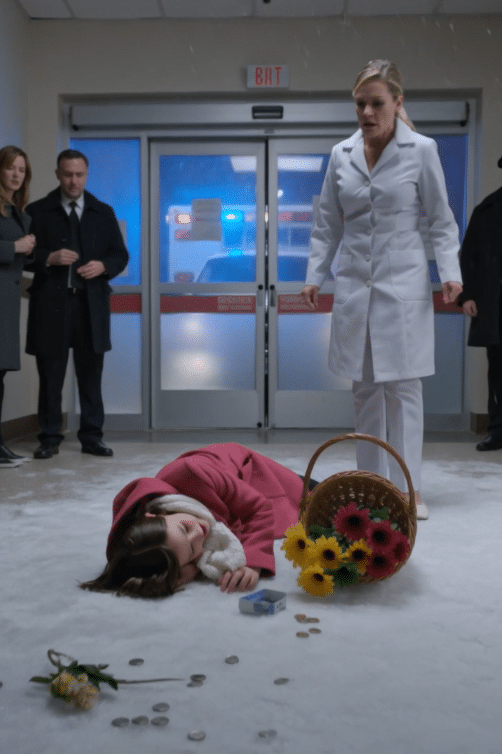
The coins scattered across the ice just as the little girl reached for them.
“Please,” thirteen-year-old Lily Bennett whispered, kneeling beside her overturned flower basket. “My mom needs medicine.”
The woman in the expensive white coat looked down at her as if she had just stepped in something disgusting. She held the bouquet Lily had been trying to sell, its delicate pink roses already dusted with snow, and showed no intention of paying for it.
“Trash. Children shouldn’t beg at hospitals.”
Lily swallowed hard. Her old pink coat was too thin for the freezing night, and her white scarf had grown damp from the snow. She had been standing outside the hospital entrance for nearly three hours, her fingers stiff from the cold, trying to sell enough flowers to buy the prescription her mother needed.
She wasn’t begging for charity.
She was asking to be paid for something she had worked to sell.
“Ma’am,” Lily said, her voice trembling, “you took the flowers. I just need the money.”
The woman’s expression hardened.
She was Vanessa Harrington, thirty-eight, impeccably dressed, and accustomed to having people step aside when she approached. Her husband owned several luxury car dealerships, and she had spent years moving through the city as though money had purchased her the right to decide who mattered.
A poor child asking her for a few dollars was, in Vanessa’s eyes, an insult.
She knocked the remaining coins from Lily’s hand.
They skittered across the frozen pavement, some disappearing beneath a parked car, others settling in the snow near the curb. Lily immediately bent down to retrieve them. Those coins were all she had managed to save that evening, and without them, she couldn’t buy the medicine waiting at the pharmacy.
Vanessa watched her crouch.
Then she kicked her hard in the back.
Lily fell face-first beside the flower basket. The impact knocked the breath from her lungs, and the basket tipped over completely, scattering roses and carnations across the snow. She scraped her forearm against the icy pavement, leaving a thin red mark.
For several seconds, she couldn’t move.
The cold pressed against her cheek. Her chest hurt when she tried to breathe, and the world seemed to narrow to the flowers lying around her and the coins she could no longer reach.
Then Vanessa stepped closer.
Lily tried to pull herself up, but the woman kicked her twice more, striking her back and side. Lily curled instinctively, wrapping her arms around herself as she fought through the pain.
Several people stood near the hospital entrance. A man carrying a paper coffee cup froze. A woman waiting for an ambulance covered her mouth. Two security guards near the automatic doors turned toward the commotion, but neither reached Lily before the next terrible moment had passed.
Everyone had seen it.
And for a few unbearable seconds, no one moved.
Lily lifted her face. Tears mixed with melting snow on her cheeks.
“My mom needs medicine,” she repeated.
Vanessa looked at the scattered flowers.
“Sell flowers somewhere cheaper.”
The words seemed to humiliate Lily more deeply than the attack itself. She had spent the evening telling herself that if she worked hard enough, she could bring something useful home. She had promised her mother she would find a way.
Now the flowers were ruined, the coins were scattered, and her hands shook so badly that she could barely reach for them.
She didn’t ask Vanessa to apologize.
She didn’t even ask for help.
She only tried to gather the flowers that were still intact, because she could not bear to return home empty-handed.
Then the hospital doors swung open.
A tall man in a long navy coat stepped into the snowfall, followed by two security officers and a woman carrying a tablet. Behind them, ambulance lights painted the glass entrance in alternating flashes of red and blue.
The man was Dr. Samuel Reed, the hospital’s sixty-one-year-old director.
He saw Lily on the ground.
He saw the flowers.
And he saw the woman standing over her.
Dr. Reed crossed the pavement immediately, removing his coat as he approached the girl. He crouched beside Lily and placed it around her shoulders, shielding her from the wind.
“Don’t try to stand yet,” he said. “Let us make sure you’re all right.”
One security officer moved between Lily and Vanessa. The other called for medical staff.
Dr. Reed turned to his assistant.
“Bring her mother’s chart to me.”
The assistant’s face changed.
She looked toward the hospital entrance, then back at the director, as though she had suddenly understood something that everyone else had missed.
Vanessa’s confidence faltered.
She stared at Dr. Reed, trying to reconcile his urgency with the sight of a homeless-looking child in a battered coat.
Then she asked the question that made the security guards exchange glances.
“You know her?”
Dr. Reed did not answer.
Not yet.
Because the moment he discovered whose medical chart he had just ordered, the incident outside the hospital would become far more than an assault on a poor child.
It would reopen a secret that someone had worked very hard to keep buried.
Act II
Lily Bennett had never considered herself brave.
Brave people, she imagined, were the ones who ran into burning buildings or stood in front of danger without shaking. Lily was simply a girl who had learned that some problems did not disappear when you were frightened of them.
Her mother, Claire, had taught her that.
Claire had once been the kind of person who remembered everyone’s birthday, kept emergency snacks in her purse, and stopped to help strangers whose cars had broken down on the highway. She had worked as a medical records clerk before illness forced her to leave her job.
She and Lily had lived modestly, but their apartment had always been warm with laughter.
Then Claire became sick.
At first, she dismissed the exhaustion as the result of working too many hours. When the pain became harder to ignore, she went to a clinic and underwent a series of tests. The diagnosis was serious, and treatment became a complicated cycle of appointments, medication, and bills.
Claire tried to hide how frightened she was.
She told Lily that they would manage, that doctors knew what they were doing, and that a difficult season did not mean their lives were over.
But Lily noticed everything.
She noticed when her mother began splitting meals in half. She noticed when the heating stayed off longer than usual. She noticed the unopened envelopes stacked beside the microwave and the way Claire sometimes stared at a prescription bottle before quietly putting it away.
Lily also noticed that her mother had stopped buying flowers.
That had been their little tradition.
Whenever Claire had a particularly hard week, she would buy a single flower from a street vendor and put it in a glass beside the kitchen window. She said a room did not need expensive decorations to feel alive.
After Claire became ill, Lily began collecting inexpensive flowers whenever she could find them. She would place them beside her mother’s bed and watch her smile, even on the days when smiling took effort.
When money grew tighter, Lily started helping a neighborhood florist prepare small bouquets for sale. She was too young for a regular job, but the florist sometimes allowed her to carry arrangements to nearby businesses and keep a modest amount from each sale.
It wasn’t much.
But Lily had discovered that people would occasionally buy a flower from a child standing outside a busy building, especially when she explained that she was trying to help her mother.
She never invented a story to get sympathy. She didn’t tell strangers every detail of Claire’s illness. Most of the time, she simply held out the flowers and asked whether they wanted one.
That night, however, the medicine had become urgent.
Claire’s prescription needed to be refilled, and the family had received notice that a portion of the cost was not covered by their existing assistance arrangement. The pharmacist had explained that there were other options, but the paperwork would take time.
Lily had listened from the doorway.
She knew her mother would tell her not to worry. She knew Claire would try to find a way to manage until the paperwork was processed.
And she knew that waiting was becoming harder.
So Lily took the flowers outside the hospital, hoping to earn enough to cover the immediate expense.
She had almost reached her goal when Vanessa Harrington appeared.
Now Lily sat in an examination room with a blanket around her shoulders, her scraped arm cleaned and bandaged. A nurse checked her breathing and asked where she hurt. Lily answered quietly, still glancing toward the door.
“Can I go home soon?”
“We need to make sure you’re safe first,” the nurse said.
“My mom is waiting.”
“We know. Someone is checking on her.”
Lily’s face tightened.
“Did something happen to her?”
The nurse immediately reassured her that no new medical emergency had been reported. Lily nodded, but her fingers continued twisting the edge of the blanket.
She had spent years trying not to become another problem her mother needed to solve.
When Claire was exhausted, Lily made dinner. When a bill arrived, Lily pretended not to notice her mother’s worried expression. When Claire apologized for missing a school event, Lily told her it didn’t matter, even though she had spent the entire afternoon watching other parents arrive.
Now a stranger had hurt her, and she was still worried about whether her mother had enough medicine.
Across the hallway, Dr. Reed stood beside his assistant, Rebecca Shaw.
“Which patient is she asking about?” he asked.
Rebecca consulted the information the hospital was authorized to access.
“Claire Bennett. She’s currently being treated through the internal medicine service.”
Dr. Reed went still.
“Claire Bennett?”
“Yes.”
“Is she the former medical records clerk?”
Rebecca looked up.
“She was. Why?”
Dr. Reed didn’t answer immediately.
He remembered a woman who had worked at the hospital years earlier, someone who had helped resolve a serious records discrepancy during a chaotic administrative transition. She had been meticulous, patient, and stubborn about the principle that every patient deserved accurate documentation.
He remembered her leaving after a family crisis, though he had never learned the full details.
But he had not known she had a daughter.
And he had not known she was now struggling to afford medication.
“Get her treating physician,” he said. “I want to understand her current needs, and I want the social worker involved.”
Rebecca nodded.
Then she hesitated.
“There’s something else. Mrs. Harrington has been here several times recently. She knows members of the board.”
Dr. Reed looked toward the corridor where Vanessa was speaking angrily to a security officer.
“That doesn’t change what happened.”
“No,” Rebecca said. “But it may complicate what happens next.”
Dr. Reed returned his attention to Lily.
The girl was sitting very still, trying not to cry.
He had spent decades inside hospitals, where he had seen how quickly fear could overwhelm a family and how often people who needed help were too ashamed to ask for it. Yet something about Lily’s determination to protect her mother had unsettled him.
She had been attacked in the snow, and her first concern was still the prescription at home.
Dr. Reed walked back into the examination room.
“Lily,” he said gently, “I’m going to speak with your mother’s doctor. We’ll see what options are available for her treatment and medication.”
Lily looked up.
“Will she have to leave the hospital?”
“Not because you asked for help.”
She studied him for a long moment.
Then she asked, almost in a whisper, “Do you really know my mom?”
Dr. Reed paused.
“I knew of her work here,” he said. “But I think there may be something about her past that neither of us understands yet.”
And when he opened the old administrative records, he found a name that connected Claire to a decision the hospital had never properly explained.
Act III
The chart arrived less than twenty minutes later.
Dr. Reed reviewed it in his office with Claire’s treating physician and the hospital’s patient advocate. The first pages contained the usual medical information: test results, medication history, consultation notes, and recommendations for follow-up care.
But it was an older administrative attachment that caught his attention.
Years earlier, Claire had been involved in a review of patient-assistance records during a period when the hospital was struggling with funding and staffing changes. Several families had been incorrectly classified as ineligible for financial support because their documentation had been entered under outdated account codes.
Claire had flagged the problem.
Her notes showed that she had worked late for several weeks, comparing records and correcting errors that might otherwise have prevented vulnerable patients from receiving help. She had also documented concerns about a supervisor who wanted the corrections delayed until after an external review.
The file contained no evidence that Claire had done anything improper.
Instead, it showed that she had followed the hospital’s procedures and raised concerns through the appropriate channels.
Dr. Reed remembered the incident now.
He had been a senior administrator at the time, not yet hospital director. He had seen a summary of the review, but the final report had described the discrepancies as a technical problem that had been resolved. Claire’s role had not been mentioned.
He turned another page.
A handwritten note had been attached to the report.
Do not close these cases until every patient has been contacted. An error in our system should never become a patient’s punishment.
Dr. Reed read it twice.
“That’s her handwriting,” he said.
The treating physician nodded.
“Claire has been consistent about the importance of accurate records. She mentioned working here when she first became a patient.”
“Did she ever explain why she left?”
“She said she needed to care for her daughter after a family emergency.”
Dr. Reed looked down at the chart.
The hospital had changed considerably since Claire worked there. New leadership had arrived, departments had been reorganized, and several old systems had been replaced. Yet the same principle remained: a patient could be harmed not only by an illness, but by an institution’s failure to recognize the person behind the paperwork.
He asked the patient advocate to review Claire’s eligibility for available support programs, including any assistance that could lawfully apply to her current treatment.
The advocate agreed, making it clear that no one could promise a particular outcome before the review was complete.
Then Rebecca returned with another piece of information.
Vanessa Harrington had contacted a hospital board member.
She had complained that security had embarrassed her outside the entrance and suggested that the hospital was allowing children to harass paying patients. She had also implied that she expected the matter to be resolved discreetly.
Dr. Reed’s expression cooled.
“Did she mention the assault?”
“She said there had been a misunderstanding.”
“Did she mention the flowers?”
Rebecca shook her head.
“Did she mention the child on the ground?”
“No.”
Dr. Reed closed the folder.
“Then she hasn’t explained the incident. She’s tried to rename it.”
He instructed security to preserve any available footage and collect witness statements. He also made sure the hospital’s response would be based on evidence, not on Vanessa’s social connections or the amount of money her family spent at the facility.
But the deeper surprise came when the patient advocate located a second set of records.
Claire’s old employee file contained a letter she had written after the administrative review. It was not a complaint against any individual. It was a request for a formal review of how the hospital handled financial assistance, particularly when patients could not navigate the system alone.
The letter had been acknowledged, but there was no record of a substantive response.
A later note indicated that the issue had been referred to another department during the restructuring. The trail ended there.
Dr. Reed felt a familiar discomfort.
The hospital had not necessarily set out to harm Claire or any other patient. But good intentions were not enough when a system lost track of a concern and no one took responsibility for following it through.
He asked the compliance office to examine the old matter independently, alongside the current review of Claire’s eligibility for assistance.
Then he returned to Lily.
She had been moved to a quiet family room. Someone had found her a pair of dry socks, and her damp pink coat hung over a chair near the radiator. A paper cup of hot chocolate sat on the table, barely touched.
“Is my mom all right?” she asked immediately.
“She’s receiving care,” Dr. Reed replied. “Her doctor is reviewing the medication plan, and our patient advocate is checking what assistance may be available.”
Lily looked down at her hands.
“I didn’t want to make trouble.”
“You haven’t.”
“But that woman said I shouldn’t be there.”
Dr. Reed pulled a chair closer.
“You were outside a hospital trying to earn money for your mother’s medicine. You did not deserve to be hurt for that.”
Lily’s eyes filled.
“People kept watching.”
Dr. Reed was silent for a moment.
“Sometimes people freeze because they don’t know what to do. Sometimes they are afraid of making things worse. But that doesn’t mean what happened was acceptable.”
Lily wiped her cheek with her sleeve.
“Will she come back?”
“Security has her information, and the incident is being documented. If you feel unsafe, tell us immediately.”
The answer was practical, not magical. Dr. Reed couldn’t erase what Lily had experienced, and he couldn’t promise that every person would suddenly become kinder.
But he could make sure she was not left to face the consequences alone.
Later that night, Claire learned what had happened.
She was furious—not at Lily, but at the world that had placed her daughter in a position where selling flowers in the cold seemed like the only way to help.
When Lily was brought to see her, Claire held her tightly, careful of the girl’s sore back.
“I should have found another way,” Claire whispered.
Lily shook her head.
“I was trying to help you.”
“I know, sweetheart.”
Claire drew back to look at her.
“You were trying to help me. None of this was your fault.”
Dr. Reed stood by the doorway, giving them privacy.
He had entered the night believing he was responding to a public assault. He now understood that he was facing something larger: a child forced to carry adult worries, a sick mother afraid of becoming a burden, and an old institutional failure that had never been fully examined.
But the records had revealed one more detail.
The person who had first signed off on the unresolved assistance review was no longer at the hospital.
He now served on the board of a charitable foundation that funded several of the hospital’s community programs.
And his name was connected to Vanessa Harrington’s family.
Act IV
The following morning, the snow had stopped, but the hospital entrance was crowded with people trying to get out of the cold.
Dr. Reed called an urgent meeting with the hospital’s compliance officer, patient advocate, and legal counsel. He made two things clear from the beginning: the investigation into Lily’s assault would remain separate from Claire’s medical care, and neither matter would be influenced by anyone’s personal connections.
The first review concerned Vanessa.
Security footage confirmed that she had taken the bouquet, knocked Lily’s coins into the snow, and kicked the girl after she bent down to retrieve them. Witness statements supported the sequence of events.
The hospital provided the relevant evidence to the appropriate authorities and cooperated with their investigation. Vanessa was informed that she would not be permitted to approach Lily or interfere with the hospital’s handling of the incident.
Her husband’s money did not erase the footage.
Her social standing did not change the witness statements.
And her claim that the child had been begging did not explain why she had attacked her.
When Vanessa returned to the hospital later that day, she expected the matter to have cooled. Instead, she was met by security and informed that any further discussion would have to take place through the proper channels.
She demanded to see Dr. Reed.
He agreed to meet with her briefly, with hospital counsel present.
Vanessa entered his office in another immaculate coat, carrying herself with the indignation of someone who believed the entire city had misunderstood her.
“I think this has been blown out of proportion,” she began. “I was approached by a child who was selling things outside the hospital. I didn’t want to encourage that behavior.”
Dr. Reed looked at her.
“You took her flowers.”
“She was standing in the wrong place.”
“You knocked her money into the snow.”
“She was being rude.”
“You kicked her while she was trying to collect it.”
Vanessa’s lips tightened.
“I barely touched her.”
“The footage has been preserved, and witnesses have given statements.”
She shifted in her chair.
“Surely you understand that I have a reputation to protect.”
Dr. Reed’s voice remained level.
“Then you should have protected it by treating a child with basic decency.”
Vanessa stared at him.
She had expected a warning, perhaps an apology for the inconvenience. She had not expected the director of a major hospital to speak to her as though her behavior mattered more than her connections.
“Do you know who my husband is?” she asked.
“I know who you are,” Dr. Reed replied. “That is why we are discussing your actions.”
The meeting ended without an apology.
Vanessa left believing the hospital was being unreasonable. But as she crossed the lobby, she noticed two employees speaking quietly near the reception desk. One looked toward her, then away.
For the first time, she seemed uncertain whether the people around her were impressed by her status or simply afraid of her temper.
Meanwhile, the review of Claire’s records was uncovering a different kind of problem.
The old assistance cases had not all been mishandled in the same way. Some had been corrected, while others had been transferred between departments without clear documentation. Investigators found that the hospital’s restructuring had left gaps in accountability, making it difficult to determine who had followed up on every case.
The records did not prove that Vanessa or her family had deliberately caused Claire’s hardship. Nor did they establish that the old review had been suppressed to benefit anyone connected to her.
But they did show that Claire’s concerns had never received the thorough response they deserved.
Dr. Reed refused to let the team turn that finding into a convenient accusation. He ordered the review to continue until the hospital could distinguish verified facts from assumptions.
At the same time, the patient advocate completed an initial assessment of Claire’s current circumstances. She qualified for assistance that could reduce her immediate medication burden, and the team helped her navigate the remaining paperwork.
The physician reviewed her treatment plan and discussed appropriate options with her. No miracle cure was offered, and no one promised that illness would become easy. But Claire finally had a clearer path forward, with support that had previously felt impossibly difficult to access.
When Dr. Reed visited her room, Claire thanked him.
“I don’t want special treatment because my daughter was hurt,” she said.
“You’re not receiving special treatment,” he answered. “Your care is being reviewed under the same standards we should apply to every patient.”
Claire looked toward Lily, who was sitting beside the window with a book in her lap.
“Then I want you to make sure other families can get help before they reach the point we did.”
Dr. Reed nodded.
“That is exactly what we’re reviewing.”
The hospital eventually reopened the old assistance process, contacted affected patients where records allowed, and established a formal system for tracking concerns until they were resolved. Staff were retrained, and responsibility for patient-support cases was assigned more clearly so that requests could not disappear between departments.
The changes did not undo Claire’s illness or return the years she had spent worrying about money.
But they addressed the failure she had tried to bring to light long before Lily ever stepped into the snow with a basket of flowers.
As for Vanessa, the consequences continued through the appropriate legal and institutional channels. Her conduct was no longer a private disagreement that she could settle with a forceful phone call. It was a documented incident involving a child, supported by evidence and witnesses.
Her husband contacted the hospital board, hoping to persuade someone to intervene.
The board declined to influence the investigation.
Dr. Reed also made clear that donations to the hospital did not purchase immunity from its rules. The foundation associated with Vanessa’s family could continue to support legitimate programs, but no contribution would determine how the hospital treated a patient or responded to an assault.
Vanessa had spent years believing that every problem had a price.
Now she was discovering that some consequences could not be bought away.
Yet the most important moment came not in Dr. Reed’s office or at a board meeting, but beside Claire’s hospital bed.
Lily had been quiet all morning. She had begun to recover physically, but whenever someone walked quickly behind her, her shoulders tightened. She still remembered the sound of the coins sliding across the ice and the faces of the people who had watched.
Claire noticed.
“Do you want to talk about it?” she asked.
Lily shook her head, then changed her mind.
“Why didn’t anyone help me?”
Claire’s eyes filled with tears.
“I don’t know, sweetheart.”
“Was I doing something wrong?”
“No.”
The answer came immediately.
Claire took Lily’s hand.
“You were trying to take care of someone you love. There was nothing wrong with that.”
Lily looked at their joined hands.
“I don’t want to be scared every time I need something.”
Claire pulled her closer.
“Then we’ll learn how to ask for help without believing we’re doing something shameful.”
Outside the room, Dr. Reed heard the words as he approached the doorway. He stopped and waited, unwilling to interrupt.
He had spent years thinking about hospital systems, budgets, staffing, and the complex machinery of patient care.
But Claire had reduced the entire issue to one sentence.
People should not have to feel ashamed for needing help.
Dr. Reed returned to his office and drafted a new directive for the hospital’s patient-support teams. It would require clearer explanations of available assistance, easier ways to raise concerns, and a named staff contact for families struggling to navigate care.
He signed it before the end of the day.
Then he made one final request.
He wanted Lily to be given something she had lost that night—not the exact coins, which had disappeared beneath the snow, but the chance to remember herself as more than the girl who had fallen.
The next morning, he invited her to the hospital’s small community room.
Lily arrived holding Claire’s hand, unsure why the director had asked to see them.
On the table sat a fresh basket of flowers.
Beside it was a sealed envelope containing a modest payment for the bouquet she had lost, arranged through the florist who had supplied the original flowers. There was no publicity attached, no request for a photograph, and no expectation that Lily tell her story to anyone.
Dr. Reed stood beside the table.
“These flowers belonged to you,” he said. “You were trying to sell them honestly. What happened to you was wrong, and I wanted you to know that your work deserved respect.”
Lily looked at the basket.
Then she looked at Claire.
For the first time since the night of the assault, she smiled without forcing herself to.
But Dr. Reed wasn’t finished.
He had one more question for Lily, and the answer would determine what happened next.
Act V
“Would you like to help us choose flowers for the family rooms?” Dr. Reed asked.
Lily blinked.
“For the hospital?”
“For the hospital.”
He explained that the community team was creating a small program in which local florists could donate unsold flowers for patients and families. Lily could offer suggestions about the arrangements, if she wanted. The program would be supervised by adults, and it would never interfere with her schooling or place responsibility for the hospital’s work on her shoulders.
It wasn’t a job she had to accept.
It was an invitation to participate.
Lily glanced at her mother.
Claire smiled.
“You love choosing flowers.”
Lily looked back at Dr. Reed.
“Can I choose the colors?”
“Absolutely.”
“Even if they’re not expensive?”
“Especially if they aren’t expensive. Beautiful things don’t have to cost a fortune.”
Lily studied the basket again.
She reached for a small yellow flower nestled between the roses and carnations. Its petals were slightly uneven, and one leaf had curled at the edge.
“This one,” she said.
Dr. Reed smiled.
“Then this one goes first.”
Over the following weeks, Lily helped the florist select small arrangements for the hospital’s family rooms. Sometimes she chose bright colors for children waiting for appointments. Sometimes she picked soft white and yellow flowers for quiet spaces where families received difficult news.
She was never asked to recount the assault.
She was never introduced as a symbol of suffering.
She was simply Lily, a girl who loved flowers and wanted to help make an unfamiliar place feel a little less frightening.
Claire continued treatment and attended regular follow-up appointments. The assistance program eased some of the immediate financial pressure, though there were still difficult days and uncertain medical decisions. She and Lily began to plan again—not grand plans, but ordinary ones.
A visit to the library.
A home-cooked dinner with a neighbor.
A Saturday morning when Lily could sleep late instead of searching for ways to earn money.
Those small freedoms began to feel like gifts.
One afternoon, Claire sat beside Lily at their kitchen table while the girl arranged a handful of flowers in a glass jar.
“Do you remember what you said to that woman?” Claire asked.
Lily’s hands slowed.
“I said you needed medicine.”
“Yes.”
“I thought if I explained, she’d understand.”
Claire watched her carefully.
“Sometimes people understand perfectly well that someone is hurting and choose to be cruel anyway. Her behavior was not your fault, and you could not have found the perfect words to make her kind.”
Lily looked down at the flowers.
“I keep thinking I should have done something different.”
“You were thirteen,” Claire said softly. “You were cold, you were trying to help me, and an adult chose to hurt you. The responsibility belongs to that adult.”
Lily nodded slowly.
The memory would take time to fade. Some nights, she still woke remembering the snow beneath her hands. Sometimes she wondered what the witnesses had thought as they stood watching.
But she no longer believed that the attack proved she was weak.
She had been frightened and hurt, and she had still tried to protect the flowers. She had asked for what she was owed. She had told the truth about her mother’s illness.
None of those things made her deserving of cruelty.
They made her a child trying to survive a difficult night.
The hospital also changed in ways that extended beyond Lily and Claire. The renewed patient-assistance review identified other families whose applications had been delayed or left unresolved. Staff contacted those who could be reached and helped them understand their options. The hospital’s leadership began receiving regular reports on outstanding support requests, making it harder for concerns to disappear unnoticed.
Dr. Reed knew that no procedure could guarantee kindness.
But a good system could make it harder for indifference to hide behind confusion, and easier for a person in need to find someone willing to listen.
As for Vanessa Harrington, her life did not collapse in a single dramatic moment. There was no magical reversal in which everyone she knew suddenly turned against her. Instead, the consequences arrived through ordinary channels: documented evidence, formal restrictions, legal proceedings, and the loss of the unquestioned deference she had once expected.
The authorities handled the assault according to the evidence and applicable law. The hospital maintained its boundaries, regardless of the pressure brought by Vanessa’s family.
She could dispute the facts.
She could defend herself through the proper process.
But she could no longer make the incident disappear simply by declaring that a poor child had no right to stand in her way.
One evening, several months after the snowfall, Vanessa passed the hospital entrance on her way to a scheduled appointment. She noticed the small flower display near the reception desk.
A card beside it read:
For the people waiting, worrying, hoping, and healing.
The flowers were simple. Yellow daisies, pale carnations, a few pink roses.
For a moment, Vanessa stood looking at them.
She remembered the girl in the pink coat. She remembered the coins scattered across the ice and the words she had spoken without hesitation. She remembered asking Dr. Reed whether he knew the child, as though the girl’s importance depended on her relationship to someone powerful.
That question had revealed more about Vanessa than she intended.
She had assumed that a poor child mattered only if an influential adult could claim her.
But Lily had mattered before Dr. Reed arrived.
She had mattered while she was kneeling in the snow, trying to recover the money for her mother’s medicine. She had mattered while strangers watched. She had mattered even when the only person willing to speak up was a hospital director who had not yet understood the full story.
Her worth had never depended on the chart.
Vanessa continued toward the elevators, the flower display fading behind her.
Inside the hospital, Lily stood beside her mother near the main entrance. Claire was feeling stronger, and they had come for a follow-up appointment. The snow had melted, leaving the pavement dark with winter rain.
Lily carried no basket that evening.
Instead, she held a small bunch of yellow flowers she had chosen for their kitchen table.
Dr. Reed saw them and approached.
“Those look familiar,” he said.
Lily smiled.
“They’re my favorite now.”
“Why yellow?”
She considered the question.
“Because they look happy, even when it’s cold.”
Dr. Reed nodded, understanding that the answer carried more than the girl intended to explain.
Claire slipped her arm around Lily’s shoulders.
They walked toward the exit together, not because all their problems had vanished, but because the future no longer felt like a door that would remain closed no matter how hard they knocked.
Lily had gone into the snow believing that a handful of coins might be the difference between her mother getting medicine and going without it. She had returned from that night with bruises, fear, and a memory she would need time to heal from.
But she had also learned something no cruel person could take from her.
Needing help did not make her shameful.
Being poor did not make her invisible.
And the fact that someone had treated her as though she did not matter did not make it true.
The woman in the white coat had asked, “You know her?” because she could not imagine why the hospital director would stop everything for a girl with no money and no influence.
Dr. Reed had known Claire’s name.
He had recognized the unfinished story in the medical records.
But even before he understood either connection, he had seen a child on the ground and chosen to protect her.
That was the part that mattered most.
Because the real revelation was not that Lily’s mother had a history with the hospital, or that old records could expose a forgotten failure, or that a wealthy woman could finally be held accountable for her actions.
It was that Lily had deserved kindness from the very beginning.
Not because someone important knew her.
Not because her mother’s chart contained a secret.
Not because her suffering could teach the world a lesson.
Simply because she was a child, standing in the snow, trying to help the person she loved.
And no amount of money, status, or power could ever make cruelty toward her acceptable.