Act I
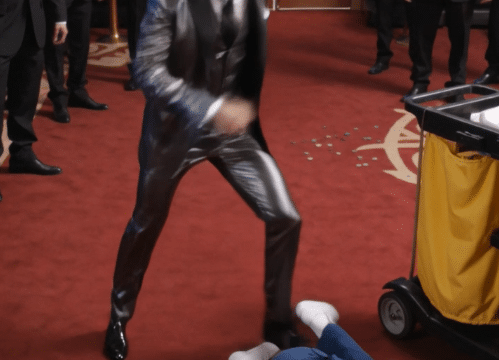
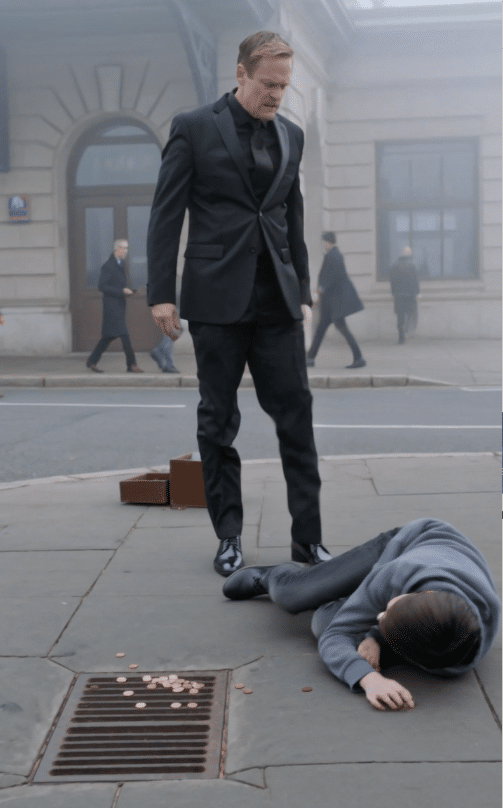
The coins were still spinning across the wet stone when the man in the black suit delivered his first kick.
Fourteen-year-old Daniel Carter dropped to his knees, scrambling after the small metal pieces as they rolled toward the storm drain outside the central train station. Fog clung to the pavement, blurring the faces of hurried commuters, while cold rain soaked through his faded jeans and the sleeves of his old gray hoodie.
“Please,” Daniel whispered, reaching for a coin that had stopped just inches from the drain. “Please, that’s all I have.”
The man looked down at him with the expression of someone watching an inconvenience being removed from his path.
His shoes were immaculate. His black suit probably cost more than Daniel had seen in an entire year. And after allowing the boy to polish those shoes for nearly fifteen minutes, he had refused to pay a single dollar.
Now he had kicked the boy’s coin box away as if it were garbage.
Daniel stretched his arm toward the scattered money, trying to gather it before the rainwater carried the smallest coins into the gutter. He was so focused on saving them that he barely saw the man’s foot move again.
The kick struck him hard in the back.
Daniel fell forward beside his shoeshine box, his palms slapping against the cold stone. Brushes spilled from their compartments, the wooden box scraped across the pavement, and the remaining coins scattered in every direction.
A sharp breath escaped his mouth.
For a moment, he could not move. His elbow stung where it had scraped against the rough ground, and his chest tightened as he tried to force air back into his lungs.
Around him, the station entrance had become a theater of silent horror.
A woman carrying a paper coffee cup stopped walking. Two businessmen turned toward the commotion. An older commuter covered her mouth with both hands.
Nobody stepped forward.
The man in the black suit simply adjusted his cuff.
Daniel curled onto his side, shielding the little coin pouch that had remained beside his chest. He could feel the coins pressing against his ribs through the thin fabric of his hoodie.
There were only a few left.
A few dollars.
A few dollars that meant something far more important than the man standing above him could possibly understand.
“My little brother needs medicine,” Daniel said.
His voice trembled, but he forced himself to look up.
For the briefest moment, something in his expression resembled a child’s desperate hope that an adult might finally recognize what he was doing.
The man answered with a sneer.
“Trash. Shine shoes, not your tears.”
Daniel lowered his eyes.
He had heard cruel words before. He had been called lazy, worthless, and a dozen other things by people who saw his old clothes before they saw his face.
But this was different.
The man had heard about his brother. He knew why the boy was begging. And he had decided that the explanation made the humiliation more entertaining.
When Daniel reached for another coin, the man stepped closer.
Two more kicks landed against the boy’s back and side, forcing him to curl inward and gasp through the pain. His fingers clutched the little pouch as though it were the only thing keeping his world from falling apart.
“Earn faster next time,” the man said.
A nervous murmur passed through the crowd.
Someone took a step backward. Another commuter looked toward the station doors, apparently hoping an employee would emerge and take responsibility for what everyone was witnessing.
Daniel said nothing.
He was afraid that if he tried to stand, he would fall again. He was afraid that if he left the coins behind, his little brother would spend another night coughing beneath their thin blanket.
Most of all, he was afraid of returning home empty-handed.
Then, through the fog, came the sound of tires braking hard against the curb.
A black sedan had stopped beside the station entrance.
And the man who stepped out of it recognized the boy on the ground.
What happened next would make every witness wish they had paid attention to Daniel before the car arrived.
Act II
Daniel Carter had learned early that poverty made people impatient.
His mother, Emily, had died two years earlier after a sudden illness, leaving Daniel to care for his seven-year-old brother, Noah. Their father had disappeared from their lives long before that, and the small apartment they occupied on the edge of the city was now held together by overdue bills, borrowed groceries, and promises Daniel made to a child too young to understand how difficult those promises were to keep.
Daniel had once been an ordinary student.
He had liked science, especially experiments involving magnets and electricity. His teacher had told him that he had the kind of mind that noticed things other people overlooked.
But after his mother died, he began missing school to take Noah to appointments, cook meals, and find whatever work he could.
Eventually, the absences became too frequent.
He told himself he would return when things improved.
Things never seemed to improve.
Every morning before sunrise, Daniel carried his shoeshine box to the central station. He had inherited it from an elderly man who used to work near the entrance and had given it to Daniel when arthritis made it impossible for him to continue.
The box was scratched and uneven. One corner had been repaired with a strip of metal, and the leather strap was so worn that it left a red mark on Daniel’s shoulder.
But it was his livelihood.
He knew which commuters were generous, which ones preferred silence, and which ones would promise to pay later before disappearing into the crowd.
He never asked for more than the price he quoted.
He never followed anyone who refused him.
And he never spent the money he earned until he had counted it twice.
That morning, Noah’s cough had been worse.
The little boy had spent most of the night sitting upright against a pillow, struggling to sleep between coughing fits. Daniel had warmed water, tucked a blanket around his brother, and promised to bring home the medicine the clinic had recommended.
Noah had looked at him with tired eyes.
“You’ll come back before dinner, right?”
“Of course,” Daniel had answered.
He had said it confidently because that was what older brothers were supposed to do.
He had not told Noah that they were nearly out of food, that the electricity bill was overdue, or that he had only a few dollars left after paying for their last bus ride.
Instead, he had placed a hand on his brother’s forehead and smiled.
“Just get some rest. I’ll handle everything.”
That promise followed him to the station.
It was the reason he accepted the black-suited man’s request to polish his shoes despite the man’s impatient tone. It was why Daniel worked carefully, even when the cold made his fingers stiff.
He wanted to do a good job.
He wanted the man to look at his polished shoes and decide that the boy deserved to be paid.
When the man stood up, Daniel had held out his hand.
The customer laughed.
Then came the kick that sent the coin box toward the drain.
Now, as Daniel lay on the wet pavement, he could see one of his coins caught against a crack in the stone. It was a small copper-colored coin, almost worthless by itself.
He reached for it anyway.
He did not see the black sedan’s driver door close.
He did not notice the older man in the long black coat crossing the pavement with measured steps.
He did not know that someone had watched him the previous morning, when he had quietly given his own breakfast sandwich to a homeless woman outside the station and pretended he was not hungry.
The man approaching him had noticed something else, too.
Daniel had carefully collected the coins that morning before opening his shoeshine box. When another child nearby dropped a few pennies, Daniel had helped retrieve them without keeping a single one.
The older man had remembered the boy’s face.
He had intended to speak to him again.
Instead, he found him on the ground, surrounded by scattered money, while a grown man stood over him with contempt.
The businessman stopped beside the shoeshine box.
His expression changed when he saw Daniel’s trembling hands.
He did not begin by asking who was responsible.
He did not demand an explanation from the crowd.
He lowered himself beside the boy and carefully placed his coat between Daniel and the busy flow of commuters, giving him space and shielding him from the staring faces.
“Easy,” he said quietly. “Don’t try to get up too fast.”
Daniel looked at him, confused.
The stranger’s voice was calm, but his eyes had hardened.
Then he turned toward the station entrance.
“Bring me the station manager.”
The words were not shouted.
They did not need to be.
And the businessman had not yet explained why he was asking.
Act III
The man in the black suit stared at the newcomer as if someone had interrupted a performance he was certain to win.
He was Richard Hale, a senior executive at a prestigious property development company. He was accustomed to getting what he wanted, whether through money, influence, or the simple certainty that nobody around him wanted the trouble of saying no.
He had spent years cultivating an image of success.
Expensive suits. Private meetings. Invitations to exclusive dinners. Photographs with influential people.
He believed that reputation was power.
And he believed the boy at his feet had none.
The older businessman, however, was not a stranger to power.
His name was Alexander Whitmore.
At sixty-three, he had built Whitmore Group from a small regional investment firm into one of the companies responsible for major transportation and commercial developments across the country.
His signature appeared on contracts worth millions. His decisions could determine whether a project moved forward or collapsed under the weight of scrutiny.
But Alexander had not grown up wealthy.
His father had repaired shoes in a cramped storefront near a railway station. His mother had worked nights cleaning offices, often returning home long after Alexander had fallen asleep.
As a child, he had sat beside his father and watched him polish leather until it shone.
His father used to tell him that a person’s character was easiest to see when the other person had nothing to offer in return.
“Anyone can be polite to someone who might help them,” his father had said. “Watch how they treat the person who cannot help them at all.”
Alexander had carried those words into adulthood.
He had seen generosity from people with almost nothing and cruelty from people who owned everything they could reasonably want.
He had also made mistakes.
Years earlier, he had trusted the wrong executives with too much authority. He had allowed polished presentations and impressive credentials to persuade him that certain men were better than their actions suggested.
One of those men had been Richard Hale.
Richard was not merely an executive at a company that sometimes worked with Whitmore Group. He was also the public face of a proposed redevelopment project involving the very station where Daniel earned his living.
The project was supposed to transform the aging transportation district into a modern commercial hub, bringing new businesses, improved facilities, and thousands of jobs.
It was also facing a final review.
Alexander had arrived that morning to attend a private meeting about the project’s management and its treatment of local workers and small vendors. He had come earlier than expected because he wanted to observe the station before the official presentation began.
He had not announced his arrival.
He had wanted to see the place without the carefully arranged smiles that usually appeared whenever executives knew he was watching.
Instead, he had seen Richard kick a boy into the rain.
And suddenly, all those polished presentations meant very little.
“Sir,” Richard began, forcing a smile into place. “I think there’s been a misunderstanding.”
Alexander looked down at Daniel.
The boy was trying to gather his brushes with shaking fingers. His face was pale, and every movement seemed to cost him effort.
One of the coins had rolled beneath the edge of Alexander’s shoe.
He moved his foot aside.
Then he picked up the coin and placed it in Daniel’s open palm.
It was a tiny gesture, almost insignificant.
Yet Daniel stared at it as if the businessman had returned something far more valuable.
“Thank you,” he whispered.
Alexander nodded once.
“Your money belongs to you.”
Only then did he rise.
He turned toward Richard, who had begun to recover his confidence now that the newcomer was speaking directly to him.
“Do you know who I am?” Richard asked.
Alexander did not answer.
Richard mistook the silence for uncertainty.
“This boy was being disruptive. He was practically begging for money after doing a mediocre job. I was handling the situation.”
“You were handling it,” Alexander repeated.
His voice remained quiet.
Richard gestured toward the scattered brushes, as if the objects themselves were evidence of Daniel’s wrongdoing.
“Look at the mess. Someone needs to teach these people that they can’t demand payment from everyone who walks past them.”
Several commuters lowered their eyes.
One man who had witnessed the assault suddenly became very interested in his phone.
Alexander studied Richard’s face.
He saw no regret. No concern about the injured boy. Not even the embarrassment of someone caught behaving badly.
Only irritation that the scene had been interrupted.
That was what made Alexander’s decision easier.
He reached into his coat and took out his phone.
“Bring me the station manager,” he repeated to his assistant, who had just arrived from the sedan.
Then he added a second instruction.
“Call our legal team. Tell them the station redevelopment review is on hold until I have examined the conduct of everyone involved.”
Richard’s expression flickered.
For the first time, the word review seemed to reach him.
He took a step forward.
“Wait. What redevelopment review?”
Alexander looked at him with a patience that somehow felt more threatening than anger.
“The one you were scheduled to discuss with me this morning.”
Richard’s face lost some of its color.
But he still did not understand the full danger.
He glanced at Daniel, then back at Alexander, and gave a short, incredulous laugh.
“You’re putting a multimillion-dollar project on hold over a street kid?”
Alexander said nothing.
Instead, he turned to the station staff member who had finally hurried outside and asked for an ambulance or medical assistance for the boy.
Then he looked back at Richard.
The next revelation would not come from Alexander’s title.
It would come from the records Richard had spent years assuming nobody would ever examine.
Act IV
Within minutes, the station entrance had changed.
The commuters who had watched in silence now stood at a distance, their faces drawn with discomfort. A station employee brought a first-aid kit while another called for medical assistance.
Daniel sat carefully against the stone wall, wrapped in Alexander’s coat.
He kept asking whether anyone had found the coins near the drain.
Not once did he ask whether Richard would be punished.
Not once did he complain about the pain in his back.
His first concern was still the medicine.
Alexander crouched beside him again.
“What is your brother’s name?”
“Noah,” Daniel answered.
“How old is he?”
“Seven.”
“And the money you were collecting?”
Daniel hesitated, embarrassed by the question.
“For his medicine. He’s been coughing all night.”
Alexander’s jaw tightened.
“Then we’ll make sure he gets the care he needs.”
Daniel looked at him cautiously.
He had heard promises before. Adults made them when they wanted children to stop crying, when they wanted a problem to disappear, or when they simply did not know what else to say.
But Alexander did not ask Daniel to trust him.
He instructed his assistant to arrange proper medical care and make sure the boy’s brother was not left without help. He also asked the station employee to preserve any security footage of the incident.
Then he stood and faced Richard.
The executive had begun pacing.
“You’re overreacting,” Richard said. “I don’t know what this child told you, but you can’t let an emotional scene dictate a business decision.”
Alexander’s gaze remained steady.
“I’m not making a decision based on what he told me. I’m making one based on what I watched you do.”
Richard opened his mouth, then closed it.
The assistant returned with a tablet.
The station’s security supervisor had confirmed that cameras covered the entrance, including the area around Daniel’s shoeshine spot. The footage could be preserved for the authorities.
There would be no convenient story about an accidental fall.
No claim that Richard had merely tried to move the box.
No argument that the boy had invented the attack.
The cameras had recorded the entire sequence.
Richard looked at the tablet as though it were a weapon.
“This is ridiculous,” he muttered.
Alexander turned to his assistant.
“Now, about the project. I want the most recent compliance report.”
The assistant hesitated.
“Sir, there are a few unresolved matters in the file.”
“Which matters?”
“The subcontractor payments. The complaints about vendor displacement. And the revised community-support budget.”
Richard stiffened.
Those were not new problems.
For months, several small vendors near the station had complained that they were being pressured to leave their pitches before the redevelopment work began. Some claimed that compensation promised during earlier consultations had never arrived.
Richard had dismissed the complaints as administrative misunderstandings.
He had also assured the board that all affected vendors had been treated fairly.
Alexander had believed the report was accurate.
Now, standing beside a boy whose livelihood could fit inside a battered wooden box, he began to wonder what else the report had concealed.
“Bring me the full file,” he said.
Richard stepped closer.
“Those are internal matters. They have nothing to do with what happened here.”
“Then you won’t mind explaining them.”
“I don’t have to explain anything on the pavement.”
“No,” Alexander replied. “You can explain it in a formal review.”
The station manager arrived, followed by a security supervisor carrying a small folder. Alexander asked for the incident report, the camera footage, and the records concerning vendors operating outside the station.
Richard’s composure began to fracture.
He had expected the wealthy stranger to scold him, perhaps threaten to call the police, and eventually leave. He had not expected someone with the authority to examine his professional record.
More importantly, he had not expected that person to care enough about a shoeshine boy to do it.
The manager handed Alexander a preliminary report.
As he read, his expression grew colder.
Several vendor complaints had been marked as resolved without supporting signatures. A compensation payment listed in the redevelopment records could not immediately be matched to a receipt from the person it was supposed to benefit.
The documents did not yet prove who was responsible, and Alexander refused to pretend otherwise.
But they were serious enough to demand an independent investigation.
“Who approved these closures?” he asked.
The station manager looked at Richard.
Richard looked away.
For the first time, the crowd understood that the incident was no longer just about a cruel man and a helpless boy.
The assault had exposed something larger: a system in which complaints could be ignored when the people making them lacked money, influence, or the confidence to fight back.
Alexander handed the report to his legal representative.
“Preserve every record. No documents are to be altered, deleted, or destroyed. The review will be independent.”
Richard’s voice rose.
“You can’t do this because you’re angry!”
Alexander faced him.
“You’re right. Anger isn’t evidence. That’s why we’re keeping the footage and examining the records.”
The answer left Richard with nothing useful to say.
A security officer approached and asked him to remain available while the incident was documented. Richard protested, insisting that he had meetings to attend and a reputation to protect.
No one rushed to reassure him.
No one hurried to clear a path.
The witnesses who had stepped back from Daniel now watched Richard with a different expression. Some looked ashamed. Others looked angry with themselves for having mistaken his expensive clothes for authority that deserved unquestioned respect.
Daniel, meanwhile, had begun to cry silently.
Not because he was satisfied to see Richard frightened.
Because an ambulance worker had told him that his injuries needed to be checked, and he was afraid that the time spent at the station would mean missing the pharmacy’s opening hours.
Alexander noticed.
He knelt beside the boy.
“Daniel, look at me.”
The teenager raised his eyes.
“You have done nothing wrong. Your brother is going to get help. You don’t need to protect anyone from the truth.”
Daniel swallowed hard.
“But what if he makes me leave? What if I can’t work here anymore?”
It was the question of a child who had learned to measure safety in the number of coins inside a wooden box.
Alexander glanced toward Richard, then back at Daniel.
“No one is going to decide your future by threatening you in the street.”
He did not promise that every problem would vanish by sunset.
He promised something more practical.
The incident would be documented. The evidence would be preserved. The boy would receive medical attention, and the redevelopment team would investigate the treatment of local vendors before proceeding.
Then Alexander made one final call.
He contacted the board chair of Whitmore Group and requested an emergency meeting.
Richard heard enough of the conversation to understand what was coming.
His job was no longer protected by the image he had built.
His project was no longer moving forward on his assurances alone.
And the boy he had kicked into the rain had become the witness whose suffering forced powerful people to look at what they had ignored.
Still, Richard managed to summon one last trace of arrogance.
He looked at Daniel, then at the businessman standing beside him.
His mouth twisted into a disbelieving smile.
“For a shoeshine boy?”
The question hung in the cold air.
Alexander did not answer it immediately.
He had something more important to do first.
He helped Daniel gather the last of his scattered coins.
And then he showed the boy what it meant when someone finally decided that his life mattered.
Act V
The first thing Alexander did was make sure Daniel received medical attention.
The boy’s injuries were assessed, his back was examined, and his scraped elbow was cleaned and dressed. The medical staff found no reason to suspect a life-threatening injury, but they instructed him to rest and return for further evaluation if his pain worsened.
Daniel kept apologizing for the time everyone was spending on him.
Alexander gently stopped him.
“You don’t have to apologize for being hurt.”
Those words unsettled Daniel more than the confrontation had.
He was accustomed to being told to work harder, move faster, stop complaining, or get out of the way. He had almost forgotten that a person could be injured without becoming a burden.
Before the morning was over, Alexander’s assistant had contacted Noah’s caregiver and arranged for the younger boy to receive appropriate medical assessment and help obtaining the recommended medicine.
Daniel was allowed to speak to his brother on the phone.
“Danny?” Noah’s small voice came through the speaker. “Are you coming home?”
Daniel shut his eyes.
“Yeah, buddy. I’m coming.”
“Did you get the medicine?”
Daniel looked at Alexander.
For the first time that day, he smiled without forcing himself to.
“We’re working on it.”
Noah paused.
“Did you eat breakfast?”
The question broke something open inside Daniel.
He had spent the entire morning trying to be strong enough for his brother. He had endured humiliation and pain without asking for help, convinced that asking would only make him appear weaker.
Now his little brother was worrying about him.
Daniel pressed the phone closer to his ear.
“I will,” he promised. “You just rest, okay?”
When the call ended, Alexander gave him a few moments of privacy.
Then he asked whether Daniel wanted to continue his education.
The question seemed to come from nowhere.
Daniel looked down at his battered shoeshine box.
“Of course,” he said. “But I can’t leave Noah alone, and somebody has to pay the bills.”
Alexander did not dismiss those concerns with a speech about dreams.
He understood that telling a poor child to pursue an education meant very little if the child had no food, no reliable care for his sibling, and no way to pay for transportation.
So he asked his team to contact a local family-support organization and an education advocate. With Daniel’s consent and appropriate arrangements for Noah, they would explore practical support: school re-enrollment, help with essential expenses, and a stable plan for the brothers’ care.
Nothing would be contingent on Daniel telling a particular story or agreeing to become a public symbol.
He had already endured enough of other people deciding what his life was worth.
At the station, the investigation continued.
Security footage confirmed Richard’s actions. Witnesses who had initially hesitated began providing statements, including the commuter who had watched the first kick land and the woman who had covered her mouth when Daniel fell.
Their accounts helped establish what had happened.
The station authorities referred the assault to the appropriate law enforcement officials. Richard’s conduct was also reported to his employer, and his involvement in the redevelopment project was suspended pending an independent review.
That review uncovered troubling inconsistencies in vendor records and compensation documentation.
Investigators examined the discrepancies rather than treating suspicion as proof. Some administrative failures had been attributed to subcontractors, while other questions required further inquiry into approvals and missing documentation.
Richard was not removed from the project simply because Alexander disliked him.
He lost his authority over it because the evidence, the witness accounts, and the unresolved financial records made it impossible to justify allowing him to continue without scrutiny.
The company ultimately replaced the original management arrangement and required an independent audit before the redevelopment could proceed.
The changes were not instantaneous.
There were meetings, legal reviews, interviews, and months of paperwork. Some affected vendors had to submit new claims. Others needed help recovering documents they had been told were unnecessary.
But for the first time, their complaints were being examined by people who had both the authority and the obligation to take them seriously.
Richard, who had once believed that the poor could be silenced by a sharp word or an expensive shoe, discovered that public humiliation could not erase recorded evidence.
His polished image could not answer every question.
And his position could not protect him from the consequences of his own actions.
Several weeks later, Daniel returned to the central station.
He carried the same shoeshine box, though one corner had been repaired and the brushes had been cleaned. His gray hoodie was still old. His jeans were still faded.
But he was no longer carrying the entire weight of his family’s survival alone.
With help from local support services, Noah had received medical care, and Daniel was working toward returning to school while their living arrangements became more stable.
The brothers still faced difficulties. They still had bills to worry about, and Daniel still understood how quickly a good day could turn into a frightening one.
Yet there was a difference.
He no longer had to believe that the only way to protect Noah was to suffer in silence.
On his first morning back, Daniel noticed a black sedan approaching the curb.
For one brief moment, his shoulders tightened.
Then the car stopped, and Alexander stepped out.
This time, he was not rushing toward a boy on the ground.
He was coming to see how Daniel was doing.
“Morning,” Alexander said.
Daniel smiled shyly.
“Morning, sir.”
Alexander looked at the shoeshine box.
“Still in business?”
Daniel glanced at the brushes and then toward the station doors.
“Trying to be.”
Alexander sat down on the low stone ledge nearby.
“Then shine my shoes.”
Daniel hesitated.
“You don’t have to do that.”
“I know.”
Alexander placed his shoes on the small wooden rest.
“And I’ll pay you the price you ask.”
For the first time in a long while, Daniel laughed.
It was a small, uncertain sound, but it was real.
He worked carefully, brushing away the dust and applying polish in smooth circles. When he finished, he stepped back to inspect his work.
Alexander examined the shoes with exaggerated seriousness.
“Excellent,” he said.
He paid the agreed price, then placed an additional envelope on the ledge.
Daniel immediately shook his head.
“I can’t take that.”
“You don’t have to take anything you don’t want,” Alexander replied. “But this isn’t payment for what happened to you. It’s an offer of support, with no obligation to tell your story or owe me anything.”
Daniel stared at the envelope.
For years, help had seemed to come with a hidden cost. Someone wanted gratitude. Someone wanted obedience. Someone wanted him to remember that he was dependent on their generosity.
Alexander was offering something different.
The choice was Daniel’s.
After a moment, the boy accepted the envelope with both hands.
“Thank you,” he whispered.
Alexander nodded toward the station entrance, where commuters hurried past the same stone steps.
“Remember something, Daniel. The man who hurt you had money, a title, and a room full of people who were afraid to challenge him. None of those things made him greater than you.”
Daniel looked down at his hands.
They were still rough from work. His nails were still stained with polish, and the little scars on his knuckles had not disappeared.
But he no longer felt compelled to hide them.
Across the pavement, a station employee approached with a small bag.
Inside were the coins that had been recovered near the drain, along with Daniel’s remaining brushes and the metal container from his shoeshine box.
The employee apologized for not stepping in sooner.
Daniel listened without interrupting.
He did not tell the man that everything was forgiven. He did not pretend that the crowd’s silence had not hurt him.
He simply accepted the returned belongings and began arranging them carefully inside the box.
Each brush went into its proper place.
Each coin was counted.
And when he closed the lid, he did not clutch it as though the world might take everything away again.
He carried it because it was his.
That evening, Daniel went home with Noah’s medicine and enough food for dinner. His younger brother was sitting beneath a blanket when he walked through the door, waiting with the stubborn determination of a child who had trusted a promise all day.
“You came back,” Noah said.
Daniel knelt beside him.
“I told you I would.”
Noah wrapped his arms around his brother’s neck.
For a few seconds, Daniel could not speak. He held the little boy close and let himself feel what he had been too frightened to feel outside the station.
Relief.
Exhaustion.
Grief for everything they had lost.
And, somewhere beneath it all, the fragile possibility that their lives might become more than a daily struggle to survive.
The following morning, the station was crowded again.
The fog had lifted, and the stone entrance shone beneath the pale autumn sun. Commuters hurried through the doors, checking their watches and thinking about meetings, deadlines, and trains they could not afford to miss.
Daniel sat beside his shoeshine box.
He was still a fourteen-year-old boy trying to build a future out of small earnings and difficult choices.
But the story of that morning had changed something—not because a wealthy businessman had appeared to rescue him, but because the cruelty that had once seemed untouchable had finally been confronted with evidence, accountability, and compassion.
Richard Hale had looked at Daniel and seen someone who could be humiliated without consequence.
Alexander Whitmore had looked at the same boy and seen a human being whose dignity had never depended on the contents of his pockets.
And Daniel had learned that accepting help did not make him weak.
The coins in his box were still worth only a few dollars.
But the promise they represented was worth far more.
He had promised his little brother that he would come home.
He had kept that promise.
And when the next customer approached, Daniel lifted his head, met the man’s eyes, and asked the same question he had asked hundreds of times before.
“Would you like a shoeshine, sir?”
This time, he asked without lowering his voice.
Because the most important thing Alexander had returned to him was not money, medicine, or the chance to start again.
It was the belief that even a boy with a battered wooden box and a handful of coins deserved to stand upright in the world.