Act I
“Sir, he won’t give up the memorial seat.”
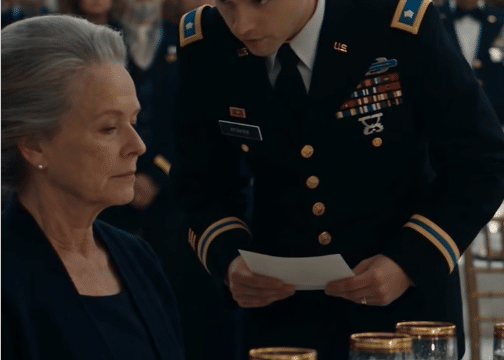
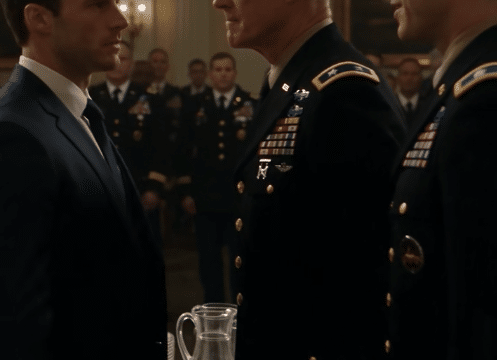
The words cut through the quiet murmur of the military memorial dinner. At the front of the grand hall, beneath portraits of fallen service members and the soft glow of memorial candles, a colonel’s aide stood beside a Lieutenant General and pointed toward an elderly man seated near the head of the room.
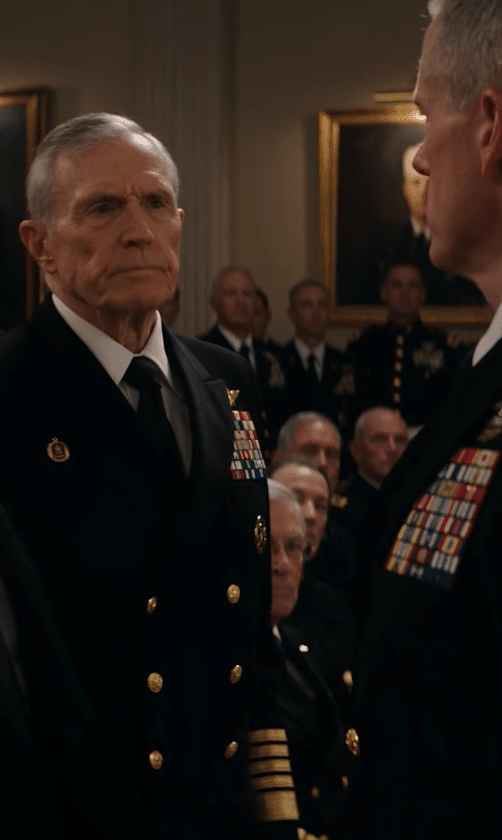
The old veteran wore a simple black suit, a dark tie, and polished shoes that had clearly seen years of service and countless miles. His silver hair was neatly combed, his face weathered, and his hands rested quietly beside a small place card bearing his name.
The Lieutenant General, a broad-shouldered officer of fifty-six in immaculate dress uniform, glanced at the card with open irritation.
“Who assigned him that seat?” he demanded.
The aide hesitated. “It’s on the seating plan, sir. The front section was reserved for invited honorees.”
“That wasn’t my question.”
The elderly man lifted his eyes.
“It was assigned to me.”
He spoke without anger or hesitation. There was no challenge in his voice, no attempt to embarrass the officer. He was simply stating a fact.
But the Lieutenant General had spent too many years believing that every room had a hierarchy and that every person in it should understand his place.
He stepped closer.
“Do you know who you’re speaking to?”
The veteran looked at the three stars on the officer’s shoulders.
“I can see your rank.”
“Then you should understand why I need this seat.”
The old man glanced briefly at the empty chair beside him. “I understand the seating arrangement.”
A few conversations nearby faded. An older couple stopped speaking. Across the table, a retired Army colonel slowly lowered his glass, sensing that the disagreement had become something more dangerous than a question of seating.
The Lieutenant General’s jaw tightened.
He reached down, seized the place card, and tore it from the table.
“Old men like you mistake courtesy for authority,” he snapped.
Before the veteran could respond, the officer struck him hard across the cheek.
The impact echoed through the hall.
The elderly man staggered sideways, catching the edge of the table with one hand. A glass rattled against a plate. Someone gasped. For a moment, the only sound was the faint crackle of candles and the hurried scrape of a chair against the floor.
The veteran steadied himself.
His cheek was already reddening, and a faint trace of blood appeared at the corner of his lip. He drew one careful breath and straightened his jacket.
The Lieutenant General mistook that effort to regain his balance for another act of defiance.
He drove a forceful kick into the man’s torso.
The veteran fell beside the memorial chair, one hand pressing against his ribs as pain tightened his face. The people closest to him recoiled, but no one moved quickly enough to prevent what had happened.
The officer stood over him.
“Old veterans don’t take command seats.”
The insult was louder than it needed to be. He wanted the entire room to hear it. He wanted every person watching to understand that his rank placed him beyond challenge.
The old man remained on the floor for a moment, breathing through the pain.
Then he planted one hand against the chair and pushed himself upright.
It was not graceful. His body hurt, and the movement cost him more than he allowed his face to reveal. But when he stood, he returned to the exact place where he had been seated.
Beside the assigned chair.
Not begging. Not shouting. Not reaching for a medal or announcing a rank.
The Lieutenant General stared at him, visibly offended that the beating had failed to produce the submission he expected.
“You really want to make this worse?” he asked.
The veteran said nothing.
Then his jacket shifted.
And something hidden inside the lapel caught the light.
The Lieutenant General hadn’t noticed it.
But a retired admiral seated only a few feet away had.
And the moment the admiral saw that ribbon, the expression on his face changed completely.
What he recognized was not merely an old decoration. It was a piece of history that almost no one in that room was supposed to recognize.
Act II
The dinner had been organized to honor military personnel who had died in service, along with the veterans who had carried their memories long after the official ceremonies ended.
Every detail had been chosen to reflect dignity. Black-and-gold decorations framed the stage. White candles burned beneath photographs of the fallen. Place cards separated active commanders from retired officers, distinguished guests, and the families invited to remember those who had never returned home.
For most attendees, it was an evening of speeches, handshakes, and solemn promises that sacrifice would never be forgotten.
For the elderly veteran, it was something far more personal.
He had arrived early, before the hall filled with polished uniforms and the low hum of conversations. He had paused in front of several portraits, reading the names beneath them with the quiet concentration of someone who understood that every name represented a life that had once seemed ordinary.
A young lieutenant had greeted him near the entrance and checked his invitation.
“General, your place is ready.”
The old man had gently corrected him.
“Just put me where the card says.”
The lieutenant, unfamiliar with his face, had assumed the guest was one of the many retired veterans invited through a local service organization. He had shown him to the front memorial section, where a place card had already been arranged.
The elderly man had thanked him and sat down.
He had no interest in being announced. He had no desire to draw attention to himself. The people who mattered to him were not there to applaud him, and the dead certainly weren’t waiting for him to recite his accomplishments.
He had come because one of the names on the wall belonged to a man who had once saved his life.
And because, after so many years, he still felt that leaving that man unremembered would be a second kind of abandonment.
The Lieutenant General, by contrast, had arrived with a very different purpose.
He was accustomed to ceremonial rooms where the seating chart was another instrument of command. He knew which officers were likely to be promoted, which guests had access to senior leadership, and which photographs would appear in official publications the following morning.
To him, the front section was not simply a place to honor the dead. It was a visible map of influence.
He had expected a seat near the senior officials and the retired admirals whose reputations still carried weight. When he discovered that his preferred chair was occupied, he had interpreted the inconvenience as an insult.
The colonel’s aide had encouraged that interpretation.
“Sir, the front row is filling up. I thought you should know that a retired veteran is sitting in the place reserved for command.”
The aide had not checked the seating plan carefully enough. Or perhaps he had checked it and decided that the old man would be easier to move than the officer demanding the chair.
Either way, he had delivered the problem to his superior as though it were a breach of discipline.
The Lieutenant General had accepted the accusation without asking a single question.
That was the first mistake.
The second was assuming that a man who dressed modestly must have lived modestly in every sense that mattered.
The third was believing that the absence of visible medals meant the absence of history.
Across the table, the retired admiral had watched the exchange develop with increasing concern. At seventy-five, he had spent enough time around military leadership to recognize the difference between authority and insecurity.
He knew the Lieutenant General by reputation. The officer was considered decisive, ambitious, and particularly sensitive to public challenges. He could be charming when surrounded by people who might help his career, but he had a habit of turning small disagreements into tests of obedience.
The admiral had seen that tendency before.
Usually, someone interrupted before it became physical.
Tonight, nobody had.
He had been preparing to rise when the first punch landed. The kick had followed so quickly that his chair scraped backward, but by then the veteran was already down.
Now he watched the old man stand again.
There was pain in the veteran’s breathing. His cheek had swollen, and he kept one hand close to his torso. Yet his gaze remained steady.
He wasn’t trying to win an argument.
He was refusing to let another man turn a memorial into a private display of power.
Then the jacket moved, and the admiral saw the ribbon.
His fingers tightened around the edge of the table.
For several seconds, he could no longer hear the conversations around him. The room seemed to recede, leaving only the small strip of color inside the old man’s lapel.
He knew that ribbon.
He had not seen one in decades.
And he had never expected to see one worn by a man whose face he had failed to recognize.
The admiral rose so abruptly that his chair struck the floor behind him.
“General… don’t touch him again.”
The Lieutenant General turned, annoyed.
“Admiral, this is an internal command matter.”
“No,” the older man replied. “It isn’t.”
The quiet certainty in his voice unsettled several officers who had been content to watch in silence.
The Lieutenant General glanced toward the veteran’s jacket, then back at the admiral.
He saw an old ribbon.
Nothing more.
“It’s an old ribbon,” he said with a dismissive laugh.
The admiral did not laugh with him.
And the old veteran finally lifted his eyes toward the man who had recognized what he was wearing.
“He remembers how few came home with it.”
The admiral’s expression tightened.
The Lieutenant General’s smile began to fade.
Because there was something in those words that the old officer understood, even if he did not yet understand why.
The ribbon belonged to a chapter of military history that was rarely discussed at public dinners.
A chapter with too many missing names.
And an ending that had never been as clean as the official records suggested.
The Lieutenant General had spent years collecting honors. He was about to discover that one small ribbon could carry more weight than every decoration on his uniform.
Act III
The Lieutenant General looked at the veteran’s lapel again.
He had seen thousands of military decorations during his career. Most could be identified by shape, color, or the service records associated with them. Some marked courage under fire. Others recognized long service, distinguished command, or participation in operations that had become part of official history.
But this ribbon was different.
It was partly concealed, tucked into the inside of an ordinary black jacket rather than displayed prominently on the veteran’s chest. Its edges were worn, its fabric softened by time.
It looked almost insignificant beside the rows of bright decorations on the Lieutenant General’s dress uniform.
That was why he dismissed it.
He had built his career around visible recognition. To him, a decoration mattered because others could see it, identify it, and understand what it said about the person wearing it.
The old man had hidden his.
The admiral, however, was no longer looking at the ribbon as an object.
He was looking at the person wearing it.
His expression had changed from alarm to something much harder to witness: grief mixed with reverence.
“Where did you get that?” the Lieutenant General demanded.
The veteran studied him.
“I didn’t get it from anyone.”
“That isn’t an answer.”
“It is the only one you need.”
The officer took a half-step forward, but the admiral moved between them.
“Stand where you are.”
It was not shouted. It did not need to be.
The retired admiral had spent years in rooms where a single sentence could stop a discussion, redirect a mission, or send men into danger. He no longer held active command, but there was nothing uncertain about his posture now.
The Lieutenant General looked from him to the old man.
“You’re going to explain why this civilian is occupying a command seat and why everyone is suddenly treating him like a national monument.”
Nobody answered immediately.
The aide who had initiated the confrontation lowered his eyes. A few minutes earlier, he had been eager to demonstrate that he understood the chain of command. Now he seemed unable to decide where to stand.
The veteran adjusted his jacket, wincing slightly as the movement pulled against his injured torso.
“I’m not asking anyone to treat me like anything,” he said.
“Then tell me who you are.”
The old man glanced at the photographs along the wall.
For a moment, he seemed to be listening to something beyond the room: a voice from another time, a distant engine, the silence that followed a radio transmission no one wanted to receive.
“I came to remember the men whose names are on those walls.”
“That’s not what I asked.”
“No,” the veteran replied. “It isn’t.”
The admiral looked at him, and the two men exchanged a glance so brief that almost everyone missed it.
Almost everyone except the Lieutenant General.
Something passed between them that had nothing to do with the formal hierarchy of the room. It was not the strained politeness of acquaintances or the deference of a junior officer to a senior one.
It was recognition.
The kind that came from shared danger, from decisions made when every available choice carried a cost, from knowing exactly what another man had endured because you had been there when it happened.
The Lieutenant General’s irritation sharpened into suspicion.
“Admiral, do you know him?”
The older man did not immediately answer.
He was studying the veteran’s face now, tracing the lines around his eyes and the silver hair above his temples. Time had changed the man. It had taken away the strength of youth, softened his movements, and left pain in the way he stood.
But the eyes were the same.
The admiral remembered those eyes beneath a different light, in a place where the distinction between courage and desperation had been almost impossible to make.
He remembered a voice over a failing communications channel.
He remembered an order that had never appeared in the public account of the operation.
And he remembered the names of men who had not returned.
“You were told not to display it,” the admiral said quietly.
The veteran glanced down at his lapel.
“I haven’t displayed it.”
“No,” the admiral replied. “You haven’t.”
The Lieutenant General looked between them, growing more unsettled with every unanswered question.
“What operation are you talking about?”
The admiral’s gaze snapped toward him.
“Be careful.”
The warning was unmistakable.
The old veteran remained silent. He did not confirm the operation, name a unit, or offer an account of the mission. He did not even try to make the officer understand what he had done.
That restraint made the situation worse.
If the veteran had started boasting about his past, the Lieutenant General could have dismissed him as a bitter old man trading on forgotten glory. If he had produced a stack of medals, the officer could have demanded to inspect them.
Instead, the old man simply stood beside his assigned seat, holding his injured torso as discreetly as possible.
The ribbon remained partly visible.
And the admiral looked at it as if he were seeing a name on a casualty list.
The Lieutenant General’s confidence began to fracture. He had expected a confrontation that would end with a chair being vacated and a room reminded of his rank.
Instead, the most senior person present outside active command was warning him not to take another step.
“Who is he?” the officer demanded again.
This time, the admiral answered with a question of his own.
“Have you ever read the full report?”
“What report?”
“The one that was never included in the public history.”
The Lieutenant General went still.
He had encountered references to classified operations during staff assignments and advanced command briefings. Some were little more than coded entries in archived files. Others were connected to decisions that senior officers discussed only behind closed doors.
There was one particular operation whose official account had always struck him as incomplete.
An operation with an unusually high casualty rate.
An operation praised in formal histories for its strategic outcome, while the individual actions of the people involved were recorded in remarkably vague language.
He had never been given a reason to look deeper.
Now, for the first time, he wondered whether he had mistaken the absence of detail for the absence of significance.
The admiral saw the realization beginning to take shape.
But he did not rescue the officer from it.
The truth was not going to arrive as a speech. It was already standing in front of him, wearing an ordinary suit and refusing to ask for respect.
Act IV
The silence spread across the hall.
An officer near the stage quietly asked a member of the event staff to contact the military police liaison assigned to the dinner. No one announced the request, but the movement of the staff member drew several eyes toward the entrance.
The Lieutenant General noticed.
“There’s no need for that,” he said sharply.
The officer who had made the request did not look away.
“Sir, a guest has been assaulted.”
For the first time that evening, someone had addressed what had actually happened rather than the inconvenience that had preceded it.
The Lieutenant General turned toward the aide.
“You said he was refusing a lawful instruction.”
The colonel’s aide swallowed.
“I said he wouldn’t give up the seat, sir.”
“That isn’t what I asked.”
The aide’s eyes moved toward the place card lying crumpled on the floor. He had seen the seating plan before the dinner. He knew the front section had been reserved for invited honorees, and he had not confirmed that the elderly man was in the wrong place.
“I didn’t verify the assignment,” he admitted.
The words were quiet, but the people nearest him heard them.
The Lieutenant General stared at him, suddenly aware that the explanation he had used to justify the confrontation was collapsing in front of witnesses.
“You brought this to me as a disciplinary problem.”
“I thought you should know, sir.”
“You thought I should know,” the officer repeated, as if the words might somehow restore his authority.
The admiral stepped aside, giving the old veteran room to sit if he wanted.
The veteran remained standing.
“Please,” the admiral said softly. “Let someone look at your injuries.”
“In a moment.”
“You’ve been struck twice.”
“I know.”
The exchange was so ordinary, so free of ceremony, that several people watching felt a strange tightening in their chests. The veteran did not seem interested in punishing anyone. He was not searching the room for allies or waiting for a senior officer to announce his importance.
He wanted to finish the evening he had come for.
The admiral understood that impulse. He had seen it in men who had survived events they rarely discussed. They could endure pain more easily than they could endure watching someone turn their sacrifice into a spectacle.
But the evening could not return to what it had been.
The Lieutenant General looked once more at the ribbon.
“Are you saying that decoration gives him the right to ignore a senior officer?”
The admiral’s face hardened.
“No.”
The answer seemed to surprise him.
The admiral continued.
“I’m saying that nothing gives you the right to strike a man because he won’t surrender an assigned seat.”
The officer opened his mouth, but the admiral raised one hand.
“And if you believe that ribbon makes the difference, you’ve misunderstood the entire point.”
For several seconds, nobody spoke.
The veteran finally turned toward the portraits along the wall. He had not come to this dinner for the living to argue about his status. He had come to honor the dead, and every passing minute was carrying him further away from the reason he had entered the building.
“Those men never asked what rank someone held before they helped him,” he said.
His voice remained low, but the room was quiet enough for everyone nearby to hear.
“They didn’t ask how many decorations a man wore. They asked whether he would stay when staying became difficult.”
The Lieutenant General looked away.
He had spent his adult life learning the formal language of military leadership: readiness, accountability, discipline, operational success. He understood the structures that kept large organizations functioning. He understood that command required difficult decisions and that respect could not depend on popularity.
But he had confused being obeyed with being respected.
Worse, he had treated the absence of visible status as proof that a person could be humiliated without consequence.
The admiral looked toward the event staff.
“Get a medical officer here. And preserve the seating plan and witness statements.”
“Admiral,” the Lieutenant General interrupted, “I can handle this through my chain of command.”
“Then you should have remembered that chain before you used your rank to strike a guest.”
The words landed with the weight of a formal reprimand, though no document had yet been written.
The officer’s face reddened.
“You don’t know the circumstances.”
“I saw them.”
“You saw a few seconds.”
“I saw enough.”
The admiral moved closer, lowering his voice so that only the officers nearest them could hear the next words clearly.
“Whatever you think that ribbon means, do not assume the man wearing it owes you an explanation.”
The Lieutenant General glanced at the veteran.
For the first time, he seemed to notice how carefully the old man was controlling his breathing. How one hand remained near his ribs. How he had not once raised his voice, even after being punched and kicked in front of an entire room.
The officer had thought silence meant weakness.
Now he wondered whether the veteran’s silence was the last courtesy he was going to receive.
The aide stood motionless beside the table. His earlier confidence had disappeared, replaced by the uneasy awareness that he had helped set the entire incident in motion.
A medical officer arrived and approached the veteran with a small first-aid kit.
“Sir, may I examine you?”
The old man nodded.
As the medic guided him toward a nearby chair, the veteran paused beside the place card the Lieutenant General had torn away. He bent carefully, picked it up, and placed it on the table.
He smoothed the crease with his thumb.
Then he sat down.
The gesture was so small that it might have gone unnoticed in any other room.
Here, it felt like a judgment.
The veteran had not demanded that the officer be thrown out. He had not ordered anyone to stand at attention. He had simply returned the damaged place card to its proper place, as though the evening could still be rescued from the behavior of one man.
The admiral watched him, his eyes bright with an emotion he refused to display.
The Lieutenant General followed that look.
And the thought he had been trying to avoid finally became impossible to ignore.
The old man had not used the ribbon to establish authority.
He had hidden it.
He had not demanded recognition.
He had avoided it.
Which meant the history attached to that decoration was not something he had brought into the room to impress anyone.
It was something he had carried quietly for decades.
The Lieutenant General felt his mouth go dry.
He had seen references to that operation in a restricted command briefing years earlier. The details had been sparse, but one sentence had stayed with him: the outcome had depended on a small group whose losses were never fully acknowledged in the public record.
He remembered the briefing officer’s warning not to speculate about the individuals involved.
He remembered a list of names that had not appeared on the summary slide.
And now he remembered another detail: the few survivors who had received a particular recognition were not celebrated in the usual way. Their service was treated with a kind of solemn discretion, as if the distinction belonged as much to the missing as it did to the living.
The officer’s gaze returned to the ribbon.
His voice, when he spoke, was no longer loud.
“Admiral…”
The older man did not answer.
The Lieutenant General swallowed.
“How many people received it?”
The admiral looked at the veteran, waiting for him to decide whether the question deserved an answer.
The old man lifted his eyes.
“Enough to remember the men who didn’t.”
It was not a number.
It was not a confirmation.
But it was the closest thing to an answer the Lieutenant General was going to receive.
And somehow, it frightened him more than a full explanation would have.
Because he was beginning to understand that the ribbon represented not a career he could compare with his own, but a price he had never been asked to pay.
Act V
The military police liaison arrived before the dinner resumed.
By then, the room had changed completely. The candles still burned, the portraits still watched from the walls, and the formal decorations remained untouched. Yet nobody was speaking about the menu or the upcoming speeches.
Every conversation had become quieter.
Witnesses were asked to describe what they had seen. The event staff produced the seating plan. The colonel’s aide acknowledged that he had failed to verify the assignment before reporting the matter to his superior.
The Lieutenant General was asked to remain while the initial accounts were collected.
He objected once.
Then he saw the admiral’s expression and stopped.
The veteran was examined by the medical officer. His cheek had swollen, his lip showed a faint trace of blood, and his torso was painful enough to require further evaluation. He answered the medic’s questions clearly, refusing neither treatment nor assistance, but he did not use the examination as an opportunity to accuse the man who had struck him.
When the admiral approached, the veteran was sitting beside the memorial chair, his hands resting loosely in his lap.
“I should have moved sooner,” the admiral said.
The old man looked at him.
“You stood when it mattered.”
“Not soon enough.”
“No.”
The answer was gentle, but it was honest.
The admiral lowered his eyes. For a moment, the two men seemed much older than they had a few minutes earlier, not because of their age, but because the past had returned to the room and demanded to be acknowledged.
“I thought I would never see that ribbon again,” the admiral said.
“Neither did I.”
“Why wear it tonight?”
The veteran looked toward the photographs.
“Because one of the men on that wall wore the same colors on the day we lost him.”
The admiral said nothing.
“He never received the recognition he deserved,” the old man continued. “His name was left out of the first account. By the time the record was corrected, most people had stopped looking.”
The admiral sat beside him.
“I remember.”
“Then you know why I came.”
The older man nodded.
For years, the veteran had avoided public ceremonies. He had declined invitations to speak, ignored requests for interviews, and left his old decorations in a drawer where visitors would never notice them. He had not wanted his life reduced to a heroic anecdote or his friends turned into supporting characters in a story about his survival.
The men who had died were not there to correct anyone.
He had always believed that remembering them required something more than applause.
It required telling the truth, even when the truth was inconvenient.
The Lieutenant General watched from several feet away.
He could no longer pretend that the incident had been a simple disagreement over seating. His actions had been witnessed by officers, veterans, event staff, and people who had come to honor the dead. Whatever his intentions had been, he had used his rank to assault an elderly guest whose only offense was refusing to surrender a place that had been assigned to him.
The ribbon had not created the wrongdoing.
It had merely exposed how little he had understood the man he had attacked.
An officer from the investigation team approached the Lieutenant General and asked him to accompany them to a separate room to provide a formal account.
The officer’s face had gone pale.
Before leaving, he turned toward the veteran.
“I didn’t know who you were.”
The old man studied him for a long moment.
“That was never the problem.”
The Lieutenant General seemed unable to find an answer.
“You could have told me,” he said at last.
The veteran’s expression did not change.
“Would that have stopped you?”
The officer looked down.
There was no honest answer he could give.
If the old man had announced that he was a retired four-star general, would the punch have remained suspended in the air? If he had listed his service record, would the kick have been withheld? If he had displayed the ribbon openly, would the Lieutenant General suddenly have discovered the dignity he had failed to show an ordinary veteran?
The questions answered themselves.
The admiral rose and offered the old man his arm.
This time, the veteran accepted the assistance.
As they walked toward the front of the hall, several guests stood. One by one, others followed. No announcement had been made, and nobody instructed them to rise. The movement spread through the room quietly, without applause or ceremony.
The veteran glanced around, uncomfortable with the attention.
“Please,” he said. “Sit down. We’re here for them.”
He nodded toward the portraits.
The guests obeyed, though a few remained standing until he had reached his seat.
The Lieutenant General was escorted through a side door. He did not look back until he reached the threshold.
From there, he could see the old veteran seated beneath the photographs, the damaged place card restored to the table in front of him.
The ribbon had disappeared inside the lapel again.
No one had demanded that it be displayed.
No one had asked for its official name.
And the admiral had not told the room what he knew.
The Lieutenant General stared at the small, ordinary detail of the man’s jacket and felt the last of his certainty give way.
He had imagined that history belonged to people who had been promoted, photographed, and remembered in official ceremonies.
But some of the most consequential people in that history had gone home quietly. Some had spent the rest of their lives refusing to make their sacrifices into a spectacle. Some had carried the names of the dead more carefully than they carried their own honors.
The old veteran had been one of them.
The admiral knew it.
And now the Lieutenant General understood enough to be afraid of what the complete record might reveal.
“How few…?” he whispered.
No one answered him.
The door closed behind him, and the sound of the memorial dinner returned in fragments: the faint movement of chairs, the soft clink of glass, the low voices of people trying to decide how to continue an evening that could never again be ordinary.
At the front of the hall, the veteran reached into his jacket and touched the hidden ribbon once.
Then he lowered his hand.
He had not come to prove that he was more important than the man who had attacked him. He had come to honor people who could no longer speak for themselves.
The investigation would determine the Lieutenant General’s professional consequences. Witness statements would establish what happened, and the official record would preserve the assault that rank had failed to excuse.
But the deeper lesson had already been delivered.
The ribbon had not made the old man worthy of respect.
He had been worthy of respect before anyone recognized it.
And somewhere beneath the black-and-gold decorations, beneath the polished uniforms and carefully arranged chairs, the faces of the fallen seemed to ask the question that had haunted the veteran for decades:
When the moment comes, will the living remember what the dead stood for?
That night, one powerful officer had learned the answer too late.
He had mistaken an ordinary suit for an ordinary life.
He had mistaken quiet dignity for weakness.
And he had struck a man whose greatest distinction was not that he had survived a terrible chapter of military history.
It was that he had never forgotten the people who had not.