Act I
The place card crumpled in Major General Richard Vance’s fist was worth more than he could possibly understand.
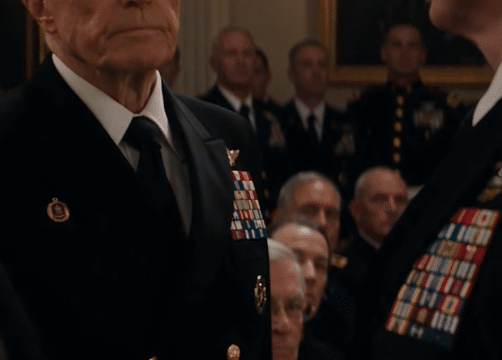
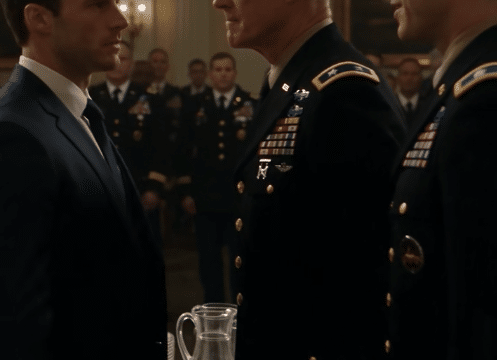
Across the ballroom, an orchestra played beneath glittering chandeliers while senior officers and their families gathered for the anniversary gala of one of the military’s most prestigious commands. Gold-trimmed flags stood beside the stage, crystal glasses caught the candlelight, and every detail had been arranged to honor decades of service.
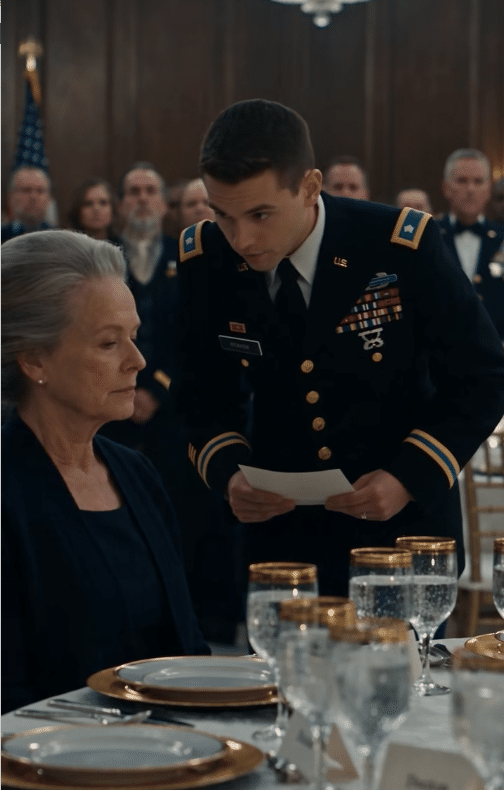
At the front command-family table, an elderly woman in a simple dark dress stood beside a chair with her name on it.
She had silver hair, a thin cardigan, and a small handbag hanging from one arm. Her shoes were polished but old-fashioned, and nothing about her appearance suggested wealth or influence. She looked like someone who had come to honor a loved one, not someone who expected an entire ballroom to make room for her.
A young protocol aide approached Vance with a troubled expression.
“General, she says that front seat belongs to her.”
Vance turned, already irritated. He had spent the evening watching officers compete for his attention, and the last thing he wanted was a seating dispute in front of his superiors.
He looked at the woman’s clothes, then at the place card in her hand.
“Is that right?” he asked.
The woman met his eyes without flinching.
“It has my name on it.”
Her answer was quiet. It contained no accusation, no demand for special treatment, and no attempt to impress him. She was simply stating a fact.
But Vance had spent too many years confusing authority with the right to get his way. To him, a calm refusal from someone he considered beneath him was more offensive than an open insult.
He snatched the place card from her fingers and crushed it.
Then he struck her across the face.
The sound cut through the orchestra’s music. The woman stumbled sideways and fell beside the command-family chair, one hand catching the floor as her handbag slipped away. A red mark spread across her cheek, and a faint trace of blood appeared at her lip.
The ballroom fell silent.
Before anyone could process what had happened, Vance delivered two brutal kicks to her back and side. Her breath left her in a sharp gasp. He kicked her handbag away and dragged the chair aside, as if removing the woman from the space mattered more than the fact that he had just assaulted an elderly guest in front of dozens of witnesses.
She remained on the floor, visibly hurt, but she did not beg him to stop.
Vance looked down at her uniformed audience, apparently pleased with the lesson he believed he had taught.
“Command families don’t arrive looking like this.”
The words were almost worse than the blows.
Several spouses stared at him in disbelief. A colonel near the stage lowered his glass. The young protocol aide stood frozen, his face draining of color as he realized that his uncertainty about a seating chart had become something no polite explanation could repair.
The woman braced one hand against the floor.
She could have screamed. She could have called him a coward. She could have demanded to know whether his uniform meant anything at all.
Instead, she slowly pushed herself upright.
Her cheek throbbed. Her breathing was painful, and she needed a moment before she could stand straight. Yet even as she accepted a helping hand from a nearby guest after the assault had ended, her eyes remained fixed on the chair Vance had moved.
She straightened her cardigan.
Then she looked at him again.
Vance mistook her silence for defeat.
He had no idea that the next man to approach her would make the entire ballroom reconsider which person in that room truly possessed authority.
Act II
Her name was Eleanor Cole.
At seventy-one, Eleanor had become accustomed to being underestimated. She had never cultivated the polished image of a military spouse who knew every protocol officer, every seating tradition, and every person whose opinion mattered in a room full of brass.
She preferred quiet restaurants, old photographs, and handwritten letters. She wore the same simple watch she had owned for years, carried a small handbag repaired twice by a local leatherworker, and considered a person’s manners more revealing than the number of stars on his shoulders.
There had been a time when she lived close enough to military life to recognize its rhythms without needing anyone to explain them. She understood the long absences, the late-night telephone calls, the careful silences that followed certain assignments, and the way a family learned to read the difference between ordinary exhaustion and the kind that changed a person.
But Eleanor had never used that knowledge to demand attention.
The invitation to the anniversary gala had arrived several weeks earlier. It was addressed to her by name, and the enclosed seating card assigned her a place at the front command-family table, beside the chair reserved for the evening’s senior honoree.
She had called to confirm the arrangement.
The staff member who answered checked the roster and assured her that everything was correct. Her place was not a courtesy extended at the last minute. It had been planned, approved, and recorded.
Eleanor arrived early because she disliked making an entrance after a program had begun. She checked in, gave her name to the attendant, and followed the directions to the front table.
Then the protocol aide noticed her.
He had been working the gala for only a few months, but he had already absorbed the dangerous lesson that appearances could be used as a shortcut to judgment. The guests who arrived in expensive evening clothes and tailored uniforms seemed to belong. The people who did not match the room’s expectations seemed to require additional scrutiny.
Eleanor had looked at him patiently while he checked his list.
When he found her name, he hesitated.
Then someone called him away.
Vance arrived moments later, saw the woman standing beside the chair, and assumed the matter was obvious. He did not ask the seating coordinator to verify the card. He did not call the event director. He did not even consider the possibility that a woman in a modest dress might have been invited for a reason he did not know.
He simply decided she was in the wrong place.
That decision revealed more about him than any speech he would give that night.
Vance had spent years building a reputation as a demanding officer. Some subordinates admired his decisiveness. Others learned to anticipate his moods and agree with him before he finished speaking. He believed discipline meant immediate obedience, and he had grown increasingly comfortable treating embarrassment as a useful management tool.
His ambition was not necessarily visible to everyone, but it shaped nearly every interaction. He wanted the front tables to notice him. He wanted the senior command staff to see a man who could control a room with a glance.
Eleanor’s refusal threatened that image.
She had not challenged his rank. She had not raised her voice or drawn attention to herself. She had merely declined to surrender a seat assigned to her.
For Vance, that was enough.
Now, as the orchestra remained silent and the guests stared at the aftermath, Eleanor saw the young protocol aide looking toward her with helpless regret.
She gave him the smallest shake of her head.
It was not permission to forget what he had witnessed. It was a quiet instruction not to make the moment about himself.
Then she turned back toward the front table.
The chair stood several feet away from where it belonged. Her place card lay crushed on the floor, its printed name hidden inside Vance’s fist-shaped folds.
She wanted that chair restored.
Not because she needed to sit above anyone else, and not because she intended to punish the man who had attacked her.
She wanted the event to continue as it had been planned, with the people being honored treated as more important than the people trying to impress one another.
But before anyone could return the chair to its place, the ballroom doors opened.
A retired general had just arrived.
And the moment he saw Eleanor, his expression changed completely.
Act III
General Thomas Whitaker had retired four years earlier, but the room still seemed to make space for him when he entered.
He wore a dark civilian suit rather than a uniform. His silver hair was neatly combed, and his posture carried the unmistakable precision of someone who had spent a lifetime moving through rooms where every gesture could be interpreted as a statement.
He had been delayed by a traffic accident outside the installation. His original plan had been to meet Eleanor at the entrance and escort her to the front table himself.
Instead, he saw her standing beside a displaced chair, her cardigan crooked and one cheek visibly swollen.
For a second, Whitaker appeared unable to believe what he was seeing.
Then he crossed the ballroom.
“Mrs. Cole… forgive me. I should’ve met you at the entrance.”
He reached her only after the assault had ended, offering his arm so she could steady herself without making a spectacle of the help. Eleanor accepted, but she did not lean on him more than necessary.
Whitaker’s eyes moved to her cheek.
The warmth vanished from his face.
He turned toward Vance.
“General, do you have any idea who this woman is?”
Vance straightened his uniform. The presence of a retired general should have encouraged him to reconsider what he had done. Instead, he seemed offended that someone had interrupted his attempt to restore order.
He glanced at Eleanor, then back at Whitaker.
“She’s nobody. Just some old woman trying to steal a command seat.”
The words traveled farther than Vance intended.
An officer near the stage lowered his head. The protocol aide looked as though he wished the floor would open beneath him. Even people who had not witnessed the first blow understood from Whitaker’s expression that the situation was far more serious than a dispute over seating.
Whitaker did not shout.
He looked at Vance for a long moment, as if giving him one final opportunity to hear himself.
Then he asked a question that made the atmosphere in the ballroom change.
“Does Black Eagle know you’re here?”
At the front table, Lieutenant General Marcus Reed stopped moving.
He had been speaking to another senior officer when the nickname reached him. Now he turned sharply toward Whitaker, his expression tightening as recognition spread across his face.
Reed looked at Eleanor.
Then he looked at Vance.
“General… stop. Right now.”
His voice was low, but it carried the unmistakable urgency of an order that had become necessary too late.
Vance blinked.
He had expected Whitaker to defend a fellow guest, perhaps to lecture him about manners or remind him that the evening was meant to honor service. He had not expected another active-duty general to intervene with such visible alarm.
Still, he was unwilling to surrender the authority he had spent the evening performing.
He glanced at Eleanor’s simple dress, at her inexpensive handbag lying on the floor, and at the chair he had moved.
“Who is Black Eagle?” he demanded.
Nobody answered immediately.
That silence was different from the silence that had followed the assault. Before, the room had been stunned by cruelty. Now, it seemed to be waiting for a name that everyone important except Vance already understood.
Whitaker’s jaw tightened.
Reed stood perfectly still, his attention fixed on Eleanor. Neither man offered an explanation. Neither attempted to rescue Vance from his own question.
Eleanor, meanwhile, appeared almost detached from the commotion around her. She had spent enough of her life around people who mistook secrecy for importance to know that some names carried their meaning through the reactions they provoked.
She did not need to announce anything about herself.
She did not need to list achievements, produce a document, or demand that someone inspect her invitation.
Instead, she looked toward the command-family table.
Her gaze settled on the chair beside the place where the evening’s senior honoree was expected to sit.
Then she spoke.
“The man whose chair you’re standing beside.”
Vance followed her eyes.
For the first time that evening, he seemed to notice the chair as something other than a piece of furniture he could move to establish dominance. Its position beside the stage, the carefully arranged place settings, and the reserved space around it suddenly looked less like privileges to be guarded and more like a warning he had ignored.
He looked back at Whitaker.
The retired general’s face held no satisfaction. Only anger, concern, and a kind of exhausted disappointment.
Reed had gone pale.
Vance had spent the entire evening judging Eleanor by what he could see.
Now, for the first time, he began to fear what he could not.
And the nickname he had just dismissed was about to become the only thing he could hear.
Act IV
The ballroom seemed to contract around Major General Vance.
He looked from Eleanor to the chair, then toward the two generals standing nearby. He searched their faces for some sign that this was an elaborate misunderstanding, a private joke, or an exaggerated response to a simple mistake.
He found none.
Whitaker remained beside Eleanor, careful not to crowd her. Reed stood several paces away, rigid with the restraint of a senior officer who knew that the wrong words could make an already serious situation worse.
No one rushed to explain.
That was what unsettled Vance most.
In his experience, rank usually came with a familiar choreography. A subordinate made a mistake, a superior corrected it, and everyone moved on. Even serious confrontations often ended with a compromise designed to preserve the institution’s appearance.
But nobody was offering him an easy exit.
Eleanor’s invitation still existed in the event records. Her assigned seat had not become hers because Whitaker recognized her, or because Reed reacted to a nickname. It had been hers before Vance entered the conversation.
The assault had not changed that fact.
It had only exposed his decision to ignore it.
The protocol aide finally stepped forward, clutching the seating roster. His fingers trembled slightly as he opened it and confirmed what he should have verified before approaching Vance.
“Her name is on the approved list, sir.”
It was a small sentence.
It landed like a verdict.
Vance turned on him. “You told me there was a problem.”
The aide swallowed. “I told you she was disputing the seat, sir. I hadn’t confirmed the assignment when you approached.”
He did not attempt to shift all the blame onto his superior. His own failure was clear, and the shame on his face suggested he understood it. But his answer also made the sequence impossible to disguise.
Vance had acted before the facts were established.
He had escalated before asking a single useful question.
And when the woman he had assaulted refused to surrender a place assigned to her, he had answered her with violence.
Whitaker glanced at the crushed place card still on the floor.
“Pick it up,” he said.
Vance looked at him sharply.
Whitaker did not repeat the instruction. He did not need to. The room had heard enough orders that evening, and everyone understood how little it would take for the moment to become another display of Vance’s pride.
Slowly, Vance bent and retrieved the card.
He tried to smooth it with his thumb, but the folds remained. Eleanor watched without speaking.
“Mrs. Cole,” Whitaker said gently, “would you like medical assistance?”
“I’ll have someone examine me,” she replied. “But the child of this command’s legacy isn’t the issue here.”
Her words were quiet, almost weary. She was not asking the room to pity her, and she was not pretending that the pain did not matter. She was refusing to let the evening become a performance centered on her injuries.
Whitaker gave a short nod and signaled for the event medical team.
Only then did he turn back to Vance.
“You assaulted an invited guest over a chair you never bothered to verify.”
Vance opened his mouth.
Perhaps he intended to say that he had been maintaining order. Perhaps he planned to blame the aide, the confusion, or the pressure of hosting a formal event. The first words never came.
Because Reed was still watching him.
And Reed’s expression made it clear that no explanation would erase what had happened in front of him.
Vance looked at Eleanor again, searching for some indication that she would use the name behind Black Eagle to destroy him. He seemed to expect a threat, a declaration of rank, or a demand that he be stripped of his command before the orchestra played another note.
Eleanor offered none.
She simply held out her hand.
Vance stared at it, confused.
“The card,” she said.
He placed the crushed place card in her palm.
She unfolded it as best she could, smoothing the paper with careful fingers. Her name remained legible, though the corners had torn.
Then she handed it to the protocol aide.
“Please restore the seating as assigned.”
The aide accepted it immediately.
Vance watched the exchange, and something in his expression began to collapse. He had expected the revelation to be about power: who could outrank him, who could threaten his career, and whose family name he should have recognized.
But Eleanor was not asking anyone to surrender a seat to her.
She was asking them to put the room back in order.
The distinction was devastating.
For the first time, Vance understood that the chair had never been the real issue. The real issue was that he had decided a person’s dignity could be measured by her clothing, and that his rank gave him permission to enforce that judgment.
Then Eleanor looked at the chair once more.
“Is it ready?” she asked the aide.
He nodded and moved quickly to return it to its proper place.
Whitaker stepped aside to let her pass.
And as Eleanor approached the front table, Vance finally understood that the nickname Black Eagle was not a threat she had chosen to wield.
It was a history he had insulted without knowing whose history it was.
Act V
The medical team examined Eleanor in a quiet room adjoining the ballroom.
Her cheek had swollen, and the faint trace at her lip required attention, but she remained alert and composed. She answered the medic’s questions clearly and insisted that the staff document her injuries accurately.
She did not minimize what had happened.
She simply refused to let it define the rest of the evening.
Outside, the gala did not resume as though nothing had occurred. The orchestra remained silent while senior officers conferred with the event director and security personnel. The protocol aide provided his account. Several guests who had watched the assault agreed to give statements.
Vance was escorted away from the front table while the incident was formally reported through the command’s leadership and investigative channels. He was relieved of his responsibilities for the evening pending review, and his conduct would be examined on the evidence—not on the nickname he had failed to recognize or the people who knew Eleanor.
The distinction mattered.
A powerful family connection could explain why the room had reacted so sharply, but it could not be the only reason Vance faced consequences. He had assaulted a civilian guest in public. The seating record, the witnesses, and the injuries provided their own evidence.
Later that night, when the ballroom had quieted and the guests were preparing to leave, Whitaker found Eleanor near the entrance.
“I should have been there when you arrived,” he said.
Eleanor looked at him for a moment.
“You were delayed.”
“I should have made sure someone was waiting for you.”
“You cannot stand beside everyone every moment of their lives, Thomas.”
He lowered his eyes, accepting the rebuke hidden inside her kindness.
Then he asked the question he had been holding back.
“Have you spoken to him?”
Eleanor knew whom he meant.
“Not yet.”
Whitaker looked toward the ballroom, where the command chair stood restored beside the stage. “He should know what happened.”
“He will,” she said. “But I won’t have someone call him here so that he can frighten a man into behaving decently.”
Whitaker studied her face.
“That isn’t what he would do.”
“No,” Eleanor replied. “But it is what everyone in that room seemed to expect.”
For a moment, neither spoke.
The nickname Black Eagle had followed her family for years, carried in briefings, whispered in old stories, and remembered by people who had witnessed events most of the world would never hear about. It had become attached to a man whose reputation was larger than his public appearances, a man who rarely discussed the moments that had shaped him.
To some, Black Eagle represented command. To others, it meant courage under impossible circumstances. To the people who had served closest to him, the name carried memories that were too personal to be reduced to a legend.
Eleanor had never needed that legend to live her life.
She had raised a child, endured long periods of uncertainty, and learned to recognize the quiet costs of service. She knew the difference between honoring a person’s achievements and treating the person as a symbol.
That was why she had come to the gala.
Not to display a famous name.
Not to demand a privileged place.
She had come because the invitation had been extended to her, and because the evening was meant to honor the people and families who had carried the command through difficult years.
Her assigned chair had been a small acknowledgment of that purpose.
Vance had turned it into a test of status.
When Eleanor finally spoke to her son, she did not begin with the assault. She told him she was safe, that the medical staff had examined her, and that the incident was being handled through the appropriate channels.
Only after he had heard those facts did she tell him what had happened.
There was a long silence on the other end of the line.
Then he asked, very quietly, whether she wanted him to come.
Eleanor looked at the restored place card resting on the table beside her.
“No,” she said. “I want you to understand why I stayed.”
She explained that she had not remained beside the chair to challenge Vance or to provoke a revelation. She had stayed because the seat was assigned to her, because the rules mattered even when someone powerful chose to ignore them, and because surrendering it under threat would have made the lie easier to believe.
Her son listened.
At last, he told her that he understood.
And for the first time that night, Eleanor allowed herself to close her eyes and take a careful breath.
The next morning, the command began its formal review. Vance’s actions would carry professional consequences, and the witnesses’ statements would ensure that the incident could not be dismissed as a misunderstanding over event protocol.
He would have to answer for what he had done without hiding behind his rank.
The protocol aide would also be required to explain why he had presented an unverified seating dispute as a problem for a senior commander. He had not thrown the blows, but he had learned how dangerous it could be to frame a person as an obstacle before confirming the facts.
As for Eleanor, she did not give interviews or release a statement invoking her son’s reputation. She returned to her ordinary life, carrying the memory of the ballroom with the same quiet restraint with which she had entered it.
The command later sent her a formal apology.
She accepted it, but she kept the original place card.
Its folds never entirely disappeared. The paper remained creased where Vance had crushed it, and one corner had torn when she smoothed it back into shape.
She placed it in a drawer beside old family photographs and letters she had saved through years of moves and long absences.
Not as a trophy.
As a reminder.
A uniform could communicate authority. A rank could establish responsibility. A celebrated name could carry the weight of history.
But none of those things guaranteed character.
And a person who truly understood service would never need to know who stood behind an elderly woman before deciding she deserved to be treated with dignity.
Major General Vance had entered the gala believing that the most important person in the room was the one whose rank demanded obedience.
He left the evening facing an investigation, a damaged reputation, and a question he could no longer escape.
Who was Black Eagle?
The answer mattered.
But the more difficult question was the one he had never thought to ask before he raised his hand.
Who was the woman standing in front of him—and why had he believed her dignity was his to take away?