Act I
“Trash. Step away from the donation box.”
The words sliced through the elegant charity gala just as a pregnant woman in a navy-blue gown reached toward the sealed donation box. Seven months pregnant, blonde hair gathered into a low bun, she stood beside the charity table with one hand resting beneath her belly and the other hovering near a strip of adhesive that had begun peeling away from the box.
“The seal is loose,” she explained calmly. “I’m checking it.”
The woman confronting her wasn’t interested in explanations.
Vanessa Cole, the gala’s event director, stood in a silver blazer over a fitted black dress, her staff badge shining beneath the blue-white stage lights. At thirty-eight, Vanessa had built her reputation on absolute control. Every flower arrangement, every guest placement, every donation announcement had to meet her standards.
And anyone who challenged her authority, even accidentally, quickly learned how little patience she had for other people.
She glanced at the pregnant woman’s hand near the donation box, then raised her voice so the nearest guests could hear.
“Do you expect me to believe that? You walk up to a sealed charity box, start touching it, and suddenly you’re performing an inspection?”
The woman withdrew her hand.
“I haven’t opened anything. I noticed the seal was coming loose.”
“Of course you did.”
Vanessa stepped closer, her expression hardening.
Around them, wealthy donors in tuxedos and evening gowns began turning away from their conversations. A waiter paused beside a tray of sparkling water. Two corporate executives exchanged uncomfortable glances.
The woman tried to remain calm.
“Please, I’m not trying to cause a scene. Someone should make sure the donations are secure.”
Vanessa laughed without humor.
“People like you always have a story.”
The pregnant woman stared at her, momentarily speechless.
She was twenty-nine years old. Her name was Claire Whitmore, and she had spent most of her adult life learning that the fastest way to avoid unnecessary attention was to dress simply, speak politely, and never use her family name to get what she wanted.
Her navy maternity gown was elegant but modest. Her white coat was thin, her silver earrings small, and she carried no designer handbag that might have announced her wealth to strangers.
Vanessa saw none of the qualities that might have earned Claire the benefit of the doubt.
She saw someone she believed she could intimidate.
“I’m asking you one last time,” Vanessa said. “Step away from the box.”
Claire took a small step back.
“There. I’m stepping away. Can you please just check the seal?”
Instead of calling security, Vanessa moved directly into her path.
“You don’t get to tell me how to do my job.”
“I wasn’t—”
“Don’t interrupt me!”
The sudden shout silenced the nearest conversations.
Claire instinctively placed both hands against her stomach. She had spent the afternoon feeling unusually tired, and the strain of standing beneath the ballroom lights was beginning to wear on her.
“Please,” she said. “I just want to sit down.”
Vanessa looked at Claire’s belly and sneered.
“Pregnant or not, thieves crawl out.”
A collective gasp rippled through the crowd.
Claire’s face went pale.
“You think I’m stealing?”
“I think I know exactly what this looks like.”
Vanessa’s eyes flicked toward the donation box. The event was raising millions of dollars for a children’s hospital network, and the box had become one of the evening’s most closely watched symbols. Vanessa had spent weeks preparing the gala, and she had convinced herself that any irregularity near the donations reflected directly on her competence.
But the loose seal was real.
And Claire had noticed it before anyone else.
Vanessa could have checked the security log. She could have asked a staff member to inspect the box. She could even have requested Claire’s name.
Instead, her pride took over.
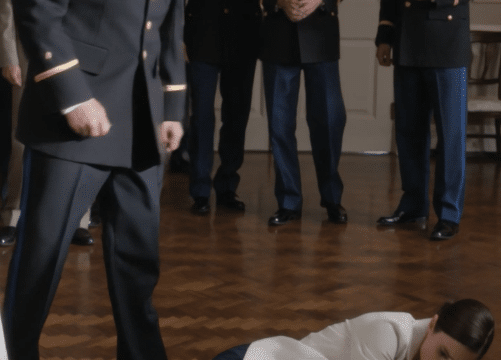
With a sudden burst of anger, Vanessa drove a forceful kick into Claire’s chest, knocking her sideways beside the donation table.
Claire struck the floor, her elbow scraping against its hard surface. A thin trace of blood appeared along her skin as she curled inward, gasping and instinctively protecting her unborn child.
For one terrible second, the guests simply stared.
Then Vanessa stepped around her.
She delivered two more forceful kicks into Claire’s back while the pregnant woman struggled to shield herself.
A woman near the stage covered her mouth. Someone dropped a champagne glass. The sharp crash seemed to echo across the entire ballroom.
Still, nobody moved to stop Vanessa.
She stood over Claire, breathing hard, her expression filled with contempt rather than remorse.
“Pregnant or not,” she repeated, “you don’t get to steal from these people.”
Claire could barely lift her head.
“I didn’t steal anything.”
Vanessa leaned toward her.
“Then you should have thought about that before you touched the box.”
Behind the stage curtain, a man who had been preparing to address the gala heard the commotion.
He stepped out quickly, his silver hair catching the blue-white lights. His black suit was immaculate, but his expression changed the instant he saw the woman on the floor.
He stopped.
The crowd parted.
And the sixty-year-old chairman of Whitmore International walked toward the donation table with a look that made even the most powerful executives in the room fall silent.
“Step,” he said, his voice shaking with restrained fury, “away from my daughter.”
Vanessa turned.
For the first time that evening, she had absolutely nothing to say.
And when she finally understood whose daughter she had attacked, the entire future she had spent years building began to disappear.
Act II
Claire Whitmore had never wanted to be the most recognizable person in her father’s company.
Her father, Edward Whitmore, had built Whitmore International from a regional logistics business into one of America’s largest privately held corporate groups. Over four decades, he had expanded into healthcare infrastructure, transportation, technology, and charitable investment.
His name appeared on hospital wings, scholarship programs, and community centers across the country.
To the business world, Edward was a formidable chairman. He was known for his discipline, his refusal to tolerate dishonesty, and his habit of asking difficult questions when everyone else was celebrating good numbers.
At home, however, he was simply a father who had spent too many years confusing protection with control.
When Claire was younger, she had watched strangers change their behavior the instant they discovered who he was. Teachers became unusually accommodating. Shopkeepers offered discounts she had never requested. People who barely knew her suddenly wanted to be her closest friends.
By the time she reached college, she had learned to introduce herself using only her first name whenever possible.
She wanted people to know her for herself.
After graduating, Claire worked with a nonprofit organization that helped families navigate medical expenses and access community healthcare programs. She spent weekends visiting local hospitals, listening to parents describe bills they could not pay, and helping small charities organize fundraising drives.
Her father had offered her a position in the family business more than once.
She declined every time.
“I don’t want a job because of your name,” she once told him. “If I ever work for your company, I want to earn the right to be there.”
Edward had been disappointed, but he respected her determination.
When Claire married Daniel Whitmore, a quiet architect she had met at a hospital renovation project, Edward welcomed him into the family with cautious warmth. Daniel wasn’t impressed by corporate power, and he had never treated Claire as an extension of her father’s fortune.
For the first time in years, Edward believed his daughter had found someone who understood her.
Now Claire was expecting their first child, and Edward had been looking forward to becoming a grandfather with a mixture of excitement and nervousness he rarely showed in public.
The charity gala was supposed to be a joyful evening.
Whitmore International had partnered with several medical foundations to fund new pediatric treatment centers. Edward planned to announce a major expansion of the program before the evening ended, and Claire had volunteered to review a few details because of her experience with nonprofit fundraising.
She had arrived early enough to walk through the donation area.
That was when she noticed the seal.
The transparent strip securing the collection box had lifted at one corner. It might have been a simple adhesive failure, but Claire knew that charity funds required careful handling. If the seal was damaged after the event, the organization could face unnecessary questions about whether the box had been tampered with.
She intended to notify the event director.
She never imagined the event director would accuse her of theft.
Vanessa Cole, meanwhile, had spent the previous six months preparing for the gala as though her professional future depended on it.
In some ways, it did.
She had joined Whitmore International nine years earlier as a junior events coordinator. Her organizational skills were impressive, and she had quickly become known for delivering elaborate corporate functions under impossible deadlines.
But her ambition had gradually hardened into something uglier.
Vanessa believed that people deserved respect in proportion to their usefulness. Senior executives received her warmest smiles. Wealthy donors received extraordinary attention. Junior staff members were expected to anticipate her needs before she expressed them.
She rarely shouted in front of important guests because she understood the value of appearances.
Behind closed doors, however, she humiliated employees who made mistakes and threatened to damage the careers of people who challenged her.
She had once forced a young assistant to work through the night to correct a seating chart Vanessa herself had approved incorrectly. When the assistant complained about being blamed for the error, Vanessa warned her that there were hundreds of people willing to take her job.
The assistant apologized.
Vanessa took that as proof that fear worked.
The gala was especially important because Edward had promised to announce a new leadership initiative the following quarter. Several senior managers believed the event director would be considered for a larger role if the evening went smoothly.
Vanessa had heard the rumors.
She had begun imagining an office with a better view, a larger team, and a title that would make people think twice before questioning her.
Then she saw Claire touching the donation box.
To Vanessa, the moment looked like a threat to everything she had worked to control.
She didn’t ask for identification because she believed she already understood the situation. She didn’t call security because she wanted to demonstrate authority in front of the guests.
And she didn’t consider the possibility that the woman she was humiliating might have a legitimate reason to be there.
The cruel irony was that Claire’s concern about the loose seal had been correct.
A member of the fundraising team had noticed the adhesive peeling earlier that evening and had planned to replace it after confirming the donation box’s serial number. Claire had simply spotted the problem first.
There was no theft.
There was no attempted theft.
There was only a pregnant woman trying to prevent a problem and an event director so obsessed with her own authority that she transformed a minor maintenance issue into a public assault.
Now Edward Whitmore was standing beside his daughter.
And Vanessa was about to learn that the family she had treated with contempt had been funding the very charity she claimed to protect.
Act III
Edward knelt beside Claire before he said another word.
“Claire, sweetheart, can you hear me?”
She opened her eyes, and the sight of her father seemed to break through the shock.
“Dad?”
“I’m here.”
He took her hand carefully, his expression tightening as he noticed the scrape on her elbow and the way she was holding herself protectively around her stomach.
“Don’t try to get up.”
Edward looked toward the nearest event employee.
“Call emergency services. Tell them we have a pregnant woman who has been assaulted. I want medical personnel here immediately.”
The employee hurried away.
Edward remained beside Claire, keeping his voice gentle while his eyes moved over her face, searching for signs of distress.
“Is the baby moving?” he asked.
Claire swallowed.
“I don’t know. Everything happened so fast.”
“It’s all right. Just stay with me.”
He removed his jacket and folded it beside her, careful not to move her unnecessarily. One of his security officers approached, but Edward raised a hand, directing him to give the medical team room when they arrived.
Only when he was certain Claire was being attended to did he slowly stand.
Vanessa had not moved.
Her mouth was slightly open, and her eyes darted between Edward and the woman on the floor.
She recognized him, of course.
Everyone at Whitmore International recognized Edward Whitmore.
His photograph appeared in annual reports, corporate announcements, and the framed leadership portraits hanging outside executive offices. Vanessa had attended two meetings where he addressed senior management, and she remembered how the entire room had fallen silent when he entered.
But she had never seen him look like this.
His face was pale with fear for his daughter, and his hands were trembling with an anger he was struggling to control.
“Mr. Whitmore,” Vanessa began.
Edward turned toward her.
“Don’t come any closer.”
She stopped immediately.
“Sir, I can explain what happened.”
“What happened?”
His voice was quiet, almost disbelieving.
Vanessa gestured toward the donation box.
“She was touching the seal. I thought she was tampering with the donations, and I was trying to protect the charity.”
Edward looked at the box.
Then he looked at his daughter.
“You thought she was stealing, so you kicked her?”
Vanessa’s face flushed.
“It wasn’t like that.”
“What was it like?”
“She wouldn’t listen to me.”
Edward stared at her.
“She told you the seal was loose.”
Vanessa said nothing.
“She explained what she was doing. You could have called security. You could have checked the seal yourself. You could have asked a single question before accusing her of a crime.”
He took a slow breath.
“Instead, you attacked her.”
Vanessa’s eyes began to fill with panic.
“I didn’t know she was your daughter.”
Edward’s expression hardened.
For a moment, the entire ballroom seemed to stop breathing.
“That,” he said, “is what you think matters?”
She swallowed.
“Sir, I didn’t mean—”
“Would you have treated her differently if she were the daughter of a donor? A hospital administrator? A woman who had no money and no influential family at all?”
Vanessa looked down.
“You don’t understand the pressure I was under.”
Edward glanced toward the sealed donation box.
“Then explain the pressure that made you believe you could assault a pregnant woman in front of a room full of witnesses.”
No answer came.
Behind him, several guests were openly recording the scene. The senior executives who had spent the evening congratulating Vanessa on the flawless event now stood rigidly near the stage.
Edward turned toward the head of corporate security.
“Secure every recording from this ballroom. Preserve the footage from the entrance, the donation table, and the stage area. I want the original files protected from alteration.”
“Yes, sir.”
“Get the event staff’s accounts. Anyone who witnessed this should be interviewed, and no one is to pressure them about what they say.”
The security director nodded.
Edward then looked toward the head of human resources.
“Notify our legal team. Make sure the appropriate authorities receive the evidence. This must be handled properly.”
Vanessa stepped forward half a pace.
“Mr. Whitmore, please. I’ve given this company nine years.”
Edward didn’t look at her.
“And my daughter has spent her life trying to make sure people are judged by their character rather than their connections. Tonight, you gave her a very painful demonstration of why that matters.”
The paramedics arrived and began examining Claire.
Edward moved aside only when asked, but he remained close enough for her to see him. His daughter had stopped crying, though the pain and shock on her face were difficult for him to bear.
As the medical team prepared to transfer her, Edward leaned down.
“I’ll be right behind you.”
Claire caught his wrist.
“Dad?”
“Yes?”
“Don’t let them turn this into a story about who I am.”
He looked at her, startled.
She took a shaky breath.
“I don’t want people saying she shouldn’t have touched me because I’m your daughter. She shouldn’t have done it to anyone.”
Edward felt the words settle heavily in his chest.
He had spent years building a company that spoke publicly about responsibility, fairness, and community service. He had funded scholarships, supported hospitals, and stood before thousands of people to describe the importance of human dignity.
Yet his daughter was reminding him that none of those achievements meant anything if the principles behind them applied only to people with the right names.
He squeezed her hand.
“You’re right.”
Then he looked toward the employees who had watched the attack.
“What happened to Claire must be investigated because it was wrong. Not because of her family. Not because of my position. Because no one should be treated that way.”
For the first time that evening, a few people in the crowd began to nod.
But as the paramedics wheeled Claire toward the exit, another unexpected problem emerged.
The security manager approached Edward with a tablet.
“Sir, there’s something else you should see.”
He opened the preliminary access report for the donation area.
The seal had not simply begun peeling by accident.
Someone had entered the restricted collection area earlier that evening, and the access record did not match the schedule approved by the fundraising team.
Edward looked at the report, then toward Vanessa.
The assault had already exposed a terrible failure of judgment.
Now it threatened to expose something much larger.
Act IV
The hospital confirmed that Claire needed continued medical observation following the assault.
Edward stayed with her while doctors examined her and monitored the baby. He refused to leave when his assistant arrived with calls from the board, and he asked his staff to postpone every meeting that could wait.
The preliminary medical updates were cautiously reassuring, but the doctors made it clear that the full picture required time.
Edward listened to every instruction.
For the first time in decades, the business empire he had built felt utterly insignificant beside the hospital bed.
Claire’s husband, Daniel, arrived shortly afterward. He had been traveling for work when the first call came through, and he had driven directly to the hospital without stopping at home.
When he saw Claire, he went straight to her bedside.
“I’m here,” he whispered.
She reached for him, and he held her hand with both of his.
Edward stepped back, giving them a moment together.
Daniel had never been intimidated by his father-in-law’s wealth, but he had always respected the love Edward carried for Claire. Now the two men stood on opposite sides of the bed, united by the same fear.
No executive title could make the waiting easier.
No amount of money could guarantee the outcome they wanted.
Meanwhile, the investigation at the gala continued.
The ballroom footage confirmed that Claire had approached the donation table without opening or removing anything from the box. It showed the loose seal, her attempt to inspect it, Vanessa’s escalating confrontation, and the physical assault.
Several witnesses confirmed that Claire had explained herself calmly.
The evidence left little room for Vanessa’s claim that she had acted in self-defense or attempted to prevent an immediate theft.
But the access report required further examination.
The fundraising team had recorded the donation box’s serial number when it was placed on the table. A volunteer had checked the seal before the reception began, and the box had been monitored throughout the evening.
The security log showed that Vanessa had entered the restricted preparation area earlier that afternoon, before the box was moved to the ballroom.
That fact alone did not prove wrongdoing.
The investigators needed to determine why she had entered, what she had done, and whether the seal’s condition was connected to any other irregularity.
When questioned, Vanessa claimed she had been checking the event layout. She insisted that the access record was routine and that the donation box had been secure when she last saw it.
However, the fundraising coordinator recalled Vanessa asking whether the company planned to count the donations that night or the following morning.
The question had seemed ordinary at the time.
Now, alongside the access record and the damaged seal, it warranted closer scrutiny.
Investigators interviewed the staff members responsible for receiving, sealing, and transferring the donations. They compared the box’s documentation with the event schedule and began reviewing the procedures that would have applied if the seal had been found damaged after the gala.
No one rushed to a conclusion.
Edward made that requirement explicit.
“I want facts,” he told the company’s legal counsel. “Not rumors, not assumptions, and not a convenient story designed to make this disappear.”
The company placed Vanessa on immediate administrative leave while the assault investigation proceeded. Her access to internal systems was restricted, and she was instructed not to contact witnesses about the incident.
She tried to reach two members of the events team anyway.
Both reported the calls.
That decision further damaged her position.
The staff members had once been afraid to challenge Vanessa because she controlled their schedules, evaluations, and opportunities for advancement. Now they were speaking to investigators without her in the room.
One employee recalled being ordered to remove a written note about a missing donation receipt from the event’s preparation file. Another remembered Vanessa becoming unusually angry when the fundraising coordinator insisted that all collection-box records be completed before the gala opened.
Neither account proved that money had been stolen, but both gave investigators reasons to examine the procedures more closely.
Within days, the company concluded its initial review of the assault.
The footage, witness statements, and event records established that Vanessa had deliberately attacked Claire. Her claim that she had acted to protect the charity could not justify her conduct.
Whitmore International terminated her employment for serious misconduct, while the authorities continued their separate review of the assault.
The donation inquiry remained open until the records could be reconciled. Investigators eventually found that the loose seal had resulted from a handling failure during setup, and the documented funds were accounted for. There was no evidence that Claire had attempted to steal money.
Her concern had been legitimate from the beginning.
Vanessa’s accusations had been baseless.
And the very charity she claimed to protect had become the setting in which her own judgment was exposed.
When the company announced the outcome internally, Edward refused to turn the incident into a public celebration of his authority. He did not hold a press conference to condemn Vanessa personally, nor did he encourage anyone to harass her.
He focused on the evidence, the investigation, and the changes needed to prevent similar incidents.
The company introduced clearer procedures for handling suspected irregularities, reinforced rules against workplace intimidation, and established a more direct reporting path for event staff who witnessed misconduct.
Edward also asked the board to review how senior managers were evaluated.
He wanted performance to include not only the ability to organize impressive events or deliver strong financial results, but also the ability to exercise sound judgment when dealing with people who had less power.
The board agreed.
Vanessa had believed that control was the same thing as leadership.
Now her own actions had demonstrated the difference.
Yet Edward knew that firing one employee would not answer the most painful question of the night.
Why had so many people watched his daughter suffer before anyone tried to help?
The answer, he realized, was more complicated than cowardice.
Some had been shocked into silence. Others feared losing their jobs. A few had assumed security would intervene, only to discover that the moment passed before anyone took responsibility.
None of those explanations erased what had happened.
But they revealed a culture in which people had learned to wait for someone more powerful to decide whether doing the right thing was safe.
Edward could not change the past.
He could, however, change what happened next.
And when Claire finally learned how the investigation had unfolded, she asked her father to make one more promise.
Act V
Two days after the gala, Claire lay in a quiet hospital room with Daniel seated beside her.
Her condition had stabilized, but the doctors wanted to continue monitoring her and the baby before allowing her to return home. The bruising and pain reminded her of the attack whenever she shifted in bed, and the memory of the ballroom remained painfully vivid.
Edward arrived carrying a small bouquet of white roses.
He placed them beside the window and approached her slowly.
“How are you feeling?”
“Tired,” Claire admitted. “And angry. Mostly tired.”
He nodded.
“You have every right to be angry.”
She looked at him for a moment.
“Did you find out what happened with the donation box?”
“Yes. The seal came loose during setup. The records show that the funds were accounted for, and there’s no evidence that anyone tried to steal them.”
Claire closed her eyes in relief.
“I knew something was wrong with the seal.”
“You did.”
“And she wouldn’t even listen.”
Edward pulled a chair toward the bed.
“No,” he said quietly. “She didn’t.”
For a while, the three of them sat together without speaking. Daniel held Claire’s hand, and Edward watched the sunlight move slowly across the hospital floor.
Finally, Claire turned toward her father.
“What happened to Vanessa?”
Edward explained that the company had completed its initial investigation and terminated her employment. The evidence had been preserved, and the authorities were handling the assault through the appropriate process. The donation procedures had also been reviewed, with the documented funds accounted for.
Claire listened carefully.
When he finished, she asked, “Did you tell them to fire her because she’s the woman who hurt me?”
Edward looked startled.
“No. The decision was based on the evidence and the company’s conduct policies.”
“Good.”
She adjusted her pillow.
“I don’t want someone losing their job just because my father is the chairman. I want them to lose it when they do something that deserves consequences.”
Edward felt a familiar ache in his chest.
Even now, after everything that had happened, Claire was trying to separate justice from revenge.
“I understand,” he said.
“Do you?”
He waited.
Claire looked toward the window.
“When I was on the floor, I kept thinking that if I had been someone else, no one would have cared enough to make sure the truth came out. Maybe some people would have helped. Maybe they wouldn’t have. But I shouldn’t have needed your name to make people believe me.”
Edward lowered his eyes.
She was right.
He had spent years building institutions that carried his name and supporting causes that spoke about fairness. Yet the most important lesson of the gala had come from a woman who had been unable to stand up without help.
“I can’t promise that everyone will always do the right thing,” he said. “But I can promise that this company won’t ask people to stay silent just because someone important has made a mistake.”
Claire watched him closely.
“And the employees who were afraid of her?”
“We’re reviewing how they can report misconduct without going through the person they’re reporting. We’re also changing how managers are evaluated.”
She nodded.
“That’s what I wanted to hear.”
Edward reached for her hand.
“I am sorry, Claire.”
She looked at him, confused.
“For what?”
“For the fact that you had to experience something like this in a room full of people who should have known better. I spent so many years telling people what this company stands for that I sometimes forgot to ask whether they felt safe enough to live by those principles.”
Claire’s expression softened.
“You didn’t kick me, Dad.”
“No. But I have a responsibility for the culture I help create.”
She was quiet for a moment.
Then she squeezed his hand.
“Then do something with it.”
He nodded.
“I will.”
The following months brought gradual changes to Whitmore International. Staff members received clearer instructions for reporting suspected wrongdoing, and managers were reminded that concerns about security or donations had to be handled through established procedures rather than personal confrontation.
The company also expanded training for employees responsible for public events, emphasizing de-escalation, evidence preservation, and the responsibility to seek assistance when someone might be in danger.
Edward made sure the changes were reviewed rather than treated as a one-time response to a scandal.
He knew that policies written after a crisis meant very little if people returned to old habits once the headlines disappeared.
As for Vanessa, the consequences of the gala followed her long after she left the company.
The footage and witness accounts made it impossible to portray the incident as a simple misunderstanding. Her professional reputation suffered, and the assault remained subject to the legal process. Whatever future she hoped to build, she would have to confront the fact that her own choices had destroyed the trust she had demanded from everyone else.
She had spent years believing that authority gave her the right to decide who deserved respect.
In the end, the evidence showed exactly how she had used that authority.
There was no grand revenge.
No triumphant speech designed to humiliate her in return.
Just a documented record of what happened, a company forced to confront its failures, and a woman who refused to let her family name become the reason she deserved justice.
Several weeks later, Claire returned home.
Her recovery continued, and she and Daniel followed the medical team’s guidance while preparing for the baby’s arrival. Edward visited often, sometimes bringing food, sometimes offering to fix things that didn’t need fixing, and sometimes sitting quietly with his daughter because neither of them needed to fill every silence.
One afternoon, Claire found him standing beside the nursery window.
The room was painted a soft cream, with a small wooden crib against the wall and folded blankets arranged on a shelf. Daniel had spent an entire weekend assembling the furniture, insisting that the instructions were wrong whenever a piece didn’t fit.
Edward smiled at the memory when Claire joined him.
“Have you decided on a name yet?”
“Almost.”
“Almost?”
“Daniel likes one name. I like another.”
Edward sighed dramatically.
“I built a company with thousands of employees, and somehow this is the negotiation I can’t win.”
Claire laughed.
It was the first time in weeks that her laughter had come without hesitation.
Edward turned toward her.
“I’ve been thinking about something you said at the hospital.”
“Which part?”
“That you shouldn’t have needed to be my daughter for someone to take your safety seriously.”
Claire rested a hand against her belly.
“You shouldn’t need to be anyone’s daughter, wife, or employee. People should be treated properly because they’re people.”
He nodded slowly.
“I know.”
She gave him a small smile.
“Knowing it and making sure other people understand it are different things.”
Edward looked around the nursery, then back at his daughter.
“Your child is going to have a very determined mother.”
“Hopefully.”
“And a grandfather who has a great deal to learn.”
“Definitely.”
They laughed together.
For the first time since the gala, the future felt larger than the memory of what had happened.
When their child finally arrived, Edward stood beside Claire’s hospital bed as Daniel held the newborn close. He had prepared himself to be calm, dignified, and composed.
He lasted approximately three seconds.
Then he began to cry.
Claire smiled at him from the bed, exhausted but relieved, while Daniel carefully settled the baby into her arms.
Outside the room, the world continued as it always had. Business deals were negotiated, corporate announcements were published, and wealthy donors attended elegant events beneath sparkling lights.
But Edward never forgot the night he stepped out from behind the stage curtain and found his daughter on the floor.
He remembered the damaged seal beside the donation box. He remembered the guests who had backed away. He remembered Vanessa’s stunned expression when she discovered that the woman she had attacked was the chairman’s daughter.
Most of all, he remembered Claire’s words.
She shouldn’t have done it to anyone.
That became the principle he carried into every meeting about the incident.
The lesson was not that Vanessa should have been more careful because Claire belonged to a powerful family.
The lesson was that Vanessa should never have believed she had the right to hurt another human being in the first place.
The chairman’s arrival had changed the balance of power in the ballroom, but it had not created the truth. The evidence had established what happened. The witnesses had finally spoken. The company had acted on the findings.
And Claire had reminded her father that justice meant more than punishing one person.
It meant building a place where people no longer had to wait for a powerful man to emerge from behind a curtain before someone dared to help them.
That night, Vanessa had looked at Edward Whitmore and whispered, “Chairman… your daughter?”
The question revealed everything she had misunderstood.
She had assumed the identity of the woman on the floor was the most important fact in the room.
It wasn’t.
Claire’s identity explained why Edward rushed to her side.
It did not explain why the assault was wrong.
For that, no title was necessary. No family connection was required. No chairman needed to appear.
A loose seal on a charity box should have led to a simple inspection.
Instead, Vanessa had chosen cruelty, and the ballroom had watched her make that choice.
By the time the truth emerged, the donation money was accounted for, the evidence had been preserved, and her authority was gone.
But the most important thing Claire had protected was never inside the donation box.
It was the belief that dignity should never depend on how powerful a person is, who their family happens to be, or whether someone important is watching.
And that was the lesson the entire gala would remember long after the lights came down.