Act I
“You cannot sign that list.”
The words were quiet, but they cut through the rooftop party like a blade.
A few feet away, a construction site supervisor stood beside a scale model of the company’s newest development, a half-empty glass in one hand and a pen in the other. His loosened tie hung crookedly over his white shirt, and his dark vest strained against his broad shoulders as he glared at the pregnant woman blocking his path.
“Excuse me?” he demanded.
The woman didn’t move.
She was thirty-one, seven months pregnant, and dressed in a simple black maternity dress beneath a long camel coat. Her brown hair was tied low at the nape of her neck, and her flat shoes looked painfully ordinary among the designer heels and polished dress shoes of the executives celebrating beneath the rooftop lights.
Her name was Emily Carter.
At least, that was the name printed on the temporary guest badge clipped to her coat.
The man facing her was Richard Hale, a forty-four-year-old site supervisor who had spent nearly two decades learning how to make himself indispensable to the construction company that employed him.
And at that moment, he was trying to add his name to a bonus authorization list for a project he had barely helped complete.
Emily pointed toward the document on the project table.
“You’ve already received payment for the work listed here. These additional hours weren’t approved, and several of the crew members on this sheet weren’t even assigned to your site.”
Richard stared at her.
For a second, he looked almost amused.
Then he noticed the employees watching from near the bar, and his expression darkened.
“Who do you think you are?”
“Someone who read the records.”
“You have no idea what you’re looking at.”
Emily glanced down at the papers again. Beside the signature column were several leadership name cards, including one bearing the name of the company’s chief financial officer. A second document contained a list of bonus payments that had supposedly been approved by the executive team.
But Emily knew something Richard didn’t.
The signatures had never been authorized.
She had spent the afternoon reviewing the project accounts after noticing that several crew members had complained about missing overtime payments. What began as a routine question about payroll had uncovered a discrepancy large enough to threaten the company’s reputation and the livelihoods of the workers who had actually built the development.
She had come to the party intending to ask one question.
Instead, she had caught Richard attempting to put his signature on a document that would make the false authorization appear legitimate.
“I’m giving you a chance to correct this before it goes any further,” she said.
Richard laughed bitterly.
“Correct what? You think you can walk into a room full of executives and start accusing people of stealing?”
“I’m not accusing you of anything. I’m telling you not to sign a document you know is false.”
His smile vanished.
Around them, the party continued for another few seconds. Someone laughed near the bar. A server carried a tray of drinks past the windows. The city glittered beneath the rooftop terrace as if nothing unusual were happening.
Then Richard stepped closer.
“Trash. This company is none of your business.”
Emily’s fingers tightened around the edge of her coat.
“Please lower your voice.”
That only made him angrier.
He had spent years ordering crews around construction sites, threatening subcontractors with delays, and intimidating junior employees who questioned his decisions. He was accustomed to people backing away when his voice rose.
Emily didn’t.
She stood beside the project model, one hand resting protectively against her stomach, and looked him directly in the eye.
“You cannot sign that list.”
Richard’s face twisted with contempt.
“You think you can tell me what to do?”
“I’m telling you what the records show.”
He glanced toward the witnesses, then back at her.
For him, the argument had stopped being about the document. It had become a public challenge to his authority, and he was determined to win it by any means necessary.
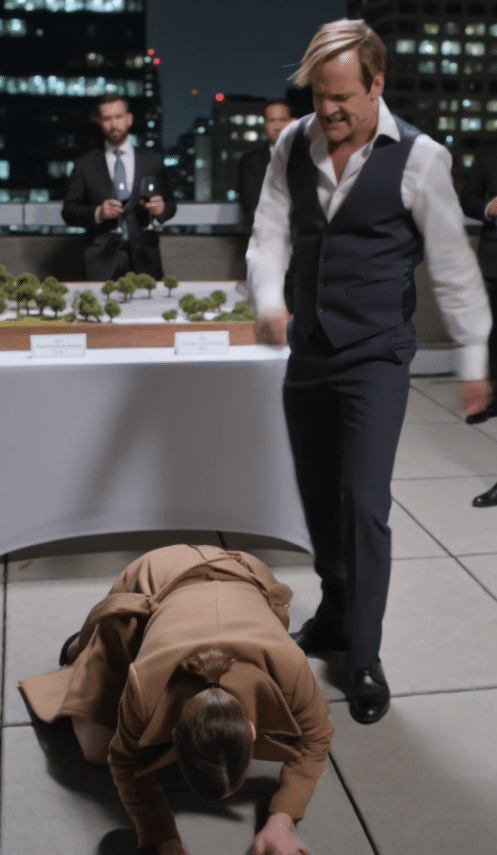
Without warning, Richard lunged forward and drove a forceful kick into Emily’s chest.
She stumbled backward and fell beside the project model table, her arm striking the floor as she tried to protect her unborn child. A sharp cry escaped her lips, and a thin trace of blood appeared where her forearm had scraped against the hard surface.
The room erupted in startled gasps.
But Richard didn’t stop.
He stepped around her and delivered two more forceful kicks to her back while she curled in pain on the floor.
A glass slipped from someone’s hand and shattered.
No one seemed to breathe.
Emily struggled to raise her head, her hand trembling against her stomach.
Richard stood over her, his face flushed with anger.
“Stay out of men’s work.”
Then he turned toward the silent employees as though he expected them to applaud him.
Instead, every face in the room had changed.
Because the elevator at the far end of the rooftop had just opened.
And the silver-haired man stepping out of it had heard enough to understand that something terrible had happened inside his own company.
Richard had no idea who was coming toward him.
But in a matter of seconds, he would wish he had never touched the document—or the woman who had tried to stop him.
Act II
Richard Hale had never considered himself a dishonest man.
That was the story he told himself, anyway.
He preferred the word resourceful. He believed that construction was an industry built on pressure, negotiation, and knowing which rules could be bent without attracting attention. To him, a project that came in under budget was a victory, even if the savings came from workers who were never paid for every hour they had worked.
Over the years, Richard had developed a system.
He submitted inflated overtime estimates, shifted labor costs between projects, and took credit for work completed by subcontractors. When an employee complained about an incorrect paycheck, he blamed accounting. When accounting questioned his numbers, he produced revised spreadsheets and insisted the original documents had been misunderstood.
Most of the time, people gave up.
They had families to support, bills to pay, and little appetite for fighting a supervisor who could make their working lives miserable.
Richard understood that fear was often more effective than authority.
And he had become very good at using both.
The company, Carter Meridian Construction, had grown from a regional contractor into one of the country’s most successful privately held construction firms. Its projects included luxury residential towers, commercial developments, hospitals, and major infrastructure contracts.
Its chairman, William Carter, had spent forty years building the business.
At sixty-one, William was known for his silver hair, immaculate black suits, and an expression that could silence an entire boardroom. He demanded precision, hated excuses, and believed that a company’s reputation was built long before anyone saw its finished buildings.
But there was one thing William valued more than a flawless balance sheet.
The people whose labor made the balance sheet possible.
He had started his career as a junior engineer on a construction site where workers routinely went unpaid for weeks. He remembered the humiliation of watching exhausted men line up outside a payroll office, hoping someone would explain why their families had no money for groceries.
He had never forgotten those faces.
When he eventually founded Carter Meridian, he made timely payroll and honest accounting nonnegotiable. Supervisors who manipulated worker payments were dismissed, regardless of how much money they generated.
Richard knew that policy.
He simply believed he was too useful to lose his job over a few numbers.
He had been preparing for the rooftop party for weeks. The company had just completed a major downtown development, and senior management had promised performance bonuses to the teams responsible for delivering it.
Richard saw an opportunity.
If he could get the extra payments approved before the finance department completed its final reconciliation, he could redirect a substantial sum toward a network of fabricated overtime claims. The paperwork would appear legitimate, the money would be distributed through the normal payroll system, and the irregularities would be difficult to detect until long after the celebration ended.
He had even prepared a list of workers whose names could make the additional payments look reasonable.
Some had never worked on the project.
Others had no idea their names were being used.
Richard’s mistake was assuming no one at the party understood the details well enough to challenge him.
Emily Carter did.
She had been raised around construction plans, payroll discussions, and the complicated realities of running a large business. Her father rarely discussed confidential matters at the dinner table, but she had grown up watching him ask difficult questions and refuse to accept convenient answers.
She had learned to read a budget before she learned to drive.
At thirty-one, Emily was not an executive at Carter Meridian. She had deliberately chosen a different career path, working in nonprofit housing advocacy and helping families navigate the financial obstacles that kept them from securing stable homes.
She knew the human cost of a missing paycheck.
She had met construction workers who slept in their cars between shifts because their rent was overdue. She had spoken to parents who skipped meals to make sure their children had enough food. She had seen how a single delayed payment could trigger a chain reaction that took months to repair.
That was why the overtime complaints had caught her attention.
A crew member working on one of her father’s developments had mentioned that several workers were still waiting for money they had earned. Emily had initially assumed the problem was administrative.
Then she noticed that the hours listed in the disputed records exceeded the project’s actual working schedule.
She checked the site logs.
She compared the payroll summaries.
She reviewed the authorization trail.
The deeper she looked, the more troubling the discrepancies became.
And when she saw Richard approaching the bonus table with a pen in his hand, she recognized the signature list immediately.
She could have called her father.
She could have asked the finance department to intervene.
Instead, she had decided to give Richard a chance to stop.
She had expected denial, perhaps an angry argument.
She had not expected violence.
Now she lay on the rooftop floor while the man responsible stood above her, surrounded by witnesses who were still too shocked to move.
Richard glanced toward the elevator.
The silver-haired man had crossed the threshold.
William Carter was walking directly toward the project table.
And for the first time that evening, Richard’s confidence began to crack.
Act III
William Carter did not run.
He moved quickly, but with the controlled urgency of a man who understood that panic would help no one. His eyes found Emily on the floor, and every other detail around him seemed to disappear.
“Emily!”
He reached her and dropped to one knee.
“Sweetheart, can you hear me?”
Emily opened her eyes. When she recognized her father, her expression broke with relief.
“Dad…”
William took her hand carefully, his gaze moving from her face to the arm she was holding close to her body.
“Don’t try to get up.”
His voice remained steady, but the tension in his jaw was unmistakable.
He called for emergency services and ordered the staff to give Emily room. Then he positioned himself beside her, shielding her from the crowd while a shaken employee finally hurried forward with a phone.
“Someone get medical help now,” William commanded. “And nobody moves those documents.”
Only after he was satisfied that Emily was receiving attention did he stand.
His eyes shifted to Richard.
The supervisor had gone pale.
William looked at the papers on the table, then at the pen lying beside the false bonus list. He recognized the project number, the authorization form, and the names of several workers whose hours had already been disputed.
Then he looked at Richard’s loosened tie.
“You just kicked my daughter in front of my company.”
The sentence landed with the force of a verdict.
Richard stared at him.
For a moment, he seemed unable to understand the words. He knew William Carter was the chairman. He knew the man standing in front of him controlled the company, approved major contracts, and could end a career with a single decision.
But he had never connected that authority to the woman he had just assaulted.
“Your daughter?”
William did not answer immediately.
He glanced down at Emily, who was trying to remain still despite the pain. His expression softened for a fraction of a second.
Then he turned back to Richard.
“Yes. My daughter.”
The entire rooftop seemed to contract around those words.
An executive near the bar lowered his glass. The head of project finance stared at the bonus list as though it had suddenly become radioactive. Two employees exchanged a glance, realizing that the confrontation they had witnessed was about to expose something far larger than a drunken supervisor losing control.
Richard took a step backward.
“Mr. Carter, I didn’t know—”
William cut him off.
“You didn’t know who she was?”
Richard swallowed.
“I mean, there was a misunderstanding. She came over and started interfering with a company process. I thought she was—”
“What?”
William’s voice was still quiet.
“What did you think she was?”
Richard looked around the room, searching for someone who might rescue him from the question.
No one moved.
“I was trying to maintain order,” he said finally.
William looked at the papers again.
“By falsifying a bonus authorization?”
Richard’s face changed.
For the first time, the false signature list became more dangerous to him than the assault.
He tried to smile.
“Those numbers aren’t what they look like. It’s a routine adjustment. The finance department knows how these things work.”
“Then you won’t mind explaining them to the finance department.”
William turned toward the chief financial officer, who had just arrived from the elevator.
“Preserve every version of this document. Every email, every revision, every authorization. I want the original records secured before anyone has a chance to alter them.”
The executive nodded.
William’s gaze returned to Richard.
“And you will not touch another company record.”
Richard’s mouth opened, but no answer came.
He had spent years relying on the assumption that the company needed him more than it needed the truth. He had believed that his knowledge of the job sites, his relationships with subcontractors, and his ability to keep projects moving made him indispensable.
But William was not looking at him as a valuable employee.
He was looking at a man who had assaulted a pregnant woman and might have been stealing from the workers he was paid to supervise.
Then the chairman did something Richard had not expected.
He turned away from him.
William returned to Emily’s side and crouched beside her as the first responders arrived. He answered their questions, explained what he had witnessed, and stayed close while they prepared to move her for medical evaluation.
“Dad,” Emily whispered, “the list.”
William looked at her.
“I see it.”
“He was going to sign it.”
“I know.”
“The workers haven’t been paid.”
William’s expression hardened, but his voice remained gentle.
“We’ll take care of that.”
Emily closed her eyes for a moment, fighting through the pain.
“Promise me they won’t get forgotten.”
William held her hand.
“I promise.”
As the paramedics carefully prepared to transport her, he stepped aside only when they needed room. He watched until she was safely on the stretcher, then turned toward the finance team.
“Find out exactly what happened,” he said. “Every dollar. Every name. Every person who approved it.”
His eyes settled on Richard one final time before he followed his daughter toward the elevator.
Richard remained beside the table, staring at the documents that had seemed so harmless only minutes earlier.
He had thought the woman challenging him was an outsider.
He had thought the chairman would arrive too late to see anything.
He had thought a little intimidation would make the problem disappear.
Now he understood that the woman he had kicked was the daughter of the man whose company had given him everything he possessed.
But even then, Richard was still making one fatal mistake.
He believed that if he could explain away the violence, he might still explain away the money.
He had yet to discover that William Carter was determined to investigate both.
Act IV
The hospital corridor smelled of antiseptic and cold coffee.
William sat outside the examination room with his hands clasped together, his overcoat folded beside him. For the first time in decades, he had no meeting to control, no contract to negotiate, and no decision that could make the waiting end faster.
His daughter was inside with the medical team.
That was the only thing that mattered.
When the doctor finally emerged, William stood immediately.
Emily had suffered painful injuries from the assault and required continued observation. The medical team was monitoring both mother and baby, and they would not make any promises until the necessary checks were complete.
William listened carefully.
He asked what the doctors needed, confirmed the next steps, and thanked them before returning to Emily’s bedside.
She was awake, pale, and exhausted.
When he sat beside her, she reached for his hand.
“Did they get the records?”
He almost laughed, though there was no humor in it.
“Emily, you were just hurt. You don’t have to think about records right now.”
“I know.”
“Then let yourself rest.”
She looked toward the window.
“Those workers were counting on that money.”
William fell silent.
There it was again: even after everything that had happened, Emily was thinking about people who might never know how close they had come to losing their pay.
He brushed a strand of hair away from her forehead.
“We’ll make sure every legitimate payment is made.”
“And the people who helped him?”
“We’ll find out what they did.”
Emily studied his face.
“I don’t want you to protect me by making this disappear.”
William’s expression changed.
“I would never do that.”
“You know what I mean. If I weren’t your daughter, what would happen?”
He looked at her for a long moment.
“Then the company would still be responsible for protecting you. And the law would still be responsible for holding him accountable.”
She nodded slowly.
“That’s all I want.”
William squeezed her hand.
“Then that’s what we’ll do.”
By the following morning, the investigation was underway.
Richard had been removed from his position pending the outcome of the company’s review. His access to internal systems had been suspended, and the disputed bonus documents were secured for examination.
The finance department compared the signature list against the original project records. Investigators examined timesheets, site logs, payroll submissions, and messages exchanged between supervisors and accounting staff.
The discrepancies were larger than the chairman had initially suspected.
Several overtime claims included hours that could not be reconciled with the project’s recorded schedule. Some workers had been listed on jobs they had never attended. Other entries appeared to have been altered after the original payroll reports were submitted.
The evidence did not establish that every disputed entry was fraudulent, but it was enough to justify a much broader inquiry.
And the false bonus list was only the beginning.
When investigators interviewed the site employees, they learned that Richard had frequently pressured workers to accept incomplete payments while assuring them that the missing amounts would be corrected later.
Some had been told that complaining would damage their chances of receiving future assignments.
Others had been instructed to sign revised time records without being given copies.
A few had kept their own notes, fearing they would never be paid otherwise.
Those records became critical.
One laborer produced a notebook containing the dates and hours of every shift he had worked. Another provided messages in which Richard promised to fix a discrepancy that had remained unresolved for months.
The more people spoke, the more Richard’s carefully maintained image began to collapse.
At the rooftop party, he had claimed to be protecting company business.
Now the company was examining whether he had used his position to manipulate its payroll system.
And the assault had ensured that no one could quietly dismiss the investigation as a routine accounting disagreement.
William instructed the board to appoint independent reviewers and required that the findings be documented without interference from project leadership.
He also ordered an immediate audit of the affected payroll accounts.
Within days, the company began verifying the legitimate unpaid wages and correcting confirmed errors. Employees who had been waiting for their money received clear explanations of the review process and were told how to submit supporting records.
William insisted that workers would not have to prove their loyalty before being paid what they had earned.
That decision mattered more than the company’s public statements.
For many of the workers, the missing money had never been an abstract accounting problem. It had meant overdue rent, delayed car payments, and difficult conversations with their families.
The company could not undo the stress they had endured.
But it could stop asking them to wait indefinitely for answers.
Richard, meanwhile, began calling people he had once considered friends.
He contacted a former manager, hoping to find someone willing to describe him as an effective supervisor who occasionally lost his temper. He sent messages to colleagues suggesting that Emily had misunderstood the documents and that the chairman was overreacting because of the family connection.
No one wanted to participate.
Several witnesses had already provided formal statements about the assault. The rooftop’s security cameras had captured the confrontation, including the moment Emily challenged the false list and the deliberate violence that followed.
There was no plausible way to turn the footage into an innocent misunderstanding.
Then Richard tried one last approach.
He sent William a letter apologizing for the incident and describing his behavior as the result of alcohol, stress, and a heated workplace dispute.
William read it once.
Then he passed it to the company’s legal counsel.
He would not allow an apology to replace an investigation, and he would not allow his daughter’s identity to become an excuse for treating the matter differently from any other assault.
The company’s review continued, while law enforcement assessed the evidence and determined the appropriate next steps.
Richard’s position was no longer his to control.
His reputation was no longer protected by the fear he had cultivated.
And the man who had once told a pregnant woman to stay out of men’s work was about to face a truth far more difficult than losing his job.
The people he had intimidated were finally prepared to tell their stories.
And the chairman was listening.
Act V
Three weeks after the rooftop incident, Emily returned home.
Her recovery had been slow and frustrating. Some mornings, she felt almost like herself. On others, even the smallest movement reminded her of the violence that had interrupted an ordinary evening.
The doctors continued monitoring her pregnancy, and William rearranged his schedule so he could accompany her to appointments whenever possible.
He had always been a man who solved problems by moving quickly.
Now he was learning that some forms of healing could not be rushed.
One afternoon, he found Emily sitting near the living room window with a folder resting on her lap.
Inside were copies of the disputed bonus records and a list of workers whose payments had been reviewed.
“You’re supposed to be resting,” he said.
She smiled faintly.
“I am resting.”
“You’re reading payroll records.”
“I’m sitting down while I read payroll records.”
For the first time since the incident, William laughed.
It was brief, but it loosened something in his chest.
He sat beside her and looked at the folder.
“The review team confirmed the first batch of corrections this morning. The verified unpaid wages are being processed.”
Emily exhaled.
“Good.”
“The broader audit is still underway. We haven’t reached every conclusion yet.”
“I know.”
William studied her.
“You realize you don’t have to carry this entire problem on your shoulders.”
“I don’t think I do.”
She closed the folder.
“I just don’t want everyone to remember what happened to me and forget why I was standing at that table.”
William nodded.
He understood.
The assault was shocking. The chairman’s daughter had been attacked in public by a supervisor who believed he could use violence to silence her. The story was dramatic enough to consume every conversation about the company.
But beneath the spectacle was a quieter injustice.
Workers had been waiting for money they had earned.
Their names had been used on documents they had never approved.
Their complaints had been dismissed because the people responsible for listening had decided they were easier to ignore.
Emily wanted that part remembered, too.
And William was determined to make sure it was.
The company eventually completed its internal review and confirmed that Richard had violated its conduct standards. He was dismissed, and the findings relating to the disputed records were referred to the appropriate authorities for further assessment.
The final accounting review also led to changes in the way bonus approvals were handled. No single supervisor could push disputed payments through the system without independent verification, and payroll complaints were routed to a team outside the affected project’s management structure.
Employees received clearer documentation of their hours and a formal process for challenging errors.
The company also established a confidential reporting channel for intimidation, retaliation, and misconduct.
William did not announce these changes as a victory.
He described them as overdue.
In a message to the company’s workforce, he acknowledged that management had failed to identify problems early enough and promised that complaints would no longer be treated as inconveniences simply because they were uncomfortable.
He did not name Emily.
He did not describe her as the hero who had saved the company.
He knew she would have hated that.
Instead, he reminded employees of a principle he had carried with him since his earliest days on construction sites: no project was successful if the people who built it were treated as disposable.
For Richard, the consequences were profound.
The dismissal ended the career he had spent years protecting. His professional reputation suffered as the investigation became known within the industry, and his claims that the incident had been a misunderstanding were undermined by the testimony of witnesses and the preserved footage.
The legal process continued independently of the company, with the evidence reviewed according to the applicable procedures.
William did not attempt to dictate the outcome.
He had made his position clear from the beginning.
No one would be shielded from accountability because of their rank, and no one would be denied justice because they lacked influence.
One month later, Emily returned to the company’s headquarters for the first time since the attack.
She wore her camel coat over a simple dress, and she walked slowly through the lobby with her father beside her.
Employees greeted her warmly, but no one made a spectacle of her arrival.
That was exactly how she wanted it.
In the conference room upstairs, the finance team presented the latest findings from the payroll audit. Confirmed discrepancies had been corrected, outstanding legitimate payments were being processed, and additional controls had been introduced to prevent similar problems.
Emily listened quietly.
When the presentation ended, she asked one question.
“How will the next worker who reports a missing paycheck know that someone is actually listening?”
The room fell silent.
It was not a question that could be answered with a new spreadsheet or another policy document.
The chief financial officer explained the new reporting process, including the independent review team and the requirement to provide employees with updates rather than allowing complaints to disappear into the system.
Emily listened, then nodded.
“Good. Make sure they can see that it works.”
After the meeting, William walked with her toward the elevator.
“You were right to ask that question,” he said.
She looked at him.
“I hope so.”
“You were right about more than that.”
Emily rested a hand against her belly.
“I wish I hadn’t needed to be.”
William’s expression softened.
“So do I.”
They stood quietly for a moment, listening to the distant sounds of the office around them.
Then Emily turned toward her father.
“Dad?”
“Yes?”
“When you came out of that elevator, you looked like you were ready to tear the whole building apart.”
He gave her a tired smile.
“I was.”
“I know.”
She took his hand.
“But you stayed with me first.”
William looked at her, his eyes brightening.
“Always.”
For all the money he had earned, the buildings he had constructed, and the years he had spent protecting a company from failure, that promise was the one thing he never wanted to break.
Emily leaned against his shoulder for a moment before the elevator arrived.
She had not challenged Richard because she wanted to prove she was powerful. She had challenged him because a document was false and workers deserved to be paid honestly.
She had not needed her father’s name to understand what was wrong.
And she should never have needed it to be safe.
Richard had believed the company belonged to men like him—men who raised their voices, controlled the paperwork, and expected everyone else to step aside.
He had mistaken fear for respect.
He had mistaken silence for agreement.
And when a pregnant woman refused to let him sign his name to a lie, he had responded with violence because he could not bear the possibility that someone he considered insignificant might be right.
Then the elevator doors opened.
The chairman stepped out.
And the room learned that the woman Richard had tried to silence was not an outsider at all.
She was the daughter of the man who had built the company, the person who understood exactly why the truth mattered, and the witness who had refused to look away when other people might have stayed quiet.
But the most important revelation was not that Emily belonged to the chairman’s family.
It was that she never should have needed to.
Because no employee should have to be related to the boss to challenge fraud. No worker should have to know a powerful person to receive the wages they earned. And no woman should have to carry a famous name to deserve protection from violence.
Richard had asked Emily to stay out of men’s work.
In the end, she did something far more consequential than taking his place.
She forced the company to confront the work it had failed to do.
And the signature he had tried to place on that false bonus list became the mark of his own undoing.