Act I
“Trash. Civilians don’t know generals.”
The officer’s insult echoed through the military base reception area, drawing the attention of every soldier and family member within earshot.
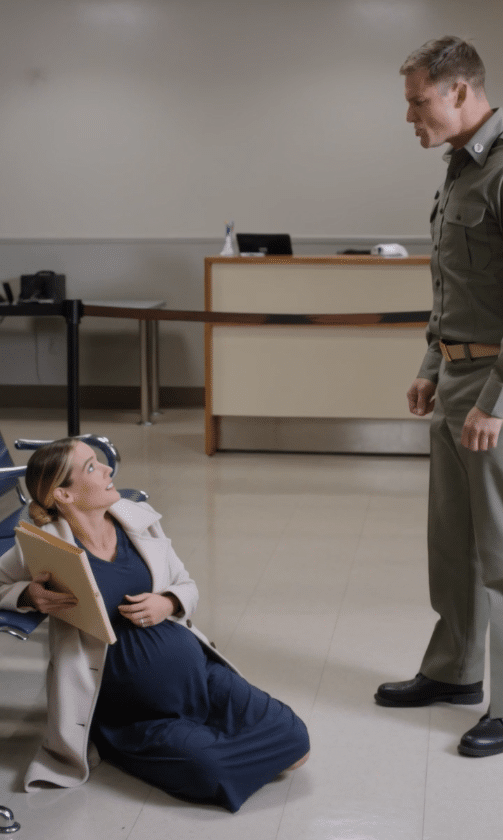
A pregnant woman stood beside the check-in desk, clutching a thick folder against her chest. She wore a dark blue maternity dress beneath a beige coat, with flat shoes and blonde hair gathered into a simple low bun. At eight months pregnant, she moved carefully, one hand resting against her belly as she tried to explain why she had come.
“I’m here to see my grandfather,” she said.
The officer standing in front of her gave a contemptuous laugh.
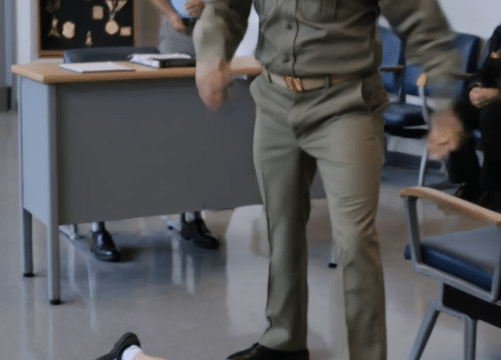
He was thirty-eight, broad-shouldered, and dressed in an olive military uniform with polished boots and a service belt. His name was Captain Derek Walsh, and he had spent years cultivating a reputation for being the hardest man in any room.
He looked at the woman’s plain clothes, then at the family document folder in her hands.
“Your grandfather?” he repeated. “And I’m supposed to believe that?”
She nodded calmly.
“I was told to check in here and ask for directions to the command office.”
“By whom?”
“My grandfather’s staff.”
Derek leaned closer, his expression sharpening.
“Do you have any idea how many civilians come through here claiming to know someone important?”
“I understand there are security procedures. I’m not asking you to bypass them. I just need to know where to check in.”
That reasonable answer seemed to offend him even more.
Derek had spent years learning how to use his rank to control conversations. He could silence junior personnel with a glance, make recruits reconsider a question with a single sneer, and turn routine instructions into public demonstrations of authority.
He expected civilians to be even easier to intimidate.
“Listen carefully,” he said. “This isn’t a tourist attraction. You don’t walk onto a military base and demand to see a general because you feel like it.”
“I didn’t demand anything.”
“Then stop acting as if you belong here.”
The woman looked toward the reception desk, where a young administrative specialist had been watching the exchange with growing discomfort.
“I have the documents they asked me to bring,” she said. “Could someone please verify my appointment?”
Derek stepped sideways, blocking her path.
“I’m not finished talking to you.”
Her fingers tightened around the folder.
“My name is Charlotte Hayes. My grandfather is expecting me.”
Derek’s expression turned openly mocking.
“Charlotte Hayes. Wonderful. And I’m supposed to salute because you know how to say a name?”
A soldier passing through the lobby slowed down.
Another looked toward the command hallway, then quickly lowered his eyes.
Charlotte felt the humiliation spreading across her face, but she refused to argue with him. She had promised her grandfather she would come, and she was determined not to let one hostile officer turn a simple visit into a confrontation.
“Please,” she said. “Just tell me where I should wait.”
Derek’s mouth tightened.
“Wait outside like everyone else.”
Charlotte glanced toward the check-in desk.
“I can wait here if that’s the proper procedure.”
That was the moment his temper broke.
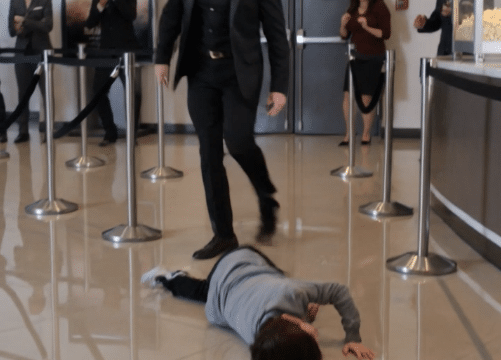
He stepped directly in front of her and drove a forceful kick into her chest.
Charlotte fell hard beside the waiting chairs, her folder slipping from her hands as she tried to protect her unborn child. Her elbow struck the floor, scraping against the hard surface, and she curled inward with a cry of pain.
Papers scattered across the lobby.
Someone gasped.
A woman sitting near the reception desk covered her mouth. Two soldiers stopped in their tracks, their faces frozen in disbelief.
But Derek did not step away.
He moved around Charlotte and delivered two more forceful kicks into her back as she lay curled on the floor.
The impacts were swift and deliberate.
Charlotte could barely catch her breath. One hand remained pressed against her belly while the other trembled against the floor.
Derek stood over her, breathing hard.
“Wait outside like everyone else,” he repeated, as if the violence had somehow proved his point.
No one spoke.
The lobby, usually filled with footsteps, radio chatter, and routine conversations, had fallen into a terrible silence.
Then a door at the end of the command hallway opened sharply.
A silver-haired man in a dark blue command uniform stepped into view. His insignia caught the overhead light as he looked across the reception area.
He saw the scattered documents.
He saw the soldiers standing motionless.
And then he saw the pregnant woman on the floor.
“Charlotte?”
The voice was unmistakable.
Captain Walsh turned toward the hallway.
His expression changed the instant he recognized the man approaching them.
General Thomas Hayes was not merely a senior officer.
He was the most powerful commander on that base.
And the woman Derek had just attacked was his granddaughter.
The general crossed the lobby, dropped beside Charlotte, and shielded her from the crowd before slowly raising his eyes toward the captain.
“You just attacked my granddaughter on my base.”
For the first time in his career, Derek Walsh had absolutely nothing to say.
And he had no idea how much more the general was about to discover.
Act II
Charlotte Hayes had never used her grandfather’s rank to get what she wanted.
Growing up, she had learned that being related to a senior military officer came with expectations that were rarely discussed openly. People assumed she received special treatment. Others expected her to behave as if she were somehow more important than everyone around her.
Her grandfather had spent her childhood teaching her the opposite.
General Thomas Hayes believed that authority was a responsibility, not a privilege. He had served for decades, earning the respect of soldiers who had seen him make difficult decisions under pressure and accept responsibility when those decisions went wrong.
At home, however, he was simply Grandpa.
He remembered Charlotte’s school performances, called her on birthdays even when he was deployed, and kept every handwritten letter she had ever sent him. When she was a child, he had taught her how to polish her shoes before explaining why she should never judge another person by theirs.
“Rank tells you what someone is responsible for,” he once told her. “It doesn’t tell you whether they’re a good person.”
Charlotte had never forgotten that lesson.
Now twenty-nine and seven months pregnant, she had built a life far removed from military command. She worked in a community outreach program that helped military families navigate housing, medical appointments, and the complicated paperwork that often followed a deployment.
She had seen how much families sacrificed while their loved ones served.
She had also seen how difficult it could be for those families to get help when they didn’t know the right person to call.
That was why her visit to the base mattered.
Her grandfather had invited her to meet him at his command office to discuss a family support initiative he had been quietly developing. Charlotte had spent weeks helping gather documents about childcare access, housing referrals, and support for spouses caring for wounded service members.
The folder she carried contained appointment information, program proposals, and a personal letter from her grandfather’s administrative team confirming the meeting.
She had arrived early because she did not want to interrupt his schedule.
She had expected a routine check-in.
Instead, she had encountered an officer who seemed to regard every civilian as an inconvenience.
Captain Derek Walsh had developed his own understanding of military authority.
At thirty-eight, he was experienced enough to know the regulations and ambitious enough to believe he deserved more. He had served on several installations, received commendations for his work, and recently been placed in a supervisory role that gave him greater responsibility over personnel and base procedures.
He wanted a promotion.
More than that, he wanted the kind of reputation that made people stop questioning him.
To Derek, strictness was indistinguishable from strength. A soldier who challenged him was insubordinate. A civilian who asked questions was disrespectful. Anyone who requested an explanation was, in his mind, testing the limits of his authority.
He had been reprimanded before for his temper, but never in a way that seemed to threaten his career.
Each time, he convinced himself that the problem was someone else’s sensitivity.
A junior specialist had complained about being publicly humiliated during a shift change. Derek had described the complaint as an attempt to avoid accountability.
A military spouse had reported being spoken to aggressively at a checkpoint. He had argued that security personnel needed to maintain control.
A junior officer had questioned his handling of a visitor, only to be told that Derek’s experience gave him the right to make the final decision.
His supervisors had received fragments of these incidents, but none had assembled the full picture.
Derek had become skilled at keeping each confrontation small enough to dismiss.
He never imagined that a pregnant civilian would expose the worst of his behavior in a lobby full of witnesses.
When Charlotte approached him, he had already been irritated by a morning of inspections and administrative problems. He had been forced to correct a junior soldier in front of his peers and had spent the next hour complaining that people no longer respected authority.
Charlotte’s request arrived at precisely the moment he wanted an easy target.
He saw her simple coat, her flat shoes, and her family document folder.
He did not see a person.
He saw someone he believed he could humiliate without consequences.
When she calmly insisted that she had an appointment, he interpreted her refusal to back down as a challenge to his rank. By the time she asked for directions to the command office, he had already decided that she was lying.
Nothing she said could change his mind because he was no longer interested in the truth.
He wanted submission.
Now, as General Hayes knelt beside his granddaughter, the consequences of that decision were unfolding in front of him.
Charlotte’s eyes opened slowly.
“Grandpa?”
Thomas took her hand.
“I’m here, sweetheart. Don’t try to get up.”
Her face tightened as another wave of pain passed through her body.
“The baby…”
The general’s expression changed, but he kept his voice steady.
“Medical help is coming. Just stay still.”
He called for emergency assistance and instructed the reception staff to clear the area. Then he looked at the scattered documents beside the waiting chairs.
One page had slid beneath a table.
Another rested near Derek’s polished boots.
Thomas recognized the command office appointment letter immediately.
He had personally asked his staff to make sure Charlotte could reach him without unnecessary delays.
Someone had failed her.
And an officer wearing his uniform had done far worse than that.
Thomas remained beside Charlotte as the medical team was summoned, but his mind was already moving through the questions that needed answers.
Who had witnessed the assault?
Why had no one intervened?
Had Derek been acting this way for years?
And how many other people had been frightened into silence because they believed a man in uniform could treat them however he pleased?
The general had spent his career holding people accountable for their decisions.
Now the person responsible was standing only a few feet away.
And Thomas intended to make sure that rank would not protect him from the truth.
Act III
General Hayes did not raise his voice.
That was what frightened Derek most.
The general knelt beside Charlotte until the medical personnel arrived, speaking to her gently while they assessed her injuries and prepared to transport her for urgent evaluation. He refused to leave her alone until he was certain she was in capable hands.
Only then did he stand.
His eyes moved toward the officer waiting near the reception desk.
“Captain Walsh.”
Derek snapped straighter.
“General.”
“What happened here?”
Derek glanced at the scattered papers.
“Sir, there was a security issue involving a civilian who refused to follow instructions.”
Thomas looked at him without expression.
“A security issue?”
“Yes, sir. She claimed to know someone in command. I was attempting to remove her from a restricted area.”
The general’s gaze shifted toward the check-in desk.
The administrative specialist standing behind it looked pale but composed. She had been holding a phone throughout the confrontation, and her fingers were still trembling.
“Was this woman attempting to enter a restricted area?” Thomas asked.
The specialist swallowed.
“No, sir. She asked where to check in for an appointment.”
Derek turned sharply.
“That’s not what happened.”
The specialist flinched but continued.
“She showed me her documents. I was about to verify them when Captain Walsh stepped in.”
Thomas looked back at Derek.
“You were about to verify her appointment?”
“Yes, sir, but—”
“And instead, you assaulted her?”
Derek’s face tightened.
“I did not—”
Several witnesses stared at him in disbelief.
The general lifted a hand.
“Choose your next words carefully, Captain.”
The silence that followed was absolute.
Derek had spent years believing that confidence could overcome almost any accusation. If he spoke firmly enough, he could make a questionable decision sound reasonable. If he appeared certain, other people often doubted their own recollections.
But the witnesses in the lobby had seen what happened.
The security cameras had recorded it.
And the general was no longer asking questions because he lacked information.
He was giving Derek an opportunity to stop making things worse.
Thomas turned to the base security chief, who had arrived after hearing the commotion.
“Secure the camera footage. Preserve the visitor logs and all records related to today’s appointments. Obtain statements from everyone who witnessed this incident.”
“Yes, sir.”
“Contact the appropriate investigative authorities. I want this handled through the proper channels, without interference from my office.”
The security chief nodded.
Derek’s eyes widened.
“General, surely we can discuss this privately.”
Thomas looked at him.
“Privately?”
“Yes, sir. I think there’s been a misunderstanding.”
The general’s expression hardened.
“My granddaughter is being taken for medical evaluation after you kicked her to the floor. What part of that do you believe requires a private discussion?”
Derek opened his mouth, then closed it again.
Thomas continued.
“You were wearing this uniform when you did it. You were standing in a military facility. You had authority over the situation, and you chose to use that authority to hurt someone who was asking for directions.”
He paused.
“And now you want to discuss it privately?”
Derek lowered his eyes.
“Sir, I was under a lot of pressure.”
“So was she.”
The words were quiet.
They struck harder than a shout.
Thomas glanced toward the hallway through which the medical team had taken Charlotte. For a moment, the stern command presence on his face gave way to the fear of a grandfather who had just seen someone he loved lying helpless on the floor.
Then he turned back to Derek.
“You will not contact the witnesses. You will not approach my granddaughter. You will not attempt to influence this investigation. Follow every lawful instruction given to you.”
“Yes, sir.”
“Your access to the reception area is suspended pending review. You will report to the designated command representative for further instructions.”
Derek swallowed.
“Understood.”
But he still did not seem to understand the full extent of his situation.
He believed the general was angry because Charlotte was family. He assumed that if the incident had involved an ordinary civilian, the consequences would have been less severe.
That assumption was precisely what Thomas intended to examine.
As the witnesses were separated for statements, the administrative specialist approached the security chief and explained that Charlotte had arrived with the correct appointment documentation.
The folder was recovered and secured.
The visitor log confirmed that she had followed the prescribed check-in process.
The camera footage showed Derek blocking her path, insulting her, and launching the attack.
There was no evidence that Charlotte had threatened him or attempted to enter a restricted area.
There was no security emergency.
There had been only a woman asking for directions and an officer who had decided that humiliation was an acceptable response.
When the initial findings reached Thomas later that day, he read them in silence.
He had expected to be angry.
He had not expected to feel ashamed.
Not because he had personally committed the assault, but because a person had come to his base seeking help and had been treated as though she had no right to be there.
He had built his career around the belief that military authority existed to protect people, uphold standards, and maintain discipline.
Derek had turned that authority into a weapon.
And the general could not ignore the possibility that other people had suffered the same treatment without a powerful relative to stand beside them.
The investigation was only beginning.
But the first evidence had already established something undeniable.
Charlotte had followed the rules.
Derek had broken them.
And his uniform could not erase what the cameras had recorded.
Act IV
The hospital room was quiet except for the steady sounds of medical equipment.
Thomas sat beside Charlotte’s bed, still wearing his command uniform. He had removed his service cap and placed it on the table, but he had not changed out of his uniform or returned to his office.
He wanted to be there when she woke.
When Charlotte finally opened her eyes, she looked confused for a moment. Then she saw him and tried to sit up.
“Easy,” Thomas said, reaching for her hand. “The doctors want you to rest.”
She settled back against the pillow.
“Have they checked the baby?”
“The medical team is monitoring both of you closely.”
He explained that the doctors were continuing their assessments and that they needed time before they could confidently rule out complications.
Charlotte closed her eyes.
Thomas watched her carefully.
He had led soldiers through emergencies, made decisions with consequences measured in lives, and stood beside families receiving the worst news imaginable.
None of that had prepared him for seeing his granddaughter hurt in a place where she should have been safe.
“I’m sorry,” he said.
Charlotte looked at him.
“Why are you sorry?”
“You came here because I invited you. You should have been welcomed, checked in, and brought to my office. Instead…”
His voice trailed off.
Charlotte squeezed his hand.
“You didn’t do this.”
“No. But I am responsible for what happens on my command.”
She studied him.
“Then don’t let it happen to someone else.”
Thomas nodded slowly.
“I won’t.”
She looked toward the window.
“I wasn’t asking for special treatment. I just wanted directions.”
“I know.”
“He kept saying I didn’t belong there.”
Thomas lowered his head.
“You belonged there as much as anyone who had a legitimate reason to visit.”
Charlotte’s eyes filled with tears.
For the first time since the attack, she allowed herself to stop pretending she was fine. Her hand trembled in his, and her face crumpled with the exhaustion of what she had endured.
Thomas stayed beside her until she was ready to speak again.
Meanwhile, the formal investigation continued at the base.
Security personnel reviewed the footage frame by frame. Witnesses provided statements, and the administrative specialist supplied the appointment records that confirmed Charlotte’s reason for visiting.
The evidence left little room for doubt.
Derek had not been responding to a threat. He had not been attempting to protect a restricted office. He had assaulted a civilian in the public reception area after she politely asked for directions.
The deliberate nature of the attack became a central part of the inquiry.
Investigators also examined Derek’s previous interactions with civilians and junior personnel. Several earlier complaints surfaced, including reports that he had used intimidating language and treated people who questioned him with unnecessary hostility.
Those incidents required separate review, and investigators took care not to treat every unverified allegation as proven. But the records revealed a pattern that command could no longer dismiss as a series of unrelated misunderstandings.
Derek had repeatedly been given opportunities to correct his behavior.
Instead, he had grown more confident that his position would protect him.
His first formal response to the investigation was an attempt to describe the confrontation as an escalation caused by Charlotte’s refusal to comply.
The footage contradicted that account.
He then argued that he had been acting under pressure.
Witness statements showed that he had insulted Charlotte before any physical contact occurred.
Finally, he suggested that his actions had been misunderstood because the witnesses were shocked.
That explanation failed, too.
The evidence was not ambiguous.
While the investigation proceeded, the command team took steps to ensure that Derek could not interfere with the witnesses or repeat the behavior under review. His duties were restricted, and the matter was referred through the appropriate military channels for further action.
Thomas insisted that the process remain independent.
He would not direct investigators to reach a predetermined conclusion, nor would he demand a particular punishment because the victim was his granddaughter.
He wanted the facts established and the rules applied properly.
Anything less would undermine the very standards he had spent his career defending.
As the days passed, more people began to speak.
One junior soldier described being publicly belittled by Derek after asking a routine question. A civilian contractor recalled being threatened with removal from the installation after challenging an unnecessary delay. A military spouse reported that Derek had dismissed her concerns before she could finish explaining them.
Each account was evaluated on its own merits.
Together, they raised a troubling question about how long Derek had mistaken intimidation for leadership.
The command team began reviewing the process for receiving and escalating complaints. Staff were reminded that rank did not excuse misconduct and that concerns involving an officer’s behavior should not be left solely to the officer’s immediate circle.
The goal was not to turn the base into a place where every disagreement became a formal investigation.
It was to ensure that people could ask questions, seek help, and report misconduct without fearing humiliation or retaliation.
When Thomas returned to his office, he found Charlotte’s family document folder waiting on his desk.
The papers had been carefully gathered and placed in order.
On top lay the appointment confirmation bearing his own signature.
He stared at it for a long time.
His granddaughter had arrived exactly when she was supposed to. She had followed the procedure his staff had provided. She had asked a simple question and tried to remain calm when confronted with hostility.
None of that had protected her.
The failure had not been hers.
It belonged to the people who had allowed an officer to believe that authority made him untouchable.
Thomas placed the appointment letter in a folder marked for the command review.
Then he called his staff together.
“We are going to examine how this happened,” he told them. “Not only the assault, but every point where someone could have stepped in, reported a problem, or corrected a pattern of behavior before it reached this point.”
He looked around the room.
“This is not about protecting the general’s family. It is about protecting the people who come here expecting us to act with discipline and honor.”
No one challenged him.
Because everyone in that room understood what the investigation had already shown.
The uniform did not make Derek Walsh a man of integrity.
His actions did.
And the same standard would apply to everyone else.
Act V
The first good news came quietly.
Several days after the attack, Charlotte’s medical team confirmed that the immediate assessments had revealed no catastrophic injury to the baby. Both mother and child remained under observation, and doctors continued monitoring her recovery rather than making premature promises.
When Thomas heard the update, he stepped into an empty corridor and allowed himself to breathe.
He had spent the previous days preparing for every possible outcome, forcing himself to remain composed while his mind returned again and again to the moment he had seen Charlotte on the floor.
Now there was room for cautious hope.
When he returned to her room, Charlotte was awake and sitting more comfortably against the pillows.
“Grandpa?”
He crossed to her bedside.
“The doctors are encouraged by what they’re seeing.”
Her eyes filled with tears.
“Really?”
“They’re still monitoring you, but the news is encouraging.”
Charlotte pressed a hand against her belly and closed her eyes in relief.
Thomas sat beside her.
For a while, neither spoke.
Then Charlotte asked the question he had been expecting.
“What happened to him?”
“The investigation is continuing. He’s been removed from his regular duties while the matter is reviewed.”
“And the witnesses?”
“They’ve given their statements. The footage has been preserved.”
She nodded.
“Good.”
Thomas looked at her.
“You don’t need to worry about the investigation right now.”
“I’m not worried about him.”
“Then what are you worried about?”
Charlotte glanced toward the door.
“The next person who walks in there and doesn’t know anyone.”
The question stayed with him long after she fell asleep.
It was easy to focus on the dramatic part of the story: an officer attacking a pregnant woman, a senior general appearing from the command hallway, and a public confrontation that left a powerful man speechless.
But Charlotte was thinking about someone else.
A young spouse arriving at the base for the first time.
An elderly parent looking for the visitor center.
A contractor carrying documents for a meeting.
A nervous family member who did not know the right words, the right procedure, or the right person to ask.
What would happen if that person encountered an officer like Derek and had no witnesses to speak for them?
Thomas refused to let the question go unanswered.
The command review introduced clearer guidance for civilian reception procedures and reinforced the responsibility of personnel to direct visitors through the proper check-in process. Complaints involving intimidation or abuse of authority were to be documented and escalated rather than dismissed as personality conflicts.
The base also reviewed its response procedures for incidents in public areas, emphasizing immediate assistance for injured people and the preservation of witness accounts.
These changes were not presented as extraordinary reforms.
They were basic obligations that should have been working all along.
The investigation into Derek’s conduct proceeded through the appropriate military process. His actions were assessed against the applicable standards, and his future in the service would be determined by the findings and the authorized disciplinary procedures.
Thomas did not interfere.
He did not need to.
The evidence spoke clearly enough.
The security footage showed what had happened. The witnesses described what they had seen. The appointment records established why Charlotte had come to the base.
Derek’s claims that he had been dealing with a disruptive stranger could not withstand the facts.
The officer who had once demanded that everyone respect his authority now had to answer questions about how he had used it.
For Charlotte, recovery was slower than the investigation.
Some days, she was able to walk a little farther. Other days, she needed to rest and let the medical team guide her progress. Thomas visited whenever he could, bringing books she barely read and coffee he often forgot to drink.
One afternoon, she caught him staring at the family document folder on the chair beside her bed.
“You kept it?”
“Of course.”
“Everything’s still in there?”
“Every page.”
She smiled faintly.
“I thought I lost the appointment letter.”
“It was recovered.”
“Good. I don’t want you to have to reschedule.”
Thomas stared at her for a moment, then shook his head with a quiet, disbelieving laugh.
“Charlotte, after everything that happened, you’re thinking about rescheduling a meeting?”
“It’s an important meeting.”
“It can wait.”
She tilted her head.
“Can it?”
He considered arguing, then gave up.
“You’re exactly like your grandmother.”
Charlotte smiled.
It was the first time he had heard her laugh since the attack.
Weeks later, when her doctors approved a gradual return to normal activities, Charlotte visited the base again.
This time, Thomas met her at the entrance.
He wore the same dark blue command uniform, but he had left his service cap in his office. When Charlotte stepped inside, the familiar sounds of the lobby returned around her: footsteps, radios, conversations, and the quiet rhythm of a place where people were moving from one responsibility to the next.
For a moment, she paused beside the waiting chairs.
Thomas noticed.
“Would you rather take another entrance?”
She shook her head.
“No. I want to walk through here.”
He offered his arm.
She accepted it, and together they approached the reception desk.
The administrative specialist who had witnessed the assault was on duty. When she recognized Charlotte, her expression softened.
“It’s good to see you again,” she said.
“Thank you.”
The specialist hesitated.
“I’ve thought a lot about that day.”
“So have I.”
“I wish I had done more.”
Charlotte looked at her carefully.
“You were trying to get help.”
“I was afraid.”
Charlotte did not pretend otherwise.
“I understand.”
The specialist lowered her eyes.
“I hope I never freeze like that again.”
“Then remember what you saw,” Charlotte said gently. “And remember that the next person might need someone to speak up.”
The specialist nodded.
Thomas watched the exchange without interrupting.
He understood that no new procedure could erase the moment when everyone had stood frozen. But he also knew that people could learn from failure if they were willing to face it honestly.
Charlotte completed her visit and met with the team working on the family support initiative. She discussed practical ways to help military families navigate the base, find the right offices, and receive assistance without feeling that they had to know someone important.
She did not make her experience the centerpiece of the meeting.
She spoke about the people who had quietly struggled to access services and the importance of treating every visitor with dignity.
When the meeting ended, Thomas accompanied her back to the lobby.
They stopped beside the waiting chairs.
“Are you all right?” he asked.
Charlotte looked around the room.
“Yes.”
“Are you sure?”
She took a slow breath.
“I’m still angry about what happened. And sometimes I’m frightened when I think about it.”
Thomas nodded.
“You don’t have to pretend otherwise.”
“I know.”
She looked up at him.
“But I don’t want that day to be the only thing I remember about this place.”
Thomas felt a tightness rise in his throat.
“What do you want to remember?”
Charlotte considered the question.
“That someone was supposed to help me. That the system failed. And that people can decide to fix it instead of pretending it never happened.”
He held her hand.
“Then we’ll make sure that’s what happens.”
They walked toward the entrance together.
Behind them, the lobby continued its ordinary work. Soldiers passed through the doors, families waited for appointments, and staff directed visitors toward the offices they needed to find.
It was not a perfect place.
No institution was.
But the events of that day had forced its leaders to confront a truth they could no longer ignore: authority was not measured by how quickly people obeyed, but by how responsibly power was used.
Captain Derek Walsh had believed a civilian could be humiliated simply because she lacked rank.
He had believed a uniform placed him above questions.
And he had believed that a pregnant woman asking for directions was too insignificant to challenge him.
Then the command hallway door opened.
A senior general stepped into the lobby, knelt beside his granddaughter, and looked at the officer who had attacked her.
“You just attacked my granddaughter on my base.”
Derek’s final question—“Your base?”—captured the instant his confidence collapsed.
But the deeper lesson was not that Charlotte belonged to a powerful family.
It was that she should never have needed to.
She deserved to be treated with dignity before anyone knew her name. She deserved help because she was a visitor asking a reasonable question. And she deserved protection because no person should be subjected to violence for challenging an officer’s arrogance.
Her grandfather’s rank made the revelation dramatic.
The truth made it important.
A uniform can command attention. Rank can command obedience. Authority can open doors that remain closed to everyone else.
But none of those things can turn cruelty into leadership.
And when the doors of command opened that day, the officer who thought he was untouchable discovered that the most powerful person in the room was not the one who had kicked someone to the floor.
It was the one who understood that real authority begins with accountability.