Act I
“Go play where poor kids belong.”
The woman’s voice cut through the city park, sharp enough to silence the children playing nearby.
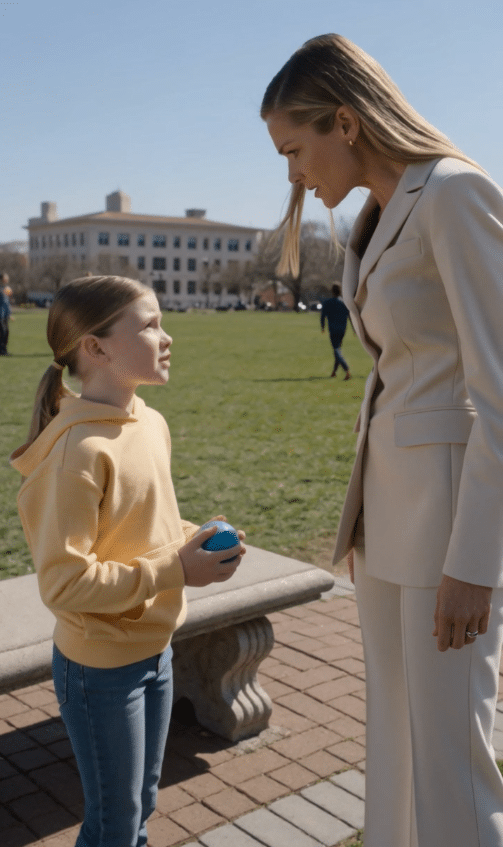
A twelve-year-old girl stood beside a stone bench, clutching a small ball against her pale yellow hoodie. Her blonde ponytail had come loose, and her blue jeans were streaked with grass from an afternoon of running around with friends.
In front of her stood a woman dressed in a cream designer coat, immaculate white trousers, and oversized sunglasses. A leather handbag hung from her arm, and a polished watch gleamed at her wrist.
The woman looked furious.
A few seconds earlier, the girl’s ball had rolled across the brick walkway and lightly touched the white sneaker of the woman’s daughter.
That was all.
No one had been injured. The shoe was barely marked. The little girl had not even cried.
But the woman, Victoria Sterling, reacted as though someone had deliberately insulted her family.
“I’m sorry,” the twelve-year-old said. “The ball rolled away.”
Victoria glanced at her daughter’s shoe, then slowly raised her sunglasses.
“Do you have any idea what those cost?”
The girl shook her head.
“I didn’t mean to—”
“Of course you didn’t. Children like you never think about anyone but yourselves.”
A few parents turned toward them.
On the grass nearby, two boys stopped kicking a soccer ball. An elderly man sitting on a bench lowered his newspaper. A young mother gathered her toddler closer, sensing that something ugly was unfolding.
The girl swallowed nervously.
“My name is Lily,” she said. “I’m really sorry.”
Victoria gave a short, contemptuous laugh.
“Your name is Lily? Well, Lily, perhaps your parents should teach you how to behave in public.”
Lily looked down at the ball in her hands.
Her parents had taught her to apologize when she made a mistake. They had taught her to share, to be kind, and to treat people with respect, even when those people were rude to her.
They had not taught her what to do when an adult decided that an apology was an invitation to humiliate her further.
Victoria stepped closer.
“Look at this place,” she continued, gesturing toward the grass, the benches, and the children scattered around the park. “People come here to enjoy themselves. They don’t come here to deal with careless children who can’t control their toys.”
Lily glanced at the public playground only a few yards away.
“This is a public park,” she said softly.
The words were innocent. She had not meant them as a challenge.
But Victoria heard defiance.
Her expression hardened.
“Excuse me?”
Lily immediately regretted speaking.
“I just meant I didn’t see your daughter. I’m sorry.”
Victoria moved directly into the girl’s path, towering over her.
“You think you can talk back to me?”
“No.”
“Then learn your place.”
Several witnesses shifted uneasily. One man took a step forward, then stopped when Victoria turned her furious gaze in his direction.
She was accustomed to getting her way. In her world, money opened doors, complaints moved people out of the way, and anyone who challenged her could be made to regret it.
She had spent the morning at a private shopping club before bringing her daughter to the park. Even here, surrounded by ordinary families and children sharing a patch of grass, she expected the world to rearrange itself around her preferences.
Lily was simply the nearest person who could not do that.
Victoria stepped in front of her and drove a forceful kick into the girl’s chest.
Lily fell backward onto the grass beside the stone bench. Her palm scraped against the ground, and she cried out, clutching the ball as she tried to understand what had happened.
For one stunned second, the park seemed to stop breathing.
Then Victoria stepped toward the fallen child and delivered two more forceful kicks into her back and side.
A woman gasped loudly.
Someone shouted, “What are you doing?”
But no one had moved quickly enough to stop it.
Lily curled protectively around herself, frightened and hurting. A thin trace of blood marked the scrape on her palm, but she seemed more shocked than anything else.
She looked up at Victoria.
“Why did you do that?”
Victoria straightened her coat.
“Maybe now you’ll remember to keep your dirty ball away from my daughter.”
Lily’s eyes filled with tears.
She had apologized. She had tried to explain. She had done everything she knew how to do.
And the woman was still standing over her as though the girl deserved what had happened.
Victoria pointed toward the far end of the park.
“Go play where poor kids belong.”
Then a black city vehicle came to a sharp stop near the park entrance.
The rear door opened.
A woman in a navy suit and long dark coat stepped onto the brick walkway, a city pin gleaming on her lapel. She scanned the scene, saw the girl on the grass, and began moving toward her with unmistakable urgency.
“Lily!”
Victoria turned.
The approaching woman crossed the walkway and reached the fallen girl first, dropping beside her and placing an arm protectively around her shoulders.
“Sweetheart, look at me. Are you hurt?”
Lily stared up at her through tears.
“Aunt Claire?”
The woman drew her close, then lifted her eyes toward Victoria.
Her face had gone still.
“You kicked my granddaughter over a ball?”
Victoria’s lips parted.
She recognized the woman now.
Claire Bennett was the mayor of the city.
And Lily was not merely a child playing in the park.
She was the mayor’s granddaughter.
Victoria’s face drained of color.
“Mayor…?”
But Claire was no longer looking at her as a powerful public official looks at a troublesome citizen.
She was looking at her as a family member who had just witnessed an adult attack a child she loved.
And Victoria was about to discover that the most dangerous thing she had done was not offend a wealthy family.
It was reveal exactly who she was when she believed nobody important was watching.
Act II
Claire Bennett had become mayor through years of work, difficult decisions, and a stubborn belief that public service meant protecting people who rarely had anyone powerful standing beside them.
At forty-six, she was known for her disciplined manner and direct communication. She could sit through hours of budget meetings without losing focus, challenge department heads when they failed to explain their decisions, and face an angry room without allowing her emotions to dictate her response.
But nothing in city government had prepared her for the sight of her twelve-year-old niece lying on the grass after being kicked by a stranger.
Lily was the daughter of Claire’s older sister, Emily.
Emily had raised her daughter to be thoughtful and independent, and Lily had inherited her mother’s quiet determination. She was not the loudest child in a room, nor the one who demanded attention. She was the girl who noticed when another student sat alone at lunch and quietly invited them to join her.
Claire adored her.
After Claire’s husband died several years earlier, her sister and niece had become an even more important part of her life. Their family had learned to support one another through grief without making every conversation about what they had lost.
Lily often visited the mayor’s home on weekends. She liked baking with Claire, teasing her about the endless papers stacked on the dining table, and asking questions about the city that sometimes made the adults around them pause.
Why did some neighborhoods have better playgrounds than others?
Why did people complain about potholes for months before anyone fixed them?
Why did grown-ups sometimes act as if admitting a mistake were worse than making one?
Claire never dismissed those questions.
She believed that children saw unfairness with a clarity adults sometimes trained themselves to ignore.
That afternoon, Claire had been returning from a community meeting near the park when her driver stopped at the entrance. She had arranged to meet Lily there briefly before the girl went home with her mother.
She expected to find her niece playing with a ball.
Instead, she found her on the ground.
“Can you take a deep breath for me?” Claire asked gently.
Lily tried, then winced.
“Does your chest hurt?”
She nodded.
Claire’s stomach tightened, but she kept her voice steady.
“Okay. Don’t try to get up yet.”
She called for emergency medical assistance and asked her driver to contact the appropriate city response team. Then she positioned herself between Lily and Victoria.
Only when she was confident that help was on its way did she turn toward the woman who had attacked her niece.
“Step back.”
Victoria obeyed almost instinctively.
The transformation in her face was extraordinary. Moments earlier, she had stood over a frightened child with the confidence of someone who believed she could dictate the terms of every interaction.
Now she looked like a person searching for an exit.
“I didn’t know who she was,” Victoria said quickly.
Claire stared at her.
“What?”
“I didn’t know she was your granddaughter.”
Claire’s expression changed, not into surprise, but into something colder.
“You didn’t know who she was.”
Victoria glanced at the people watching.
“She let a ball hit my daughter’s shoe. I was upset, and things got out of hand.”
“Things got out of hand?”
Claire looked down at Lily, who was still holding the ball against her chest.
“She apologized to you.”
Victoria said nothing.
“She explained that it was an accident.”
“I know, but—”
“And you kicked her.”
Victoria’s eyes darted toward the crowd.
A few people had begun recording with their phones. Others stood with expressions of disbelief. One woman had tears in her eyes, while a man near the brick path was speaking to emergency dispatch.
Victoria lowered her voice.
“Mayor Bennett, surely we can discuss this privately.”
Claire did not move.
“Why would we discuss an assault on a child privately?”
“I didn’t mean for her to get hurt.”
“Then why did you kick her?”
Victoria opened her mouth, then closed it.
For the first time, she seemed to understand that there was no version of the story that would make her behavior look reasonable.
Claire turned toward a nearby city employee who had been accompanying her.
“Please identify the witnesses and make sure their contact information is collected. Preserve any available footage, including recordings made by members of the public. I want everything documented accurately.”
“Yes, Mayor.”
“Do not ask anyone to change or soften their account.”
The employee nodded and moved away.
Victoria’s voice sharpened.
“You’re using your position to threaten me.”
Claire looked directly at her.
“No. I’m using my position to make sure the incident is documented and handled properly. The authorities will determine what happens next.”
“You can’t just decide I’m guilty because you’re angry.”
“I haven’t decided your legal guilt. I have seen you attack a child.”
The distinction silenced Victoria.
Claire continued.
“And my niece’s identity has nothing to do with whether that was wrong.”
Victoria looked away.
Around them, the park had become unnaturally quiet. Children had stopped playing nearby, and several parents were moving their families farther from the confrontation.
Lily squeezed Claire’s hand.
“Aunt Claire?”
Claire immediately turned back to her.
“I’m right here.”
“Did I do something bad?”
The question cut through the tension more effectively than any accusation.
Claire’s face softened.
“No, sweetheart. You made an ordinary mistake. You apologized. None of this was your fault.”
“But she said I was dirty.”
Claire brushed a loose strand of hair away from Lily’s forehead.
“People sometimes say cruel things when they want to make someone feel small. That doesn’t make those things true.”
Lily blinked back tears.
“I didn’t want to make her daughter sad.”
“I know.”
Claire held her close as the emergency responders arrived.
They assessed Lily and arranged for her to receive further medical evaluation. Claire accompanied her, refusing to leave her side until she knew that the child was being properly cared for.
As they prepared to leave the park, Lily looked over Claire’s shoulder.
Victoria was still standing near the stone bench.
For the first time, the woman seemed unable to find the right words.
Claire did not offer her a dramatic threat. She did not promise to ruin her life or use the city government as a weapon.
She simply made sure that the incident would be recorded, that witnesses would be heard, and that Lily would receive the care she needed.
Then she turned away.
Victoria watched the mayor leave with the child she had attacked, and the realization began to settle in.
The mayor was not going to shout at her.
She was not going to bargain.
She was going to let the truth speak.
And Victoria had badly underestimated how much the truth could cost.
Act III
By the following morning, the incident had become the subject of an official review.
Several people who had witnessed the attack had already provided statements. A man who had been walking his dog had captured part of the confrontation on his phone, beginning just before the first kick.
His recording showed Lily holding her ball and apologizing.
It showed Victoria stepping into the girl’s space, speaking angrily, and kicking her to the ground.
It showed the two additional kicks.
And it showed the crowd’s reaction: the shocked faces, the startled movements, the seconds in which nobody seemed to know how to respond.
The video did not capture every word spoken, but it confirmed the central facts.
Lily had not attacked Victoria or her daughter.
The ball had rolled into contact with a shoe.
The girl had apologized.
Then an adult had used force against her.
Other witnesses supplied additional details. One parent said Victoria had insulted Lily before the assault. Another remembered hearing the words “poor kids” immediately afterward.
The accounts were collected and evaluated through the appropriate procedures. No one needed to embellish what had happened.
The facts were disturbing enough.
Claire was careful not to turn her public office into a shortcut around those procedures. She did not direct investigators to reach a particular conclusion, nor did she demand a special penalty because the victim was her niece.
Instead, she made it clear that she expected the same thorough response she would expect if the child belonged to a family nobody in city hall knew.
That principle mattered to her.
Claire had spent years hearing residents describe situations in which they felt ignored because they lacked money, influence, or the ability to attract attention. She had promised to make city services more responsive, particularly when vulnerable people were involved.
Now she faced a test of whether she truly believed what she had told the public.
If she demanded special treatment for Lily, she would undermine that promise.
If she ignored the incident because she wanted to appear impartial, she would fail her family and the public in a different way.
The answer was neither favoritism nor indifference.
It was accountability.
Victoria, meanwhile, was making a series of increasingly desperate calls.
She contacted a friend who knew someone in local politics. She asked whether the mayor could be persuaded to keep the matter out of the news. She even considered contacting Claire directly, hoping that a personal apology might convince her to stop the investigation.
But the situation had moved beyond a private disagreement between two women.
There were witnesses.
There was video.
And there was a child who had been injured in a public place.
When Victoria finally received a response to her request for a meeting, it was not an invitation to negotiate.
She was informed that any communication concerning the incident should be handled through the appropriate channels.
She read the message twice.
Then she threw her phone onto the sofa.
“This is ridiculous,” she muttered.
Her daughter, Sophie, stood in the doorway.
The little girl had been unusually quiet since the incident. She had seen her mother shouting at Lily, and she had witnessed the violence that followed.
“Mom?”
Victoria looked up.
“What?”
“Why did you kick that girl?”
The question landed with more force than Victoria expected.
She stared at her daughter.
“I was angry.”
“But she said sorry.”
Victoria’s mouth tightened.
“Sophie, adults have to deal with things differently.”
Sophie looked confused.
“But you told me I shouldn’t hit people when I’m mad.”
Victoria had no immediate answer.
Her daughter lowered her eyes.
“Was Lily bad?”
“No,” Victoria said sharply. “She wasn’t bad.”
“Then why did you do it?”
Victoria felt the first real crack in her certainty.
She could explain the incident to a lawyer. She could complain about the recording. She could insist that people were judging her without understanding the pressure she had been under.
But she could not easily explain to her own child why an apology had not been enough.
She had spent years teaching Sophie that certain rules mattered. Be polite. Respect other people. Never take something that belonged to someone else.
Now Sophie had seen her mother violate the simplest rule of all.
Do not hurt someone because you are angry.
Victoria turned away.
“Go to your room, Sophie.”
The child hesitated, then obeyed.
Alone, Victoria sat on the sofa and replayed the moment in the park. She remembered Lily’s frightened expression, the ball in the girl’s hands, and the stunned silence that followed the assault.
She had believed the most important fact about Lily was that she appeared ordinary.
No expensive clothes.
No entourage.
No visible connection to anyone who could challenge her.
Victoria had assumed that made the girl safe to insult.
Then the mayor had arrived.
The revelation had changed the balance of power in an instant, but it had not changed the underlying truth. Lily had been a child before Claire stepped out of the city vehicle. She had been deserving of respect before anyone recognized her family name.
Victoria knew that now.
What frightened her was not only the possibility of consequences.
It was the realization that other people had seen the version of herself she had always managed to conceal behind polished manners and expensive clothing.
And the video was making it impossible to pretend otherwise.
Act IV
Three days later, Victoria received formal notice that the incident was being handled through the relevant authorities and that the available evidence had been preserved.
The notice was measured and procedural.
It made no dramatic accusations. It did not promise a particular outcome. It simply confirmed that the incident had been documented and that the process would continue.
Victoria read it at her kitchen island, surrounded by the trappings of the life she had carefully built.
Her handbag sat on a chair beside her. Her designer coat hung near the door. A vase of fresh flowers stood in the center of the counter.
Everything looked immaculate.
Yet she felt as though the room had become smaller.
For years, Victoria had believed that presentation could solve almost any problem. If she looked composed, spoke confidently, and made it clear that she expected to be taken seriously, people usually accommodated her.
She had confused courtesy with submission.
Now, for the first time, the people responding to her were not interested in whether she was wealthy, connected, or accustomed to getting her way.
They were interested in what had happened.
Victoria contacted an attorney and was advised to preserve relevant communications and cooperate with the process. She was also warned against contacting witnesses or attempting to influence their accounts.
She had wanted to call the parent who recorded the assault and demand that the video be deleted.
She no longer dared.
The footage had become a fixed record of her behavior, and any attempt to pressure a witness could make the situation worse.
Meanwhile, Claire visited Lily at home.
Lily was recovering, but she remained hesitant whenever someone raised their voice unexpectedly. She had started asking whether she could play in the backyard instead of going to the park.
Claire noticed the change.
“You don’t have to go back there until you’re ready,” she told her.
Lily sat cross-legged on the couch, turning a small ball between her hands.
“I liked that park.”
“I know.”
“I don’t want her to take it away from me.”
Claire sat beside her.
“She doesn’t own the park, sweetheart. Neither do I. It’s a place for everyone.”
Lily looked down.
“What if someone else gets mad?”
Claire took a moment before answering.
“I can’t promise that nobody will ever be unkind. But you can tell a trusted adult, and you don’t have to handle something frightening by yourself.”
Lily nodded slowly.
“Are you going to make her go to jail?”
Claire’s expression remained gentle.
“That’s not my decision. The authorities will look at the evidence and follow the law. My job is to make sure people are treated fairly and that the process isn’t interfered with.”
“Even if she’s mean?”
“Even then.”
Lily seemed to think about that.
“Does that mean she gets away with it?”
“No,” Claire said. “Fairness doesn’t mean pretending nothing happened. It means responding to what happened in the right way.”
The answer did not erase Lily’s fear, but it gave her something solid to hold on to.
In the days that followed, Claire continued her public duties. She attended meetings, reviewed city projects, and listened to residents who had concerns about their neighborhoods.
She did not use her office to announce personal details about Lily or turn the case into a political spectacle.
Instead, she asked her staff to review the city’s procedures for reporting violence in public spaces and to ensure that residents knew how to request help when they witnessed an assault.
She also raised a broader question during a community safety meeting.
“What do people do,” she asked, “when they witness something wrong but are afraid to get involved?”
The discussion was uncomfortable.
Several residents admitted that they had watched bullying or harassment occur in public without knowing how to intervene safely. Others said they feared becoming targets themselves.
Claire listened.
She did not accuse everyone who had frozen in the park of being cruel. Shock could make people hesitate, and confronting an aggressive adult could carry risks.
But she challenged the idea that doing nothing was the only option.
Calling emergency services, alerting security, documenting what happened from a safe distance, or helping a victim once the immediate danger had passed could all make a difference.
A community did not need every bystander to become a hero.
It needed people to understand that fear and uncertainty did not erase their responsibility to seek help.
As the review continued, Victoria faced the consequences of her behavior through the appropriate legal and administrative channels. Her social circle grew quieter. Some acquaintances stopped returning her calls, while others told her directly that they could not defend what she had done.
She had expected people to focus on the mayor’s power.
Instead, they focused on the child.
One friend finally said what others had been too polite to tell her.
“You keep talking about who Lily is related to. But what if she had been anyone else’s daughter?”
Victoria stared at her.
The friend continued.
“You can’t make the story about the mayor just because you don’t like what people saw you do.”
The call ended shortly afterward.
That evening, Victoria stood outside Sophie’s bedroom and listened to her daughter reading aloud.
She remembered the question Sophie had asked.
Why did you do it?
She still had no answer that made her proud.
For the first time, she began to understand that the most damaging consequence of the incident might not be a lost invitation, a strained friendship, or a formal penalty.
It might be that her daughter had witnessed her become the very kind of person she had taught Sophie never to be.
And no designer coat could cover that.
Act V
Several weeks later, Claire brought Lily back to the park.
They chose a quiet afternoon, when the grass was bright beneath the sun and the brick walkway was dotted with families returning from school and work.
Lily wore her pale yellow hoodie again.
She had brought the same small ball.
At the entrance, she paused.
Claire did not rush her.
“Would you rather go somewhere else?” she asked.
Lily shook her head.
“No. I want to play.”
They walked toward the open grass.
The stone bench was still there. Children were running across the field, laughing as a soccer ball bounced between them. A man walked his dog along the brick path, and a mother called to her little boy to stay away from the flower beds.
Nothing about the park had changed.
But Lily felt different.
She had thought about the incident many times. She remembered Victoria’s angry voice, the sudden kick, and the terrible confusion of lying on the ground while adults watched.
For a while, she had wondered whether she should have said something different.
Maybe she should have picked up the ball faster. Maybe she should have apologized more loudly. Maybe she should have stayed quiet.
Claire had patiently answered each question.
None of those things would have made the assault her fault.
Today, Lily wanted to find out whether she could play without replaying the memory every time the ball rolled away.
She stepped onto the grass.
A little boy nearby kicked a ball too hard, sending it bouncing toward her. It stopped beside her shoe.
The boy hurried over.
“Sorry!” he said.
Lily picked up the ball and handed it back.
“It’s okay. It happens.”
The boy smiled and ran back to his friends.
Claire watched from beside the stone bench, a quiet warmth spreading through her chest.
Lily had not become fearless.
She had simply refused to let one cruel encounter decide what the world would mean to her.
After a few minutes, she began tossing her own ball into the air and catching it. Soon, she was laughing as she tried to keep it from bouncing away.
Claire sat down on the bench.
For the first time since the assault, the sound of children playing felt ordinary again.
Across town, Victoria was still dealing with the consequences of the incident. The process had not been erased by her money or her connections, and the evidence remained part of the record.
Claire did not publicly celebrate Victoria’s difficulties.
She had never wanted revenge for the sake of revenge.
She wanted Lily to recover, witnesses to be heard, and the rules to mean the same thing for everyone.
That was the difference between power used as a weapon and power used responsibly.
Victoria had tried to make a child feel small because she believed the girl could not fight back.
Claire had a choice when she arrived at the park. She could have used her title to intimidate, to threaten, or to demand an outcome before the facts were examined.
Instead, she had protected Lily first and allowed the process to continue.
She could not undo the assault.
But she could refuse to let influence replace fairness.
As the afternoon wore on, Lily ran toward a group of children playing near the grass field. Her ball bounced off the ground and rolled several feet before she caught it.
She looked back at Claire.
“Watch this!”
She tossed the ball, caught it against her chest, and laughed.
Claire applauded.
For a moment, she saw not the frightened girl beside the stone bench, but the child Lily had been before the incident: curious, energetic, and eager to share an ordinary afternoon with the people she loved.
That was what Claire had wanted to protect.
Not the mayor’s reputation.
Not her family’s status.
Lily’s childhood.
The right to make a small mistake, apologize, and keep playing.
As they prepared to leave, Lily picked up her ball and walked over to her aunt.
“Can we come back next weekend?”
Claire smiled.
“Of course.”
Lily slipped her hand into Claire’s, and together they headed toward the brick walkway.
Behind them, the park filled with the familiar sounds of a city living its life. Children shouted across the grass. Parents called their names. A ball bounced against the pavement, and someone laughed when it rolled in the wrong direction.
It was ordinary.
And that was the point.
No child should have to be related to a mayor to be safe in a public park.
No apology should have to come from an important family to be taken seriously.
And no adult should believe that a child’s apparent lack of power gives them permission to cause harm.
Victoria Sterling had looked at Lily and seen a girl she believed could be humiliated without consequence.
Then a black city vehicle stopped beside the park.
The mayor stepped out.
And Victoria’s expression changed because, suddenly, the child had a powerful family behind her.
But the real lesson was not that Lily was the mayor’s granddaughter.
It was that she should never have needed to be.
A person’s character is revealed most clearly when they believe the person in front of them has no power to fight back.