Act I
“I’m sorry. I’m still learning.”
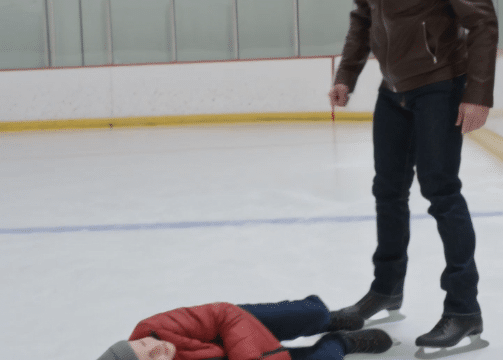
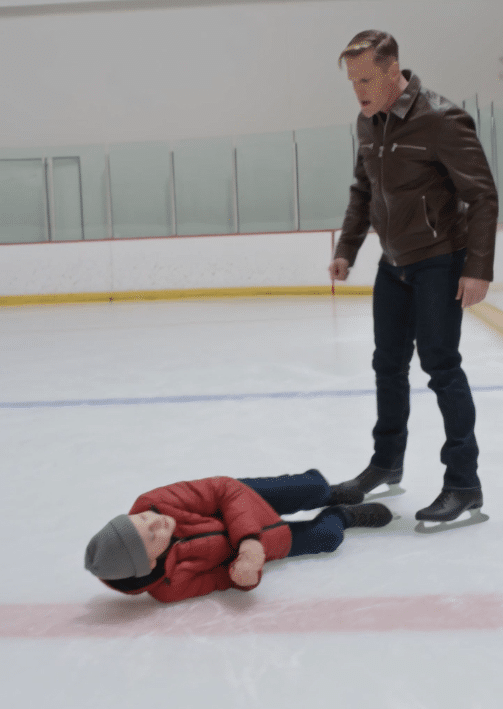
The twelve-year-old boy clung to the glass railing, his rental skates sliding slightly beneath him as he tried to steady himself. His cheeks were red from the cold, his gray knit cap had slipped toward one ear, and his red jacket stood out against the pale ice beneath his feet.
Across from him, a younger boy was rubbing his shoulder.
The contact had been accidental. The two children had brushed against each other when the younger boy changed direction, and the twelve-year-old had immediately apologized. He was still learning to skate, still struggling to keep his balance, and still trying to understand how quickly people moved around the rink.
But the other child’s father had already decided that an apology was not enough.
“Trash kid. Stay away from my son.”
The man strode toward the edge of the rink, his brown leather jacket creasing as he clenched his fists inside his black gloves. He was forty years old, expensively dressed, and carried himself with the confidence of someone accustomed to having other people move out of his way.
His son stood safely behind him.
The boy in the red jacket did not.
“I’m sorry,” the younger skater repeated nervously. “He didn’t mean to.”
His father barely glanced at him.
“This is exactly what happens when parents let their kids run wild.”
The twelve-year-old stared at him in disbelief.
“I wasn’t running. I just lost my balance.”
The man’s jaw tightened.
“You hit my son.”
“By accident.”
The words were barely audible beneath the soft music playing through the shopping mall. Beyond the rink’s glass walls, shoppers wandered past clothing stores and restaurants, carrying shopping bags and talking over the weekend crowd. Parents sat on rental benches, watching their children circle the ice.
A few people had begun to notice the confrontation.
The boy’s eyes moved toward the rink attendant’s station. He wanted an adult to explain that beginners sometimes bumped into one another, that accidents happened, and that saying sorry was supposed to mean something.
Instead, the man stepped closer.
“You think saying sorry fixes everything?”
The boy shook his head.
“No, sir.”
“Then learn to keep away from people who know what they’re doing.”
The insult stung, but the boy tried to remain polite. He tightened his fingers around the railing and concentrated on keeping his skates still.
He had come to the mall for one simple reason: his grandfather had promised him an afternoon away from the demands of public life. The boy had wanted to try ice skating for months, and his grandfather had finally arranged a visit to the rink while attending a nearby meeting.
For the moment, the boy’s family name meant nothing to the man confronting him.
All he saw was a nervous child in an ordinary red jacket.
And that was exactly why he believed he could treat him however he pleased.
The man suddenly rushed to the rink’s edge, blocking the boy’s path beside the glass railing.
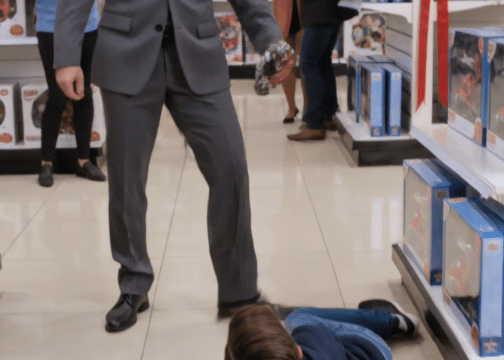
Before the child could move away, the man drove a forceful kick straight into his chest.
The boy lost his balance completely and fell hard onto the ice. His hands shot forward, but the slippery surface offered little grip. One knee scraped across the ice, leaving a thin trace of blood as he reached desperately for the railing.
A woman near the rental benches gasped.
The man did not stop.
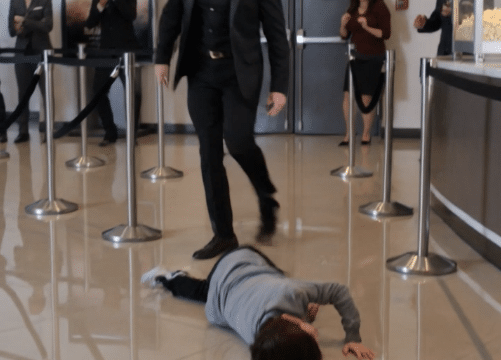
He stepped closer to the fallen child and delivered exactly two more forceful kicks, one into the boy’s back and another into his side.
The boy curled inward, frightened and in pain, unable to understand why an adult had attacked him over a mistake that had lasted less than a second.
Around the rink, people froze.
A father pulled his own daughter closer. Two teenagers stared with their mouths open. A woman covered her face with both hands, while a man beside her looked toward the staff station as though waiting for someone else to act.
Nobody intervened before the assault ended.
The man straightened and looked down at the boy.
“Learn to fall somewhere else.”
The words seemed to hang above the ice.
The boy tried to push himself upright, but his hands trembled. His skates slid away from him, and he caught the railing again before he could fall a second time.
He looked around at the watching adults.
Not one of them had moved toward him.
Then, from the VIP seating area overlooking the rink, an older man in a dark gray suit suddenly stood.
He was sixty-six, with silver hair, a long overcoat, and the quiet, unmistakable bearing of someone accustomed to being listened to. He had been speaking with two senior advisers when the commotion caught his attention.
At first, he saw only a crowd gathering at the glass.
Then he recognized the red jacket.
His expression changed instantly.
He moved fast, cutting through the mall traffic and reaching the railing just as the man in the brown leather jacket turned away from the fallen boy.
The older man descended to the rink entrance, crossed the short distance to the child, and reached him first.
“Are you hurt?”
The boy looked up.
“Grandpa?”
The older man’s face tightened.
He positioned himself between the child and the attacker, shielding his grandson before turning toward the man who had kicked him.
His voice was controlled, but there was no mistaking the fury beneath it.
“You kicked my grandson for a child’s mistake?”
The man in the leather jacket stared at him.
For the first time, his confidence faltered.
He looked from the older man’s face to the boy on the ice, then back again.
“Your grandson?”
The question came out almost as a whisper.
And suddenly, the entire afternoon was no longer about a child who had bumped into his son.
It was about what happens when someone mistakes kindness for weakness—and discovers that the person he has harmed is connected to someone he cannot afford to ignore.
Act II
The boy’s name was Oliver Hayes.
At twelve, Oliver had not yet grown into his hands and feet. He was thoughtful, a little shy around strangers, and prone to apologizing even when he was not entirely sure he had done anything wrong.
His grandfather, Richard Hayes, had noticed that habit years earlier.
Richard was a senior public official whose responsibilities often placed him in rooms where a single sentence could change the direction of a meeting. He had spent decades negotiating difficult decisions, answering public criticism, and working with people who disagreed with him.
His authority was real, but he had never wanted Oliver to grow up believing that authority made someone better than everyone else.
He wanted the boy to learn patience, humility, and the importance of keeping promises.
So when Oliver asked to go ice skating, Richard had agreed without making it a formal family event. He had arranged a quiet afternoon at a mall rink, hoping to give his grandson something ordinary to remember.
No security procession. No public announcement. No reporters.
Just an afternoon together.
Richard had even promised that he would try skating himself if Oliver could make it around the rink without holding the railing.
Oliver had laughed at that.
“You’ll fall before I do.”
“Then we’ll both have something to learn,” Richard had replied.
It was one of those small family exchanges that mattered precisely because nobody else heard it.
Oliver had been excited all morning.
He had practiced balancing at home with his arms stretched out, pretending that the living-room rug was ice. He had watched beginner skating videos and studied how skaters bent their knees when they lost balance.
But the real rink was colder and faster than he had imagined.
The blades felt strange beneath his feet. Every movement required concentration, and children who had been skating for years swept past him with effortless confidence.
He had spent the first several minutes holding the railing, moving a little farther each time before returning to it.
Richard watched from the VIP seating area, smiling whenever Oliver managed a few more steps.
Then the accident happened.
Oliver had been trying to move away from the railing when another child crossed his path. Their shoulders brushed, and both boys stumbled slightly. Oliver caught himself, turned around, and apologized immediately.
The other boy had seemed ready to accept it.
His father had not.
The man was named Grant Mercer, a wealthy real estate investor who had developed a reputation for getting his way. He was accustomed to private lounges, premium services, and staff members who anticipated his preferences before he voiced them.
He loved his son, but his protectiveness often came wrapped in anger.
When his boy complained about being bumped, Grant reacted as though the incident were an attack on his family’s dignity.
He did not ask whether the contact had been accidental.
He did not check whether either child was injured.
He looked at Oliver’s red jacket, his rental skates, and the hand gripping the railing, and made a judgment about the boy before listening to a single complete sentence.
Grant believed that children who lacked discipline needed to be corrected immediately.
In his mind, humiliating Oliver was not cruelty. It was a demonstration of authority.
That belief made him dangerous.
He did not understand the difference between protecting his son and punishing another child. He did not realize that a genuine act of protection would have meant checking whether both boys were safe, then helping them resolve the accident without turning it into a confrontation.
Instead, he chose to make an example of a child who could barely stand on the ice.
And when Oliver apologized, Grant interpreted the boy’s nervousness as weakness.
Richard had seen none of the collision itself.
He had been seated with two advisers, reviewing notes for an upcoming public meeting. The sound of raised voices had initially seemed like another ordinary disagreement at a busy mall.
Then the crowd shifted.
He noticed that people were backing away from the rink’s edge rather than moving toward it. A woman’s hand covered her mouth. A young man had stopped halfway through raising his phone.
And in the center of the commotion, Richard saw his grandson on the ice.
The sight erased every other thought from his mind.
He did not consider his schedule, his advisers, or the public consequences of what might happen next. He moved.
Now, standing beside Oliver, he could see the boy’s frightened expression clearly.
“Can you breathe comfortably?” Richard asked.
Oliver nodded, though he looked shaken.
“My knee hurts.”
“Don’t try to get up too quickly.”
Richard crouched beside him, keeping one arm protectively between Oliver and Grant. He asked someone to alert the rink staff and request medical assistance.
Only after making sure his grandson was being attended to did he stand and face the man in the leather jacket.
Grant’s eyes had settled on Richard’s face.
Something about the older man seemed familiar, but Grant could not immediately place him. He had seen Richard Hayes on television, at public ceremonies, and in photographs accompanying official announcements.
But recognition was a slow, unwelcome process.
Grant had spent the last minute acting as though nobody in the room could question him.
Now he was beginning to understand that the man confronting him was not merely an angry grandfather.
He was someone whose name Grant knew.
Someone whose position he respected when it suited him.
And someone who had just watched him attack a child.
Act III
Grant took half a step backward.
“I think there’s been a misunderstanding,” he said.
Richard looked at him without blinking.
“What part did you misunderstand?”
Grant glanced toward the rink, where Oliver was still holding the railing with one hand while a staff member approached cautiously.
“Your grandson hit my son.”
“Oliver apologized.”
“He still made contact.”
“Children make mistakes.”
Grant’s face tightened.
“My son could have been hurt.”
“And you decided to kick a twelve-year-old boy?”
A few people in the crowd lowered their eyes.
The question was so direct that there was nowhere for Grant to hide. He could argue about the original collision, complain about safety, or insist that Oliver should have been more careful.
None of those explanations could justify what he had done.
Grant tried anyway.
“I was protecting my child.”
Richard’s voice grew colder.
“Then you should have shown him what protection looks like.”
Grant looked away.
For years, he had equated control with strength. He believed that if he responded aggressively enough, other people would stop challenging him. He had used that approach in business negotiations, in disputes with service providers, and even in conversations with people who worked for him.
Often, it had worked.
People backed down because arguing with Grant was exhausting. They apologized to end the confrontation. They accepted unfair treatment rather than risk losing a contract or inviting another outburst.
Grant had mistaken their silence for respect.
At the rink, he expected the same result.
He expected Oliver to retreat. He expected the crowd to remain passive. He expected the incident to dissolve into an uncomfortable memory once he walked away with his son.
Instead, the older man in front of him was asking questions he could not intimidate into silence.
Richard turned toward the rink supervisor, who had arrived with another employee.
“Please preserve any available security footage and document what happened. I would also like the witnesses’ accounts recorded properly.”
His tone was firm, but measured.
He did not ask anyone to alter a report because of his position. He did not demand that Grant be arrested on the spot or threaten to destroy his life through personal influence.
He wanted the facts preserved.
The supervisor nodded and immediately began coordinating with the staff.
Several witnesses volunteered what they had seen. A mother who had been sitting near the rental benches described the initial collision as brief and accidental. She confirmed that Oliver had apologized before Grant approached him.
A teenage skater recalled hearing Grant call Oliver a “trash kid” moments before the attack.
Another guest said that Grant had continued kicking Oliver after the boy fell.
The accounts were consistent with what the people around the rink had witnessed.
Grant looked increasingly uncomfortable.
“Everyone is making this sound worse than it was,” he said.
A woman near the glass railing turned toward him.
“We watched you do it.”
He stared at her.
She did not look away.
“You didn’t ask what happened. You didn’t check on either child. You just attacked him.”
Grant’s son stood a short distance away, holding the sleeve of his father’s jacket. The younger boy looked frightened now, his earlier irritation replaced by confusion.
“Dad,” he whispered, “why did you do that?”
Grant turned sharply.
“Stay out of this.”
The child flinched.
Richard noticed.
So did several people nearby.
It was a small moment, but it revealed something the original collision had hidden. Grant had claimed to be acting out of concern for his son, yet even now he could not explain his behavior without frightening the child he said he wanted to protect.
Oliver watched from beside the railing.
His knee stung, and he was still trying to understand how an ordinary afternoon had become something so frightening. He had not wanted Grant to get into trouble. He had only wanted to skate without falling.
When Richard returned to him, Oliver spoke quietly.
“Grandpa, I really didn’t mean to hit him.”
Richard crouched beside him again.
“I know.”
“I said I was sorry.”
“I heard you.”
“Why was he still angry?”
Richard looked at the boy’s red, worried face.
“Sometimes people become so determined to be right that they stop caring whether they’re being fair.”
Oliver looked down at the ice.
“Did I do something wrong?”
“You had an accident,” Richard said. “You apologized. That is what a responsible person does.”
He gently touched Oliver’s shoulder.
“What happened afterward was Grant’s choice. It was not your fault.”
The words mattered more than Richard realized.
Oliver had been replaying the collision in his mind, wondering whether he should have moved sooner, whether he should have apologized more loudly, whether he should have tried to skate away instead of holding the railing.
Richard wanted him to understand that being imperfect did not make him deserving of cruelty.
An accident was an opportunity to learn.
It was not permission for someone else to hurt you.
By then, the rink staff had arranged for Oliver to receive medical attention. Richard remained with him, refusing to let the confrontation become more important than his grandson’s well-being.
Grant watched them from the other side of the railing.
He had expected a brief argument with an ordinary family.
Instead, he was facing witnesses, documented evidence, and a man whose identity was now becoming clear to everyone around them.
A guest quietly told another that the older man was Richard Hayes, the senior public official who had appeared in the news that morning.
The information spread in whispers.
Grant heard it.
His face lost color.
The grandfather he had just confronted was not someone he could dismiss as an angry bystander.
And the child he had kicked was not merely the boy he had decided was beneath him.
But the worst part was not the power Richard possessed.
It was the fact that Richard had seen everything.
Act IV
Grant’s confidence did not disappear all at once.
At first, he tried to recover it by appealing to the language of misunderstanding.
He said the rink was crowded. He said he had been worried about his son. He said he had reacted without thinking. He even suggested that the slippery ice and the confusion around the railing had made the incident appear more aggressive than it had been.
But every explanation collided with the same simple fact.
He had deliberately kicked a child who had already apologized.
And then he had kicked him twice more after he was down.
There was no plausible account in which the three kicks became a reasonable response to an accidental collision.
Richard did not shout at Grant.
He did not need to.
“You have a son,” he said. “You know what it means to be responsible for a child.”
Grant looked toward his boy.
“Of course I do.”
“Then imagine watching another adult treat him the way you treated Oliver.”
Grant’s mouth tightened.
“That is different.”
“Why?”
“He’s my son.”
“And Oliver is my grandson.”
The answer landed with devastating simplicity.
Grant seemed ready to object, but the words died before they reached his mouth. He had used his son’s relationship to him as a reason to demand special treatment, yet he could not accept that another family would feel the same fierce need to protect its child.
Richard continued.
“You wanted everyone here to believe that your anger was justified because you were defending your son. But you weren’t defending him. You were teaching him that if someone makes a mistake, you can hurt them until they submit.”
Grant’s son had moved closer to the rink supervisor. He was watching his father with a frightened, uncertain expression.
Grant saw it.
For the first time, the consequences of his behavior reached beyond his own reputation.
His son had watched him attack another child. He had heard him insult a boy who had apologized. He had seen him continue after the boy fell.
Whatever explanation Grant offered afterward, his son would remember what he had done.
Grant lowered his voice.
“Can we talk about this privately?”
Richard looked at him.
“Why?”
“Because this doesn’t need to become a public spectacle.”
Richard glanced toward the witnesses.
“You made it public when you attacked him in front of them.”
Grant’s jaw flexed.
“I don’t want my son dragged into this.”
“Then you should have thought about him before you acted.”
The rink supervisor returned with confirmation that the incident would be documented and the available footage preserved. Staff were also gathering contact information from witnesses who were willing to provide accounts.
Richard thanked the supervisor and asked that Oliver’s medical assessment be completed before any further conversation.
He did not want the boy listening to a prolonged argument about consequences while he was still hurt and frightened.
That decision only deepened Grant’s humiliation.
He had expected Richard to use his authority as a weapon. He had expected threats, insults, or a dramatic demand that security remove him immediately.
Instead, Richard was insisting on a process that would preserve the evidence and establish what had happened.
There was no easy way for Grant to portray himself as the victim.
He looked toward the people standing behind the glass railing. A few had already turned away, unwilling to continue watching him. Others remained, their expressions hard with disapproval.
He had spent the afternoon believing that the crowd’s silence made him powerful.
Now he understood that they had been silent because they were shocked.
Not because they agreed with him.
A security supervisor arrived to coordinate the response with mall management. Grant was asked to remain available while the incident was documented and the appropriate procedures were followed.
He protested that he had somewhere to be.
The supervisor calmly repeated the request.
Grant glanced at Richard, apparently hoping the older man would intervene and make the situation disappear.
Richard did not.
“This is not about my title,” he said. “It is about what you chose to do.”
Grant looked down.
For the first time, he seemed to understand that the revelation of Oliver’s identity had not created the wrongdoing. It had merely exposed the assumption behind it.
If Oliver had been the son of a cleaner, a cashier, a teacher, or a family with no influence at all, the kicks would have hurt just as much. The fear would have been just as real. The child would have deserved the same protection.
Grant had behaved as though some children mattered less than others.
Now the man standing between him and the boy was forcing him to confront that belief.
Richard returned to Oliver, who had been helped away from the ice and was sitting safely near the rental benches.
The boy looked exhausted.
“Are we going home?” he asked.
“Yes,” Richard replied. “After the medical team has checked you.”
Oliver glanced toward Grant.
“Is he going to be angry with me again?”
Richard’s expression softened.
“You don’t need to speak to him. You don’t need to explain yourself again. You’re safe with me.”
Oliver nodded slowly.
Behind them, Grant stood motionless as the crowd began to disperse.
The afternoon he had expected to control had slipped completely beyond his reach.
And the final blow was still waiting.
Not a threat from Richard. Not a public speech. Not a dramatic order.
Just the truth, preserved by the witnesses and the cameras, about what he had done to a child who had apologized.
Act V
The days that followed were difficult for Oliver.
His injuries were assessed, and his family followed the medical advice he received. The physical discomfort gradually eased, but the memory of the attack lingered longer than anyone wanted.
At first, Oliver refused to talk about ice skating.
He had been excited about learning something new. He had imagined himself gliding confidently around the rink, perhaps even managing a lap without holding the railing.
Instead, he remembered the sudden kick, the shock of falling, and the faces of the adults who had watched without moving.
The most confusing part was that he had done what he believed he was supposed to do.
He had apologized.
He had tried to explain.
He had remained polite even when Grant insulted him.
And none of it had stopped the attack.
Richard understood why the experience had unsettled him. Children often assumed that adults would respond fairly when they made a genuine effort to do the right thing. When an adult behaved cruelly instead, it could shake their sense of how the world worked.
One evening, Richard sat beside Oliver at the kitchen table while the boy turned a glass of water slowly between his hands.
“Do you think I should have just moved away?” Oliver asked.
Richard did not answer immediately.
“Would moving away have prevented what happened? Maybe. Maybe not. But you were learning to skate, and you apologized when you accidentally bumped someone.”
Oliver stared at the glass.
“I made his dad angry.”
“You did not make him kick you.”
“But he said I should stay away from his son.”
“You could have been more careful on the ice. Everyone can be more careful. That still would not justify what he did.”
Oliver thought about that.
Richard continued gently.
“Taking responsibility for a mistake means acknowledging it and trying to do better. It doesn’t mean accepting punishment from someone who decides to hurt you.”
The boy looked up.
“So I wasn’t wrong to say sorry?”
“No. You did exactly the right thing.”
For the first time since the incident, Oliver’s shoulders relaxed.
The investigation into the assault proceeded through the appropriate channels. Witnesses provided accounts, the available footage was preserved, and mall management cooperated with the relevant authorities.
Richard did not demand that the process bend around his position. He did not make private threats or promise a particular legal outcome. He wanted the incident handled properly, with the evidence assessed and any consequences determined through the appropriate procedures.
Grant, meanwhile, discovered that the story he had told himself could not survive the facts.
He had initially insisted that he was defending his son. But the witness accounts described an accidental collision followed by an immediate apology. The footage documented his response and the two additional kicks after Oliver fell.
His explanations could not change what people had seen.
Nor could his wealth make the incident disappear.
The consequences extended beyond the immediate investigation. People who had once accepted Grant’s aggressive behavior as a sign of confidence began to question it. His son had witnessed the attack, and Grant had to face the uncomfortable reality that the example he had set was not one of strength or protection.
He had wanted his child to believe that no one could disrespect their family.
Instead, he had shown him that a person could be so consumed by pride that even a frightened child’s apology would not make them stop.
That lesson would be harder to erase than any public embarrassment.
Several weeks later, Richard asked Oliver whether he wanted to visit the rink again.
Oliver looked uncertain.
“Do I have to?”
“Absolutely not,” Richard said. “You can decide when you’re ready. And if you never want to skate there again, that’s your choice too.”
Oliver considered it for a while.
Then he asked, “Would you still try skating with me?”
Richard smiled.
“I made a promise, didn’t I?”
“You said you’d try if I could go around the rink without holding the railing.”
“You’ve already done more than I have. I haven’t even put on the skates yet.”
Oliver laughed for the first time in days.
They returned to the mall on a quiet afternoon, choosing a time when the rink was less crowded. Richard left his formal overcoat with an attendant and exchanged his polished shoes for a pair of rental skates that made him look far less dignified than he preferred.
Oliver noticed immediately.
“You look ridiculous.”
Richard steadied himself against the railing.
“I am beginning to regret this arrangement.”
The boy laughed again.
This time, the sound was easy.
They entered the rink together. Oliver stayed near the glass at first, moving carefully and allowing himself to stop whenever he needed. Richard struggled to keep his balance, gripping the railing with both hands while Oliver demonstrated the few techniques he had learned before the attack.
For a while, neither of them mentioned Grant.
There was no need.
The point was not to prove that Oliver was fearless. He was still nervous, and the ice was still slippery. The point was to give him back the freedom to decide what the experience meant to him.
After several minutes, Oliver let go of the railing.
He moved forward a few feet, wobbled, then recovered.
Richard clapped.
“Look at that.”
Oliver grinned.
“I didn’t fall.”
“Neither did I.”
Richard had barely finished speaking when his skates slid apart and he grabbed the railing again.
Oliver burst into laughter.
“Grandpa!”
“I was demonstrating what not to do.”
“Sure you were.”
They stayed on the ice until both were tired.
When they finally sat on the rental benches, Oliver looked down at his skates and spoke quietly.
“I still don’t understand why that man thought he could do that.”
Richard rested his hands on his knees.
“Because he believed his anger mattered more than your dignity.”
Oliver was silent.
“But his belief didn’t make it true,” Richard continued. “You deserved to be treated with respect before he knew who your family was. You deserved it while you were holding the railing. You deserved it after you apologized.”
Oliver leaned against his grandfather’s shoulder.
“And if I bump into someone again?”
“You apologize, make sure they’re okay, and try to be more careful. That’s what responsible people do.”
“What if they get angry?”
“Then we hope they remember they’re responsible for their own choices.”
Oliver nodded slowly.
The mall continued around them. Shoppers passed the glass railing, children laughed on the ice, and the soft music played as it had on the day everything happened.
The rink had not changed.
But Oliver no longer saw it only as the place where he had been hurt. It was also the place where he had returned, where his grandfather had kept a promise, and where an ordinary afternoon had become ordinary again.
Richard knew that his position could open doors and make people listen. But he also knew that the most important lesson his grandson could learn was not that powerful people would always protect him.
It was that every child deserved protection, whether or not a powerful person happened to be watching.
Grant Mercer had looked at a nervous twelve-year-old in rental skates and seen someone he could humiliate without consequence.
He had mistaken a child’s apology for weakness and his own aggression for strength.
Then he had looked into the face of Richard Hayes and whispered, “Your grandson?”
That was the moment his certainty broke.
But the real lesson had nothing to do with a famous name, a public office, or the influence of a grandfather.
Oliver had been worth protecting from the beginning.
Before the first kick. Before the crowd gasped. Before Grant realized who stood beside the railing.
A child’s mistake should be met with patience, not cruelty. And a person’s dignity should never depend on how powerful their family happens to be.