Act I
“Trash. Pick up your tip.”
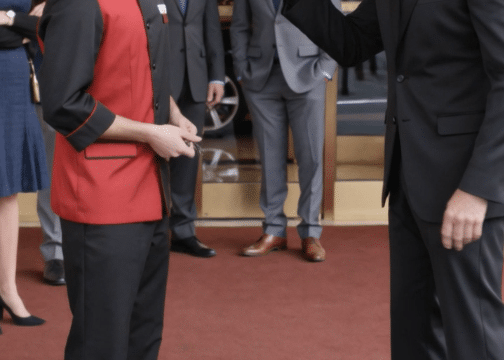
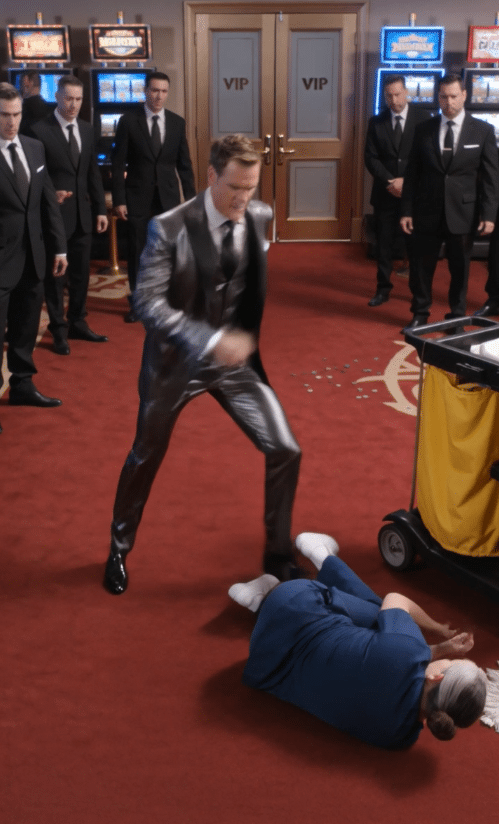
The coins scattered across the red carpet beneath the glittering lights of a Las Vegas casino. One spun in a small circle before settling beside the polished shoe of a man wearing a designer suit and a gold watch worth more than most people earned in a year.
Standing opposite him was a woman in a dark blue cleaning uniform, one hand resting on the handle of her cleaning cart. Her gray hair was tied neatly behind her head, and her name badge read MARGARET REED.
She was forty-nine years old. She had worked night shifts for nearly two decades, cleaning up spilled drinks, broken glass, and the mess left behind by people who often acted as though the entire world existed for their entertainment.
Tonight, she had made one small mistake.
Her cart had blocked the path of a VIP guest for a few seconds while she finished mopping a section of carpet near the gaming floor.
“I’ll move the cart right away,” Margaret said calmly.
The man glanced at her cart, then at the coins he had deliberately thrown onto the floor.
“Then pick those up.”
Margaret looked down.
“I’m sorry, sir. I’ll clear the walkway.”
“Did you not hear me? Pick up your tip.”
A few nearby gamblers turned their heads. Behind a gaming table, a dealer paused with a stack of chips in his hands. The casino’s bright electronic displays continued flashing, but the atmosphere around the red carpet had suddenly changed.
Margaret tightened her grip on the cart handle.
“I appreciate the offer, but I need to finish cleaning this area first.”
The man’s expression hardened.
“Offer?”
He gave a short, contemptuous laugh.
“You people are unbelievable. I just won more money in twenty minutes than you probably make in six months, and you want to lecture me about cleaning?”
His name was Richard Vance, a forty-three-year-old real estate investor who had become a regular at the casino’s exclusive VIP tables. He wore expensive suits, traveled with an entourage when it suited him, and had developed a reputation for treating service workers as though they were obstacles between him and whatever he wanted.
Earlier that evening, Richard had won a substantial hand at a private baccarat table.
The win had made him feel untouchable.
He had been buying drinks, boasting about his luck, and telling anyone who would listen that the casino knew exactly how much his business was worth. Every time a staff member addressed him, he expected an extra measure of deference.
Margaret had not given him one.
She had simply tried to move her cart.
Richard pointed at the coins.
“Get on your knees and pick up your tip.”
Margaret swallowed.
“Sir, I can move the cart. There’s no reason to—”
“There’s every reason.”
He stepped closer, his gold watch catching the light.
“You work on this floor. You follow instructions.”
Margaret glanced toward the nearest security station. A guard stood several yards away, speaking to another employee and apparently unaware of the confrontation.
She had learned over the years that the safest way through an angry guest’s outburst was often to remain calm, avoid sudden movements, and give the person room to cool down.
So she pushed the cart a few inches to the side.
She did not kneel.
Richard’s face changed instantly.
“You think you’re too good to pick up money?”
“No, sir. I’m just trying to finish my work.”
He kicked her hard in the chest.
Margaret fell backward beside the cleaning cart, her forearm striking the edge of a metal fixture. A thin trace of blood appeared on her skin as the coins bounced across the carpet around her.
For a moment, she could not catch her breath.
The casino seemed to tilt above her. Lights blurred across the ceiling, and the sound of electronic machines became a distant, meaningless hum.
Several guests gasped.
Richard looked down at her with an expression that suggested she had inconvenienced him.
Then he stepped beside the cart and delivered exactly two more kicks to her back and side.
Margaret curled in pain, pulling her arm away from the cart wheel. She tried to shield herself, unable to understand why a man who had just won money would choose to spend his triumph hurting someone who had done nothing to him.
Richard straightened his jacket.
“Cleaners bow on this floor,” he said.
No one moved.
A woman beside a slot machine covered her mouth. A dealer stared at Richard, stunned. Two men who had been laughing near the VIP entrance fell silent and took a cautious step backward.
Margaret remained on the carpet, breathing unevenly.
Richard glanced at the scattered coins.
“Should’ve picked them up.”
Then the heavy door leading from the VIP security corridor swung open.
Two security managers emerged first.
Behind them walked a man in a black suit, his silver hair neatly combed and his expression colder than anything Richard had seen all evening.
It was the casino’s owner.
And when the owner saw Margaret on the floor, he did not look at the coins.
He looked directly at Richard.
The man who had spent the evening boasting about his VIP status suddenly stopped smiling.
Because the person walking toward him was not another employee he could intimidate.
It was the one person in the building who could take everything his membership had given him.
Act II
The casino owner was Anthony Mercer, fifty-nine, a businessman who had spent more than thirty years building one of the most respected gaming and hospitality operations in Las Vegas.
His name appeared on the property’s founding documents, but he rarely displayed it prominently. Anthony preferred to move through the casino quietly, observing how the business functioned when managers believed no one important was watching.
He knew the casino’s numbers.
He knew which VIP guests generated genuine long-term value and which ones simply demanded expensive treatment. He knew which dealers had the patience to calm a frustrated gambler, which supervisors handled conflict fairly, and which employees kept the entire operation running after the high rollers had gone home.
He also knew Margaret Reed.
Not personally in the way a close friend might, but through years of employee reports and one incident he had never forgotten.
Several winters earlier, a guest had slipped near a flooded entrance during a storm. While other employees rushed to assist the guest, Margaret had quietly redirected foot traffic, fetched dry towels, and stayed beside an elderly couple until a medical team arrived.
Later, when a supervisor tried to credit the entire response to a manager who had arrived after the incident, Margaret had refused to take part in the blame game. She simply gave an accurate account of what had happened and returned to work.
Anthony had remembered her name.
People who did difficult work without needing applause were often the ones who understood a business better than the people who posed for photographs in its private rooms.
Now he crossed the red carpet with his two security managers close behind.
“Margaret,” he said, lowering himself beside her. “Can you hear me?”
She nodded weakly.
“Don’t try to get up.”
He looked at one of the security managers.
“Get medical assistance here immediately. Preserve the surveillance footage. Separate the witnesses, and make sure nobody touches those coins or the cleaning cart until the scene has been documented.”
The manager moved at once.
Anthony then stood and placed himself between Margaret and Richard.
It was a deliberate movement. Richard could no longer approach her without going through the owner first.
“What happened?” Anthony asked, although his eyes suggested he already understood enough.
Richard spread his hands.
“She was blocking the walkway. I asked her to move, and she became difficult.”
Anthony stared at him.
“You kicked her.”
“She was disrespectful.”
“She told you she would move the cart.”
Richard glanced around, apparently expecting the other guests to support his version of events.
Instead, he found a room full of people looking at him with disbelief.
“This is a casino,” he said. “People get emotional. Things happen.”
Anthony’s voice remained quiet.
“Being emotional does not explain what I just saw.”
Richard shifted his weight.
“You didn’t see the beginning.”
“Then we’ll review the beginning.”
That answer unsettled him more than a shouted accusation would have.
Richard was used to arguing with managers who feared losing his business. He knew how to make complaints expensive, how to invoke the names of executives, and how to suggest that one unhappy VIP could influence dozens of other wealthy customers.
But Anthony was not asking him to explain his behavior so that they could negotiate an acceptable story.
He was asking because the facts would be documented.
Richard lowered his voice.
“Anthony, let’s not turn this into something it doesn’t need to be. I spend a lot of money here. You know that.”
Anthony did know.
Richard’s membership gave him access to private gaming areas, personal hosts, exclusive dining reservations, and a range of privileges unavailable to ordinary guests. He had also introduced several business associates to the property.
But membership was not ownership.
“You are a guest here,” Anthony replied. “You are not in charge of the people who work here.”
Richard’s mouth tightened.
“I bring business to this place.”
“And every employee you see contributes to the business you enjoy.”
Anthony glanced at the fallen cleaning cart.
“The dealers, the kitchen staff, the security team, the cleaners. They all help make this place what it is. You don’t get to attack one of them because you dislike being inconvenienced.”
Richard gave a short laugh, but it sounded forced.
“Are you really going to risk a valuable customer over a cleaner?”
Anthony did not answer immediately.
Instead, he looked toward Margaret, who was being assessed by the arriving medical team. One medic gently examined her arm while another asked whether she could take a deep breath without pain.
She was trying to answer clearly, but her voice trembled.
That was all Anthony needed to see.
He turned back to Richard.
“You have misunderstood the value of this place.”
Richard frowned.
“What is that supposed to mean?”
Anthony gestured toward the casino floor.
“You see the lights, the private tables, the money changing hands. You think those things are what make a casino successful.”
He paused.
“They aren’t. Not if the people who keep the place running are afraid to do their jobs because someone with a gold watch might hurt them.”
For the first time, Richard seemed unable to find a quick response.
Then he noticed the security manager speaking into a radio.
“Wait,” he said. “What are you doing?”
“Securing the incident records,” Anthony replied.
Richard looked toward the VIP corridor.
His private gaming account, his reserved table, and his membership privileges were all connected to a system controlled by the casino—not by him.
He had never thought much about that distinction.
He had always assumed that the doors opened because he belonged behind them.
Now he was beginning to understand that someone else had the power to close them.
And Anthony had not yet told him what would happen next.
Act III
Richard tried to recover his composure by reaching for the one thing he believed could still protect him.
He pulled a black VIP card from his jacket pocket.
The card bore his name in gold lettering and a small emblem identifying him as a preferred guest of the casino’s private gaming program.
“Maybe you should look at this before you make any decisions,” he said.
Anthony glanced at it.
“I know what it is.”
“Then you know the amount of business I bring here. I have a private host, a standing reservation, and access to the highest gaming limits. I don’t think you want to make an example of someone who keeps this place profitable.”
Anthony’s expression did not change.
“Your membership gives you privileges. It does not give you immunity.”
Richard held up the card as if the words printed on it could settle the matter.
“You’re talking about throwing away years of business because of a misunderstanding.”
“An assault is not a misunderstanding.”
“That’s your interpretation.”
“No. That’s why we preserve evidence.”
Anthony turned to the security manager.
“Have the relevant footage secured. Include the cameras covering the red carpet, the gaming area, and the VIP corridor. Make sure the time stamps are preserved.”
Richard’s hand lowered slightly.
The casino’s surveillance system covered nearly every public area of the property. It was designed to monitor gaming integrity, protect guests, and investigate incidents. The cameras had no reason to care how much money a person had spent at the tables.
If they had captured the confrontation, the recording would show exactly what happened.
Richard looked toward the nearest ceiling camera.
Then he looked back at Anthony.
“You’re making a mistake.”
Anthony folded his hands in front of him.
“That remains to be seen.”
A few feet away, the medical team asked Margaret whether she could sit up. She attempted to move, winced, and stopped.
One of the medics told her not to force it.
Anthony’s expression tightened.
Richard saw it and mistook it for an opportunity.
“Look, I’ll pay her,” he said. “Whatever she needs. A few thousand dollars, maybe more. We can settle this quietly, and everybody can go back to work.”
Margaret turned her head toward him.
Even through the pain, she heard the casual certainty in his voice. He spoke as though the only problem was the amount required to make the incident disappear.
Anthony answered before she could.
“She is receiving medical care. The incident will be documented, and the appropriate authorities will determine what happens next. You do not get to purchase silence.”
Richard’s face reddened.
“I’m offering compensation.”
“You are offering money before you’ve even acknowledged what you did.”
Richard looked around the casino floor.
Several people had begun giving statements to security staff. A dealer who had witnessed the confrontation was describing the sequence of events. A guest near the slot machines had volunteered to provide her contact information.
The witnesses had not helped Margaret while the assault was happening. Their fear and shock had left them frozen.
But now that the immediate danger had passed, they were beginning to speak.
Richard had assumed their silence meant they were on his side.
He was discovering that silence could mean something else entirely.
Anthony stepped slightly closer.
“Why did you throw the coins?”
Richard stared at him.
“What?”
“You could have asked her to move the cart. You could have walked around it. Instead, you threw money on the floor and ordered her to pick it up.”
Richard scoffed.
“It was a tip.”
“No. It was a command.”
The words struck a nerve.
Richard had spent much of his life using money to avoid feeling powerless. As a younger man, he had watched people with greater wealth dismiss him at business meetings, ignore his suggestions, and treat him as someone whose opinions did not matter.
He had promised himself that he would never be treated that way again.
Over time, success had given him the means to control rooms, schedules, and relationships. He began to confuse being respected with being obeyed.
A refusal, however small, felt to him like a personal humiliation.
Margaret moving her cart instead of kneeling had triggered the same anger that once followed a business partner rejecting one of his proposals.
The difference was that his business partner could walk away.
Margaret had been doing her job.
Richard looked at the coins scattered across the carpet.
For one brief moment, he seemed to recognize how absurd the whole thing was. A few pieces of metal lay between him and a woman who had been trying to keep the walkway clean.
Then he pushed the thought away.
“I don’t need a lecture,” he snapped.
Anthony nodded once.
“Then you’ll have no objection to allowing the evidence to speak.”
The security manager returned and quietly informed Anthony that the relevant surveillance recordings had been identified and secured. The casino would preserve them in accordance with its procedures and cooperate with any formal investigation.
Richard’s face went pale.
He turned the VIP card between his fingers.
He had expected Anthony to be impressed by the card. Instead, it had become a reminder of the privileges he could lose.
He had come to the casino believing his membership made him untouchable.
Now he was learning that the card was not a shield.
It was a privilege granted by a business that had every reason to reconsider whether he should be allowed to remain a customer.
Act IV
“I’m going to speak with my attorney,” Richard announced.
“You may do that,” Anthony replied.
“And I expect this situation to be handled privately.”
“The investigation will be handled appropriately. We will not conceal what happened.”
Richard’s eyes narrowed.
“You can’t just throw me out.”
Anthony glanced toward the security manager.
“Please escort Mr. Vance away from the gaming floor while we complete the immediate review. Do not use unnecessary force. Make sure he has an opportunity to collect his belongings.”
Richard looked genuinely stunned.
“You’re banning me?”
“Your access is being suspended pending review of this incident. Your membership status will be considered under the casino’s policies.”
“You can’t do that to me.”
Anthony’s voice remained level.
“I can enforce the rules of this property.”
Richard stared at the VIP card in his hand as if he expected it to offer a counterargument.
Then, in a flash of anger, he stepped forward.
“You’re going to regret this.”
Anthony did not retreat.
“You have already made one serious decision tonight. I suggest you don’t make another.”
Richard’s jaw tightened.
He moved closer, his face twisting with the same arrogance that had dominated his confrontation with Margaret.
Anthony’s patience finally broke.
He struck Richard once across the face with a forceful punch.
The impact stunned the VIP gambler. He stumbled backward, caught himself, and pressed a hand to his mouth. A faint trace of blood marked the corner of his lips, and the black VIP card shook against his chest.
Gasps rose from the surrounding guests.
Anthony immediately stepped away and signaled to the security managers to maintain distance. He did not strike Richard again.
The owner had crossed a line of his own, and the venue’s procedures would have to address that action as well. His position did not place him above scrutiny, and he did not pretend otherwise.
But for one suspended moment, the casino floor was completely silent.
Anthony looked at Richard.
“You just gambled your membership on the wrong floor.”
Richard’s eyes widened.
“My membership?”
He glanced down at the card.
Only minutes earlier, it had been his favorite weapon. He had used it to intimidate staff, dismiss criticism, and remind everyone that he belonged in places other people could only enter as guests.
Now it looked remarkably small.
Anthony turned to the security managers.
“Document everything. Preserve all recordings, including the confrontation that just occurred. I want an independent review of the full incident, not a version that leaves out anything inconvenient.”
One manager nodded and began coordinating the next steps.
Anthony then looked toward the medical team.
“How is Margaret?”
“She needs further assessment,” one medic replied. “We’re taking her for medical evaluation.”
“Please make sure she receives whatever care she needs. Her supervisor can handle her schedule and pay while she recovers.”
He paused.
“And make it clear to every department that she is not to face retaliation for reporting this incident.”
The instruction was deliberate. Anthony knew that workers in low-paid positions sometimes feared losing their jobs more than they feared the person who had hurt them. A promise of support mattered only if the business followed through.
Margaret was carefully moved onto a stretcher.
As the medical team prepared to take her away, she looked toward Anthony.
“I’m sorry about the floor,” she whispered.
Anthony stared at her, momentarily unable to answer.
Then he crouched beside the stretcher.
“Margaret, you have nothing to apologize for.”
She blinked, confused by the words.
“I was supposed to finish that section.”
“The floor can wait.”
For the first time that night, her expression crumpled. Not from the pain alone, but from the unexpected relief of hearing someone with authority tell her that her safety mattered more than the work she had been trying to finish.
Anthony stood as the medics wheeled her away.
Richard watched from between the security managers.
He was no longer looking at Margaret with contempt. He was looking at the VIP card in his hand, his face caught between anger and fear.
The owner had made his position clear. The recordings would be preserved, the assault would be investigated, and the membership decision would not be negotiated on the casino floor.
Richard had spent years believing that the greatest risk in gambling was losing money.
Tonight, he had discovered that the far greater risk was believing that money could make him immune to consequences.
And as security escorted him toward the exit, the card that had once opened the VIP doors seemed to weigh more heavily in his hand than any stack of chips he had ever carried.
Act V
The consequences did not end when Richard left the casino.
Margaret received medical care and was advised to take time away from work while her injuries were assessed. The casino documented the incident, preserved its surveillance footage, and cooperated with the authorities as the matter was reviewed.
Witness statements were collected from guests and employees who had seen the confrontation. The recordings provided an additional record of what had occurred before and after the assault.
Richard was given the opportunity to respond through the proper process. Anthony’s own strike was also documented for independent review. Neither the casino’s owner nor its wealthiest guest would be allowed to decide which parts of the incident mattered.
Within days, Richard’s VIP access remained suspended while the casino reviewed his conduct under its membership rules.
The decision carried consequences beyond the gaming floor.
His private host was no longer authorized to arrange special access on his behalf, and the casino declined to honor new VIP reservations while the review remained unresolved. Associates who had once accompanied him to the property began reconsidering whether they wanted to be associated with the incident.
Some had seen only the confrontation.
Others had heard the witnesses describe the coins, the demand that Margaret kneel, and the assault that followed.
The story Richard wanted to tell—that an employee had been rude and he had simply lost his temper—could not easily survive the evidence.
Yet the most important change happened far from the casino’s private tables.
Margaret had spent years working in places where guests rarely noticed her unless something went wrong. She knew how to clean a spill without interrupting a conversation, how to move a cart without disturbing a dealer, and how to make a busy floor look effortless even when it took hours of difficult work to keep it that way.
She had never expected a wealthy customer to thank her for doing her job.
She had certainly never expected a casino owner to remember her name.
During her recovery, her supervisor called regularly to check on her. Her schedule was protected, and the company arranged support so she would not have to worry about losing income because she had been injured at work.
Anthony also requested a meeting with the facilities team.
He did not arrange a publicity event or summon Margaret to stand beside him for a photograph. He asked managers to review how staff could report threats, how security should respond when a guest harassed an employee, and how workers could receive help without having to risk their jobs by speaking up.
The changes were practical, not theatrical.
The casino clarified its procedures for incidents involving staff, reinforced escalation protocols, and reminded VIP hosts that customer spending did not excuse abusive behavior.
Anthony knew that one dramatic confrontation could attract attention.
Building a workplace where employees did not need a dramatic confrontation to be protected would matter much more.
When Margaret eventually returned, the casino floor looked exactly as it had before.
The slot machines glowed beneath the ceiling lights. Dealers called out results at the gaming tables. Guests in expensive clothes moved between restaurants and private rooms, carrying the same expectations they had carried the week before.
But the section near the red carpet had changed for Margaret.
For a few seconds, she stood beside her cleaning cart and looked at the carpet where the coins had scattered.
She could still remember the sound of them hitting the floor.
She could remember the humiliation of being ordered to kneel, the shock of falling, and the fear that no one would intervene.
Then she remembered Anthony telling her she had nothing to apologize for.
She took a slow breath and began her shift.
Later that afternoon, Anthony visited the facilities department. He asked to speak with Margaret privately, without cameras or a group of managers standing around to watch.
“I wanted to check how you’re doing,” he said.
“I’m doing better, thank you.”
“Good. And I wanted you to know that the review of the incident is continuing. You won’t be expected to handle any contact with Mr. Vance on your own.”
Margaret nodded.
After a moment, she looked down at her hands.
“I’ve worked here a long time,” she said. “Most people don’t even notice me.”
Anthony considered that.
“I’ve noticed the work you do.”
She looked up, uncertain whether he meant it.
He continued.
“A casino doesn’t run on the people whose names appear on the membership cards. It runs because people come in every day and do their jobs properly. You are one of those people.”
Margaret’s eyes filled with tears.
She had never wanted special treatment. She had wanted to finish cleaning a walkway without being humiliated or hurt. Yet hearing her work described as something valuable made her feel seen in a way she had not expected.
Anthony did not promise that no difficult guest would ever cross her path again. He promised that the casino would take reports seriously and that the company would be accountable for how it responded.
It was not a grand gesture.
It was a responsibility.
As for Richard, his membership review eventually ended with the casino revoking his VIP privileges under its conduct policies. The decision was communicated formally, with the relevant records preserved and the reasons documented.
He could still gamble elsewhere.
He could still wear expensive suits and gold watches. He could still tell people about his business deals and the money he had won at private tables.
But he could no longer walk into that casino expecting the doors to open simply because he considered himself important.
His money had bought him access.
It had never bought him ownership of the people who worked there.
The coins he had thrown at Margaret were eventually collected and returned to the casino’s ordinary handling process. They were not a meaningful sum, and no one treated them as a grand symbol of justice.
But the memory of them stayed with the people who had witnessed what happened.
A man had tried to turn a few coins into proof that another human being belonged beneath him.
Instead, the coins had become the smallest thing in the room.
The surveillance footage mattered more. The witness statements mattered more. Margaret’s recovery mattered more. And the decision to protect workers rather than excuse a wealthy guest mattered more than any amount Richard had ever wagered.
Anthony had not handled every moment perfectly. His own use of force required scrutiny, just as Richard’s assault did. But the casino’s response could not be reduced to one punch or one dramatic line.
The real turning point came when the owner insisted that the evidence be preserved—even the evidence that might reflect badly on him—and that the rules apply to everyone.
Richard had believed the casino was a kingdom, and his VIP card was proof that he was royalty.
He had forgotten that every kingdom built on service depends on the people doing the work.
Margaret never asked for revenge. She never demanded a public apology or a reward. She wanted to recover, return to her job, and be treated with the basic respect she had offered Richard from the beginning.
And that was the part he had never understood.
He had thrown coins at a woman because he thought her dignity had a price. In the end, it was his own privileges that proved to be conditional.