Act I
“Move.”
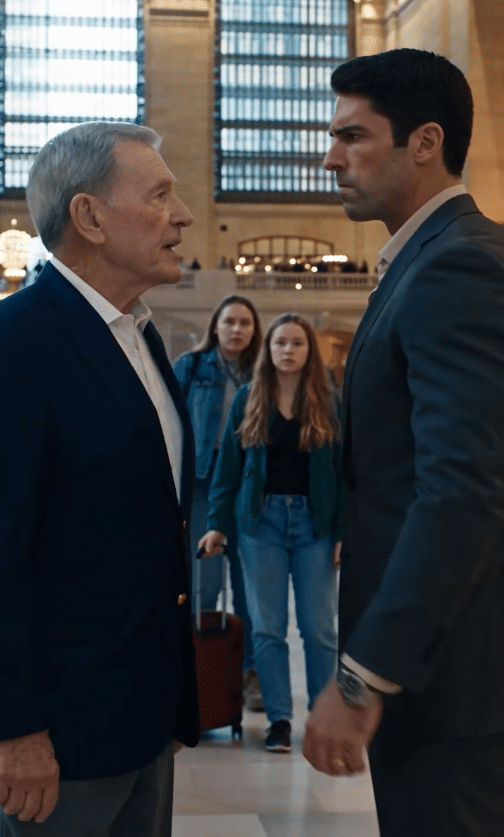
The command came sharply from a man in an expensive charcoal suit.
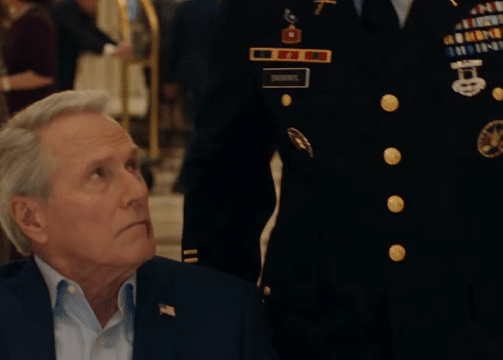
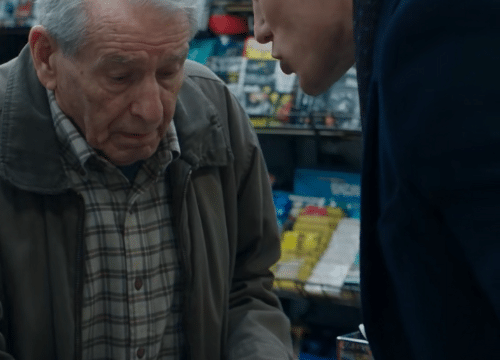
An elderly veteran stood in the middle of the historic train station’s main hall, trying to make his way through the crowded marble concourse. He had short silver hair, a navy blazer, gray trousers, and a quiet dignity that made him almost invisible among the rushing commuters.
He was moving carefully.
His left leg was a prosthetic, concealed beneath his trousers. Every step required concentration, and the polished floor offered little forgiveness if he lost his balance.
The man in the charcoal suit had no patience for any of that.
“Move.”
The veteran looked up.
“I’m moving as fast as I can.”
His answer was calm. Almost apologetic.
But the suited man seemed personally offended that an elderly stranger had failed to clear his path quickly enough.
He was around fifty, affluent, imposing, and dressed with the confidence of someone accustomed to having doors opened before he reached them. A luxury watch gleamed beneath his sleeve.
He glanced at the veteran’s careful steps, then at the people gathering behind them.
His expression turned contemptuous.
The older man tried to move aside.
But before he could find a stable position, the stranger stepped closer.
What happened next would turn a crowded train station into the scene of a public disgrace.
And the man who thought he was simply pushing an old stranger out of his way was about to discover that the veteran had spent a lifetime earning respect he could never buy.
Act II
The elderly man had not always walked this slowly.
Decades earlier, he had served in the United States military, rising through the ranks until he became a Lieutenant General.
His career had taken him through years of difficult deployments, demanding command assignments, and decisions that affected thousands of lives.
He had known the weight of responsibility long before he ever needed a prosthetic leg.
The injury that eventually cost him his natural left leg had come during his military service. The details were not something he shared with strangers. He had never considered his disability a reason to demand special treatment.
After retiring, he had chosen a quieter life.
He wore civilian clothes, traveled without an entourage, and rarely mentioned his former rank unless someone specifically asked.
He had learned that a person’s character was often revealed by how they treated people who could do nothing for them.
That morning, he was simply trying to cross the station.
The man confronting him, however, saw none of that history.
He saw an obstacle.
The stranger was a Brigadier General, though nothing about his civilian clothing immediately revealed it. His charcoal suit, expensive shoes, and luxury watch suggested wealth and influence, but his behavior revealed something less flattering.
He was impatient with anyone who slowed him down.
The elderly veteran’s disability made him particularly irritated.
A few commuters had already noticed the exchange. A young woman stopped near a departure board. A traveler holding a suitcase slowed his pace.
The veteran tried to keep moving.
He wasn’t looking for an argument.
He wasn’t asking anyone to admire his service.
He only wanted enough space to walk safely.
But the suited man had mistaken patience for weakness.
And he was about to make that mistake in front of an entire station.
Act III
The punch came suddenly.
The suited man struck the elderly veteran hard across the cheek.
The older man’s head snapped sideways. Redness and swelling appeared across his cheek, with a faint trace of blood at the corner of his mouth.
A woman nearby gasped.
Before the veteran could recover, the attacker shoved him forcefully.
The older man’s body moved backward.
His left prosthetic leg could not respond like a natural leg. It did not adjust quickly enough to restore his balance on the polished marble.
He fell hard.
One hand struck the floor as he tried to catch himself.
The sound echoed through the station hall.
For a moment, commuters seemed unable to understand what they had witnessed.
An elderly man was lying on the marble floor.
His navy blazer had shifted, his face was visibly injured, and one hand remained pressed against the ground as he struggled to steady himself.
The suited man looked down at him.
“Then stay out of everyone’s way.”
There was no apology.
No concern.
No hesitation.
The attacker seemed satisfied, as though he had merely corrected an inconvenience.
But the people around him were no longer looking at the veteran with simple curiosity.
They were beginning to understand what had happened.
A traveler stepped forward, then stopped when he saw the injured man’s prosthetic leg.
Another commuter moved closer, clearly wanting to help.
The veteran remained conscious.
He did not beg.
He did not shout.
He drew a careful breath and tried to gather himself, maintaining the same quiet dignity he had shown before the assault.
The suited man adjusted his jacket.
He appeared ready to walk away.
Then the sound of several powerful engines rose outside the station.
A group of commuters turned toward the entrance.
Black military SUVs had just pulled up.
And the people stepping out were not ordinary visitors.
Act IV
The doors opened.
A Four-Star General entered the station hall with five senior officers.
His face remained outside the camera’s view.
The visible details were unmistakable: decorated shoulders bearing four stars, a dense ribbon rack, a formal military uniform, and polished shoes moving steadily across the marble floor.
The entourage followed closely behind him.
The crowd began to shift aside.
A few travelers recognized the significance of the uniform. Others simply sensed that something important had happened.
The Four-Star General scanned the hall.
Then he saw the elderly man on the floor.
His movement changed.
He walked directly toward the injured veteran.
Not toward the commuters.
Not toward the station staff.
And certainly not toward the man in the expensive suit.
The veteran looked up.
For the first time, a faint expression of recognition crossed his face.
He didn’t attempt to stand immediately. His injured cheek was swelling, and his prosthetic leg remained awkwardly positioned beneath him.
The senior general stopped nearby.
The five officers behind him remained silent.
Then the general looked toward the man in the charcoal suit.
The camera stayed on the decorated shoulders and the four stars.
His voice cut through the hall.
“Which hand hit him?”
The question was quiet.
That made it more intimidating.
The suited man’s expression changed instantly.
He looked at the general’s uniform.
Then at the five officers.
Then down at the elderly veteran.
Something was beginning to connect.
The man on the floor was not simply an old traveler who had gotten in his way.
The senior commander had arrived, and his attention was entirely focused on the person the suited man had just assaulted.
The attack that had seemed so effortless only moments earlier was now impossible to dismiss.
Act V
The Brigadier General stood motionless.
His expensive watch was still visible beneath his cuff.
His polished shoes were still planted firmly on the marble.
But the confidence that had filled his face before the assault had vanished.
He looked at the Four-Star General’s insignia again.
The five senior officers stood behind their commander, watching in silence.
Nobody rushed to explain the situation.
Nobody needed to.
The veteran remained on the floor, breathing carefully. His face was injured, but his expression was controlled.
The senior general had not taken his eyes off the man who had struck him.
The suited attacker finally understood that this was no longer a private incident between two strangers.
He had assaulted an elderly military veteran in public.
He had done it because the man’s disability made him inconvenient.
And now a Four-Star General had arrived and was asking who had thrown the punch.
The man in the charcoal suit seemed to search for an explanation.
His eyes moved from the senior commander’s decorations to the veteran’s face.
Perhaps he was remembering the older man’s calm voice.
Perhaps he was finally realizing that the person he had dismissed as an obstacle had once held a position of extraordinary responsibility.
The senior general remained just beyond the frame.
The crowd watched.
The veteran said nothing.
Then the Brigadier General’s expression collapsed into fear.
His lips parted.
“Sir…?”
It was barely more than a whisper.
The same man who had ordered an elderly veteran to move was now struggling to speak to someone whose authority he recognized.
And the question hanging over the marble hall was no longer why the old man had walked so slowly.
It was how a military officer could have forgotten that dignity was never measured by the speed of someone’s steps.