Act I
The first thing he noticed was not the girl.
It was the way she stood outside the restaurant window without moving, as if stillness itself could hide hunger. The city rushed around her in a thousand careless lights, headlights dragging white streaks across wet pavement, strangers brushing past with shopping bags and tired faces, but she stayed exactly where she was. Small. Silent. Watching other people eat.
Ethan Vale had seen need before. At least, he thought he had.
He had seen charity galas with polished speeches. He had signed donation checks large enough to make his name sound generous in newspapers. He had listened to boardroom conversations about “urban hardship” spoken by people who never rolled down their car windows in neighborhoods like this one.
But he had never seen hunger standing on two feet and trying to look invisible.
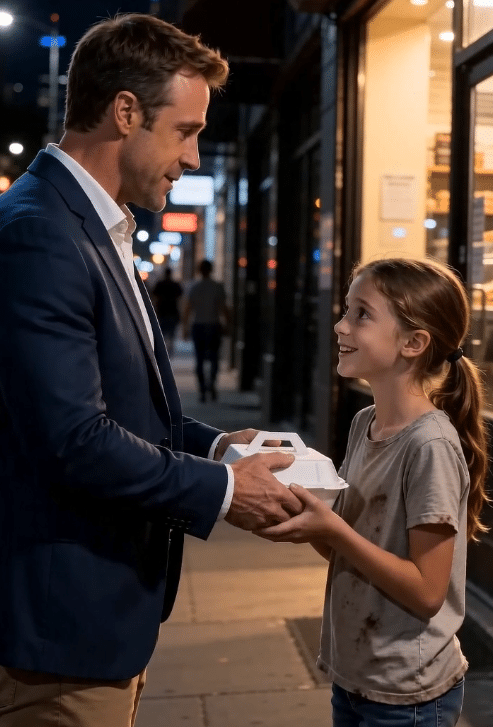
When he stepped out of the restaurant, the warm scent of roasted chicken and garlic still clung to his coat. The girl glanced up, startled, as if she had been caught doing something shameful. She could not have been older than nine. Her tunic was too thin for the cold, her sandals worn down at the heels, and her dark hair fell loose around a face that should have looked soft with childhood but instead carried that careful, guarded expression children learned only when life had asked too much of them too early.
He held out the white takeout container the waiter had packed for him.
Her eyes widened.
“For me?” she asked.
There was no entitlement in her voice. No expectation. Only disbelief.
Ethan nodded. “You’re welcome.”
For one second, she simply stared at the box as if it might disappear. Then she took it with both hands, like it was precious enough to break, and a smile burst across her face so suddenly it nearly undid him.
“Thank you, sir!”
She spun and ran before he could say anything else.
At first, he told himself to leave it there. A meal given. A moment done. He had somewhere to be, and the car waiting at the corner was probably already idling under the impatience of his driver. Tomorrow morning he was expected in a meeting that could determine the future of half the district. Men in expensive suits were waiting for his signature.
But the girl was not running the way children ran with food for themselves.
She ran like someone carrying hope home.
Before he could think better of it, Ethan started after her.
She slipped from the warm spill of the storefront into a narrow alley cut between two old brick buildings, and the city changed all at once. The laughter from the restaurant vanished behind him. The alley was dark, damp, and nearly empty, the cobblestones uneven underfoot, the blue streetlamp above giving everything a cold, unforgiving glow. The girl moved quickly, hugging the container against her chest.
“Did you get food?” he called before he knew why he was speaking.
She did not turn around. She only ran faster.
Something tightened in his chest.
He followed her deeper into the alley, past rusted doors and shuttered windows, until she darted through the broken entrance of a building most people would have mistaken for abandoned. Ethan slowed at the threshold, suddenly aware of the polished shoes on his feet, the pressed collar at his throat, the expensive watch gleaming at his wrist like an accusation.
Then he heard voices inside. Small voices.
He stepped to the doorway and looked in.
The room was barely a room at all. One exposed bulb hung low from a frayed wire. A single mattress lay in one corner beside folded blankets. Four children sat crowded around a dented metal bowl on the floor. Against the wall, a woman with tired eyes and hollow cheeks leaned back as if even sitting upright cost her effort.
The girl Ethan had followed dropped to her knees beside them and opened the container.
The smell of hot food filled the room.
Every child looked at it the way drowning people looked at air.
Then the girl lifted the meal and placed it in her mother’s hands.
“You eat, Mama,” she said softly. “I already ate at school.”
Her mother’s fingers trembled around the box.
The younger children said nothing, but their eyes never left the food.
And in that instant, Ethan understood something with brutal clarity.
The smile outside the restaurant had not been for herself.
It had been for all of them.
He stayed in the doorway, unable to move, staring at the child who had accepted kindness with gratitude only to hand it away the moment she reached home. His throat tightened. Something old and uncomfortable cracked open in him.
“That’s a lie,” he said before he could stop himself.
And when the mother looked up and saw his face, the color drained from hers for a reason that had nothing to do with hunger.
The room went still.
Because she knew exactly who he was.
Act II
For a moment, no one breathed.
The children turned toward the doorway, alarm flaring across their faces. The mother’s hand flew to the food container as though she were afraid he might take it back. The little girl rose halfway to her feet and stepped in front of her siblings without thinking, one thin arm reaching across them in a motion so instinctive it told Ethan everything he needed to know.
This child had learned to protect before she had learned to be protected.
“I’m sorry,” Ethan said, his voice quieter now. “I didn’t mean to frighten anyone.”
The mother stared at him with a kind of exhausted dread. “You shouldn’t be here.”
He would remember that sentence for a long time. Not because it sounded rude. Because it sounded defeated. Like the arrival of a well-dressed stranger at her door could only mean one more thing being taken away.
“I only wanted to make sure she got home safely,” he said.
The little girl looked up at him with fierce suspicion, as if she regretted thanking him at all. Up close, he could see that her gratitude outside had not come from innocence. It had come from discipline. She had learned how to smile for survival.
“What is your name?” he asked her gently.
She hesitated. “Asha.”
It suited her somehow. Quiet, but steady.
Ethan knelt near the doorway so he would not loom over them. “I’m Ethan.”
The mother gave a hollow, humorless laugh. “I know who you are.”
There it was again. That strange recognition.
He looked at her more carefully then. Her face was thinner than it should have been, sharpened by strain and sleeplessness, but there was something familiar in the angle of her eyes, in the set of her mouth when she said his name without actually saying it. Something that tugged at memory without fully surfacing.
“I don’t think we’ve met,” he said.
“No,” she answered. “But your family has met mine.”
Outside, somewhere far down the street, a siren wailed and faded. Inside the room, the bulb overhead buzzed faintly. The children were still staring at the food. Ethan could not bear it.
“You should eat,” he said.
The mother looked at the container in her lap, then at the children, then back at him. Pride and necessity warred openly across her face. At last, she passed the first piece to the youngest child. Then another. Then another. Asha tried to refuse her portion until her mother pressed it into her hand.
Only after every child had something did the mother take a bite herself.
Ethan swallowed hard.
“My name is Meera,” she said when the immediate urgency had quieted. “And before tonight, I prayed I would never have to see another Vale at my door.”
The name landed heavily between them.
Ethan had spent most of his adult life pretending his surname was just a surname. Not a machine. Not a legacy. Not a weapon that opened doors for him while closing them on other people. But in neighborhoods like this, Vale did not sound like success. It sounded like ownership.
His family’s company had built half the city.
It had also displaced half of what used to be here.
He knew the headlines, of course. Redevelopment. Expansion. Restoration. The language had always been polished. Clean. Strategic. Necessary. The uglier truths lived in footnotes and forgotten court filings and the thin silence of people who could not afford long fights.
Ethan’s father had been the architect of all of it.
And now that his father was dead, the company belonged largely to Ethan.
“I don’t understand,” he said, though he was beginning to.
Meera leaned her head back against the brick wall. “Of course you don’t. Men in your world never do. They sign papers in bright rooms and think the damage stays on the paper.”
Asha looked between them, confused but alert. The older children had gone quiet in that particular way children do when adults are speaking about pain they already know too much about.
Meera pointed weakly toward a metal box half-hidden under the mattress. “Open it.”
Ethan stood, crossed the room, and lifted the lid.
Inside were documents. Old letters. An envelope gone soft at the edges from being opened too many times. A hospital bill. A death certificate. Several official notices stamped with the insignia of Vale Development Group.
His pulse slowed to something cold.
He picked up the first notice. Eviction. Temporary relocation pending structural demolition.
The second. Compensation review delayed.
The third. Claim denied.
At the bottom of one page was a signature he recognized instantly.
Not his own.
His father’s.
Meera watched his face as the truth began arranging itself piece by piece.
“My husband worked at the foundry your father shut down,” she said. “When the building partially collapsed, they said it was an accident. They promised compensation to the families. Then the land was sold. Records disappeared. Claims were rejected. My husband died two months later from injuries he never properly treated because we could not pay for care.”
Ethan looked up sharply.
She kept going, her voice calm in the way only long suffering can make it. “We were supposed to receive enough to start over. Enough for rent. Enough to keep the children in school. Enough to survive. Instead, we got notices. Delays. Lies. Then men came and said the neighborhood would be redeveloped and everyone had to move.”
The room felt smaller with every word.
Ethan had heard versions of these accusations before, usually from activists, reporters, angry community groups. He had believed there had been mistakes, yes. Mismanagement, perhaps. But not this. Not something so personal, so ruinous, so obviously deliberate when laid out in a metal box inside a one-room home.
“Why keep all this?” he asked quietly.
Meera’s gaze shifted to Asha. “Because one day, my children would ask why their father died poor after giving his life to men who became richer from his labor. And I wanted proof that I had not imagined the cruelty.”
Asha lowered her eyes.
Ethan looked again at the papers, then at the thin walls, the blankets, the children trying to eat slowly so the food would last longer.
He had walked into many hard conversations in his life. None had ever made him feel this ashamed.
And then he found the one envelope in the box that had never been opened.
It had his name on it.
Not printed. Written by hand.
He turned to Meera.
Her expression changed.
“Don’t,” she said.
But it was already too late.
Because whatever waited inside that envelope had been kept for him for years.
Act III
The paper was old enough to crack along the folds.
Ethan opened it carefully, aware that everyone in the room was watching him now, even the smallest child who had stopped eating altogether. The handwriting inside was firm but uneven, as if the person who wrote it had been in pain or in a hurry.
It was signed by Arjun Shah.
Meera’s husband.
Asha’s father.
Ethan read the first line once, then again.
If anything happens to me, give this to Ethan Vale only when he is old enough to understand what his father has done.
A chill moved through him.
The room seemed to tilt. Meera closed her eyes as if she had hoped the letter would remain buried forever.
“What is this?” Ethan asked.
She said nothing.
He kept reading.
Arjun wrote that he had once worked not only at the foundry but on maintenance contracts in the Vale family’s private estates years earlier. He wrote of a night Ethan did not remember clearly but suddenly felt pressing at the edge of memory: a summer storm, a flooded service road, a car that had skidded, a frightened boy no older than ten trapped in the back seat while adults shouted outside.
A worker had pulled the child free before the engine caught.
That worker had been Arjun.
Ethan’s breath caught.
He remembered flashes only then. Rain hammering glass. The smell of smoke. Strong arms carrying him through mud. A man coughing, telling him not to cry because he was safe. Afterward, his father had called it an incident. An inconvenience. The household staff had been made to sign papers. Ethan, a child at the time, had been sent away to school the next week.
In the letter, Arjun wrote that years later, when he recognized the Vale name on the foundry ownership records, he had gone to Ethan’s father not for favor, but for fairness. He reminded him of the night he had saved his son. He asked only that the injured workers receive the compensation they had been promised.
Instead, according to the letter, Ethan’s father had him removed from the office and warned never to come back.
A month later, the foundry collapsed.
Ethan’s fingers tightened around the page.
Arjun had not written like a bitter man. That was the worst part. The letter was steady, almost painfully dignified. He said he did not blame the son for the sins of the father. But if Ethan ever became a man with power, he begged him to become a different kind of one.
Do not let them tell you these losses are numbers, Arjun wrote. Numbers do not sit hungry in dark rooms. Numbers do not bury fathers.
The silence after Ethan finished reading felt sacred and terrible at the same time.
He looked at Meera. “Why didn’t you send this?”
A faint, broken smile touched her mouth. “To where? Your father kept you behind gates and headlines. Men like him do not raise sons to hear women like me.”
The truth of it hit too cleanly to deny.
Ethan had spent years believing distance made him different. He had gone abroad for university. He had disagreed with his father’s methods in private. He had funded scholarships, donated to shelters, talked often and eloquently about responsible development. He had told himself he was better because he felt discomfort where his father felt none.
But feeling discomfort had not stopped any of this.
And now he was in the city for one reason: to finalize a redevelopment project that would clear the last blocks of the old district.
This block.
This building.
This room.
He had not known.
That excuse died the moment it formed.
Asha was watching him very closely now, her expression older than her age. Not hopeful. Not trusting. Assessing. As if children like her had already learned that wealthy men sometimes looked moved right before they walked away forever.
Ethan folded the letter with unsteady care.
“When are they making you leave?” he asked.
Meera’s answer was barely above a whisper. “Tomorrow.”
Asha’s hand went to the sleeve of her mother’s sweatshirt.
Tomorrow.
Not next month. Not in legal negotiation. Not abstractly pending review. Tomorrow these children would be pushed from even this narrow room into whatever came after, and Ethan realized with a sick drop in his stomach that the final authorization had crossed his desk that morning.
He had signed it.
He could see the page in his mind with horrifying clarity. Parcel clearance. Safety risk. Immediate compliance recommended. He had initialed it between calls and coffee and polite conversation, trusting a stack of documents prepared by lawyers who never entered the places they erased.
Asha stood.
“You should go now,” she said.
It was not childish defiance. It was mercy he did not deserve.
She did not want her mother humiliated any further by a man in a navy blazer discovering exactly how much damage men like him could do.
Ethan looked at the nearly empty takeout container, the siblings sharing the last scraps carefully, Meera’s exhausted posture, the letter in his hand.
Then he looked at the child who had lied about eating so her family could have one more meal.
“No,” he said.
His voice had changed.
“Not this time.”
Because by morning, he was either going to become the man his father raised—or the man Arjun Shah had asked him to be.
Act IV
Ethan left the building just before midnight with the letter inside his coat and the taste of shame still sharp in his mouth.
The driver straightened when he saw him approach, but Ethan waved him off and took the wheel himself. He drove through the sleeping city toward the glass tower bearing his family’s name, toward offices that gleamed even at that hour because wealth hated darkness and always paid to keep itself lit.
Security let him in without question.
The legal archive room was on the twenty-third floor, behind a keypad and a frosted door no ordinary tenant would ever see. Ethan had passed it countless times. He had never once considered how much buried damage might be resting quietly inside file cabinets labeled with neutral words.
He began pulling records.
Foundry settlement files. Claims ledgers. Insurance reports. Internal correspondence. Demolition approvals. Relocation funds.
At first, all he found was bureaucracy. Then, at 1:17 a.m., he opened a scanned memo marked confidential.
Compensation disbursement postponed pending acquisition strategy. Priority should be preservation of redevelopment timetable. Individual hardship claims are not to interfere with parcel consolidation.
The memo had been circulated by senior counsel and approved by his father.
There were more.
A private note discussing “manageable public fallout.”
A list of families categorized by relocation resistance.
A recommendation to deny claims lacking “document continuity,” even though separate emails showed company officials themselves had moved or destroyed records during the site transition.
It was all there.
Not chaos. Not unfortunate oversight. Design.
Ethan stood in the middle of the archive room under cold fluorescent light and understood, finally, the full architecture of respectable cruelty. It did not scream. It did not storm through doors. It arranged signatures. It delayed responses. It buried names under strategy language until suffering looked procedural.
By dawn, he had copied everything.
At eight o’clock, the board assembled in the conference room expecting routine approval on the district clearance plan. Men arrived with leather folders and easy confidence. A woman from external counsel began outlining liability shields. Someone joked about turning “dead blocks” into luxury heritage units.
Then Ethan placed Arjun’s letter on the table.
The room quieted.
“I’m suspending the demolition,” he said.
Confusion flickered first, then irritation.
One board member actually smiled, as though indulging a moral detour. “You can’t halt a live project based on sentiment.”
Ethan slid copies of the internal memos across the polished table.
“This is not sentiment,” he said. “It’s fraud.”
The smile vanished.
What followed was not cinematic in the way stories sometimes pretend justice is. No one gasped dramatically. No one confessed under pressure. The room became cold, technical, adversarial. Lawyers interrupted. Executives deflected. Old men with practiced voices warned about reputational risk as though reputational risk were the injury and not the evidence of it.
But Ethan had spent all night becoming impossible to intimidate.
He informed them he had already forwarded the documents to independent counsel, city regulators, and a journalist whose investigations had once nearly exposed the foundry case before being buried under injunction threats. He announced an emergency restitution fund under his personal authority as majority shareholder and froze all evictions tied to the district until every contested claim was reviewed.
His father’s oldest associate leaned forward, face hardening. “You’ll destroy this company.”
Ethan met his gaze. “Then perhaps it should be destroyed in its current form.”
There it was. The thing he had inherited and feared to challenge. Not just money, not just power, but the invisible demand to protect the machine at all costs because the machine had fed him, educated him, clothed him, built his life and called that debt.
For the first time, he refused to pay it.
By noon, word had spread.
By afternoon, city officers arrived at the district not to enforce clearance but to halt it. Community advocates appeared with copies of suspension notices. A legal aid group set up folding tables on the sidewalk. Reporters followed. So did cameras.
And in the middle of all that noise, Ethan returned to the building where Asha lived.
She opened the door before he could knock twice.
This time she did not smile. Children who had survived too much rarely trusted good news on the first telling.
Behind her, Meera rose slowly from the floor, bracing one hand against the wall.
“The eviction is suspended,” Ethan said. “The company is reopening all compensation cases connected to the foundry and the relocation orders. I found the records. Your husband was telling the truth.”
Meera stared at him as if language had stopped working.
Ethan continued, because some truths should be spoken plainly. “My father did this. My company continued it. And I signed papers this morning that would have hurt you again without ever seeing your faces. I can’t undo what was done. But I can stop what happens next.”
Asha looked from him to her mother.
“Does that mean we stay?” one of the younger children asked.
Meera covered her mouth with shaking fingers.
“For now, yes,” Ethan said. “And not like this. Not alone.”
The oldest boy, who had barely spoken all night, stepped forward with the fierce protectiveness of someone too young for such responsibility. “Why are you helping now?”
The question was fair. Necessary, even.
Ethan thought of Arjun’s letter. Of being carried from a burning car by a man his father later discarded. Of a girl lying about lunch so her mother could eat. Of the thin line between ignorance and complicity.
“Because your father once saved my life,” he said quietly. “And because all these years later, your sister saved what was left of my conscience.”
For the first time, Asha’s expression changed.
Not trust.
But something close enough to let the light in.
Still, one thing remained.
And when the first article went live that evening with leaked documents, names, dates, and evidence attached, the city finally began looking where it had trained itself not to look for years.
Straight at the Vales.
Act V
Scandal, when it comes for powerful people, rarely arrives as thunder.
It arrives as paperwork no one can explain away anymore.
Over the following weeks, the story widened. More families came forward. More denied claims resurfaced. Former employees spoke under oath. A retired clerk admitted records had been altered under instruction. Regulators reopened the foundry case. The board fractured. Lawsuits multiplied. Men who had spent years dining under chandeliers suddenly developed poor memories under questioning.
For the first time in a long time, the city listened to voices that did not come from podiums.
Meera was one of them.
She hated cameras, but she gave her statement anyway, sitting upright in a borrowed blazer, hands still but eyes unwavering as she spoke about the collapse, the letters, the hunger, the eviction notices, the years of being treated like inconvenience rather than widow. She did not cry on television. She did not need to. Truth, when spoken plainly by someone who has paid for it with her life, has a power tears cannot improve.
Asha sat beside her during one interview, feet not reaching the floor, expression solemn until a reporter asked what she wanted most now.
She thought for a second.
“For my mom to stop pretending she isn’t hungry,” she said.
The clip spread everywhere.
People who had ignored legal jargon understood that sentence immediately.
Restitution took time, but it came. Not as charity. As debt finally acknowledged. Temporary housing turned into a clean apartment with two rooms and windows that opened properly. The children enrolled in school with regular meals and real uniforms. Meera received the compensation her husband had been denied, along with additional damages once the fraud was proven. It did not give the years back. Nothing could. But it let grief breathe without starvation sitting on its chest.
Ethan kept his promise the difficult way, not the theatrical one.
He did not sweep in playing savior. He paid legal fees anonymously where possible, testified against his own executives, restructured the company under outside oversight, sold major assets to fund restitution, and stepped down from several public-facing roles when it became clear his surname itself had become part of the wound. He did not seek applause for any of it. Shame had taught him at least that much.
But he did keep returning to see the family.
At first, the visits were awkward.
The children spoke to him cautiously, as though he were a storm that might be gone by morning. Meera remained polite but measured. Trust, after all, was not repaired by one night of decency or one burst of courage in a boardroom.
It was repaired by repetition.
He brought groceries, then books, then nothing at all except time. He helped the oldest boy with school applications. He found a doctor for the youngest child’s untreated asthma. He listened when Meera spoke of Arjun, not as tragedy, but as a man who loved old songs, laughed too loudly, and could repair almost anything with his hands.
And Asha watched all of it.
One evening, months later, Ethan met them in a small park just after sunset. The children were chasing one another across a patch of grass, loud and bright in a way they had not been the night he first saw them. Meera sat on a bench with a paper cup of tea, looking tired in the ordinary way people looked after long days, not in the frightening way of people running out of life.
Asha approached him with the careful seriousness she always carried when something mattered.
“What did my father write at the end of the letter?” she asked.
Ethan had wondered when she would ask.
He sat beside her on the bench and took his time answering. “He wrote that power is tested most honestly by the people who think no one sees what they’re doing.”
Asha frowned a little. “That sounds like something for adults.”
He smiled faintly. “Then this part is better. He wrote that a person should be known by what they protect when protecting it costs them something.”
She thought about that.
Then she looked out at her brothers and sisters running in circles under the fading light. “Did it cost you something?”
“Yes,” Ethan said.
“Was it worth it?”
He watched the family before him. The mother no longer hiding food. The children arguing over a ball instead of crumbs. The living proof that justice, though late, was still worth chasing.
“Yes,” he said again, and this time there was no hesitation.
Asha nodded as if filing the answer away for later use. Then, after a silence, she said the one thing he had not expected.
“I really didn’t eat at school that day.”
Ethan turned to her.
There was no drama in her face now. Just honesty.
“I know,” he said softly.
She studied him a moment longer, then slipped her hand into his—not because he had earned forgiveness for everything, because he hadn’t, and maybe never fully could. But because children understand something adults often forget: redemption is not the same as erasure. It is choosing what comes next with open eyes.
The city would go on. Cases would take months, some years. Headlines would fade, and powerful people would try, as they always did, to outlast the memory of what they had done. But some things had already changed too deeply to be undone.
A letter had been read.
A lie had been recognized.
A hungry child had carried one meal through a dark alley and, without knowing it, dragged the truth into the light.
And in the end, that was the part Ethan never stopped thinking about.
Not the boardroom. Not the scandal. Not even the ruin of his father’s carefully guarded legacy.
It was that first image.
A small girl under a blue streetlamp, running home with food she had no intention of keeping for herself.
He had followed her out of curiosity.
He stayed because once he saw what love looked like in a room stripped of almost everything else, he could no longer pretend not to know the cost of looking away.