Act I
At first, people did what people always do.
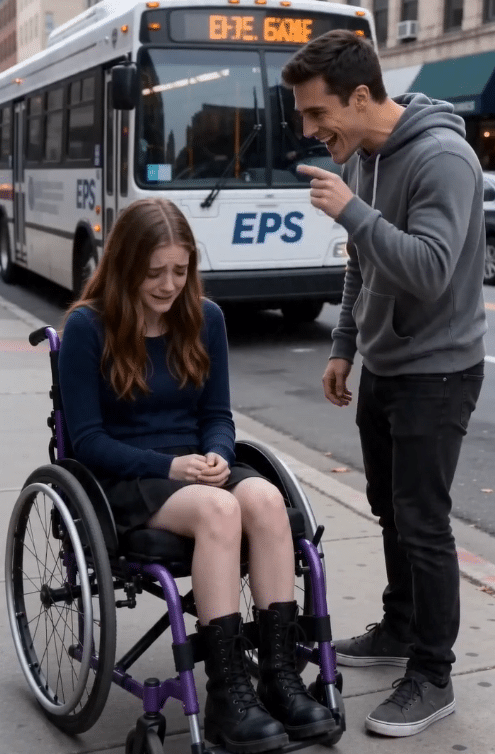
They slowed down just enough to notice, then sped up again as if cruelty became less real when it happened in daylight. The city kept moving. Shoes struck concrete. Traffic rolled past. A bus hissed toward the curb. And in the middle of all that ordinary noise, a man in a gray hoodie stood over a woman in a wheelchair and laughed like humiliation was a performance he had every right to enjoy.
“Go! Nae-Nae! Hahaha!”
His finger jabbed toward her face again and again, cruel and childish at once. He wanted attention. He wanted a reaction. Most of all, he wanted the kind of power cowards always chase—the power of choosing someone who could not easily stand up and daring the world to stop him.
The woman in the wheelchair did not look at him.
She kept her eyes on her lap, fingers clenched tight against the bright floral fabric of her dress. The purple frame of her chair caught the light in flashes, too vivid for a moment that ugly. Her shoulders were rigid, not weak. Not broken. Just exhausted in the particular way a person becomes exhausted after learning how often strangers confuse vulnerability with permission.
People noticed that too.
No one stepped in.
The aggressor grinned wider when he realized that.
There was something especially ugly about a man who became bolder each time the crowd failed him morally. He rocked back on his boots, laughed louder, and leaned in closer like the silence around them was cheering him on.
“C’mon,” he sneered. “At least look at me.”
Still, she said nothing.
Her name was Elena Cruz, though no one on that sidewalk knew it yet. No one knew she used to love crowded places before an accident taught her how quickly a crowd could turn into a wall of eyes. No one knew she had nearly gone back home twice that morning before forcing herself back onto the bus route because she was tired of canceling her own life to make cruel people more comfortable.
All they saw was a young woman in a wheelchair and a man deciding what that meant.
Elena heard the bus pull up behind her. The brakes wheezed. The doors folded open.
For one brief, bitter second, she told herself not to hope.
Hope was dangerous in moments like this. Hope made you lift your head. Hope made you believe someone might finally say enough. And when no one did, hope left you more humiliated than before. So she kept her gaze lowered and tried to disappear into the red-and-white folds of her dress while the man kept laughing.
Then the sidewalk changed.
It did not change loudly at first. No one shouted. No one ran. But a new presence entered the space behind her, heavy and deliberate, and the air itself seemed to rearrange around it.
Boots hit pavement.
Then more boots.
The aggressor kept talking until he realized he was no longer the biggest thing in the scene.
Elena looked up.
A large man with a beard and a black leather vest had just stepped off the bus, his expression flat in the way truly serious men often looked when they had already made up their minds. Behind him came several more, broad-shouldered and silent, filling the sidewalk one after another until the open bus doors seemed to be releasing not passengers but consequence.
The man in the hoodie turned.
And for the first time since the harassment began, he looked uncertain.
The lead biker walked straight toward him.
No rush. No drama. Just certainty.
That was when the laughter died.
And Elena realized, with a shock so sudden it felt physical, that this was not going to end the way public humiliations usually did.
Because the man stepping toward her bully was not a stranger to moments like this.
He looked like someone who had been waiting years to meet exactly this kind of coward again.
Act II
“That’s enough,” the biker said.
His voice was not loud. It did not need to be.
He shoved the aggressor’s hand away from Elena’s face with a single hard motion, then stepped between them so completely that the woman in the wheelchair disappeared from the bully’s sight. It was not a threat performed for effect. It was a boundary laid down with the finality of a locked door.
“Step back.”
The man in the hoodie stumbled half a pace, stunned less by the force than by the fact that someone had actually touched the script he had written for this moment and torn it in half. His mouth opened, closed, then opened again, but whatever line he had prepared was swallowed by the sight of the others coming off the bus behind the lead biker.
One by one, they formed a loose semicircle.
Black leather vests. Heavy boots. Hard faces. Not wild, not chaotic. Controlled. Protective. Deliberate.
The letters on the back of one vest caught sunlight as he turned slightly.
BACA.
The aggressor saw it too, though he clearly did not understand all of what it meant. He only understood the immediate truth: the sidewalk no longer belonged to him.
Elena sat very still.
Her pulse was racing now, not from the man in the hoodie anymore, but from the sudden collision between shame and relief. She hated being watched. She hated scenes. She hated being turned into the center of public emotion. But she had also spent enough time in this chair to know the difference between attention that stripped you down and attention that stood guard.
These men were not looking at her like she was helpless.
They were looking at her like she mattered.
The lead biker turned just enough to glance back at her. His face shifted almost imperceptibly, sternness softening around the edges.
“You okay, ma’am?”
Elena opened her mouth, but nothing came out at first. She was not used to being asked that question by strangers in moments like this. Usually people asked what happened. Or whether she knew the harasser. Or whether she wanted them to call someone, their voices already half-turned away.
This man asked the only thing that mattered.
She nodded once.
The bully tried to recover himself with a scoff. “I was just joking.”
The lead biker looked back at him with such total lack of amusement that the excuse died as soon as it left his mouth.
“No,” he said. “You were enjoying yourself.”
A few people had stopped now. Not because the woman had been mocked. That had not been enough to hold them. But a wall of bikers stepping off a city bus apparently made the cruelty visible in a way disability never did.
Elena felt anger rise beneath the relief.
She knew this pattern. People loved courage once it looked safe enough to admire.
The aggressor shoved his hands into his hoodie pocket and tried to laugh again, but it came out brittle this time. “I said I’m done.”
“Good,” the biker replied. “Then walk.”
The man didn’t move.
Some cowardly instinct in him still believed there might be a way to claw back authority if he held his ground. He looked around at the staring pedestrians, at the bus driver watching from his seat, at the half-circle of men who had turned his easy prey into protected ground.
Then he made the mistake of looking directly at Elena.
There was no triumph on her face.
That unsettled him more than anger would have.
She was not gloating. She was simply seeing him clearly now. And bullies rarely survive being seen clearly.
He cursed under his breath and backed away.
Only after he had retreated several yards did the tension on the sidewalk loosen.
But the story did not end there.
Because the lead biker crouched to Elena’s eye level, and when she finally saw his face fully, something in her expression changed.
Not relief.
Recognition.
He saw it too.
“Wait,” he said quietly. “Elena?”
She stared at him.
He took a closer breath, as if the years had suddenly rearranged themselves in front of him. “You don’t remember me, do you?”
The name hit her like a hand against old glass.
For a second, she was no longer on a city sidewalk with cars and concrete and strangers pretending not to stare. She was sixteen again, sitting in a hospital hallway after the accident, surrounded by machines and forms and legal language, listening to adults talk around her life as if she had already become a case file.
And somewhere in that blur of unbearable days, there had been a man with a beard who had placed a cup of hot chocolate beside her and told her she was allowed to be angry.
Not a doctor. Not a lawyer.
A biker.
Her throat tightened. “Mason?”
The lead biker’s eyes softened fully now.
“Yeah,” he said.
And suddenly the sidewalk humiliation was no longer just a random moment interrupted by strangers.
Because Mason had not stepped off that bus by coincidence.
He had been on his way to find her.
And what he was carrying mattered even more than what he had just stopped.
Act III
The other bikers gave them space without really leaving.
That was the first thing Elena noticed. They spread out enough to make the scene look less like a confrontation and more like a perimeter. A few stood near the curb. One stayed by the open bus door, talking quietly with the driver. Another positioned himself at the edge of the crowd with his arms folded, not menacing anyone so much as making it very clear that no one was going to drift too close unless invited.
Mason remained crouched in front of her.
The years had changed him. His shoulders looked broader. His beard had gone rougher with gray in it now. The old warmth in his eyes was still there, but it sat behind something harder, something carved by time and too many stories like this one.
“I didn’t know if it was really you,” he admitted. “Then I saw the bracelet.”
Elena looked down instinctively.
A thin silver bracelet rested against her wrist, plain except for one small engraved star. She had worn it almost every day since the accident. Not for style. For memory.
Mason noticed her confusion and gave a faint, sad smile.
“Your brother gave me the same look the first time I showed up in that hospital vest.”
The mention of her brother landed deep.
Gabriel.
The name still had the power to stop whole sections of her heart.
Years earlier, before the wheelchair, before the surgeries, before the settlement hearings and the quiet humiliations that followed, there had been Gabriel Cruz. Loud. Protective. Impossible. The kind of older brother who picked fights for fun but never let anyone else be the reason his little sister cried.
He had died in the crash that left her paralyzed.
Not instantly. Not mercifully. Just slowly enough for the family to fracture under the weight of the before and after.
Mason had entered their lives later, when Elena was still in rehab and their mother was drowning in bills. He had been part of a biker support network that worked with families in crisis, especially children and teenagers navigating trauma, courts, hospitals, and fear. Elena remembered only fragments from that time. Too much pain had blurred it. But she remembered him showing up without pity.
That had mattered.
“I thought you moved,” she said.
“We did,” Mason replied. “Chapter got reassigned. I’ve been back in the city a few months.”
He glanced toward the bus. “We were heading from a school visit when I saw you at the stop.”
A pause.
“Then I saw him.”
Elena looked away.
Her face had gone hot again now that the danger had passed. Relief always made room for humiliation afterward. She could still hear the man’s mocking voice, still feel the way the crowd had looked at her only after the bikers made them.
Mason noticed.
“You don’t owe anyone composure after that,” he said.
She laughed once, but there was no humor in it. “That’s easy to say when you’re six-foot-three and dressed like justice.”
That got the smallest smile out of him.
Then it faded.
“I was already coming to see you,” he said.
Something in his tone made her still.
“Why?”
Mason reached inside his vest and pulled out a manila envelope, worn soft at the edges from being carried too long. He held it carefully, not like paperwork, but like something heavier than paper had any right to be.
“Because your mom called one of our old chapter members last week,” he said. “Said she didn’t know who else to ask.”
Elena’s heart sank.
Her mother only reached out when things were bad.
“How bad?”
Mason did not answer immediately. He looked at her the way people do when they are deciding how much of the truth to hand you in public.
“Your building was sold.”
The sidewalk blurred for half a second.
“What?”
“The new owners are clearing tenants fast. They’ve been using technical violations, accessibility waivers, whatever they can find.” His jaw tightened. “Your apartment’s on the list.”
Elena stared at him.
No.
Not now. Not after everything it had taken to get that apartment. Not after the long fight for a ground-floor unit with a shower she could actually enter, a ramp that didn’t wobble, hallways wide enough for her chair, neighbors who knew when to help without making her feel smaller.
“It’s legal harassment dressed up as property redevelopment,” Mason said. “And there’s more.”
He handed her the envelope.
Inside were copies of notices she had never received, complaint logs she had never filed, maintenance reports falsely claiming she had refused access to repair crews. On the back of one form was a property management stamp from a company name she recognized instantly.
Barrow Urban Holdings.
The same company that had handled the insurance dispute after Gabriel’s death. The same one that had spent years cutting corners and dodging responsibility while her family sank.
Elena went cold.
“That can’t be a coincidence,” she whispered.
“It isn’t,” Mason said.
And then he told her the part no one in her family had known.
Gabriel’s crash had never been closed as cleanly as the city claimed. A former employee from a transit subcontractor had recently come forward with archived emails showing falsified maintenance records on the paratransit vehicle involved that night. Safety inspections had been signed off without being completed. Repairs had been delayed. Internal complaints had been buried.
Barrow’s name was in those files too.
Elena gripped the envelope so tightly it bent.
For years, she had forced herself to survive the visible loss.
The chair. The surgeries. The stares. The awkward kindness of strangers. The casual cruelty of others.
But this was different.
This was the possibility that what happened to her brother—and to her—had not been pure tragedy.
It had been negligence.
Profit.
A decision.
Mason watched the understanding move across her face.
“That guy back there?” he said, glancing toward where the bully had disappeared. “He thought today was about a joke. It wasn’t. It was about people deciding what kind of human being they can get away with being when they think someone’s already been knocked low enough.”
Elena closed the envelope.
The humiliation on the sidewalk suddenly felt smaller than what had just opened in front of her.
Not less painful.
Just part of a much bigger pattern.
And by the time she lifted her head again, something in her expression had changed.
Because this time, she wasn’t the only one who had come prepared.
Act IV
Mason had not brought the biker group onto that bus by accident.
They had boarded together that morning because he had a feeling Elena might not face the meeting alone if he could help it. Her mother had sounded frightened on the phone. Not panicked. Frightened in the steady, worn-down way of people who had already been cornered too many times to waste energy sounding dramatic.
So when the bullying started at the bus stop, the men who stepped off with Mason were not just random riders witnessing a cruel scene.
They were already on their way to a fight of a different kind.
An hour later, they were in the lobby of Barrow Urban Holdings.
The building was all polished surfaces and quiet contempt, the kind of place designed to make ordinary people feel loud just by existing inside it. Elena rolled across marble floors that reflected too much light, Mason walking at one side, two bikers several paces behind, not touching anything, not saying a word, simply making the room adjust to her instead of the other way around.
The receptionist looked at them, at the vests, at Elena’s wheelchair, at the envelope in her lap.
Then she looked nervous.
“We have an appointment,” Mason said.
They did.
Barrow’s regional property manager, Thomas Weller, had expected one disabled tenant and perhaps an anxious parent. He had not expected Elena Cruz arriving with a file of documents, a legal advocate on speakerphone, and enough silent leather behind her to strip the false confidence off his face before the meeting even began.
He stood when they entered the conference room, smiling the brittle smile of a man who believed charm was a substitute for ethics.
“Ms. Cruz,” he said, gesturing toward the chair position across from him as though he were welcoming her into a negotiation between equals. “I’m sure there’s been some misunderstanding.”
Elena placed the envelope on the table.
For the first time that day, her hands did not shake.
“No,” she said. “There’s been a pattern.”
Weller kept smiling.
Then she slid the false maintenance reports toward him.
The smile slipped.
She followed them with the fabricated tenant complaints. The accessibility compliance memo. The notice dates that proved management had backdated documents and failed to serve her correctly. Then Mason added copies of the transit maintenance emails linking Barrow’s liability division to the old accident case involving Gabriel.
The room got very quiet.
Weller tried to recover with corporate language, but the words sounded thinner now.
“These matters are handled by separate departments.”
“Convenient,” Elena said.
He cleared his throat. “The housing issue has nothing to do with—”
“With the fact that your company profits from breaking people twice?” she cut in.
That landed.
Weller’s gaze flicked to the bikers near the door. Not because they had threatened him. They had not. They simply existed with the kind of unblinking stillness that made lies feel more embarrassing to tell out loud.
For years, Elena had been forced into rooms where everyone else had the posture of authority. Doctors. Claims officers. Investigators. Property managers. Men who spoke to her as if tragedy had reduced her to gratitude. Men who expected tears, confusion, compromise.
Today, she gave them none.
“You used paperwork to make me look difficult,” she said. “You counted on me being tired. You counted on me being alone. You counted on me feeling too lucky to have any apartment at all.”
Weller opened his mouth.
Mason leaned forward slightly. “You might want to listen.”
The property manager didn’t like that.
Elena saw it instantly. Men like him always believed they were safer when the disabled person stayed polite and the intimidating men stayed irrelevant. But the whole balance of power in that room was wrong now. The woman he had tried to displace knew the documents better than he did, and the silent wall behind her made it impossible to patronize her without hearing how pathetic he sounded.
His voice hardened. “Threats won’t help your case.”
Elena met his eyes.
“Good,” she said. “Because I brought evidence instead.”
Her advocate joined by speakerphone then, followed by a city disability rights officer who had been forwarded the file an hour earlier. One question led to another. Dates were checked. Claims were compared. Suddenly Weller was no longer a man managing a tenant problem. He was a representative trapped between records that contradicted him and witnesses he could not intimidate.
By the end of the meeting, the eviction order was suspended pending investigation.
By evening, Barrow’s internal counsel was requesting damage control.
By morning, a local reporter had published the first piece: Disabled Tenant Challenges Questionable Eviction Tied to Firm With History of Safety Complaints. The article did not mention the bully at the bus stop.
It did not need to.
That scene had only been the spark.
What mattered now was the fire behind it.
And when the reporter called later asking Elena whether she wanted to go on record not only about the housing case, but also about the newly resurfaced documents tied to Gabriel’s crash, she looked at Mason for a long moment before answering.
All her life since the accident, people had mistaken her silence for fragility.
They were about to learn the difference.
Act V
The interview aired three nights later.
Elena wore the same floral dress from the bus stop, though this time not because it happened to be clean, not because it was easiest to put on, not because it was all she had the energy to choose. She wore it because she remembered the exact moment a stranger laughed at her in it and decided that would not be the last meaning the dress carried.
The studio lights were unforgiving.
So was the truth.
She spoke calmly. Not theatrically. Not angrily, though anger sat close enough beneath the surface to sharpen every sentence. She described the harassment in public. The false eviction paperwork. The years of inaccessible systems dressed up as policy. Then she spoke about Gabriel.
Not as a symbol.
As her brother.
She told the audience how he used to drum on every table he passed. How he once spent an entire summer fixing up a rusted bike just to give it to a kid down the block. How, on the night of the crash, he had switched seats with her at the last second because he thought the left side looked less stable and wanted her farther from the impact.
The room went silent around that detail.
Then she spoke about the maintenance files.
About signatures. Delays. falsified inspections. About what it meant to live for years with the consequences of an event the city called unfortunate while private emails suggested people in offices had known those consequences were becoming more likely by the week.
Her voice did not break.
That made it stronger.
The public response was immediate.
Suddenly, the footage from the bus stop surfaced online too. Someone had recorded the moment the bully laughed, the bus doors opened, and the bikers stepped out one after another like the visible shape of accountability. The clip spread fast, but the reason it stayed with people had less to do with intimidation than with the image at the center of it: a young woman in a wheelchair, still and humiliated, until someone finally chose not to let cruelty pass as entertainment.
Viewers learned her name.
Then they learned her story.
Barrow Urban Holdings issued statements. Then revised statements. Then careful non-statements approved by nervous attorneys. The regional property manager was placed on leave. Internal reviews were announced. Old transit records were subpoenaed. A former compliance officer came forward. Then another.
The pattern widened.
It always does once someone stops apologizing for pointing at it.
And through all of it, the biker group stayed near—but not over her. That mattered most. Mason understood something many people did not: protection was not the same as taking over. He stood beside Elena when she asked. He stepped back when she did not. He and the others escorted her to hearings, press events, and one brutally long mediation session, but they never spoke for her.
They made sure she had space.
She filled it herself.
Weeks later, Elena returned to the same bus stop.
Not for symbolism. For real life. She still had appointments. Still had errands. Still had a body that required planning and a city that remained inconvenient in a hundred unglamorous ways. Justice, she was learning, rarely arrived as a clean ending. It arrived in pieces. A hearing date. A suspension. A check. A corrected document. An apology too late to trust. A door opened when it should have been automatic all along.
Mason was there, leaning against the bench with coffee in hand.
“Thought you might want company,” he said.
She smiled. “You stalk all your friends with this much leather involved?”
“Only the difficult ones.”
She rolled her eyes, but the warmth stayed.
Traffic moved around them. A bus approached in the distance. For the first time in a long while, the sound did not tighten her chest.
“Do you ever get tired?” she asked him.
“Of what?”
“Showing up for battles that aren’t yours.”
Mason looked at her for a second, then out toward the street.
“They are ours,” he said. “That’s the point.”
The bus pulled in.
Different route. Different driver. Same hiss of brakes.
Elena glanced at the reflection in the shelter glass and caught sight of herself framed by city noise, purple wheelchair, floral dress, chin lifted higher than it had been the day the bully found her looking down. She thought of Gabriel. Of her mother crying quietly after the interview aired. Of the first legal letter that finally used the word negligence where everyone else had hidden behind accident. Of the men who stepped off a bus because they saw cruelty and refused to let it stay casual.
And she thought, too, of the man in the gray hoodie.
Not because he mattered most.
But because men like him were everywhere. In sidewalks and offices and policy meetings and property firms. Some laughed openly. Some wore ties. Some mocked you to your face. Some buried you under paperwork. All of them relied on the same rotten hope—that humiliation would exhaust you before truth could organize itself.
This time, it hadn’t.
The bus doors opened.
Mason moved aside so she could board first, one hand steady near the ramp without touching it unless needed. The driver smiled and greeted her by name. Small thing. Huge thing.
As Elena rolled forward, she looked back once at the sidewalk where everything had changed.
The worst day had not become beautiful.
That was not how real life worked.
But it had become useful.
It had exposed exactly who was willing to mock, who was willing to watch, and who was willing to stand between cruelty and the person it chose. And once a truth like that showed itself in broad daylight, it was very hard to force it back into the dark.
The bully had wanted a spectacle.
He got one.
He just never imagined the woman he tried to shame would be the one left standing at the center of it all—calm, visible, unbroken—and that the sound everyone remembered in the end would not be his laughter.
It would be the bus doors opening.