Act I
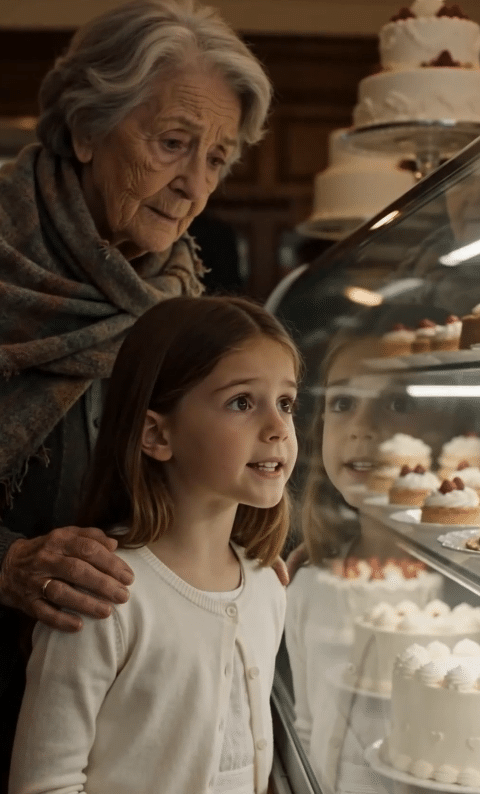
The little girl pressed both hands to the glass as if the cakes were behind a museum window.
Inside the display case, cream swirled in perfect white peaks. Strawberries shone like rubies. Chocolate curls rested on glossy frosting, and tiny sugar flowers bloomed on cakes so delicate they looked almost too beautiful to eat.
“Grandma,” the girl whispered, “do princesses get cakes like this on their birthdays?”
Eleanor Bell rested a thin hand on her granddaughter’s shoulder.
For a moment, she did not answer.
The bakery smelled of butter, vanilla, and warm sugar. It was the kind of smell that could make a person remember being loved, even if the world outside had forgotten how. Eleanor stood wrapped in an olive-green shawl, her gray hair pinned in a bun, her old shoes planted carefully on the polished floor as if she were afraid to leave a mark.
Her granddaughter, Lily, was turning five that day.
Five years old, wearing a simple green dress, staring at cakes she already knew they could not afford.
Eleanor swallowed the ache in her throat.
“I think princesses get whatever cake makes them smile,” she said softly.
Lily turned to her, hopeful. “Then can we just look at mine?”
Eleanor forced a smile.
“Yes, sweetheart. We can look.”
Behind the counter, the young baker stopped arranging pastries.
His name tag read Colin, and his white apron was spotless. His hair was dark and combed carefully, his red tie tucked beneath a pale green shirt as if he considered himself far too elegant for crumbs.
He stared at the fingerprints on the glass.
Then he leaned over the counter.
“Don’t stand here touching the glass if you can’t buy anything.”
The words landed hard enough to turn the air cold.
Eleanor pulled Lily’s hands back immediately.
“I’m sorry,” she said. “She was just looking.”
Colin’s eyes moved over the shawl, the worn purse, the child’s simple dress. His mouth twisted.
“Then look faster and leave.”
Lily’s face changed.
Not crying yet.
Worse.
The confused stillness of a child learning that wonder could offend people.
Eleanor lowered her head.
“Come, darling.”
She guided Lily away from the display case, one hand trembling around the little girl’s fingers. Behind them, Colin returned to his pastries as if he had only brushed dust from a table.
But near the window, a man in a gray three-piece suit had stopped moving.
He held a large white cake box in both hands. The label on the side read Waffle Works in gold letters, the kind of branding that belonged to a business with money, reach, and lawyers.
His face had gone completely still.
Eleanor did not notice him until he stepped into their path.
“Wait,” he said.
She froze, already bracing for more humiliation.
The man looked at her like someone seeing a ghost in daylight.
Then his eyes dropped to Lily.
“She taught my mother,” he said, voice roughening. “Your grandmother taught my mother how to survive.”
The bakery went silent.
And Colin, still behind the counter, finally looked up.
Act II
There had been a time when Eleanor Bell could walk into any kitchen in the city and people would stand straighter.
Not because she was rich.
She had never been rich.
Not because she was cruel.
She had never needed cruelty to command a room.
People respected Eleanor because she understood dough the way musicians understood silence. She could touch flour and know whether rain was coming. She could smell custard and tell if the heat had been too impatient. She could make bread rise in kitchens where everyone else had given up.
Long before Lily was born, before the shawl frayed and the purse emptied and her hands began to ache in winter, Eleanor ran a small pastry school behind an old diner on Mercer Street.
It was not fancy.
The ceiling leaked. The ovens were temperamental. The back door stuck when the weather turned damp. But every Tuesday night, people came.
Single mothers. Immigrants. Teens aging out of foster care. Men who had lost jobs and pride in the same month. Women who had been told they were too old to begin again.
Eleanor taught them for free when she could.
When she couldn’t, she accepted what they brought.
Eggs. Apples. Mended aprons. A bag of coffee. Once, a student paid with a birdcage, and Eleanor kept it by the window for years even though no bird ever lived in it.
“This place is not charity,” she would say. “It is a kitchen. Kitchens are where people learn to stand.”
One of those students was a frightened sixteen-year-old girl named Marisol Reyes.
She arrived in winter wearing a coat too thin for the cold and carrying a notebook with no blank pages left. She had run from a bad home, slept in bus stations, and trusted almost no one.
Eleanor gave her cocoa first.
Then an apron.
Then a recipe.
Waffles, of all things.
Not the frozen kind. Not the heavy diner kind. Eleanor’s waffles were light and crisp at the edges, soft in the center, scented with vanilla and orange zest. She taught Marisol to fold the batter gently, to wait for the iron to sing, to never rush the steam.
Marisol learned fast.
Too fast for sadness to hold her completely.
Years later, she would build a food cart. Then two. Then a small breakfast shop with yellow awnings. She called it Waffle Works.
But before any of that, she wrote Eleanor a letter.
You made me believe I could feed myself without being ashamed of being hungry.
Eleanor kept that letter in a tin box for twenty-eight years.
Then the bakery school closed.
Not because it failed.
Because someone took it.
A developer bought the building from under her through a maze of papers Eleanor never fully understood. Her husband had been sick then. Her daughter, Lily’s mother, had needed treatments the insurance company kept refusing. Eleanor signed what she thought was a temporary loan agreement to save the school.
It was not temporary.
The man who arranged it was named Victor Hales.
He promised partnership.
He delivered eviction.
Within six months, Eleanor’s pastry school was gone. In its place rose Hales Pâtisserie, a polished vintage bakery with wood-framed glass cases, brass handles, and prices written in gold script. Victor kept several of Eleanor’s recipes. He kept her oven notes. He even kept the old bell above the door.
But he erased her name.
Years passed.
Eleanor buried her husband. Then her daughter. She raised Lily in a small apartment above a laundromat, stretching groceries, mending sleeves, and telling bedtime stories where poor girls were never rescued by princes.
They rescued themselves.
But on Lily’s fifth birthday, the child had asked for only one thing.
“Can we see a princess cake?”
Not eat one.
See one.
So Eleanor brought her to the place that had once been hers.
She told herself it would not hurt.
That was a lie.
The moment she stepped inside, the smell nearly broke her.
Her vanilla.
Her pastry cream.
Her orange zest folded into waffle batter for a breakfast pastry now sold under the name Hales Signature Crisp.
Eleanor stood at the display case, holding Lily’s hand, and recognized pieces of her life behind glass she could no longer afford to touch.
Then Colin Hales, Victor’s son, told them to leave.
And Charles Reyes, the man in the gray suit holding the Waffle Works cake box, heard every word.
Act III
Colin set down his piping bag too hard.
“I’m sorry,” he said, though his tone made clear he was not. “Do you know these people?”
Charles Reyes turned toward him.
The room seemed to shrink under the weight of his silence.
“I know her,” Charles said. “Or rather, I know what my family owes her.”
Eleanor stared at him, trying to place his face.
The dark eyes.
The strong jaw.
The red tie, almost the same color Marisol used to wear in her hair during class because she said red made her brave.
“Marisol,” Eleanor whispered.
Charles’s expression softened.
“My mother.”
Eleanor’s hand flew to her mouth.
The bakery blurred.
Marisol Reyes had become famous after Eleanor lost the school. Waffle Works grew from a breakfast shop into a national chain, but Eleanor never reached out. Pride stopped her at first. Then grief. Then the terrible belief that people from the past were better left with prettier memories of her.
“I read your name in the papers,” Eleanor said. “Your mother did so well.”
Charles looked down at the cake box.
“She tried to find you.”
Eleanor’s face crumpled.
“She did?”
“For years.”
The box in his hands suddenly seemed heavier.
“She passed away last month.”
Eleanor closed her eyes.
The grief came quietly, but it came deep.
Marisol, the girl who had shaken while cracking eggs.
Marisol, who wrote recipes in the margins of old bills.
Marisol, who once burned an entire batch of waffles and cried until Eleanor told her, “Good. Now the kitchen knows you’re serious.”
Gone.
Charles stepped closer.
“She left instructions,” he said. “One of them was to bring this cake here today.”
Colin frowned. “Why here?”
Charles did not look at him.
“Because my mother said this was where Eleanor Bell lost her kitchen.”
Several customers turned.
The old woman behind the register went pale.
Colin’s jaw tightened. “That’s not true.”
Eleanor touched Lily’s shoulder.
“It doesn’t matter.”
Charles’s eyes sharpened.
“It matters very much.”
Lily peeked up at him. “Did your mom get princess cakes?”
Charles crouched so he was closer to her height.
“No,” he said gently. “When she was little, she didn’t get many cakes at all.”
Lily considered this with grave seriousness.
“Then did Grandma teach her princess waffles?”
For the first time, Charles smiled.
“Yes,” he said. “Something like that.”
He stood and placed the white cake box on the nearest table.
Then he opened it.
Inside was not a towering cake.
It was a small round cake covered in pale cream, decorated with sugared orange slices, gold dust, and tiny piped flowers. Around the edge, in careful script, were the words:
For Eleanor. You fed me first.
Eleanor made a sound that was almost a sob.
The bakery remained silent.
Even Colin seemed unsure where to put his hands.
Charles removed an envelope from inside his jacket.
“My mother also left this.”
Eleanor shook her head. “No, no. I can’t accept anything.”
“You haven’t heard what it is.”
“I don’t need money.”
“It isn’t money.”
He held out the envelope.
“It’s a copy of a letter she wrote to the city archives fifteen years ago, naming you as the original creator of several recipes now being sold in this bakery.”
Colin’s face went white.
Charles turned to him at last.
“And it includes a sworn statement about Victor Hales.”
The bell above the door jingled.
An older man entered in a camel coat, breathless and red-faced.
Victor Hales.
He stopped when he saw Eleanor.
Then he saw the envelope.
And suddenly, the man who had taken her kitchen looked much older than she remembered.
Act IV
“Eleanor,” Victor said carefully.
She had imagined hearing his voice again many times.
In those imagined moments, she was stronger. Younger. Less tired. She said perfect things. Cutting things. Things that made him feel even a fraction of the loss he had handed her.
But reality was different.
Reality was her granddaughter hiding against her skirt.
Reality was orange zest in the air and Marisol’s memorial cake on the table.
Reality was an old thief standing in a bakery built from her hunger.
“Victor,” she said.
That was all.
Colin moved quickly from behind the counter.
“Dad, this man is making accusations.”
Victor did not answer.
That silence told the room more than denial could have.
Charles opened the envelope and removed the documents.
“My mother’s statement says she was present the night Mrs. Bell signed what she believed was a temporary loan agreement. She also says you told students the school would reopen after renovations.”
Victor’s lips thinned.
“Your mother was a frightened girl. She misunderstood.”
Charles’s voice hardened.
“My mother built a company from nothing. She understood contracts well enough to leave behind better attorneys than yours.”
A murmur moved through the bakery.
Victor looked at Eleanor.
“You know how things were. You were desperate. The building was failing.”
“I trusted you,” Eleanor said.
The words were not loud.
That made them worse.
Victor looked away first.
Colin, still trying to recover control, pointed toward the door.
“This is a private business. You can all leave.”
Charles glanced around.
“Actually, that depends.”
He nodded toward the older woman behind the register.
“Mrs. Klein, would you like to say what you told my legal team?”
The woman flinched.
Victor snapped, “Martha.”
But Mrs. Klein had worked in that bakery long enough to know the difference between fear and the end of it.
She reached beneath the register and pulled out a worn blue folder.
“I kept copies,” she whispered.
Colin stared at her. “Copies of what?”
“Recipe cards. Payroll notes. The first menu.” Her hands trembled as she placed the folder on the counter. “Mrs. Bell’s name was on everything before your father removed it.”
Eleanor pressed her fingers to her lips.
Lily whispered, “Grandma?”
Eleanor looked down and tried to smile.
“It’s all right.”
But it was not all right.
It had not been all right for a very long time.
Charles took the folder carefully. Inside were pages stained with butter and time. Eleanor recognized her own handwriting immediately.
Orange Cream Waffle Cake.
Hazelnut Cloud Tart.
Sunday Custard Buns.
The names were hers.
The instructions were hers.
Even the little notes in the margins were hers.
Do not rush the cream.
Let the dough rest.
People can taste fear.
Customers began pulling pastries from their boxes, comparing the names to the display case labels. A woman near the window whispered, “These are her recipes?”
Victor raised his hands.
“This is business. Recipes evolve. Everyone borrows.”
Eleanor looked at the cake box.
Then at the display case.
Then at Lily, whose birthday had begun with a question about princesses and nearly ended with being shamed out of a bakery for wanting to look.
Something in Eleanor straightened.
Not her back.
Something deeper.
“No,” she said. “Borrowing is when you ask.”
Victor’s face tightened.
Charles stepped beside her.
“My company was scheduled to sign a distribution partnership with Hales Pâtisserie today,” he said. “That will not happen.”
Colin’s mouth fell open. “You’re canceling over this?”
“I’m canceling because your staff humiliated a child, your business is built on disputed ownership, and your signature line appears to come from a woman your father erased.”
Victor’s face darkened.
“You don’t know what she would have become without me.”
Eleanor looked at him.
“I know exactly what I became because of you.”
For the first time, her voice did not tremble.
“Poorer. Tired. Quieter. But not less.”
The room went still.
Then Lily stepped forward.
She was very small beside the display case.
Her hands were clasped in front of her green dress.
“Can my grandma have her cake now?” she asked.
No one laughed.
No one moved.
Then Charles gently pushed the white cake box toward Eleanor.
“No,” he said softly. “I think your grandma should cut it.”
Act V
Eleanor cut the cake with a bakery knife that had once belonged to her.
Mrs. Klein found it wrapped in cloth at the back of a drawer, where it had apparently waited twenty years to be useful again. The handle was worn smooth. Eleanor’s initials were carved near the base, faint but still there.
E.B.
Her hands shook as she sliced through cream and sponge.
The first piece went to Lily.
The second, Eleanor placed on a napkin and set gently beside the old bell near the door.
“For Marisol,” she said.
Charles bowed his head.
Around them, customers who had entered for pastries stayed for truth. Some bought nothing. Some left quietly, uncomfortable with having witnessed cruelty and correction in the same afternoon. Others approached Eleanor with apologies she had not asked for.
“I used to come to your school,” one woman said, crying openly. “You taught my brother bread.”
A man in a delivery uniform held his cap in both hands. “My mother said you fed half the neighborhood after the flood.”
Another customer simply touched the edge of the counter and whispered, “I’m sorry we forgot.”
Eleanor did not know what to do with so much memory returning at once.
For years, she had believed herself erased.
Now people were speaking her name like a light being switched back on.
Victor Hales left before the cake was finished.
Colin tried to follow, but Charles stopped him.
“You told a five-year-old to look faster and leave,” Charles said.
Colin swallowed. “I didn’t know who she was.”
“That is exactly the problem.”
The words followed him out.
By the next morning, the story had spread.
Not in the dramatic way people later told it, with shouting and broken glass. There had been no police dragging anyone away, no grand courtroom scene, no instant miracle.
Just documents.
Statements.
Recipes.
A cake.
And a little girl in a green dress who asked whether princesses got birthdays.
Charles’s legal team reopened the ownership dispute. The city arts council reviewed the original school records. Former students came forward with letters, photographs, and recipe cards signed by Eleanor Bell.
Victor’s lawyers claimed everything had been properly acquired.
Then Mrs. Klein produced the ledger.
In it was an entry Victor had forgotten to destroy: a payment marked temporary hold, not sale.
That phrase changed everything.
Months passed before the bakery returned to Eleanor’s name.
Not entirely as it had been. Time does not reverse itself that neatly. The walls were repainted. The display cases were repaired. The Hales signage came down piece by piece until only faded marks remained where the letters had been.
Eleanor stood outside the shop the day the new sign was lifted into place.
Bell & Marisol Pastry School.
She had argued against using Marisol’s name.
Charles had argued back.
“My mother would haunt us both if we left her out,” he said.
Eleanor had laughed then.
A small laugh.
Rusty from disuse.
The bakery reopened on Lily’s sixth birthday.
This time, the glass display cases were lower so children could see without standing on tiptoe. A little sign near the counter read:
Looking is free. Wonder is encouraged.
Eleanor insisted on that.
There were still cakes, beautiful ones. Cream-topped, fruit-glazed, chocolate-dusted, sugar-flowered cakes that looked fit for princesses. But behind the main room, where expensive storage shelves had once stood, there was now a teaching kitchen.
Eight students joined the first class.
Then twelve.
Then twenty.
Some paid. Some did not. Eleanor pretended not to notice which was which.
On the first morning, she stood before them in a clean apron, her gray hair pinned back, the olive shawl folded over a chair nearby. Lily sat at the counter with a notebook, drawing crowns on waffles.
Eleanor looked at the students.
Her throat tightened.
For a moment, she saw Marisol at sixteen. Saw herself younger. Saw every person who had entered a kitchen afraid they were too broken, too poor, too late, too invisible.
Then she picked up a bowl.
“We begin,” she said, “with batter.”
Charles visited often.
Sometimes for meetings. Sometimes for coffee. Sometimes just to sit by the window and watch his mother’s legacy move through Eleanor’s hands. He brought Marisol’s old notebook one day, its pages filled with recipes, business ideas, and one sentence underlined three times.
When I can afford it, I will buy Eleanor back her kitchen.
Eleanor read it and cried so hard Lily climbed into her lap without a word.
The first scholarship was named for Marisol.
The second for Eleanor’s late daughter.
The third, Lily named herself.
“The Princess Cake Fund,” she announced solemnly.
No one dared object.
A year after the humiliation, Eleanor hosted a birthday party in the bakery for children from a family shelter. There were paper crowns, warm waffles, and a towering cake covered in tiny sugar stars.
Lily, now six and very serious about her duties, helped hand out slices.
A little boy pressed his face close to the display case.
“Can I look at that one?” he asked.
Lily nodded with authority.
“You can look as long as you want.”
Eleanor heard her from behind the counter.
The words nearly undid her.
Later, after the children left and the floor was dusted with crumbs, Eleanor stood alone by the glass case. The old bell above the door gave a faint sound as the evening air shifted.
For a second, she saw her reflection.
Not young.
Not untouched.
Not restored to the woman she had been before Victor, before loss, before years of counting coins and pretending not to want what she wanted.
But standing.
In her own bakery.
With her name on the door and her granddaughter asleep in a booth, one cheek resting against a paper crown.
Charles came beside her, holding two cups of tea.
“My mother would have loved this,” he said.
Eleanor looked at the cakes glowing softly behind glass.
“No,” she said. “She does.”
Outside, the streetlights flickered on.
Inside, the bakery smelled of butter, vanilla, and second chances.
And on the counter, beside the register, sat one small framed card in Eleanor’s handwriting.
Do not rush the cream.
Let the dough rest.
People can taste fear.
Someone had added a final line beneath it, written in Lily’s uneven letters.
But they can taste love too.