Act I
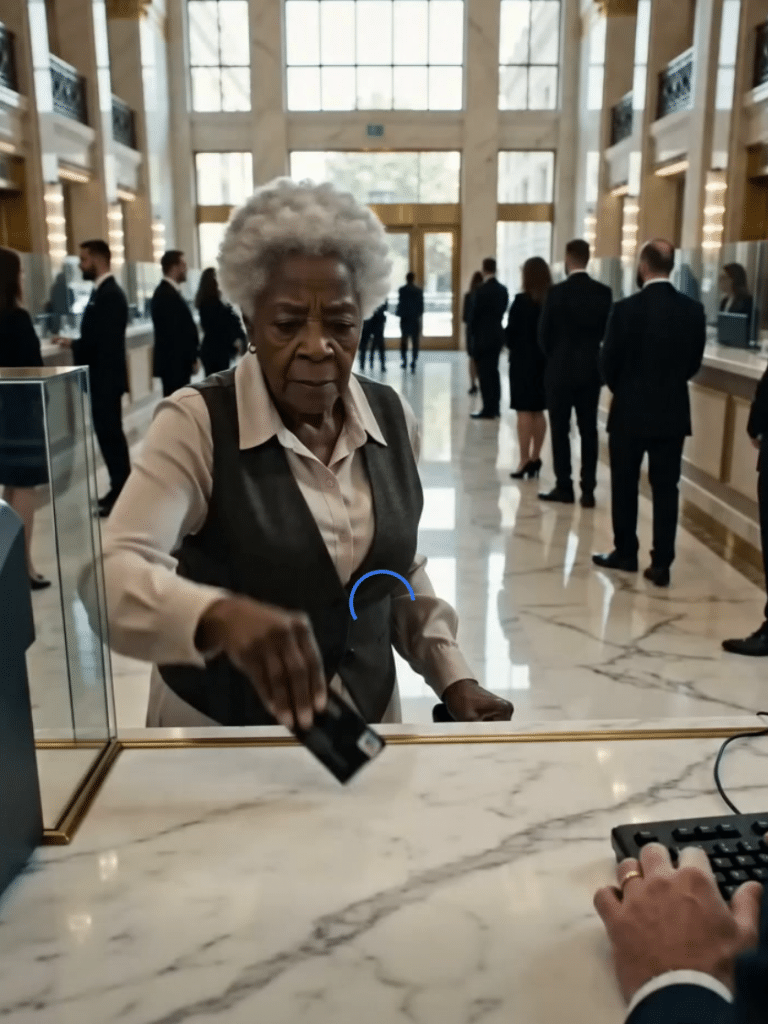
The slap of the black card against marble sounded louder than it should have.
Every head in the bank lobby turned.
The elderly woman stood at the counter with one hand on a wooden cane and the other pressed flat beside the card. She was small, white-haired, and dressed plainly in a beige shirt beneath a dark gray vest. But there was nothing weak in the way she held herself.
“I said check my balance.”
The teller behind the glass froze.
Around them, the lobby of Sterling Dominion Bank gleamed with polished white floors, gold-trimmed pillars, and high ceilings meant to make ordinary people lower their voices. Staff in black suits stood in neat formation near the back wall, waiting for the morning’s executive inspection.
They had been trained to smile.
None of them were smiling now.
A man stepped out from behind the private client desk.
Garrett Cole, branch manager, thirty-eight years old, custom suit, perfect beard, and the confident smile of a man who believed authority came with a better watch.
He approached the counter slowly, looking down at the woman as if she had wandered in from the street by mistake.
“Ma’am,” he said, voice smooth and patient in a way that was not patient at all, “you’re in the wrong bank.”
The woman leaned on her cane and looked him straight in the eye.
“No,” she said. “You’re the wrong man.”
A few employees shifted.
Garrett’s smile tightened.
The card on the marble was black, matte, and old. Not scratched. Not cheap. Old in the way important things are old, designed before banks learned to make wealth look flashy.
Garrett picked it up between two fingers.
“Let’s end this.”
He turned toward the terminal with the faint amusement of someone preparing to embarrass a difficult customer in front of witnesses. He swiped the card, typed in a manual override, and waited for the system to reject it.
The screen flashed once.
Then again.
Garrett’s expression changed.
At first, irritation.
Then confusion.
Then something close to fear.
The elderly woman did not move.
“Well?” she asked.
Garrett stared at the monitor as the color drained from his face.
Behind him, a senior teller leaned closer and covered her mouth.
Garrett looked from the screen to the woman, suddenly unable to stand as tall as before.
“This account…” His voice cracked. “This account controls our holding company.”
The lobby went silent.
The woman reached for her card, but Garrett did not release it.
Not because he refused.
Because his hand had gone numb.
And in that instant, every employee in Sterling Dominion understood that the woman they had almost removed from the lobby had not come to check her balance.
She had come to collect the bank.
Act II
Her name was Evelyn Brooks.
Once, the name had meant something inside the walls of that bank.
Not because it appeared on the glass doors. It did not.
Not because it was carved into the marble lobby. It had never been allowed there.
But the first version of Sterling Dominion Bank had not begun beneath chandeliers or gold pillars. It began in a narrow storefront on Eighth Street in 1969, between a pharmacy and a laundromat, in a neighborhood where respectable banks refused mortgages to families they considered too poor, too Black, too risky, or simply too easy to ignore.
Evelyn had been twenty-seven then.
Her husband, Isaiah Brooks, was a mathematics teacher with a talent for numbers and a stubborn belief that dignity needed paperwork.
Together, they helped neighbors open savings accounts, buy homes, start businesses, and protect money from landlords, lenders, and employers who had learned to take advantage of people who lacked access to clean credit.
They called it Brooks Community Trust.
Evelyn ran the front desk. Isaiah ran the books. Their daughter, Ruth, did homework beneath the counter while adults whispered about loan rates and hope.
It worked.
Too well.
Within ten years, larger banks noticed. Investors arrived smiling. Lawyers used words like expansion, partnership, modernization. Isaiah resisted at first, but Evelyn saw the trap earlier.
“They do not want to join us,” she told him. “They want to wear our work like a suit.”
Isaiah listened.
Before the merger, he created one protection.
A single controlling account.
The Keystone Account.
It held no ordinary balance. Its value was not cash alone, but voting authority tied to the original trust documents that made the entire bank possible. Whoever held the account controlled the underlying community trust that later became the holding company.
Isaiah built it quietly.
Legally.
Beautifully.
Then he died before he could explain every piece of it.
A heart attack, they said.
Sudden, they said.
Tragic, they said.
Evelyn was thirty-nine.
And grief, powerful men soon discovered, made a woman easier to corner.
Sterling Dominion was born from the merger. Brooks Community Trust became a footnote in an annual report. Evelyn was given a ceremonial advisory seat, then pushed out of meetings, then told the bank had grown beyond her “local concerns.”
Her daughter Ruth fought harder.
Ruth became an attorney. She found files her father had hidden. She discovered that the Keystone Account still existed and that Sterling Dominion’s entire corporate structure rested on a promise the new executives had never honored.
Then Ruth died in a car accident on a wet road three days before she was supposed to testify in a civil inquiry.
Evelyn stopped speaking publicly after that.
People mistook silence for surrender.
That was their first mistake.
For twenty-two years, she kept the black card in a small cedar box beside Isaiah’s wedding ring and Ruth’s law school photograph. She watched the bank expand into towers, private wealth divisions, offshore partnerships, and luxury branches that looked nothing like the storefront where people once lined up for a fair loan and a cup of coffee.
Then, six months before the morning in the marble lobby, Evelyn received a letter.
Not from an attorney.
From a teller.
A young woman named Naomi Bell, who had found an old trust file misclassified inside a digital archive. The file showed that Sterling Dominion’s holding company still depended on annual certification from the Keystone Account holder.
Evelyn.
But someone had been signing her name.
For years.
The signatures were careful.
Professional.
False.
The most recent certification named Garrett Cole as the executive authorized to “verify customer incapacity” if Evelyn Brooks attempted to activate the account in person.
That was when Evelyn understood.
They had not forgotten her.
They had been waiting for her to become old enough to erase.
So she dressed plainly.
She took her cane.
She walked into the most expensive branch of the bank her husband built.
And she placed the black card on the counter like a match beside dry paper.
Act III
Garrett Cole recovered badly.
That was how Evelyn knew he was dangerous but not experienced enough to be the mastermind.
A better liar would have smiled. A better thief would have excused himself, called legal, and buried her in a private room before the staff understood what they had seen.
Garrett simply stood there, pale and furious, with the screen glowing in front of him.
Evelyn tapped her cane once against the marble.
“You checked my balance.”
The word balance moved through the lobby with a meaning no one missed.
Garrett cleared his throat.
“There appears to be a system error.”
“No,” Evelyn said. “There appears to be a history error.”
A woman in the staff formation stepped forward.
Naomi Bell.
She was young, maybe twenty-six, with her hair pinned tightly and fear written all over her face. Evelyn had never met her in person, but she recognized the eyes from their one encrypted video call.
Naomi looked at Garrett.
“It’s not an error. The Keystone Account exists.”
Garrett turned on her.
“Return to your position.”
Naomi swallowed.
Then she did not move.
The lobby changed.
Not dramatically. Not all at once.
But authority is fragile when people realize it depends on obedience.
Garrett lowered his voice.
“Mrs. Brooks, we should discuss this privately.”
Evelyn smiled.
“You mean quietly.”
He stepped closer.
“This is a regulated institution. You cannot walk in here and create panic.”
“I walked in here and asked for my balance.”
“You brought an obsolete card tied to archived records you do not understand.”
Evelyn leaned forward.
“Baby, I was reading bank charters before your mother packed your first lunch.”
A breath moved through the employees.
Not laughter exactly.
Something better.
Recognition.
Garrett’s jaw tightened.
A side door opened, and two men in dark suits entered from the executive corridor. One was bank security. The other wore no badge, but Evelyn knew him immediately.
Martin Halloway.
General counsel for Sterling Dominion.
He had been a junior attorney when Ruth Brooks died. He had also been the last man known to meet her before the accident.
Halloway’s face did not change when he saw Evelyn.
That frightened her more than Garrett’s panic.
“Mrs. Brooks,” he said. “This is an unexpected pleasure.”
“No, Mr. Halloway. This is an overdue appointment.”
He glanced at the screen.
Then at Garrett.
Then at the black card.
“You should have called ahead.”
Evelyn’s smile vanished.
“My daughter called ahead.”
For the first time, Halloway’s eyes sharpened.
Evelyn reached into her vest pocket and removed a folded paper, yellowed with age but sealed in a clear protective sleeve.
Ruth’s handwriting.
If they deny the account, make them say Isaiah’s name in public.
Evelyn placed it on the counter beside the card.
Halloway did not look at it long.
But he looked long enough.
Garrett turned to him.
“What is this?”
Halloway’s silence answered more than words could.
Evelyn raised her voice just enough for every employee to hear.
“My husband, Isaiah Brooks, founded the trust this bank was built on. My daughter, Ruth Brooks, discovered that trust had been stolen. She died before she could prove it.”
Naomi’s eyes filled.
Halloway said quietly, “Be very careful.”
Evelyn looked at him.
“I was careful for twenty-two years. Today I am being accurate.”
Behind the teller counter, the terminal chimed.
A second screen activated.
Then a third.
Across the lobby, every workstation displayed the same automated message.
KEYSTONE ACCOUNT HOLDER VERIFIED.
ANNUAL CONTROL REVIEW INITIATED.
BOARD AUTHORITY TEMPORARILY SUSPENDED PENDING TRUSTEE CONFIRMATION.
Garrett stared in horror.
“What did you do?”
Evelyn rested both hands on her cane.
“I checked my balance.”
And upstairs, in the executive boardroom, every locked file connected to the Brooks Trust began uploading to regulators.
Act IV
The chairman arrived in seven minutes.
Everyone knew because the elevators opened before the doors fully stopped moving.
Charles Whitaker stepped into the lobby with three executives behind him and the expression of a man who had spent forty years mistaking calm for innocence. He was seventy, silver-haired, elegant, and still handsome in the way portraits of wealthy men try to be.
He looked at Evelyn.
For a moment, the lobby disappeared.
They were young again.
He was the investor’s son with soft hands and better suits.
She was the woman behind the counter who knew every depositor’s name.
He had once called Isaiah Brooks a visionary.
Then he helped bury him under signatures.
“Evelyn,” Charles said.
She gave him no warmth.
“Mr. Whitaker.”
His mouth tightened.
“Surely this could have been handled with dignity.”
Evelyn looked around at the marble, the gold pillars, the staff standing silent beneath cameras and chandeliers.
“Whose dignity?”
He flinched.
Only slightly.
Halloway stepped in.
“Charles, we should move upstairs before this becomes worse.”
“It is already worse,” Naomi said.
Every head turned toward her.
Garrett snapped, “Miss Bell.”
Naomi lifted her chin.
“I sent Mrs. Brooks the file.”
Charles looked at her as if seeing a stain on an expensive shirt.
“You.”
Naomi shook, but her voice held.
“I found forged certifications. I found medical incapacity claims for Mrs. Brooks signed by a doctor who never examined her. I found internal emails about waiting until she ‘aged out of resistance.’”
Evelyn closed her eyes.
Not because she was surprised.
Because even when you expect contempt, hearing its exact language still cuts.
Charles exhaled.
“Do you understand what you have done to this institution?”
Naomi answered before Evelyn could.
“I think I finally do.”
Halloway reached for his phone.
The security guard near the entrance stepped forward.
“Sir, regulators have instructed that no one contact outside counsel until devices are preserved.”
Halloway stared.
The guard looked nervous, but firm.
“Federal examiners are on the way.”
Garrett backed from the counter.
“Federal?”
Evelyn turned to him.
“You thought I came alone because I was old.”
The front doors opened.
Three regulators entered with state banking officials and two investigators. Behind them came a woman in a navy suit carrying a leather briefcase.
Evelyn’s granddaughter.
Ruth’s daughter.
Maya Brooks.
Garrett looked from Maya to Evelyn, realizing too late that the elderly woman at the counter had not been isolated, confused, or desperate.
She had been the opening move.
Maya crossed the marble lobby and kissed Evelyn on the cheek.
“Grandma.”
Evelyn’s face softened for the first time.
“Did they get the files?”
“All of them.”
Charles whispered, “Ruth had a child.”
Evelyn turned toward him.
“She had a daughter. A brilliant one. You would have known that if you had spent less time trying to erase her mother.”
Maya opened the briefcase.
Inside were original trust documents, certified copies of Isaiah’s account structure, Ruth’s investigative notes, and a sealed envelope Evelyn had not seen in twenty-two years.
Maya placed it on the counter.
“This was in my mother’s safe deposit box. It required Keystone activation to release.”
Evelyn stared at the envelope.
Ruth’s name was written across the front.
For Mama, when the bank finally has to listen.
Her hands trembled.
Maya opened it for her.
Inside was a letter and a small cassette tape.
Ruth’s voice came through a portable player moments later, soft but clear, filling the marble lobby.
“Mama, if you are hearing this, then I was right to be afraid. The trust was never dissolved. Daddy protected it. Whitaker and Halloway know. They have forged records, hidden votes, and used Brooks Community Trust as collateral while pretending we were history.”
Charles closed his eyes.
Ruth continued.
“I know you will want to fight quietly. Don’t. They survive quiet. Make them answer in the lobby. Make them look at the people who work there. Make them understand the bank was never theirs just because they learned how to stand behind the counter.”
Evelyn covered her mouth.
Naomi began crying.
Halloway reached for the counter, suddenly looking old.
The recording crackled.
“One more thing. If Garrett Cole is involved, do not underestimate him. He is young now, but men like Whitaker always choose boys they can train to smile while taking.”
Garrett went white.
Maya stopped the tape.
The silence after Ruth’s voice felt holy and terrible.
Charles looked at Evelyn with something that might have been regret if it had arrived thirty years earlier.
“Evelyn,” he said softly, “we can settle this.”
She studied him.
All the years sat between them.
Isaiah at the kitchen table, working late. Ruth carrying files in a raincoat. The funeral where Charles had held Evelyn’s hand and told her tragedy made no sense while Halloway stood behind him with dry eyes.
Evelyn picked up her black card.
“You already settled it,” she said. “You just wrote my name wrong.”
The investigators stepped toward Charles, Halloway, and Garrett.
This time, no employee moved to protect them.
No one offered a private room.
No one lowered their voice to save the bank from embarrassment.
And as Garrett Cole was led past the counter, Evelyn stopped him with one sentence.
“You were right about one thing.”
He turned, hollow-eyed.
She leaned on her cane.
“I was in the wrong bank.”
Then she looked up at the gold-lettered name above the lobby.
“So I’m taking it back.”
Act V
By noon, Sterling Dominion Bank was closed to the public.
By evening, the story was everywhere.
Not the full story. Not yet. The full truth had roots too deep for one headline. But enough came out to make the marble towers tremble.
The Keystone Account. The forged certifications. The buried Brooks Trust. The suspicious death of Ruth Brooks, reopened after two decades because her files showed she had been followed, threatened, and silenced before she could reach court.
Charles Whitaker resigned before the board could remove him.
Halloway was suspended, then charged.
Garrett Cole tried to claim he had only followed instructions, but Naomi’s files showed he had personally initiated the process to declare Evelyn mentally incompetent if she appeared at any branch.
That detail became the one people remembered.
Not because it was the largest crime.
Because it was the clearest.
They had looked at an elderly woman and decided age would make theft easier.
They had looked at a Black founder’s widow and assumed history would not know her name.
They were wrong about both.
Evelyn did not give interviews for a week.
She spent the first morning after the takeover in the old neighborhood on Eighth Street, standing before the storefront where Brooks Community Trust had begun. It was a bakery now. The sign was different. The brick had been painted. But when she closed her eyes, she could still hear the bell over the door and Isaiah’s pencil tapping against ledger paper.
Maya stood beside her.
“Are you okay?”
Evelyn smiled faintly.
“No.”
Maya nodded.
Evelyn touched the window.
“But I am here.”
That was enough for the moment.
The restructuring took months.
Evelyn refused to let the bank become a revenge machine. She did not want portraits of herself in every branch. She did not want a gala. She did not want some glossy apology written by people who had to look up Isaiah’s name before pretending to honor him.
She wanted records corrected.
She wanted families compensated.
She wanted predatory loans reviewed, stolen fees returned, and every executive who signed false documents named in public filings.
She wanted the bank to remember what it had been built to do.
Naomi Bell became a protected whistleblower, then head of internal ethics under the new trust board. Paul, the security guard who had held the door when Halloway tried to leave, was promoted to director of branch safety after Evelyn asked him what safety meant.
He said, “Making sure power cannot remove the person asking the right question.”
Evelyn liked that answer.
She made him write it into the training manual.
The grand marble branch reopened three months later under a new name.
Brooks Sterling Trust.
Dominion was gone.
Evelyn said the word had always sounded too hungry.
On reopening day, employees lined the lobby again, but not like soldiers this time. They stood with customers, community leaders, former employees, and families whose grandparents had once deposited money into the original Brooks storefront.
Maya helped Evelyn through the doors.
The cane tapped against the marble.
The sound echoed.
People applauded, but Evelyn raised a hand until they stopped.
She walked to the same counter where Garrett Cole had looked down at her and told her she was in the wrong bank.
A new teller stood there, nervous and smiling.
Evelyn placed the black card on the marble.
The teller swallowed.
“How may I help you, Mrs. Brooks?”
Evelyn looked around the lobby.
At the staff.
At Naomi.
At Maya.
At the portrait of Isaiah Brooks now hanging where no one could pretend not to see him.
Then she smiled.
“I’d like to check my balance.”
Soft laughter moved through the room.
The teller swiped the card.
This time, no one expected rejection.
The account appeared on the screen, not as a number, but as a trust statement.
Active.
Verified.
Controlling.
Evelyn looked at it for a long moment.
Then she removed one dollar from her vest pocket.
It was old, folded, and worn at the edges.
“The first deposit Isaiah ever took was from Mrs. Lottie Jenkins,” she said. “A school cafeteria worker. She came in with one dollar and asked if that was enough to begin.”
The room quieted.
Evelyn placed the dollar on the counter.
“My husband told her, ‘Beginning is the balance.’”
Maya wiped her eyes.
Evelyn pushed the dollar forward.
“Deposit this.”
The teller stamped the slip with trembling hands.
Evelyn signed her name slowly.
Not because she was weak.
Because every letter deserved time.
Evelyn Brooks.
For decades, men had signed over her, around her, and against her.
Now the bank waited for her hand to finish moving.
When she was done, she turned to the room.
“I do not want this place to worship the past,” she said. “The past had cowards in it. Thieves. Silence. Good people who waited too long to speak.”
Her eyes moved to Naomi.
“And brave people who spoke anyway.”
Naomi lowered her head, crying openly now.
Evelyn continued.
“This bank belongs to its promise. Not to men in corner offices. Not to names painted in gold. Not to anyone who thinks marble makes them more human than the person standing on the other side of the counter.”
She tapped her cane once.
“So when someone comes in here and asks you to check their balance, you will check it. Not their shoes. Not their age. Not their skin. Not whether they look like the kind of person you expect power to belong to.”
No one spoke.
They did not need to.
The lesson had already entered the walls.
Later, after the crowd thinned, Evelyn sat alone for a moment in the lobby’s quiet light. Maya joined her with two paper cups of coffee from the bakery on Eighth Street.
Evelyn took one sip and made a face.
“Too fancy.”
Maya laughed.
“Grandma, it’s black coffee.”
“Still too fancy.”
They sat together beneath Isaiah’s portrait.
After a while, Maya asked, “Do you think Mom would be proud?”
Evelyn looked at the counter.
At the place where the card had struck marble.
At the space where Garrett’s face had turned pale.
At the room where Ruth’s voice had finally made powerful men listen.
“She would be angry first,” Evelyn said.
Maya smiled through tears.
“Yes. She would.”
“Then proud.”
Evelyn reached for her granddaughter’s hand.
Outside, sunlight poured through the tall windows and spread across the white marble floor. Customers entered carefully at first, as if the building might still belong to someone else. Then a woman with two children stepped forward to open an account. An old man asked about a loan. A young couple sat with a banker and unfolded plans for a small restaurant.
The lobby filled with ordinary hope.
Evelyn watched it all.
For the first time in years, the bank did not feel like a monument to what had been stolen.
It felt like a door.
And as her black card rested quietly in her vest pocket, Evelyn Brooks understood that balance had never been a number on a screen.
Balance was justice returning late.
Balance was a daughter’s voice surviving the grave.
Balance was an old woman walking into a palace built from her family’s labor and making every liar inside it remember who laid the first stone.