Act I
The girl moved so fast no one stopped her.
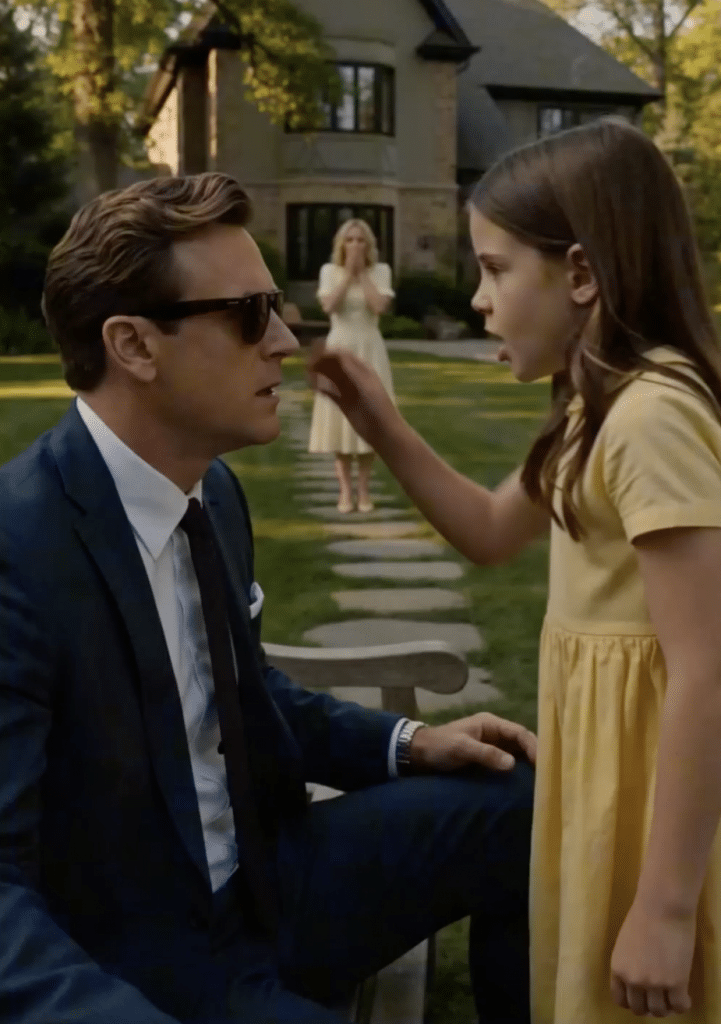
One moment, Adrian Blackwood was sitting on the garden bench beneath the old maple, his dark sunglasses hiding the ruined stare people had learned not to mention. The next, a small hand reached up and snatched them from his face.
Gasps rose from the stone path.
Adrian jerked back, startled, blinking hard against the late afternoon sun.
The girl stood before him in a yellow dress, her brown hair loose around her shoulders, both hands shaking around the sunglasses she had stolen. She was maybe nine years old, but there was nothing childish in her eyes.
“You’re not blind!” she said.
Adrian’s breath caught.
“What did you say?”
The garden went still.
Behind the hedges, a fountain murmured. The grand house rose beyond the lawn, all white columns and tall windows, glowing gold in the sinking light. Guests had gathered inside for the Blackwood Foundation dinner, but out here, only three people stood inside the truth.
Adrian.
The girl.
And his wife.
Claire Blackwood stood on the stone path in a cream dress, one hand pressed to her mouth. To anyone else, she might have looked shocked.
To the girl, she looked caught.
Adrian turned his head toward the blur of white and gold he knew was his wife’s figure.
“Claire?”
The girl pointed straight at her.
“It’s your wife,” she said. “She puts it in your food.”
Adrian froze.
Claire took one careful step forward.
“Adrian, darling, she’s confused.”
The girl’s face hardened.
“I’m not confused.”
Adrian’s eyes darted between them, unfocused but not empty. For months, doctors had told him the darkness would deepen. For months, he had lived behind tinted lenses, guided by Claire’s hand, swallowing the meals she prepared, drinking the tea she insisted would calm his nerves.
He had mourned his sight like a man watching his own life close room by room.
Now a child was standing in front of him, holding his sunglasses like evidence.
Adrian leaned forward, voice low.
“What are you talking about?”
The girl stepped closer.
“Ask her what she put in your tea.”
The words hit the garden like thunder.
Claire stopped walking.
Her beautiful face changed.
Only for a second.
But Adrian saw enough.
Not clearly. Not fully.
But enough.
For the first time in six months, he understood that the darkness around him might not have come from illness.
It might have come from the woman who kissed him goodnight.
Act II
Her name was Sophie Reed.
She was not supposed to be on the estate that afternoon.
Children of staff were not allowed near the main lawn during foundation events, especially not children with scuffed shoes, fierce eyes, and a habit of noticing things adults hoped would stay hidden.
But Sophie had grown up at Blackwood House.
Her mother, Hannah Reed, had worked there for twelve years, first as a maid, then as house manager, then as the only person Adrian trusted to tell him when wealth had made him foolish.
Before Claire arrived, the estate had not felt so cold.
Adrian had been private, yes. Serious, certainly. But he had laughed in the kitchen. He had let Sophie feed apples to the horses. He had remembered birthdays, staff names, and the fact that Hannah took her coffee with too much sugar.
Then Claire married him.
Everything softened on the surface and sharpened underneath.
The flowers became more perfect. The dinners became more elegant. The staff uniforms changed. The old family portraits came down because Claire said they made the house feel “haunted.”
Hannah noticed first.
Claire dismissed longtime employees and replaced them with people loyal to her. She opened Adrian’s mail. She sat in on meetings. She told guests that Adrian was tired before Adrian ever said so himself.
Then came the accident.
A fall on the back staircase after a private dinner.
Adrian woke with a concussion, blurred vision, and Claire crying beside his hospital bed. The doctors said recovery could take time. Claire said he needed quiet. The house changed again.
Hannah was sent away two weeks later.
Officially, she had stolen a bracelet.
Unofficially, she had accused Claire of switching Adrian’s medicine.
No one believed her.
No one except Sophie.
Sophie remembered her mother standing in the cottage kitchen, hands shaking as she packed their things.
“She is making him weak,” Hannah had whispered. “Not all at once. Slowly. So he doubts himself before anyone else does.”
Sophie had asked why they could not tell Adrian.
Hannah looked toward the great house on the hill.
“Because he already believes he is broken.”
They left Blackwood Estate that night.
Three months later, Hannah was gone too, taken by a sudden illness that left Sophie with an aunt, a shoebox of her mother’s papers, and one unfinished warning written on the back of an estate grocery list.
The tea is the key.
Sophie did not understand it then.
But grief made her patient.
She watched the house from the old bridle path. She learned when deliveries arrived. She learned which kitchen window still had a faulty latch. She learned that every afternoon at four, Claire carried a silver tray to the garden herself.
Tea for Adrian.
No staff.
No witnesses.
That afternoon, Sophie slipped through the hedge because she saw Claire take a small dark bottle from her purse and tilt it over Adrian’s cup.
Not medicine from a labeled box.
Not anything given by a nurse.
A bottle hidden inside a silk handbag.
Sophie did not know what it was.
She only knew her mother had died trying to say it out loud.
So she ran.
She reached the bench just as Adrian lifted the cup.
She did the only thing a child could think to do.
She took away the glasses that made everyone treat him like a helpless man.
And when Adrian blinked in the sunlight, when his eyes followed her movement, when he turned toward Claire before Claire spoke, Sophie knew.
He was not blind.
Not completely.
He had been buried inside a lie so carefully that even he had mistaken it for his body failing him.
Act III
Claire recovered faster than most guilty people.
That was what frightened Adrian most.
A truly innocent woman would have been horrified, confused, maybe even offended. Claire only smoothed her dress, lowered her hand from her mouth, and walked toward them with the calm of someone approaching a nervous animal.
“Adrian,” she said softly, “you’re overstimulated. Let me take you inside.”
He did not move.
Sophie backed closer to him, still holding the sunglasses.
“Don’t drink the tea.”
Claire’s eyes flicked to the cup on the bench.
Adrian heard the tiny shift in her breath.
It was not proof.
But it was the first honest thing she had given him in months.
“Sophie,” he said slowly, recognizing her now through the blur. “Hannah’s daughter.”
Sophie nodded.
Claire’s mouth tightened.
“That explains it.”
Adrian turned toward her.
“What does that mean?”
“It means this poor child has been fed her mother’s delusions.”
Sophie flinched.
Adrian felt the movement more than saw it.
Something old stirred in him then. Not anger yet. Anger required certainty. This was deeper. A memory of Hannah standing in his study, pale but firm, saying, “Sir, something is wrong with your household.”
He had not listened.
He had been tired. Embarrassed. Half-blind. Dependent.
And Claire had stood behind his chair with one hand on his shoulder, weeping beautifully while Hannah was escorted out.
Adrian reached for the tea.
Claire moved first.
“No.”
The word came too sharp.
Too fast.
Adrian’s hand hovered above the cup.
“Why not?”
Claire forced a small laugh.
“Because it’s cold.”
Sophie whispered, “She’s lying.”
Claire snapped, “Enough.”
The girl went silent, but not from shame.
From recognition.
She had heard that tone before.
Adrian stood slowly from the bench. He swayed once, and Claire stepped forward as if to catch him. He raised a hand to stop her.
For six months, he had reached for her whenever the world tilted.
This time, he reached for the back of the bench.
“Sophie,” he said, “what did you see?”
Claire’s voice sharpened.
“Adrian, you cannot seriously be asking a child to accuse your wife.”
“I asked her what she saw.”
Sophie swallowed.
“She took a little bottle from her bag. She put drops in your cup. I saw it. My mom saw it too before you made her leave.”
Adrian closed his eyes.
Made her leave.
The words struck harder than Sophie intended.
He had signed the termination papers. He had accepted Claire’s version. He had let a woman who had served his family for over a decade walk away in disgrace because believing her would have meant suspecting his wife.
He opened his eyes.
The garden was still blurred, but not black.
It had not been black for weeks, if he was honest. There were mornings when light came back in flashes. Edges. Colors. Shapes. But Claire always told him recovery could feel like that before decline resumed.
And the tea always came after.
Adrian reached into his pocket and pressed the emergency button on his phone.
Claire saw.
“Who are you calling?”
“Dr. Mercer.”
Her face changed again.
Dr. Elise Mercer was the neurologist Claire had slowly pushed out of his care after the accident. Too expensive, Claire said. Too cold. Too unwilling to give hope.
In truth, Elise Mercer had been the only doctor who questioned why Adrian’s symptoms worsened only at home.
Claire stepped closer.
“Give me the phone.”
Adrian looked at her.
Even through the blur, he saw the stranger beneath the wife.
“No.”
For the first time, Claire forgot to sound gentle.
“You ungrateful fool.”
The words did not shock him as much as they should have.
Perhaps some part of him had heard them in her silence for months.
Sophie placed the sunglasses on the bench and pulled something from the pocket of her yellow dress.
A folded paper.
“My mom left this.”
Adrian took it.
The handwriting was Hannah’s.
Sir, if you are reading this, I failed to make you hear me. Mrs. Blackwood is not only after your money. She is after control of the Ashford shares. Your father’s trust changes if you are declared permanently incapacitated. Ask why Dr. Bell signed papers he never examined you for. Ask why Claire meets Mr. Voss at the south gate. Ask what is in the tea.
Adrian’s blood went cold.
Ashford shares.
His mother’s trust.
The part of his fortune Claire could not touch unless he was no longer legally competent.
He turned toward his wife.
“Claire,” he said quietly, “what have you done?”
Before she could answer, a man’s voice called from the path.
“Mrs. Blackwood?”
Adrian turned.
A tall man in a gray suit stood near the hedges, holding a leather folder.
Adrian recognized his outline.
Martin Voss.
The family attorney who had told him, only that morning, that signing temporary control to Claire was “the responsible thing to do.”
And in that moment, Adrian understood.
This had never been about blindness.
It was about making him sign away the last thing she could not steal while he could still see enough to stop her.
Act IV
Dr. Mercer arrived before the police.
Claire had not expected that.
She expected confusion. Emotion. A private argument she could reshape before anyone important heard it. She expected Adrian to doubt his own senses because she had spent half a year teaching him to do exactly that.
She did not expect Sophie.
She did not expect Hannah’s note.
And she did not expect Adrian to have already changed the estate’s security code the night before, after waking at 3 a.m. and realizing he could read the green numbers on the clock until Claire gave him his morning tea.
By the time Claire tried to leave the garden, the gate had locked.
Martin Voss remained near the hedge, pretending he had arrived for a routine document signing.
No one believed him.
Dr. Elise Mercer strode across the lawn in a navy coat, medical bag in one hand, fury controlled beneath every step. She was followed by Adrian’s head of security, two officers, and an older woman in a charcoal suit.
Sophie stared at the woman.
Adrian did too.
“Mrs. Reed?” he whispered.
Hannah’s mother, Margaret Reed, stopped in front of him. Her face was lined with grief, but her posture was steady.
“My daughter sent me copies of everything before she died,” Margaret said. “I didn’t know what they meant until Sophie found the bottle.”
Claire’s voice cut across the garden.
“This is absurd. You are all listening to a grieving child and a bitter old woman.”
Margaret looked at her.
“My daughter was not bitter. She was right.”
Dr. Mercer took the cup from the bench and sealed it in a medical evidence bag. Then she turned to Adrian.
“Did you drink any?”
“No.”
“Good.”
Claire folded her arms.
“You have no right to test anything from my home.”
Adrian’s voice was cold.
“My home.”
Claire’s lips parted.
He had never said it like that before.
Not during their marriage. Not during her careful renovations, her guest lists, her quiet removal of everyone who remembered the house before her.
My home.
Two words, and the spell cracked.
Martin Voss tried to step in.
“Adrian, perhaps we should discuss this privately.”
“No,” Adrian said. “You prefer private rooms because that’s where lies work best.”
Voss’s expression hardened.
Dr. Mercer opened her tablet and pulled up Adrian’s medical file.
“I refused to certify permanent vision loss because your scans did not support it,” she said. “Two weeks later, I was informed you had transferred care to Dr. Bell.”
“I didn’t transfer anything,” Adrian said.
Claire looked away.
The officers noticed.
Margaret Reed removed a folder from her bag.
“Hannah found invoices,” she said. “Payments from an account under Mrs. Blackwood’s maiden name to Dr. Bell, Mr. Voss, and a private pharmacy outside the city.”
Claire went pale.
Adrian felt the world sharpen.
Not visually.
Morally.
All the blurred months rearranged themselves into a pattern.
The headaches after dinner. The weakness after tea. The way Claire answered questions for him. The documents placed under his hand when he was exhausted. Her soft voice telling him not to strain, not to read, not to meet with old staff, not to trust the flashes of sight returning at the edges of darkness.
She had not stolen his vision all at once.
She had stolen his confidence in it.
Adrian turned toward Sophie.
The child stood near Margaret, small and rigid, as if waiting for someone to tell her she had done wrong.
He knelt carefully in front of her.
“I should have believed your mother.”
Sophie’s chin trembled.
“Yes,” she said.
The honesty hurt.
Adrian bowed his head once.
“You’re right.”
Claire laughed suddenly.
It was an ugly sound in the golden garden.
“How touching. The great Adrian Blackwood apologizing to the help.”
Silence fell.
There it was.
The truth of her, stripped of silk.
Sophie stepped behind Margaret.
Adrian rose.
“You never understood this house,” he said. “You thought loyalty was something poor people gave rich people because they had no choice.”
Claire’s eyes flashed.
“And you thought love was real because women smiled at you when you paid their bills.”
Adrian flinched, but only slightly.
She saw it and tried to press harder.
“You were lonely. Grieving. So easy to guide. Do you know how little effort it took to make you doubt yourself?”
Dr. Mercer quietly touched the recorder on her phone.
Claire did not notice.
Or maybe she no longer cared.
“You would have signed everything today,” Claire said. “All of it. The trust, the shares, the medical authority. You were one cup away from being exactly what I needed.”
The words hung in the air.
Voss closed his eyes.
The officers stepped forward.
Claire finally realized what she had done.
“No,” she said.
Adrian looked at Dr. Mercer.
She held up the phone.
“Recorded.”
Claire’s face changed from rage to fear in a single breath.
Voss tried to walk away.
Security stopped him.
The garden that had been designed for roses, champagne, and charitable photographs became something else entirely.
A courtroom without walls.
And at the center of it stood a girl in a yellow dress, holding the sunglasses that had helped everyone mistake a man’s suffering for fate.
Act V
Claire Blackwood’s arrest did not make Adrian’s sight return overnight.
Life was not that generous.
There were examinations, treatment plans, withdrawals from medications he had never knowingly agreed to take, and long mornings where the world came back in cruel fragments. Light hurt. Shadows moved strangely. Faces arrived slowly, as if from underwater.
But the darkness no longer felt endless.
That mattered.
The first face he saw clearly was Sophie’s.
It happened three weeks later in Dr. Mercer’s clinic. Adrian sat beside the window while she ran a final response test. Sophie had come with Margaret because Adrian asked to see them after the hearing.
At first, the room was a blur of cream and gray.
Then Sophie turned her head toward the light.
Her face sharpened.
Brown eyes. Serious mouth. A small line between her brows, too worried for a child.
Adrian inhaled sharply.
Sophie froze.
“What?”
He smiled, and the smile broke before it fully formed.
“I can see you.”
Margaret covered her mouth.
Sophie looked embarrassed, pleased, and close to tears all at once.
“Good,” she said. “You should watch your tea better.”
Adrian laughed.
It was rusty.
It was real.
The investigation widened quickly. Dr. Bell lost his license before he lost his freedom. Martin Voss claimed he had only followed Claire’s instructions, but records proved he had been the architect of the incapacity petition. Claire had debts, offshore accounts, and a history of attaching herself to powerful men at the exact moment their health or judgment became vulnerable.
Adrian was not her first target.
But he became the one who lived to testify.
When the case reached court, Sophie did not have to stand before Claire. Adrian made sure of that. Hannah’s notes, the recorded confession, the tea sample, the financial records, and Dr. Mercer’s testimony were enough.
Still, Sophie wrote a statement.
It was read privately to the judge.
My mom told the truth and nobody listened because she cleaned rooms instead of owning them. I listened. I want people to know she was not a liar.
Adrian kept a copy.
Not for publicity. Not for guilt.
For memory.
Hannah Reed’s name was cleared. The accusation about the stolen bracelet was publicly withdrawn. Adrian created a staff protection fund in her honor, but Margaret made him rewrite the first announcement three times until it stopped sounding like rich-man guilt dressed up as charity.
He accepted every correction.
He owed the living that much.
Blackwood House changed again.
The portraits Claire had removed were restored, but so were photographs of the people who had kept the estate alive for generations. The kitchen became loud again. Staff used the garden paths without fear of being scolded for ruining the view.
Adrian stopped wearing sunglasses indoors.
At first, he still reached for them when guests arrived. Habit. Shame. The old instinct to hide weakness before anyone could use it.
Then Sophie caught him once and crossed her arms.
“Those again?”
He lowered them.
“My eyes are sensitive.”
“Your pride is sensitive.”
Margaret turned away to hide her smile.
Adrian put the glasses in his pocket.
Sophie nodded.
“Better.”
Months later, when the late afternoon light turned the estate gold again, Adrian returned to the same bench where everything had broken open.
He sat there alone for a while.
Not because he was lonely.
Because he needed to remember accurately.
Claire had counted on his shame. His dependence. His fear that a man losing sight was also losing authority, intelligence, worth. She had used the politeness of wealth and marriage to make suspicion feel vulgar.
But Sophie had not been polite.
She had been right.
Footsteps sounded on the path.
Sophie appeared in a yellow cardigan this time, carrying a small wooden box. Margaret followed at a distance, giving them space.
Sophie placed the box on the bench.
“What’s this?” Adrian asked.
“My mom’s things.”
He looked at her carefully.
“Are you sure?”
She nodded.
“I want you to have one.”
Inside were Hannah’s service keys, a photograph of Sophie as a toddler on the estate lawn, a folded grocery list, and a small silver teaspoon.
Adrian picked up the spoon.
Sophie shrugged.
“Mom said it was from the old kitchen set. She liked it because it was the only fancy thing in the house that actually got used.”
Adrian held it like something sacred.
“I don’t deserve this.”
“No,” Sophie said plainly. “But Mom said people can get better after being wrong if they don’t pretend they weren’t.”
Adrian closed his eyes.
When he opened them, the garden was clear.
The maple leaves. The stone path. The house beyond the lawn. Margaret watching quietly near the roses. Sophie beside him, no longer the child nobody believed, but the girl who had pulled darkness off a man’s face with both hands.
“Your mother was wise,” he said.
Sophie looked down.
“She was tired.”
“Yes,” Adrian said softly. “She was that too.”
They sat in silence until the sun dipped lower.
Then Sophie reached into her pocket and pulled out his old sunglasses.
Adrian stared.
“I thought those were evidence.”
“They were. Now they’re ugly.”
He laughed.
She held them out.
“Do you want them?”
Adrian took the glasses and turned them over in his hands.
For months, they had been his shield. His prison. The symbol of what he thought had been taken permanently.
Then he stood, walked to the edge of the path, and dropped them into the empty metal trash bin near the hedge.
The sound was small.
The feeling was not.
Sophie smiled.
From the house, a bell rang for dinner.
Adrian looked toward it.
Once, Claire had controlled every meal in that house. Every cup. Every plate. Every quiet ritual that made him weaker.
Now the kitchen was full of people. Margaret was staying for the week. Sophie had already insulted the cook’s carrots. Dr. Mercer was coming by later, not as a physician, but as a friend who had earned a seat at the table.
Adrian offered Sophie his hand.
She took it after a moment.
Not because she needed guidance.
Because perhaps he did.
Together, they walked toward the house.
The garden behind them glowed in the last light of evening, no longer a place where betrayal hid behind beauty, but the place where a child had stood her ground and demanded a man believe his own eyes.
And for the first time in a long time, Adrian Blackwood did.
Not perfectly.
Not without pain.
But clearly enough to see the truth walking beside him.