Act I
The boy did not belong at the funeral.
Everyone could see it.
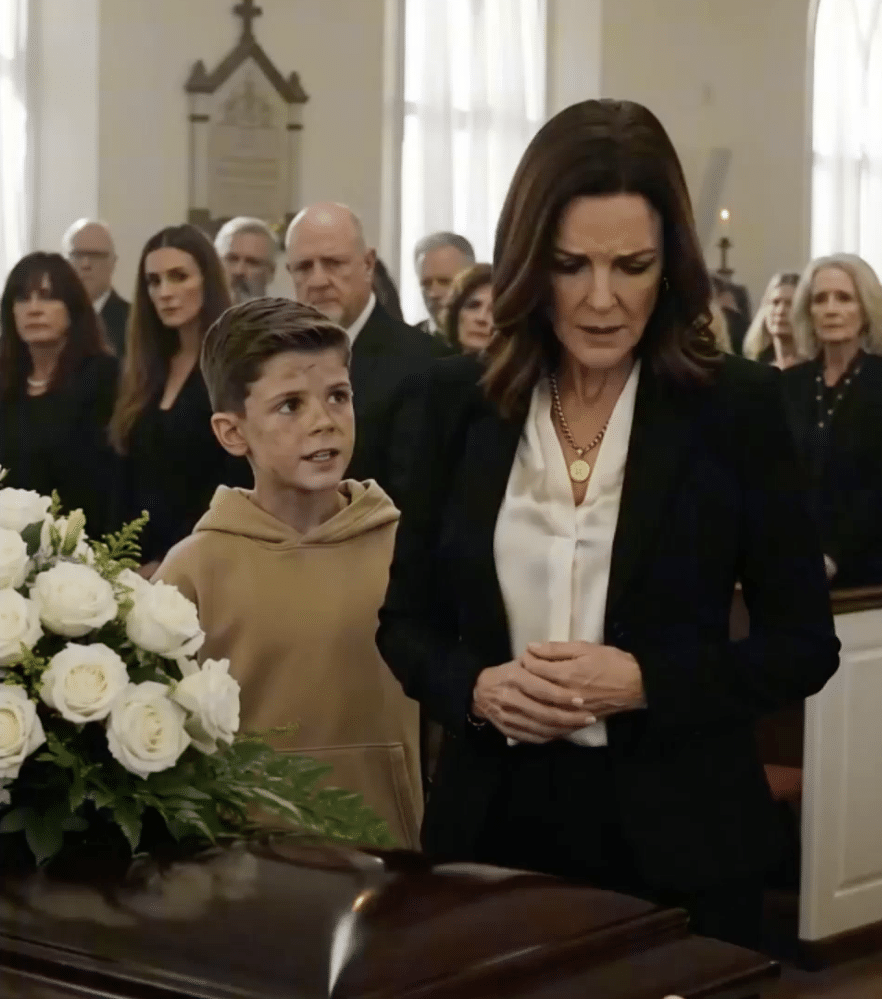
He stood beside the polished dark casket in a tan hooded sweatshirt, dirt smudged across one cheek, his small hands hanging stiffly at his sides. Around him, the church was filled with black coats, black veils, black suits, and whispered grief polished into good manners.
At the front of the sanctuary, Arthur Whitcomb lay beneath white roses.
He had been a respected man. A wealthy man. A man whose name had been carved into hospital wings, scholarship halls, and courthouse plaques. People said he gave generously, spoke softly, and never let a debt go unpaid.
His daughter, Caroline Whitcomb, stood nearest the casket.
She had not cried in front of anyone.
Not when the pastor described Arthur as a devoted father. Not when the board chairman praised his integrity. Not when distant relatives squeezed her hand and told her she was strong.
Caroline had learned strength young.
In the Whitcomb family, grief was not displayed. It was folded neatly, locked away, and carried like silver.
Then the boy stepped out from the side aisle.
No one knew where he had come from.
He walked past the first row of pews, past the women dabbing their eyes with embroidered handkerchiefs, past the men who looked offended by anything unexpected happening in a church.
He stopped at the casket and looked up at Caroline.
“He said if he died, you would take me.”
The words fell into the silence like a glass breaking.
Caroline turned slowly.
At first, she thought she had misheard him. Children said strange things around death. They repeated what adults whispered. They misunderstood promises and prayers.
But the boy’s face was steady.
Too steady.
“Take care of you?” Caroline asked. “Who are you?”
He reached into the pocket of his sweatshirt and pulled out a small black card, worn soft at the corners.
Caroline did not take it immediately.
Something about the card made her chest tighten before she touched it.
The boy held it out farther.
She opened it.
Inside, in her father’s handwriting, were six words.
Give him the watch she hid.
Caroline’s fingers went cold.
Beneath the sentence was a second line, smaller and shakier, as if Arthur had written it with pain moving through his hand.
He is the last one I failed.
Caroline looked up sharply.
“Who gave you this?”
The boy stepped closer.
“No,” he said. “He said you know who I am.”
Her breath caught.
Around her neck, beneath the lapel of her black blazer, a gold chain shifted against her skin. Without thinking, Caroline reached for it and pulled out the round pendant she had worn since she was seventeen.
It was not truly a pendant.
It was a tiny watch.
A broken one.
The hands had stopped at 2:16.
They had not moved in twenty-nine years.
The boy looked at it, and for the first time, his calm cracked.
“My mom had one like that,” he whispered.
Caroline stared at him.
And suddenly, she was not standing in a church beside her father’s casket.
She was back in a locked room, hearing her mother sob through a door, repeating the same name over and over while Arthur Whitcomb told everyone she was unwell.
Daniel.
The name Caroline had been ordered never to say.
The brother she had been told never existed.
Act II
Caroline’s mother, Elise, had died when Caroline was seventeen.
At least, that was the story the family told in public.
The softer version was that Elise Whitcomb had been fragile. Too sensitive for the pressures of wealth. Too emotional for a husband like Arthur, whose world required discipline, discretion, and spotless appearances.
The truth was uglier.
Elise had not been fragile.
She had been trapped.
Caroline remembered her mother as a woman who sang while arranging flowers, who pressed wild violets between books, who treated the household staff like people long before Caroline understood that kindness could be considered rebellion in houses like theirs.
Then one winter, everything changed.
Elise began arguing with Arthur behind closed doors. She stopped wearing her pearls. She hid letters inside piano books. She locked herself in the nursery, even though Caroline had long outgrown it.
Caroline heard the name Daniel for the first time during one of those fights.
“He is my son,” Elise screamed. “You cannot erase a child because he embarrasses you.”
Arthur’s answer was calm.
That frightened Caroline more than shouting ever could.
“You will not destroy this family over a mistake.”
The next morning, Elise was gone from breakfast.
Arthur told Caroline her mother was resting.
By spring, Elise was moved to a private care facility no one in the family was allowed to discuss. By summer, she was dead. By fall, Arthur had removed every photograph of her from the public rooms of the mansion.
Except one thing remained.
The tiny gold watch.
Caroline found it hidden beneath a loose floorboard in the nursery, wrapped in a silk ribbon and tucked beside a faded hospital bracelet.
The bracelet was too small to belong to Caroline.
A baby’s bracelet.
The name printed on it had been partially torn away.
Only three letters remained.
DAN.
Caroline took the watch and wore it under her school uniform. She never told Arthur. She never told anyone.
For years, she convinced herself it was a grief object. A last strange remnant from a mother whose mind had broken under secrets Caroline was too young to understand.
Then adulthood arrived.
College. Law school. A failed engagement. A return to the Whitcomb estate after Arthur’s first stroke. Years spent managing foundations and appearances, smiling beside the man who had raised her while keeping a piece of her mother’s forbidden truth against her heart.
Arthur never asked about the watch.
But sometimes, when Caroline leaned close enough for him to see the chain at her throat, his expression changed.
Not sorrow.
Fear.
And now a boy with dirt on his face stood beside Arthur’s casket, holding a card that spoke of the watch Elise had hidden.
Caroline looked at him more carefully.
Short brown hair. Serious eyes. A narrow chin.
Not Arthur’s face.
Not hers.
But something in the shape of his mouth made her knees weaken.
“What’s your name?” she asked.
“Sam.”
“Sam what?”
He hesitated.
“Sam Miller.”
The name meant nothing to her.
“Who brought you here?”
“Nobody.”
The mourners began murmuring.
One of Arthur’s attorneys, Richard Vail, rose from the front pew. He was a tall man with silver glasses and a practiced expression of concern.
“Caroline,” he said quietly, “perhaps we should take this outside.”
The boy flinched when Richard spoke.
Caroline saw it.
So did the pastor.
So did an elderly woman in the second row who had once worked as Elise’s private nurse and had not been invited to sit with family.
Richard stepped closer.
“This is inappropriate.”
Caroline closed the black card in her hand.
“No,” she said. “What’s inappropriate is a child arriving at my father’s funeral alone with a note in his handwriting.”
Richard’s face tightened.
The boy edged closer to Caroline.
“He told me not to go with the man in glasses,” Sam whispered.
The church went quiet again.
Richard stopped walking.
Caroline turned slowly toward him.
And for the first time in all the years she had known her father’s attorney, Richard Vail looked afraid.
Act III
They moved to the church office behind the sanctuary.
Caroline insisted the pastor stay. Richard insisted he should be present too. Sam said nothing, but when Richard sat down, the boy shifted his chair closer to Caroline.
That decided it.
“Leave,” Caroline told Richard.
His jaw tightened.
“Caroline, grief is affecting your judgment.”
“My judgment is the only thing keeping me polite.”
The pastor opened the door.
Richard did not move at first.
Then Caroline lifted the black card.
“I can read this out loud in front of the entire church.”
Richard stood.
He left with his dignity intact, but barely.
The moment the door shut, Sam reached into his sweatshirt again and pulled out a folded envelope sealed with old wax. On the front was Caroline’s name.
Her full name.
Caroline Elise Whitcomb.
Only her mother had used her middle name like that.
The handwriting was Arthur’s, but the envelope inside was older. Brittle. Yellowed at the edges. It smelled faintly of dust and cedar.
Caroline opened it with shaking fingers.
A photograph slid onto the desk.
Elise Whitcomb sat in the nursery, younger and tired, holding two babies.
One was Caroline.
The other was a newborn wrapped in a blue blanket.
On the back, in Elise’s handwriting, were the words:
My children, before he chose one.
Caroline pressed one hand to her mouth.
The room blurred.
She had spent twenty-nine years believing her mother’s grief belonged to madness. Now it sat in front of her in black ink.
Sam watched her carefully.
“My mom said not to cry in front of Mr. Vail.”
Caroline lowered the photograph.
“Your mom?”
Sam nodded.
“Her name was Anna. She said my grandpa’s real name was Daniel, but he had to use Miller because rich people get angry when poor people remember things.”
Caroline’s heart began to pound.
“Your grandfather was Daniel?”
“He died last year.”
Caroline closed her eyes.
Her brother had lived.
Not in the mansion. Not in the family records. Not in the portraits or trusts or Christmas cards.
But he had lived.
Somewhere beyond the walls Arthur built, her baby brother had grown up under another name, carrying a story no one believed.
Sam continued, voice careful.
“Grandpa Daniel said his mother tried to keep him. He said a man came with papers and took him away when he was little. He got sent to people who were paid to raise him, but they didn’t like him much.”
The pastor looked down.
Caroline could not speak.
Sam unfolded another paper.
“This is from him.”
The letter was written in blocky, uneven handwriting.
Caroline,
I don’t know if Arthur ever told you about me. I don’t know if you were too young to remember. I spent most of my life hating your name because I thought you got to stay and I got thrown away.
Then my mother found a nurse before she died and sent me one thing: a photograph of us together.
You were a baby too.
You didn’t choose any of this.
I had a daughter, Anna. She had a son, Sam. I told Arthur before I died that he owed the boy protection. Not money. Not the Whitcomb name. Protection.
Arthur came to see me once. He looked at me like a ghost had learned to breathe. He said he was sorry.
I told him sorry was too small.
If he kept one piece of mercy in that old body, he would know where to send Sam when the time came.
Give him the watch she hid.
He will know the sound.
Caroline looked at Sam.
“What sound?”
Sam pointed to the pendant.
“Open it.”
Caroline shook her head slightly.
“It doesn’t open.”
“Yes, it does.”
“I’ve worn this since I was seventeen.”
“Grandpa said adults stop trying when something looks broken.”
The words struck her so sharply she almost laughed.
Then, with the careful patience of someone touching a wound, Caroline pressed her thumbnail against the rim of the tiny watch.
Nothing happened.
Sam reached out.
“May I?”
She placed it in his small palm.
He turned the watch over, pressed the stem twice, then slid a hidden latch no larger than a grain of rice.
The back opened.
Inside was a curl of faded brown hair, a tiny folded slip of paper, and a second photograph cut into a circle.
Caroline leaned closer.
The photograph showed Elise holding baby Daniel.
Behind the picture was a note in writing so small Caroline had to hold it near the lamp.
Arthur,
If you bury my son, this watch will outlive your lie.
E.
Caroline could no longer stop the tears.
Sam pressed something else.
The watch clicked once.
Then, impossibly, the dead hands moved.
Not forward.
Backward.
They trembled from 2:16 to 2:15, then to 2:14, then stopped.
A faint mechanical chime sounded.
Two notes.
Sam began to cry.
“That’s the sound,” he whispered. “Grandpa used to hum it when he missed her.”
Caroline reached for him, but he stepped back.
Not from fear.
From exhaustion.
“I don’t want money,” he said. “I just don’t want to go back.”
Caroline looked up sharply.
“Back where?”
Before Sam could answer, shouting erupted from the sanctuary.
Then the office door opened.
Richard Vail stood there with two men in dark suits.
His voice was calm, but his eyes were not.
“Caroline,” he said, “step away from the child.”
Act IV
The pastor moved first.
He was an old man with a gentle face, but he placed himself between Sam and the men as if gentleness had never meant weakness.
“This is a church,” he said.
Richard did not even look at him.
“This is a custody matter.”
Caroline stood.
“Custody?”
Richard adjusted his glasses.
“The child has no legal guardian. Mr. Whitcomb made temporary arrangements before his passing. Until the estate is settled, Sam is to be placed with an approved residential facility.”
Sam gripped the back of Caroline’s chair.
“No,” he whispered.
Caroline heard the terror in that one word and understood everything.
Approved residential facility.
Another clean phrase for a dirty room.
Another paper door closing over another child.
Just as it had closed over Daniel.
Just as it had closed over Elise.
She stepped in front of Sam.
“You knew who he was.”
Richard’s expression remained smooth.
“I knew Arthur was vulnerable near the end of his life.”
“You knew Daniel existed.”
A flicker.
Small, but there.
Caroline saw it.
“Did my father pay you to hide him?”
Richard’s mouth hardened.
“Your father paid many people to protect this family from scandal.”
The pastor inhaled sharply.
Caroline looked at the two men behind Richard.
“Get out.”
Neither moved.
Richard sighed.
“You are emotional.”
Caroline laughed once.
It did not sound like grief.
It sounded like a door breaking.
“I have been trained my entire life not to be emotional.”
She lifted the tiny watch from her chest.
“My mother hid a baby’s proof inside this because every man around her called truth hysteria. My brother grew up believing he was unwanted because my father preferred reputation over blood. And now you want to drag his grandson away before the casket is even closed.”
Richard’s calm began to crack.
“You have no legal standing.”
Caroline looked at Sam.
Then at the photograph of Elise with both babies.
Then at the card Arthur had written in the last days of his life.
“No,” she said softly. “But he does.”
Richard frowned.
Caroline walked past him into the sanctuary.
The mourners turned as she came down the center aisle, her black blazer sharp against the white roses at the front. Arthur’s casket waited beneath the stained light, dignified and silent.
For the first time, Caroline hated how peaceful he looked.
She stood at the pulpit.
Her hands shook, but her voice did not.
“My father’s service is not over,” she said.
A murmur spread through the pews.
Richard appeared in the aisle, furious now.
“Caroline, stop.”
She ignored him.
“For most of my life, I believed my mother died ill and confused. I believed there were no secrets left in our family, only tragedies too painful to discuss.”
She held up the photograph.
“This was hidden from me. From all of you.”
Faces shifted. A woman gasped. The former nurse in the second row began silently crying.
“My mother had a son. His name was Daniel. He was taken from this family, erased from its records, and raised under another name.”
Richard moved toward the pulpit.
Then the old nurse stood.
“Sit down, Mr. Vail.”
The command shocked the room.
Richard froze.
Her name was Mrs. Alden. She had been quiet for decades, folded into the background of Whitcomb history like wallpaper. But now she stepped into the aisle with tears on her cheeks and a spine straighter than anyone expected.
“I was there,” she said.
Every head turned.
Mrs. Alden looked at Arthur’s casket.
“Elise begged him. She begged all of us. They told me I would lose my license if I spoke. They told me the boy was better off gone. I believed them because I was young and afraid and because rich men make cowardice feel sensible.”
Caroline’s eyes filled again.
Mrs. Alden faced Sam.
“I am sorry,” she said.
Sam stood near the office door, too small for the weight landing at his feet.
Richard pointed at her.
“This is slander.”
“No,” said another voice.
The pastor stepped forward, holding Arthur’s Bible.
“I found this in the casket room before the service.”
Richard’s face went white.
The pastor opened the Bible and removed a sealed envelope.
“Mr. Whitcomb asked that this be given to Caroline after the burial. Given what has happened, I believe it should be read now.”
Caroline took it.
This letter was written in her father’s failing hand.
Caroline,
I told myself I was protecting you.
That is the lie men like me use when we are protecting ourselves.
Your mother did not lose her mind. I broke her heart and called the pieces madness. Daniel was your brother. I arranged his removal. Richard helped me bury the records. When Daniel found me years later, I turned him away because I could not bear the shape of my own sin standing at my door.
His grandson, Sam, is innocent.
Anna is gone. Daniel is gone. The boy has no one left who knows what was stolen.
You have your mother’s watch. Inside it is the proof I feared most.
Use it.
Not to save my name.
To end it honestly.
Caroline lowered the letter.
The church was utterly still.
Richard backed toward the aisle, but the two men who had come with him did not follow. They had understood what he was only just realizing.
The room had turned.
Caroline looked at him.
“You will not touch that boy.”
Richard swallowed.
“You don’t know what you’re doing.”
Caroline stepped down from the pulpit and stood beside Sam.
“Yes,” she said. “For the first time in my life, I do.”
Then Sam reached for her hand.
And in front of Arthur Whitcomb’s casket, Caroline held onto the last living piece of the brother she had been taught to forget.
Act V
The funeral did not end with hymns.
It ended with questions.
People who had come to bury Arthur Whitcomb left whispering about Daniel, Elise, the hidden watch, and the boy in the hooded sweatshirt who had walked into a church and cracked open three decades of silence.
By dusk, Richard Vail was no longer managing the estate.
By midnight, Caroline’s attorneys had filed an emergency petition to protect Sam from removal. By the end of the week, court orders froze sections of the Whitcomb trust while investigators reviewed old records, sealed payments, and adoption documents that had never been properly filed.
The family name did not collapse all at once.
Names like Whitcomb do not fall dramatically.
They leak.
A missing hospital form. A nurse’s testimony. A payment to a private agency that no longer exists. A letter from Elise marked unstable and ignored by every man who had found her grief inconvenient.
Caroline sat through all of it.
Every deposition.
Every hearing.
Every humiliating headline.
She did not defend Arthur.
That surprised people most.
When reporters asked whether she was angry that her father’s reputation had been damaged, she looked at them and said, “His reputation was the damage.”
Sam moved into her house on a rainy Thursday.
He arrived with a trash bag of clothes, a cracked plastic dinosaur, and a shoebox full of things that had belonged to his mother and grandfather. He did not ask which room was his. He stood in the foyer waiting for instructions, as if homes were places where permission could disappear without warning.
Caroline knelt in front of him.
“This is your house now too.”
He looked past her, toward the staircase.
“For how long?”
The question nearly undid her.
“As long as you need,” she said. “And after that, as long as you want.”
He did not believe her right away.
She did not expect him to.
Trust, she learned, was not something adults could demand from a child who had been passed through systems and promises. It had to be built quietly.
A night-light left on.
A drawer that belonged only to him.
Breakfast made even when he said he was not hungry.
A school form with his name written carefully and correctly.
The first time he laughed in the house, Caroline was in the kitchen burning pancakes.
Sam stood at the counter watching the smoke curl upward.
“You’re bad at this,” he said.
“I’m excellent at many things.”
“Not pancakes.”
“No,” she admitted. “Not pancakes.”
He smiled.
It was small.
It was everything.
Months later, the court recognized Daniel Whitcomb as Arthur and Elise’s son. Not symbolically. Legally. His record was restored. His name was entered into the family history Arthur had tried to seal shut.
Sam was recognized as Daniel’s grandson.
And Caroline, after a long review, became his permanent guardian.
On the day the order came through, she took Sam to the cemetery.
Arthur’s grave sat beneath a carved stone already crowded with praise. Beloved father. Philanthropist. Man of honor.
Caroline stood before it without speaking.
Then she walked past him.
Farther down the hill, beneath an old maple, a new stone had been placed.
Elise Whitcomb.
Daniel Whitcomb.
Mother and son, separated in life, reunited in truth.
Sam stood quietly beside Caroline.
He held the gold watch in both hands.
She had offered it to him the day the court order arrived. He refused at first, saying it was hers. Caroline told him it had always belonged to the part of the family that refused to disappear.
Now he opened the hidden back by himself.
Inside, the tiny photograph of Elise and baby Daniel glowed softly in the afternoon light.
“Did she love him?” Sam asked.
Caroline looked at the stone.
“Yes.”
“Even when he was gone?”
“Especially then.”
Sam nodded, as if filing that away somewhere deep and necessary.
Then he reached into his pocket and pulled out the black card Arthur had given him.
The one that had started everything.
Give him the watch she hid.
He placed it at the base of Elise’s grave.
Caroline did not stop him.
“What are you doing?” she asked softly.
Sam looked at the card.
“Giving it back.”
The wind moved through the maple leaves.
For a moment, Caroline imagined her mother as she had been in the nursery photograph, young and fierce and terrified, hiding proof inside a broken watch because she understood that someday love might need evidence.
Caroline wished she had known sooner.
She wished she had asked harder questions.
She wished childhood had not trained her to mistake silence for peace.
But regret, like inheritance, had to be handled carefully. It could become a prison or a promise.
She chose promise.
That evening, back at the house, Sam asked if the watch still worked.
Caroline opened it and pressed the hidden mechanism.
The little hands shifted.
The same two-note chime sounded, soft and trembling.
Sam listened with his eyes closed.
“My grandpa used to hum that,” he said.
“My mother did too.”
They sat together in the quiet room, two people connected not by an easy past, but by a truth that had fought its way through lies, death, and locked drawers to find them.
At last, Sam leaned against her shoulder.
Not fully.
Just enough.
Caroline stayed perfectly still, afraid to move too quickly and ruin the fragile gift of his trust.
Outside, rain tapped against the windows.
Inside, the broken watch ticked once.
Then again.
Caroline looked down at it, startled.
For twenty-nine years, the hands had been frozen at 2:16, the minute her mother said Daniel was taken from her arms.
Now they moved forward.
Slowly.
Unsteadily.
But forward.
Sam heard it too.
He looked up at Caroline.
“Does that mean it’s fixed?”
Caroline thought about Arthur’s casket, Elise’s hidden note, Daniel’s stolen name, Anna’s lost life, and the little boy who had walked into a funeral with dirt on his face and more courage than anyone in that church.
She put her arm around him.
“No,” she said softly. “It means it survived.”
Sam rested his head against her.
And for the first time in the long, wounded history of the Whitcomb family, a child who had been sent to ask for shelter did not have to beg twice.
He was already home.