Act I
The boy should never have made it past the front doors.
That was what everyone would say later.
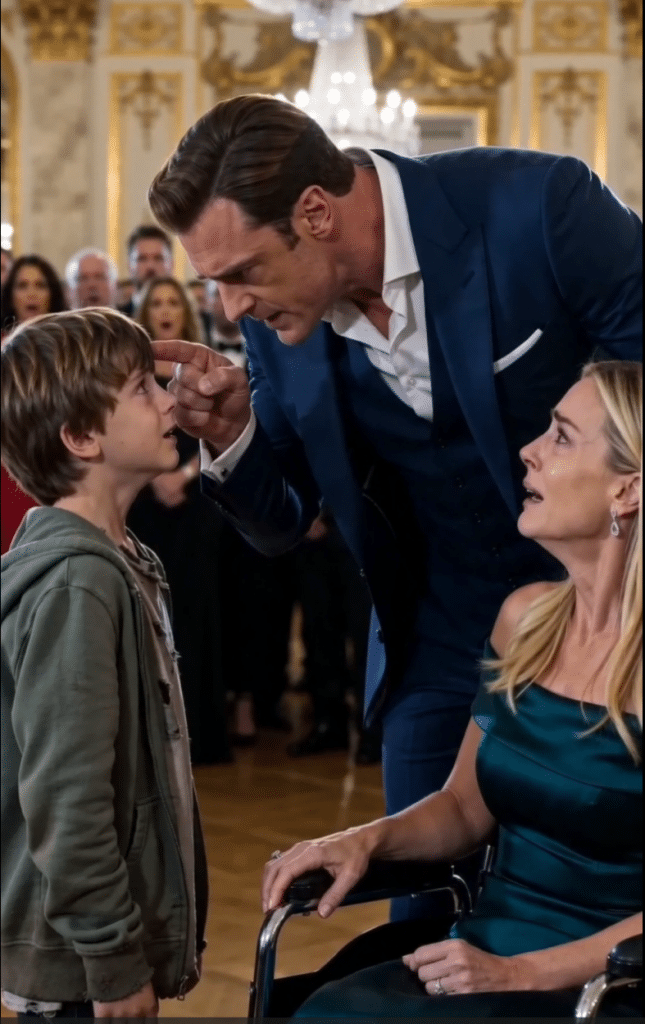
The ballroom was all chandeliers, marble, champagne, and money old enough to whisper instead of shout. Women in silk gowns floated between tables. Men in tuxedos spoke in low voices about donations, estates, and the children’s hospital wing being named before dessert.
Then a boy in a dirty green hoodie stepped into the center of the room.
He was small, maybe nine, with messy light brown hair and a face too tired for childhood. His sleeves were frayed. His shoes were cracked at the toes. He looked as if he had walked through rain, alleys, and every locked door in the city just to stand there.
At the front table sat the woman in the wheelchair.
Vivian Ashford.
Blonde, elegant, untouchable in a dark green evening gown that made her look like a portrait someone had placed under glass. She had not walked in eight years, not since the accident that took her husband, her unborn child, and most of the life she remembered having.
Beside her stood her brother, Nathan Ashford, tall and severe in a dark blue three-piece suit. He had spent the evening watching everyone who came near her.
He saw the boy first.
“Stop right there,” Nathan said.
The boy did not.
He came forward with both hands raised slightly, not in threat, but in pleading.
“I just need one thing.”
Nathan stepped in front of Vivian’s chair.
“This is a private event.”
The boy looked past him at Vivian.
His eyes filled, but he did not cry.
“Please,” he said. “That’s all I’m asking.”
Nathan leaned down, his face hard, one finger pointing inches from the boy’s face.
“You don’t approach her. You don’t speak to her. You don’t use her pain for whatever story someone paid you to tell.”
The boy swallowed.
“I wasn’t paid.”
“Then leave.”
Vivian’s hand tightened on the armrest of her wheelchair.
“Nathan,” she whispered.
But her brother did not move.
For years, people had tried to reach Vivian through grief. Journalists. frauds. spiritualists. strangers claiming to know what happened the night her car went over the bridge. Nathan had removed them all.
The boy looked at Vivian again.
“I only want to hold her hand.”
The ballroom seemed to still around him.
Nathan’s expression darkened.
“No.”
The boy’s face crumpled, but his feet stayed planted.
“She’ll know,” he whispered.
Vivian stared at him.
Something in his voice slipped beneath the layers of medicine, memory, and manners that had kept her silent for so long.
“Let him,” she said.
Nathan turned sharply.
“Vivian.”
Her eyes stayed on the boy.
“Let him.”
Slowly, the boy reached out.
His hand was small, dirty, trembling.
Vivian lifted her own from the armrest, fingers shaking as if some part of her body recognized the moment before her mind could bear it.
Their hands touched.
Vivian inhaled sharply.
The boy folded his fingers around hers, not like a stranger, not like a beggar, but like someone completing a promise.
Tears spilled down Vivian’s cheeks.
Nathan stared, stunned.
Then he grabbed the boy’s hand, intending to pull it away.
But the second his fingers closed around both their hands, he froze.
There, at the base of Vivian’s thumb, was a tiny crescent-shaped birthmark.
And there, on the boy’s hand, in the exact same place, was its mirror.
Nathan’s face went pale.
The boy looked up at him through tears.
“My name is Leo,” he said. “My mother said she would know me by the moon in our hands.”
Vivian made a sound like her heart had remembered how to break.
Because eight years ago, before the world told her he was dead, she had named her baby Leo.
Act II
Vivian Ashford had not always been fragile.
Before the wheelchair, before the careful dresses and the sympathetic speeches, before doctors spoke to her as if her body had made her less adult, she had been the loudest person in any Ashford room.
She laughed too hard.
Asked rude questions.
Donated to causes without asking whether the board approved.
And then she fell in love with Mateo Ruiz, a pianist from the wrong side of the city who played at charity events and refused to look impressed by her last name.
Nathan had disliked him at first.
Not because Mateo was poor, though the Ashford family certainly cared about that.
Nathan disliked him because Vivian changed around him.
She became softer, braver, less willing to accept the golden cage she had been raised inside.
Their father, Gregory Ashford, hated Mateo immediately.
Gregory had built the family empire into something cold and efficient. Hotels, private clinics, investment trusts, foundations with smiling children in brochures. He believed love was useful only when it produced alliances.
Mateo offered nothing but devotion.
To Gregory, that made him dangerous.
Vivian married him anyway.
Quietly.
Defiantly.
For six months, she was happy in a way that embarrassed her family. She wore plain dresses. Learned to cook badly. Sat beside Mateo at the piano with her head on his shoulder while he played melodies that were not for donors, not for guests, not for anyone but her.
Then she became pregnant.
That was when the threats began.
Gregory warned her that Mateo would ruin her. Her stepmother, Helena, cried beautifully over dinner and said Vivian was throwing away generations of sacrifice. Lawyers appeared with documents about trusts, guardianship, inheritance, and “protection.”
Vivian refused all of them.
Nathan, caught between family loyalty and his sister’s happiness, did what weak men often call peacekeeping.
He stayed neutral.
He would regret that for the rest of his life.
The accident happened on a winter road outside the city.
Vivian and Mateo were driving to a cottage near the coast. Vivian had called Nathan that evening, furious and frightened, saying her father had threatened to take the baby. Nathan was in London. His phone was off during a board meeting.
By the time he listened to the message, the car was already in the river.
Mateo was declared dead at the scene.
Vivian survived.
So did the baby, for twelve hours.
That was what the official file said.
A premature birth. emergency surgery. complications. loss. Vivian unconscious. Gregory and Helena grieving beside the hospital bed.
Nathan arrived to find his sister broken, sedated, and asking for a baby everyone told her had already been buried.
She said his name once.
Leo.
Then the doctors gave her something to sleep.
When she woke, she remembered fragments. Rain. glass. Mateo’s hand slipping from hers. A baby crying somewhere she could not reach.
Helena told her the mind created sounds to protect itself from silence.
Nathan believed the doctors.
He believed the paperwork.
Most of all, he believed that no one in his family, however cruel, would steal a living child from a woman already destroyed.
That had been his mistake.
The boy in the green hoodie had grown up under another name in another place, passed between foster homes and church shelters after the woman who took him from the hospital disappeared.
Her name was Nora Bell.
A nurse.
She had been paid to falsify a record and deliver the baby to a private adoption contact. But when she looked at the infant’s hand and saw the crescent mark, she understood whose child he was.
Nora did not take the money.
She took the baby and ran.
For eight years, she raised him in hiding, moving whenever the Ashford name appeared too close. She told Leo only pieces.
Your mother loved you.
Your father played music.
If something happens to me, find the woman in the green chair.
Leo never understood what that meant until Nora got sick.
In her last weeks, she gave him a photograph, a hospital bracelet, and one instruction.
“Do not beg the men first,” she said. “They will argue with paper. Go to her. Take her hand. A mother’s body remembers what liars erase.”
Nora died in a county clinic three months before the gala.
Leo spent those months searching.
He slept where he could. Ate what strangers gave him. Followed old newspaper photographs until he learned that Vivian Ashford would appear at the annual gala for the Ashford Children’s Trust.
A foundation built to protect vulnerable children.
So he walked into the ballroom hungry, dirty, and shaking.
And asked for the one thing no forged document could explain away.
His mother’s hand.
Act III
Vivian would not let go of him.
Not even when Nathan lowered himself in front of her chair, his face stripped of all anger now.
“Vivian,” he said carefully, “I need to see what he brought.”
Her eyes stayed on Leo.
“My baby died.”
The words sounded rehearsed because she had been forced to repeat them for eight years.
Leo’s lips trembled.
“I didn’t.”
Vivian closed her eyes.
The ballroom was watching, but she no longer seemed to know there was a ballroom. There was only the child’s hand inside hers and a place in her heart that had never healed because it had never been empty.
Nathan turned to the boy.
“Leo, do you have proof?”
Leo nodded.
With his free hand, he reached under his hoodie and pulled out a cloth pouch tied around his neck. It was worn and gray from years of being hidden under shirts.
Inside was a cracked hospital bracelet.
Baby Boy Ashford-Ruiz.
Nathan stopped breathing.
The name was not public.
Mateo’s surname had been erased from every formal statement after the accident. Gregory had ordered it removed from hospital summaries. Newspapers called Mateo “a family acquaintance” until Vivian screamed at one reporter and stopped speaking to the press altogether.
Leo handed Nathan a folded photograph.
It showed Vivian in a hospital bed, pale and unconscious, one hand resting beside a tiny wrapped infant.
On the back, in Nora Bell’s handwriting, were the words:
She held him for six minutes before they took him.
Vivian stared at the photo.
For years, she had dreamed of a weight against her chest, warmth near her shoulder, a cry cutting through medication and dark.
Doctors told her trauma invented memories.
Helena told her grief made women cruel to themselves.
Nathan told her gently, again and again, that she had to stop looking for meaning in dreams.
Vivian looked at her brother now.
“You told me I imagined him.”
Nathan flinched.
“I thought you did.”
“You told me to let him rest.”
His face tightened with pain.
“I thought he was gone.”
Leo looked between them, suddenly afraid he had done something wrong.
Vivian saw it and pulled him closer.
“No,” she whispered. “No, sweetheart.”
Sweetheart.
The word reached him slowly.
His shoulders began to shake.
Nathan stood.
He looked across the ballroom toward the main table where Helena Ashford sat in silver satin, her face still and unreadable.
Their father had died two years earlier.
But Helena remained.
Chairwoman of the Ashford Children’s Trust. Guardian of Vivian’s medical affairs. Keeper of the family image. The woman who had turned Vivian’s tragedy into the emotional center of every fundraising campaign.
Nathan began to understand with sickening clarity.
If Leo existed, he was not only Vivian’s son.
He was Mateo’s son.
Gregory’s first grandson.
The child named in Vivian’s marriage trust.
The heir who would one day inherit control of the very foundation Helena now ruled.
Nathan walked toward her.
The room parted.
Helena lifted her champagne glass.
“Nathan,” she said softly. “Don’t do this here.”
He stopped in front of her.
“Did you know?”
Her smile was small.
“Know what?”
“That my nephew was alive.”
The word nephew moved through the room like a blade.
Guests turned. Cameras lowered. The string quartet finally stopped pretending to play.
Helena set down her glass.
“You are emotional.”
Nathan laughed once.
It was an ugly, broken sound.
“I learned that answer from you.”
Vivian wheeled herself forward with Leo walking beside her, still holding her hand. She moved slowly, but every person in the ballroom stepped aside.
Helena’s eyes flicked to the boy.
There it was.
Recognition.
Not surprise.
Recognition.
Vivian saw it.
The last fragile wall inside her collapsed.
“You knew,” she said.
Helena folded her hands in her lap.
“My dear, grief has made you vulnerable.”
“No,” Vivian replied. Her voice shook, but it carried. “Grief made me obedient. There’s a difference.”
Act IV
Helena rose from her chair.
She did not shout.
Women like Helena had never needed volume. They had spent their lives training rooms to lean in.
“This child is an impostor,” she said. “A dirty little opportunist brought here by someone who knows how to exploit a disabled woman’s tragedy.”
Leo stepped back.
Vivian tightened her grip.
Nathan turned on Helena.
“Say one more word about him.”
Helena looked almost amused.
“Now you defend him? Ten minutes ago, you nearly dragged him from the room.”
The truth of that hit Nathan hard.
He accepted it.
“I was wrong.”
The sentence stunned more people than any accusation could have.
Ashford men did not admit wrongness in public. They negotiated it into something less visible.
Nathan faced the crowd.
“I was wrong because I trusted the wrong records. I trusted the wrong doctors. I trusted my father. I trusted her.”
He pointed at Helena.
Then he looked at Leo.
“And I failed a child before I ever knew his name.”
Leo stared at him, uncertain what to do with an apology from a man who had frightened him minutes earlier.
Before he could answer, a voice rose from the back of the ballroom.
“She’s lying.”
Everyone turned.
An elderly woman in a catering uniform stepped from the service doors, both hands trembling around a folder. Her name was Mrs. Alvarez, and she had worked in the Ashford kitchens since before Vivian was born.
Helena’s face hardened.
“You should not be here.”
Mrs. Alvarez lifted her chin.
“Neither should that boy, according to you.”
She walked forward and handed the folder to Nathan.
“I kept copies.”
Helena went pale.
Vivian looked at the woman.
“Copies of what?”
Mrs. Alvarez’s eyes filled.
“Your letters. Nurse Bell’s first message. The discharge order. The payment request your father made me burn.”
Nathan opened the folder.
Inside were documents that smelled faintly of smoke.
A neonatal transfer form.
A false death certificate.
A private guardianship directive signed by Gregory Ashford and witnessed by Helena.
And a handwritten note from Nora Bell dated eight years earlier.
The baby is alive. I will not deliver him to the people who harmed his mother.
Vivian covered her mouth.
Leo leaned against her chair, overwhelmed.
Helena’s control began to fracture.
“You ignorant woman,” she said to Mrs. Alvarez. “Do you know what Gregory would have done if he’d found those?”
Mrs. Alvarez looked at Leo.
“I know what he did when no one stopped him.”
The room went silent.
A member of the foundation board stood.
“This is a legal matter. We should pause the event.”
Nathan turned sharply.
“No. This event is over.”
Helena snapped, “You do not have authority to end it.”
Vivian lifted her head.
“I do.”
Everyone looked at her.
For eight years, Vivian had been presented as the tragic face of the foundation. Beautiful, damaged, grateful. Rolled onto stages to inspire donations and rolled away before decisions were made.
But the original charter had not changed.
Vivian Ashford-Ruiz was still the primary beneficiary of the family trust.
And if her son lived, Helena’s authority ended at the exact moment the truth began.
Nathan opened the final document.
His voice changed as he read.
“Upon the birth of any child of Vivian Ashford and Mateo Ruiz, controlling oversight of the Ashford Children’s Trust shall pass to Vivian as guardian until the child reaches legal majority.”
Helena stepped back.
Vivian looked at Leo.
The boy looked terrified now, not of poverty or hunger, but of suddenly becoming something adults might fight over.
Vivian pulled him closer.
“He is not your asset,” she said.
Then she looked at the board.
“He is not your scandal. He is not your threat. He is my son.”
Helena’s face twisted.
“Your son? You don’t even know him.”
Vivian’s eyes filled, but her voice did not break.
“No,” she said. “Because you stole the years.”
That was the sentence the room remembered.
Not the legal clause.
Not the hospital bracelet.
That sentence.
You stole the years.
Security moved toward Helena, but this time they were not protecting her. Nathan had already called the police. Mrs. Alvarez had already given copies of the documents to a prosecutor’s office through her grandson. Nora Bell, it turned out, had mailed one more package before she died.
The truth had not arrived alone.
Helena looked around the ballroom, searching for allies among donors who had toasted her only an hour before.
But wealthy people are loyal to power, not people.
And power had just changed hands.
As officers entered through the marble archway, Helena leaned toward Vivian.
“You think motherhood begins because a dirty boy touches your hand?”
Vivian’s face went still.
Then she lifted Leo’s hand and placed it against her cheek.
“No,” she said. “It begins because he found me after everyone else stopped looking.”
Act V
The newspapers called it the Ashford Gala Scandal.
Vivian hated that.
Scandal sounded too clean. Too social. Too concerned with embarrassment.
This was not embarrassment.
This was theft.
A child stolen from his mother. A woman convinced her grief was madness. A foundation for children used to hide what had been done to one.
Helena was arrested first. The family doctor followed. Then the attorney who filed the false death certificate. Then two former hospital administrators who insisted they had only followed orders until investigators found the payments.
Gregory Ashford was dead, beyond punishment, but not beyond truth.
Vivian made sure his name was not spared.
His portrait came down from the foundation hall within the week.
Mateo’s went up.
Not alone.
Beside it hung the first photograph of Vivian and Leo together, taken three days after the gala in the hospital garden. She was in her wheelchair, pale from sleeplessness. Leo stood beside her in a clean sweater Nathan had bought and he had refused to wear until Vivian said green was still allowed if he wanted it.
He did.
At first, Leo did not move into the Ashford estate.
Vivian would not force grandeur on a child who still hid crackers under pillows and apologized for using too much soap. She rented a quiet house with a ramp, a small garden, and a kitchen where no one wore gloves to serve breakfast.
Nathan visited every morning for the first month.
Leo avoided him at first.
Nathan accepted that.
He brought groceries, legal updates, books, and once, terribly, a soccer ball for a child who had never played organized anything in his life.
Leo stared at it.
“What do I do with that?”
Nathan looked at the ball.
“I have no idea.”
That made Leo laugh.
Only once.
But Nathan carried the sound home like absolution he had not earned.
Vivian learned motherhood in fragments.
Not the way she should have.
Not first steps, first words, fever nights, school drawings, or birthdays with crooked candles.
Those years were gone.
She learned the boy in front of her.
Leo disliked soup unless bread came with it. He counted exits in every room. He fell asleep fastest when music played softly. He hated being called lucky. He asked difficult questions without warning.
“Did you want me?”
Vivian answered instantly.
“Yes.”
“Before?”
“Before I knew your face.”
“Did my dad?”
She closed her eyes.
“More than anything.”
“Did he know I lived?”
“No.”
Leo thought about that for a long time.
Then he said, “So nobody left me on purpose?”
Vivian pulled him close.
“No one who loved you.”
That answer did not heal everything.
But it gave the wound a border.
Months later, Vivian returned to the ballroom.
Not for a gala.
Never again for that kind of gala.
The chandeliers were dimmed. The tables were gone. The stage had been removed. In their place stood rows of chairs for families waiting on case reviews, custody appeals, and records long buried in private systems tied to the Ashford Trust.
The foundation had been rebuilt under a new charter.
No child could be moved without external oversight. No medical decision could be sealed by family wealth. No donation could erase accountability.
At the entrance, Vivian placed a small plaque.
It read:
Believe the child first.
Nathan stood beside her when it was uncovered.
His face was quiet.
“Do you think it’s enough?” he asked.
Vivian looked at Leo, who was sitting near the window with Mrs. Alvarez, showing her how to make a paper airplane from an old program.
“No,” she said. “But it’s a start.”
Nathan nodded.
“I’m sorry.”
She looked at him.
He had said it many times.
This time, she did not stop him.
“I know.”
“I should have protected you.”
“Yes.”
“I should have looked for him.”
“Yes.”
He swallowed.
“Will he ever forgive me?”
Vivian watched Leo throw the paper airplane badly and laugh when it went straight into a chair.
“I don’t know,” she said. “But you can become someone he doesn’t have to be afraid of.”
Nathan accepted that.
It was harder than forgiveness.
Better, too.
That evening, after everyone left, Leo wheeled Vivian slowly across the empty ballroom. He liked pushing her chair, not because she needed it, but because she let him steer badly and bump into things without making him feel useless.
They stopped in the exact place where he had first taken her hand.
Leo looked down at the marble.
“This is where he yelled at me.”
Vivian touched his wrist.
“Yes.”
“And where I found you.”
Her throat tightened.
“Yes.”
He walked around to face her.
“Do you wish I came sooner?”
Vivian’s eyes filled.
Children ask questions like that because they still believe they might be responsible for adult sorrow.
“No,” she said carefully. “I wish we were never separated. But you came when you could. That was brave.”
Leo looked at his hand.
The crescent birthmark rested near his thumb, small and pale.
He placed his palm against hers.
Moon to moon.
For a moment, Vivian could almost feel the hospital room again. The tiny warmth of a newborn hand. The cry no one had allowed her to keep. The promise her body had remembered even when everyone told her memory was broken.
Leo leaned forward.
“Can I call you Mom?”
The question was barely a whisper.
Vivian’s breath shook.
“You can call me anything you want.”
He nodded.
Then, very softly, he said it.
“Mom.”
Vivian reached for him, and he stepped into her arms.
In the empty ballroom, beneath chandeliers that had once watched a child beg to be believed, a mother held her son for longer than anyone could measure.
Not because it restored the years.
Nothing could.
But because the years ahead had finally been returned to them.
And at the edge of the room, Nathan Ashford stood in silence, watching the boy he had almost thrown away become the truth that saved them all.