Act I
Daniel was smiling when the chapel doors opened.
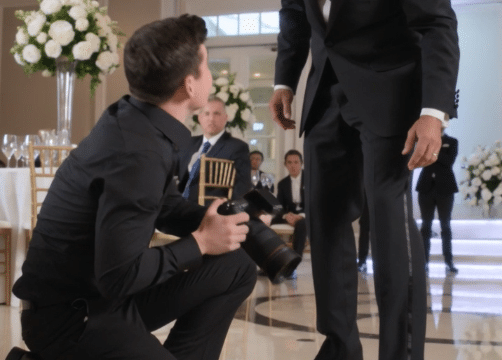
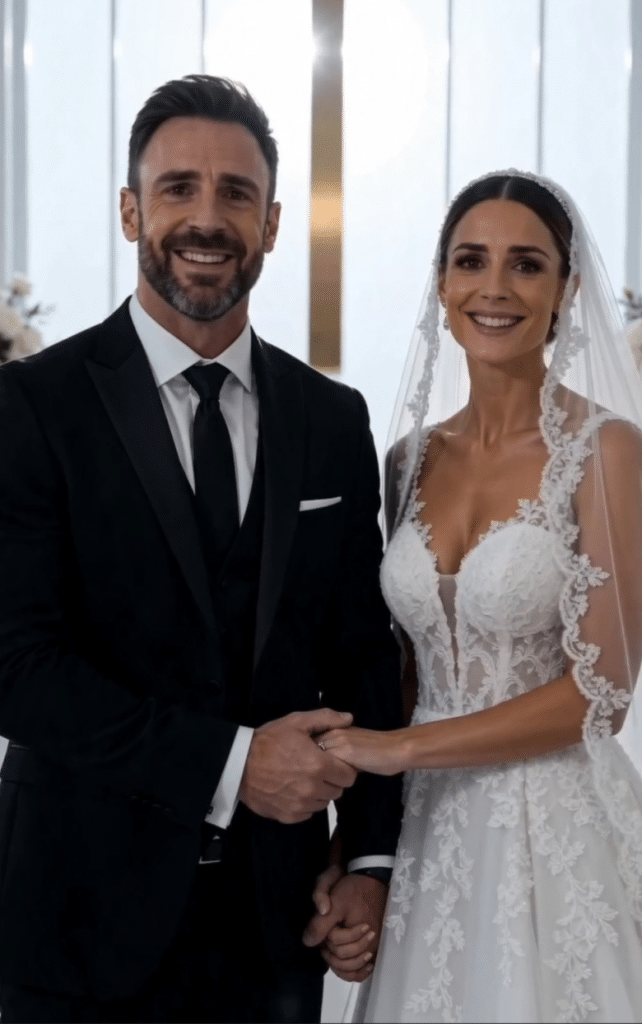
He stood beneath white arches and golden candlelight, holding his bride’s hand as the guests watched with soft, expectant faces. The marble aisle reflected the flowers, the chandeliers, and the perfect shape of a life everyone believed he had finally earned.
For the first time in years, Daniel Mercer looked happy.
Then the boy came running in barefoot.
Gasps moved through the pews.
The child sprinted down the long white aisle, dirty shirt untucked, light brown hair messy from wind or rain, his small feet slapping against the polished floor. He looked wildly out of place among the silk dresses, black tuxedos, and white roses.
Daniel’s bride, Isabelle, turned first.
Her smile vanished.
The boy stopped directly in front of the altar, panting so hard he could barely stand. In his fist was a silver bracelet.
“My mom said give you this today.”
Daniel stared down at him, confused.
Then the boy lifted the bracelet.
Something in Daniel’s chest tightened before he even touched it.
His hand shook as he took the silver bangle. It was old, scratched along the edges, but carefully polished. He turned it over.
The engraving caught the chapel light.
For my son — Daniel.
The world went silent.
Daniel’s knees nearly gave.
He had seen that bracelet only once before, in a photograph he kept locked in his desk. A young woman holding a baby wrapped in a blue blanket. Her face half-hidden, her hand resting near the child’s cheek.
The bracelet on her wrist.
The woman’s name was Elena.
His mother.
The woman he had been told abandoned him thirty years ago.
Daniel dropped to one knee in front of the boy, gripping his shoulders harder than he meant to.
“Elena?” His voice cracked. “Where is she?”
The boy did not cry.
That almost made it worse.
He looked too steady, too tired, too prepared for the pain he had just delivered.
“She said you’d know.”
Behind Daniel, Isabelle stepped forward, pale beneath her veil.
“Daniel,” she whispered. “What is this?”
Daniel could not answer.
The boy looked up at the bride, then back at Daniel.
“My mom said not to let you sign anything today.”
A ripple passed through the chapel.
Daniel froze.
Because the wedding was not supposed to end with vows.
It was supposed to end with signatures.
And suddenly the boy’s bare feet, the old bracelet, and his mother’s impossible name became more terrifying than any interruption could have been.
Act II
Daniel Mercer had spent his life being grateful to the wrong people.
That was what he would understand later.
As a child, he had been told a simple story. His mother, Elena Reyes, was young, unstable, and poor. She worked as a maid in a wealthy home. She became pregnant by a man who wanted nothing to do with her. When Daniel was three, she left him outside a church with a note and disappeared.
The Mercers took him in.
That was the story.
Charles Mercer, a respected judge, and his wife, Margaret, raised Daniel in a house with tall windows, quiet rooms, and rules about gratitude. He was given good schools, clean clothes, private tutors, and a new last name.
“Your mother could not care for you,” Margaret told him whenever he asked too many questions. “We saved you from a life of chaos.”
Daniel believed her because children believe the people who feed them.
But even as a boy, he kept one secret.
A photograph.
He found it in a locked drawer when he was twelve, while searching for birthday candles. In the picture, a woman with dark hair held him as a baby. She was smiling down at him with such fierce tenderness that the official story cracked in one corner.
On her wrist was a silver bracelet.
For my son — Daniel.
When Daniel asked Margaret about it, she slapped the drawer shut and said, “Some memories are poison.”
After that, the photograph disappeared.
But Daniel never forgot the bracelet.
He grew into the kind of man people admired. Disciplined. guarded. successful. He built a security technology company from nothing, then turned it into something powerful enough that men who once looked down on him began asking for meetings.
The Mercers smiled publicly and reminded everyone they had raised him.
Charles called him “my son” in interviews.
Margaret cried at award ceremonies.
Daniel played his part.
Then he met Isabelle Whitmore.
She was kind in a way that felt unpracticed. Beautiful, yes, but not cold. She laughed too loudly at her own mistakes. She asked about his mother once and did not press when he changed the subject. She came from a family as powerful as the Mercers, but she seemed embarrassed by inherited importance.
Daniel loved her.
At least, he believed he did.
The wedding had been arranged quickly after Charles fell ill and insisted he wanted to see Daniel “settled” before another surgery. Isabelle’s father, Richard Whitmore, offered to merge one of his foundations with Daniel’s company after the ceremony.
“A family partnership,” Richard called it.
The documents were supposed to be signed that afternoon in the chapel office.
Daniel had not read every page.
He trusted Isabelle.
He trusted Charles.
He trusted the life that had been built around him.
But Elena Reyes had been watching from the shadows of that life longer than anyone knew.
She had not abandoned him.
She had been erased.
And she had sent a barefoot child into the chapel because the people who stole her first son were about to steal the rest of him.
Act III
The boy’s name was Mateo.
He said it after Daniel led him into the side vestry, away from the staring guests and the trembling priest. Isabelle followed, still in her wedding dress, her bouquet hanging forgotten from one hand.
Charles Mercer tried to come too.
Daniel stopped him at the door.
“Not yet.”
The old judge’s face hardened.
Only for a second.
Then he softened it into concern.
“Daniel, you are upset. Let me help.”
Daniel looked down at the bracelet in his palm.
“You’ve helped enough.”
The door closed.
Mateo stood near the wall, arms wrapped around himself. Up close, Daniel saw the dirt on his cheek, the cracked skin near his toes, the way the boy kept glancing toward the door like he expected someone to burst through it.
Daniel lowered himself to one knee again, gentler this time.
“Mateo,” he said. “Where is Elena?”
“At St. Brigid’s shelter,” the boy said. “But she told me not to bring you there unless you believed the bracelet.”
Daniel swallowed.
“I believe it.”
Isabelle’s voice shook. “Who is Elena?”
Daniel looked at her.
“My mother.”
The words felt strange in his mouth.
Not because they were false.
Because they had been forbidden for most of his life.
Mateo reached into his waistband and pulled out a folded envelope wrapped in plastic. “She said give you this after the bracelet.”
Daniel opened it with shaking hands.
Inside was a letter.
My Daniel,
If this reaches you on your wedding day, forgive the cruelty of the timing. I wanted to come sooner. I tried for years. Every door I opened led back to the people who took you.
You were not abandoned.
You were taken from me after I refused to sign away your father’s estate. Charles Mercer told the court I was unstable. Margaret said I was dangerous. Richard Whitmore signed the medical affidavit that made the lie official.
Daniel stopped reading.
The room blurred.
Isabelle’s face went white.
“My father?”
Mateo looked at her. “Mom said the bride might not know.”
That sentence saved Isabelle from Daniel’s first wave of anger.
He forced himself to continue.
The merger papers are not about marriage. They are about your company, your voting rights, and the Reyes trust your father left in your name. They kept me alive because I knew where the original documents were hidden. They kept you obedient because they taught you to be grateful.
Do not sign.
Find me before Charles does.
Daniel’s hand closed around the letter.
Isabelle sat down hard on a small wooden chair.
“My father signed it?” she whispered.
Mateo nodded. “Mom said he was the lawyer before he was rich.”
Daniel stood too fast.
The vestry door opened before he reached it.
Charles Mercer stood there.
Beside him was Richard Whitmore, Isabelle’s father, dressed in a gray morning suit with an expression of polished concern.
Charles looked at the bracelet.
Then the letter.
For the first time in Daniel’s life, the man who raised him looked afraid.
Richard spoke first.
“Daniel, whatever this child told you, you must understand—”
Daniel cut him off.
“How much of my life did you buy?”
No one in the room breathed.
Act IV
Charles tried grief first.
It had always worked on Daniel.
He pressed one hand to his chest and looked older than he had at the altar. “We loved you. Whatever mistakes were made, we gave you a life.”
Daniel stared at him.
“A life built on a lie.”
Margaret Mercer appeared behind Charles, face pale beneath her perfect hat. “Your mother was not fit.”
Mateo flinched.
Daniel saw it.
The same sentence had probably haunted Elena for thirty years.
“Do not speak about her.”
Margaret’s eyes filled instantly. “After everything I sacrificed—”
“No,” Daniel said. “Not today.”
Richard moved toward Isabelle. “Darling, come here.”
Isabelle did not move.
She was still seated in her wedding gown, one hand pressed to her mouth, staring at her father as though she had found a stranger inside his skin.
“Is it true?” she asked.
Richard’s jaw tightened. “You are my daughter. You will not interrogate me in a chapel.”
That was answer enough.
Isabelle stood slowly.
“You used my wedding.”
Richard’s expression sharpened. “I protected your future.”
“You used my wedding,” she repeated.
The door behind them opened again.
This time, it was not family.
It was a woman in a dark suit carrying a leather case, followed by two men Daniel recognized from his own security team. His assistant, Nora, stepped into the vestry with a tablet in hand.
Daniel stared at her.
“Nora?”
She looked apologetic. “Your mother contacted me three weeks ago.”
Charles turned on her. “You had no authority—”
“I had a conscience,” Nora said.
She placed the tablet on the table and opened a video.
Elena appeared on screen.
Older than the photograph. Thinner. Her dark hair streaked with gray. But Daniel knew her before she spoke. Some recognition lives deeper than memory.
“My son,” she said in the recording, “if you are seeing this, I am either too sick to come or too closely watched.”
Daniel’s face crumpled, but he stayed standing.
Elena lifted a document to the camera.
“Your birth name is Daniel Reyes. Your father, Mateo Reyes Sr., died before you were born. He left you controlling rights to Reyes Logistics, which later became the backbone of Mercer Holdings. Charles and Richard transferred those rights through forged guardianship orders after declaring me mentally incompetent.”
The room went silent.
Elena continued.
“I kept the original guardianship file hidden with Father Ansel at St. Brigid’s. I gave the bracelet to Mateo because no court stamp matters to a child the way one true object can.”
Mateo looked down at his bare feet.
Daniel turned toward him.
“Are you her son?”
Mateo nodded. “She raised me after my mom died at the shelter. She said I was hers because someone should be.”
Something in Daniel broke open.
Elena had lost one child.
Then saved another.
The video ended with her looking directly into the camera.
“Daniel, I never stopped looking for you. But finding you was not enough if I delivered you back into their hands. Choose the truth before you choose anyone standing beside you.”
The screen went dark.
Charles was breathing hard now.
Richard looked toward the hallway, calculating escape.
Isabelle stepped between him and the door.
“No.”
He stared at her. “Move.”
“No.”
Daniel looked at Nora.
“Where is Elena now?”
“St. Brigid’s,” she said. “But Mercer security was dispatched there ten minutes ago.”
Daniel turned toward Charles.
The old man said nothing.
Daniel did not shout.
His voice came out colder than rage.
“You sent men after my mother on my wedding day.”
Charles whispered, “I sent men to prevent a tragedy.”
Daniel took the silver bracelet and closed it around his wrist.
“No,” he said. “You created one.”
Act V
Daniel did not finish the wedding.
He walked out of the chapel holding Mateo’s hand.
The guests rose as he passed. Some whispered. Some watched Isabelle standing alone in her white gown and thought she had been abandoned at the altar. They did not know she had chosen to stay behind just long enough to stop her father from leaving before police arrived.
Outside, the white chapel steps were bright with afternoon sun.
Daniel lifted Mateo into the back seat of his car because the boy’s feet were cut from running. Nora sat in front with two phones, already coordinating security, legal counsel, and emergency medical help.
Daniel did not speak during the drive.
He held the bracelet.
Once, Mateo looked at him and said, “She said you might hate her.”
Daniel closed his eyes.
“I hate that she had to wonder.”
St. Brigid’s shelter stood between a church and an old clinic, its brick walls worn dark by weather. By the time Daniel arrived, two men in dark suits were being detained by police near the entrance. Father Ansel, small and furious in his black clerical shirt, stood on the steps refusing to let anyone inside without a warrant.
Then Elena appeared in the doorway.
Daniel stopped at the gate.
For thirty years, he had imagined his mother as a wound, a question, a photograph, a betrayal, a woman who chose absence over him.
She was smaller than he expected.
That hurt.
She leaned on the doorframe, wrapped in a gray cardigan, her face pale with illness and fear. But when she saw him, her hand went to her mouth exactly the way it had in the old photograph when baby Daniel grabbed her bracelet.
He remembered nothing.
His body remembered everything.
“Elena,” he said.
Her eyes filled.
“My Daniel.”
He crossed the distance too quickly and then stopped just before touching her, suddenly terrified of the years between them.
She solved it.
She reached for his face with both hands.
“I’m sorry,” she whispered. “I tried. I tried so many times.”
Daniel broke then.
Not loudly.
Not like a man in a movie.
He lowered his forehead to her shoulder and shook while she held him with the strength of someone who had been waiting three decades to finish one embrace.
Mateo stood beside them, crying silently.
Elena reached one arm out and pulled him in too.
“My brave boy,” she whispered.
The truth came in waves after that.
Court orders. sealed files. forged psychiatric reports. Missing trust documents hidden beneath the floorboards of St. Brigid’s archive room. Father Ansel had kept them after Elena arrived there years earlier, too frightened to trust another lawyer and too sick to keep running.
Charles Mercer was arrested first for obstruction and fraud.
Richard Whitmore followed after Isabelle turned over the merger documents and testified that her father had pressured her to get Daniel to sign immediately after the ceremony.
Margaret Mercer fought the charges publicly, weeping before cameras about “a son poisoned against his family.”
Daniel did not respond.
He was busy learning what family meant when gratitude stopped being a chain.
Isabelle came to St. Brigid’s two days after the broken wedding.
She wore simple clothes, no veil, no diamond ring.
Daniel met her in the courtyard.
For a long time, neither spoke.
Finally, Isabelle said, “I didn’t know.”
“I believe you.”
She nodded, tears in her eyes.
“That almost makes it worse.”
He understood.
Because innocence inside a corrupt house is still a kind of prison.
The wedding was annulled before it became a marriage. Not because they hated each other. That would have been easier. They parted with grief, honesty, and the terrible knowledge that love built on hidden machinery cannot be saved by pretending the machinery was not there.
Months later, Daniel restored his birth name legally.
Daniel Reyes Mercer.
He kept both.
One for the life taken from him.
One for the life he survived.
Elena moved into a small house near the shelter, not Daniel’s mansion. She refused luxury at first. Then Mateo told her a house with heating was not betrayal, and she agreed to accept comfort if it came with a garden.
Mateo got shoes.
Then school.
Then a bed he did not trust for three weeks because it was too soft.
Daniel learned fatherhood toward Mateo in the same strange way he relearned sonship toward Elena: carefully, imperfectly, with too many apologies and not enough shared history. He did not try to replace anyone. He simply showed up.
At breakfast.
At school meetings.
At doctor visits.
At the shelter, where he established a legal clinic for mothers fighting guardianship fraud and poverty-based custody lies.
On the first anniversary of the wedding that never happened, Daniel returned to the chapel.
Not for ceremony.
For silence.
The white aisle gleamed as it had that day. The flowers were different, but the light was the same. He stood at the altar and looked down the long marble path where a barefoot boy had run toward him carrying the only honest thing in the room.
Elena came in quietly behind him.
Mateo was with her, wearing sneakers now, though he still walked softly in formal places.
Daniel touched the bracelet on his wrist.
“I was happy here,” he said.
Elena’s face tightened with pain.
“Before?”
He nodded.
“For one minute.”
She looked down the aisle.
“Then the truth came.”
Daniel smiled faintly.
“The truth has terrible timing.”
Elena almost laughed.
Then she took his hand.
“No,” she said. “Lies have terrible timing. Truth arrives when it finally finds a door open.”
Mateo looked up at them.
“I opened the door.”
Daniel placed a hand on his shoulder.
“You ran through it.”
The boy grinned.
Outside, the city bells began to ring.
Not wedding bells.
Not funeral bells.
Just ordinary bells marking an ordinary hour.
Daniel listened and realized that was enough.
He had lost a wedding that day.
But he had found his mother.
He had lost a name built by liars.
But he had found the one engraved before the lie began.
For my son — Daniel.
The bracelet was no longer proof of what had been stolen.
It was proof that someone had loved him before power renamed him, before money claimed him, before courts and signatures and respectable people tried to make his mother disappear.
And when Daniel walked out of the chapel with Elena on one side and Mateo on the other, he did not look back at the altar.
Some vows are broken.
Some are prevented.
And some, made by a mother over a silver bracelet decades earlier, survive long enough for a barefoot child to carry them home.