Act I
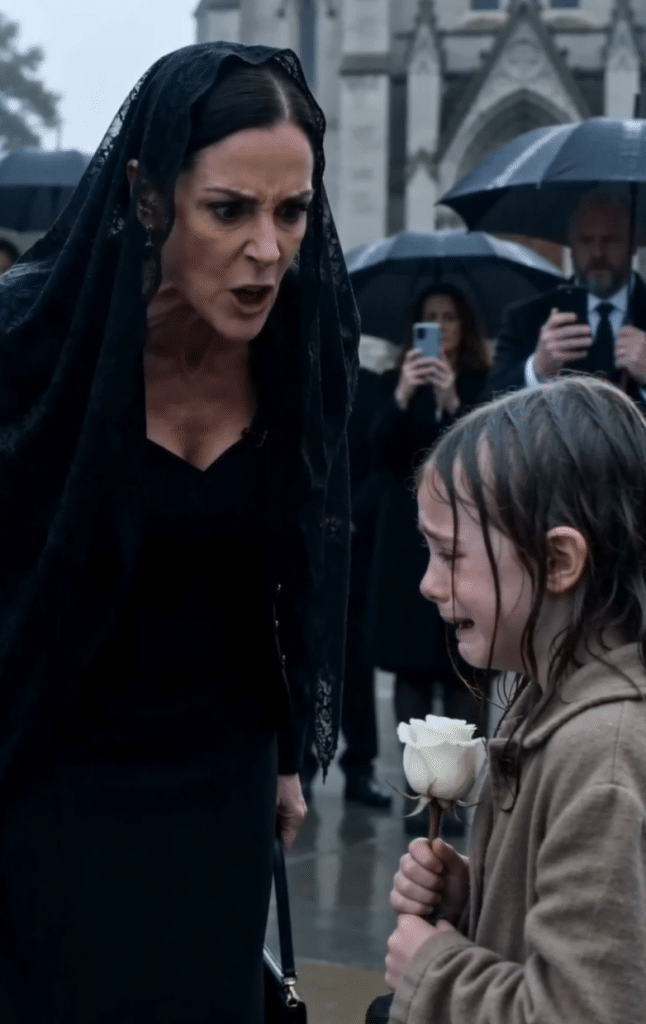
The rose hit the wet stone like it meant nothing.
Its white petals scattered against the rain-dark pavement outside the cathedral, crushed beneath the edge of a black heel before anyone thought to move.
The little girl stared at it.
She had carried that rose through the storm with both hands, holding it close to her chest as if the flower could feel fear too. Her brown coat was soaked through. Her hair clung to her face in tangled strands. Her eyes were swollen from crying, but she did not run when the woman in the black veil pointed at her.
“Get that child away!”
The woman’s voice cut through the funeral like a blade.
Around them, mourners stood beneath black umbrellas, gathered outside the grand stone cathedral where the coffin waited beneath white flowers. Rain streaked down the carved steps. The bells had stopped ringing, but the silence afterward felt heavier.
Some people looked horrified.
Others lifted their phones.
The girl swallowed and stepped forward again.
“Please,” she whispered. “I just want to give it…”
She held the rose out.
The woman snatched it from her hand.
Then she threw it onto the ground.
The child dropped to her knees.
Not because anyone told her to.
Because that rose was the last thing her mother had given her before the hospital doors closed behind them. Because she had promised she would deliver it. Because children who have already lost too much sometimes cling to small tasks as if completing them might keep the rest of the world from falling apart.
The woman in the veil looked down at her with disgust.
“This is a private funeral,” she said. “Not a place for beggars.”
The girl reached for the rose with trembling fingers.
That was when the older man moved.
He stepped out from beneath his umbrella and knelt beside her on the wet stone without caring that his black tuxedo brushed the pavement. He was tall even in age, with white hair, a gold watch at his wrist, and the solemn authority of someone used to being obeyed without needing to raise his voice.
His name was Arthur Langford.
For forty years, he had been the closest friend of the man in the coffin.
And he had never seen that child before.
“Easy,” he said gently.
The girl looked at him, terrified.
Arthur picked up the rose.
A second white flower lay beside it, also knocked loose from the coffin arrangement. Tied around the stem of the girl’s rose was a narrow ribbon, and attached to it was a small folded slip of paper.
Arthur noticed the writing first.
His breath stopped.
The handwriting was not the dead man’s.
It belonged to someone Arthur had believed was dead for twenty-two years.
He unfolded the note with rain-wet fingers.
Three lines.
If he is gone, give this rose to his coffin.
Tell Arthur the child is Elise’s.
Ask Helena what she did at Blackwater House.
Arthur looked up slowly.
The woman in the veil had gone still.
For the first time all morning, her face showed something other than contempt.
Fear.
The girl wiped rain from her cheeks and whispered, “My mommy said the man with the gold watch would know where to look.”
Arthur stared at her.
Behind him, the coffin of Charles Whitmore waited under white roses.
And suddenly, his funeral was no longer a burial.
It was a crime scene that had taken twenty-two years to open.
Act II
Charles Whitmore had died as the city believed he had lived.
Powerfully.
Respectably.
Untouchably.
The newspapers called him a builder of hospitals, libraries, and shelters. His portrait hung in the west wing of the children’s medical center. His foundation had paid for scholarships, cancer wards, emergency housing, and enough polished kindness to make people forget how wealth was earned before it was given away.
But Arthur Langford knew the private version of Charles.
He knew the man who sent birthday cards late because he could not bear to write them without crying. The man who kept one room locked in every house he owned. The man who never forgave himself for losing his only daughter.
Elise Whitmore.
She had been nineteen when she disappeared.
Not died.
Disappeared.
That distinction had mattered to Charles until the world punished him for it.
Elise was fire in a house built for portraits. She loved street musicians, old books, stray dogs, and arguments that made board members sweat. She had her mother’s laugh and her father’s stubbornness, which meant she rarely lost a fight unless someone cheated.
And someone had.
The official story was simple.
Elise ran away after an argument with Charles about her inheritance and an unsuitable boyfriend. Her car was later found near Blackwater House, an abandoned family property on the coast. Blood in the driver’s seat. No body. No ransom. No trace.
The police suspected foul play, then exhaustion, then nothing.
Charles spent millions searching.
Helena, his second wife, stood beside him in public with folded hands and red eyes. She told reporters the family wanted privacy. She told friends Charles was destroying himself. She told Arthur, more than once, that grief had made Charles see ghosts.
Eventually, the foundation board pressured him to accept legal death.
Charles refused for thirteen years.
Then, after a stroke, he stopped fighting the papers.
But he never stopped leaving the lamp on in Elise’s room.
Arthur remembered the night Charles showed him the locked drawer.
Inside was a small gold bracelet, a child’s drawing, and a photograph of Elise holding a white rose in the garden. On the back, she had written:
If I ever leave angry, know I still love you.
Charles kept that photograph until the day he died.
Now a child knelt in the rain with Elise’s handwriting tied to a rose.
Arthur turned to the girl.
“What is your name?”
“Maddie,” she said.
“Maddie what?”
She looked toward the woman in the veil before answering.
“Maddie Vale.”
Helena flinched.
Only slightly.
Arthur saw it.
“Where is your mother?”
Maddie’s lower lip trembled.
“She told me to come here if she didn’t wake up.”
The world seemed to contract around the cathedral steps.
Arthur took off his coat and wrapped it around the child’s shoulders.
The aggressive woman stepped forward.
“That child is lying.”
Arthur stood slowly.
“Helena.”
Her veil clung to her sharp cheekbones, wet with rain. Even in mourning, she looked expensive. Black lace. Pearl earrings. Gloves. A widow dressed not in grief, but control.
“This is disgusting,” she said. “Charles is barely in his coffin, and already some street child arrives with a story.”
Maddie’s face crumpled.
Arthur’s voice hardened.
“One more word like that and you will finish this funeral from the other side of the gates.”
Gasps rippled through the mourners.
No one spoke to Helena Whitmore that way.
No one had for years.
She straightened.
“You forget yourself.”
“No,” Arthur said, holding up the note. “I am remembering everyone you made this family forget.”
Helena’s eyes flicked to the paper.
Rain slid down the cathedral stones.
Behind them, Charles Whitmore’s coffin waited to be carried inside.
But Arthur no longer looked at it as a coffin.
He looked at it as a witness that had arrived too late to speak.
So he would speak for it.
Act III
They took Maddie into the cathedral side chapel to get her out of the rain.
Helena protested.
Arthur ignored her.
The girl sat on a wooden bench beneath a stained-glass window, wrapped in Arthur’s coat, both hands curled around the damaged rose. She looked exhausted in the way children look when fear has kept them upright longer than strength.
A nun from the cathedral brought towels and warm tea.
Maddie did not touch the tea until Arthur drank from his own cup first.
That told him too much.
He lowered his voice.
“Maddie, did your mother give you that note?”
She nodded.
“She said if the lady in black tried to stop me, I had to find the man with the gold watch.”
Arthur looked at his wrist.
Charles had given him that watch thirty years earlier after they survived their first business collapse together. Elise used to joke that Arthur checked it even when time had nothing to do with anything.
“How did your mother know about my watch?”
“She said you were Grandpa’s only brave friend.”
Arthur looked away.
That hurt because it had not been true enough.
He had been loyal to Charles, yes. But brave?
No.
Not when it mattered.
Not when Elise disappeared and Helena began closing doors around her husband. Not when staff were dismissed. Not when old files vanished. Not when Charles begged him to go to Blackwater House one more time and Arthur said they had already searched it.
He had believed exhaustion was realism.
Maybe it had only been cowardice with better posture.
Maddie reached into her coat pocket and pulled out a small cloth pouch. Inside was a key, dark with age, and a broken locket with a picture no larger than a thumbnail.
Arthur leaned closer.
The photograph showed Elise.
Older.
Thinner.
Alive.
Holding a baby wrapped in a yellow blanket.
On the back, in the same handwriting, were the words:
Maddie, born where no one looked.
Arthur gripped the edge of the bench.
“Elise survived.”
Maddie nodded slowly.
“She said bad people told Grandpa she was dead.”
“Where is she now?”
The girl’s eyes filled.
“In the blue room.”
Arthur’s heart went cold.
Blackwater House had a blue room.
He remembered it from summers decades earlier. A second-floor nursery painted pale blue by Charles’s first wife before Elise was born. After the family stopped using the coastal property, the room was sealed along with the rest of the east wing.
At least, that was what Helena had told everyone.
Arthur stood.
Helena appeared in the chapel doorway as if summoned by the thought of her.
Her voice was smooth now, dangerous in its calm.
“Arthur, you are embarrassing Charles’s memory.”
“No,” he said. “You are.”
Her eyes narrowed.
“You have allowed yourself to be manipulated by a child.”
Maddie shrank back.
Arthur stepped between them.
“Who is she?”
“A nobody.”
“Wrong answer.”
Helena removed her gloves slowly.
“Do not do this in public.”
Arthur almost laughed.
The phones outside. The mourners whispering. The cathedral staff pretending not to listen. The coffin waiting beneath flowers.
After twenty-two years, public was the only place left where Helena could not easily bury the truth.
He lifted the key.
“Blackwater House.”
For the first time, her composure broke.
Only for a second.
But enough.
Arthur turned to the nun.
“Sister, call Detective Maren. Tell him Arthur Langford is invoking the Whitmore emergency trust clause.”
Helena’s face hardened.
“You have no authority.”
Arthur looked at the damaged rose in Maddie’s hands.
“No. But she might.”
The old Whitmore trust had a clause Charles refused to remove even after Elise was declared dead. If any direct descendant of Elise Whitmore appeared with credible evidence of survival, all estate transfers froze pending investigation.
Helena knew it.
Arthur knew it.
And now, because of a hungry, rain-soaked child with a rose, the entire Whitmore fortune had just stopped moving toward Helena’s hands.
Act IV
Blackwater House stood on a cliff above the sea, gray and rotting beneath the storm clouds.
By the time Arthur arrived with detectives, the sky had turned the color of wet ash. Police lights flashed against broken windows. The iron gate, supposedly rusted shut for years, had fresh scratches around the lock.
Maddie refused to stay behind.
Arthur wanted to protect her from whatever waited inside, but the girl only held out the key and said, “Mommy said I had to show you the wall.”
So she came wrapped in a blanket, holding Arthur’s hand.
The house smelled of salt, mold, and old secrets.
Detective Maren led the way. Two officers followed. Helena had been instructed to remain at the cathedral, but Arthur knew better than to assume obedience from a woman whose life depended on locked doors.
The blue room was on the second floor.
The door had been painted over.
Not abandoned.
Hidden.
Maddie pointed to the baseboard beside the wardrobe.
“There.”
An officer pried it loose.
Behind the wood was a narrow gap containing papers wrapped in oilcloth, medicine bottles, a silver hairbrush, and a stack of letters tied with ribbon.
Arthur opened the top letter.
Papa,
If this ever reaches you, I did not leave you. Helena arranged everything. She said if I came back, she would tell the world I ran away pregnant and unstable. She said you would believe her because she had already made you tired enough.
Arthur closed his eyes.
Detective Maren took the letter carefully.
Then a sound came from below.
A door slamming.
An officer shouted.
Arthur turned.
Maddie bolted.
“Mama!”
Arthur ran after her.
Downstairs, in the rear servants’ hall, officers had opened a locked storage room concealed behind a false shelving unit. A woman sat on a narrow cot beneath a single hanging bulb.
She was alive.
Barely.
Elise Whitmore looked like a ghost carved from grief. Her hair, once chestnut, was streaked with gray. Her face was thin. But when Maddie ran into the room, Elise opened her arms with a sound that made every officer go still.
“My baby.”
Maddie climbed into her lap, sobbing.
“I gave him the rose. I found the watch man.”
Elise looked up.
Her eyes found Arthur.
For a moment, he saw the nineteen-year-old girl who once stole his cufflinks and hid them in the piano because he told her children should not interrupt business meetings.
“Elise,” he whispered.
She smiled faintly.
“You got old.”
He laughed once, and it broke into tears.
“So did you.”
Detective Maren stepped forward gently.
“Ms. Whitmore, who kept you here?”
Elise looked toward the doorway.
No one needed the answer.
But she gave it anyway.
“Helena.”
The investigation later showed the full shape of the crime.
Helena had discovered Elise was pregnant by a young doctor Charles disliked. She feared the child would strengthen Elise’s claim to the trust and weaken her own access to the estate. With help from a corrupt physician and two private security men, she staged Elise’s disappearance at Blackwater House.
Elise escaped once.
Long enough to give birth in a coastal clinic under a false name.
Long enough to hide Maddie with a housekeeper for several years.
But Helena found them.
After that, Elise lived between locked rooms, forged medical records, and threats that Maddie would vanish if she spoke.
The rose had been a risk.
A desperate one.
Charles died before Elise could reach him.
So she sent Maddie to his funeral.
Not to mourn.
To be seen.
As officers carried boxes of evidence from Blackwater House, Helena arrived in a black car, furious enough to forget caution. She stepped into the entry hall and saw Elise wrapped in a police blanket.
Her expression did not show surprise.
That was what condemned her before she said a word.
Elise looked at her.
“You threw my daughter’s rose on the ground.”
Helena lifted her chin.
“You should have stayed gone.”
Arthur stepped forward.
“No,” he said. “You should have let the dead man have his flower.”
Helena turned toward him, eyes burning.
“Charles was mine.”
Elise’s voice was weak but clear.
“He was my father.”
Maddie, still clinging to her mother, looked at Helena with wet eyes.
“And he was my grandpa.”
The room went silent.
Helena opened her mouth, but no elegant lie came quickly enough.
The detectives escorted her out into the rain.
And this time, the phones waiting outside belonged not to gossiping mourners, but to reporters watching a widow become a suspect before the funeral flowers had wilted.
Act V
Charles Whitmore was buried three days late.
Arthur insisted.
The first funeral had been interrupted by truth, and he refused to let Charles’s final goodbye remain in the hands of the woman who had lied beside his coffin.
This time, the cathedral steps were still wet, but the rain had softened to mist.
There were fewer guests.
That was better.
Many who came to be seen at the first funeral suddenly found reasons not to attend the second. Board members sent condolences. Society friends sent flowers. People with guilty memories sent nothing at all.
Elise came in a wheelchair, too weak to stand for long.
Maddie walked beside her, holding the same white rose.
Arthur stayed close.
Not because he thought Helena could reach them now. She could not. She sat in custody, surrounded at last by locked doors she did not control.
He stayed close because he should have done so years earlier.
The coffin was placed near the cathedral garden this time, beneath the old yew tree Charles loved. The priest spoke briefly. No one gave a polished speech about legacy. No one used words like dignity to cover what had been done.
Then Elise asked to speak.
Arthur started to help her, but she shook her head.
She wheeled herself forward.
“My father was not perfect,” she said.
Her voice was thin, but it carried.
“He was proud. He was stubborn. He made mistakes that gave cruel people room to work.”
Arthur lowered his eyes.
“But he loved me,” Elise continued. “And I know now that he looked for me. Not long enough to find me. Not hard enough to save me. But he looked. And sometimes, when you have spent years being told you were abandoned, even that truth is a kind of bread.”
Maddie leaned against her chair.
Elise touched her daughter’s hair.
“This child carried a rose through rain because I could not carry it myself. She was told she did not belong at her grandfather’s funeral.”
Her gaze moved across the mourners.
“She belonged more than anyone.”
Maddie stepped forward.
No one stopped her.
She placed the white rose on the coffin.
This time, it stayed.
Arthur felt something in his chest loosen and break at the same time.
After the burial, the Whitmore estate froze under court supervision. The foundation board was dissolved. Blackwater House was sealed, not hidden. Evidence from the blue room reopened Elise’s disappearance and exposed decades of falsified medical papers, trust manipulation, and secret payments.
Helena’s trial was ugly.
People like Helena do not surrender their stories easily. She claimed Elise had been unstable. She claimed she had protected Charles from scandal. She claimed Maddie was being coached.
Then Elise’s letters were read aloud.
Then the clinic nurse testified.
Then Maddie’s rose note was shown to the jury.
A small piece of paper, wrinkled from rain, strong enough to pull down a mansion of lies.
Helena was convicted on enough counts to spend the rest of her life watching doors close.
But Elise did not heal when Helena was sentenced.
She healed in quieter, slower ways.
Eating soup without asking who made it.
Sleeping with the door open.
Watching Maddie run through Arthur’s garden without fear that a car would come up the drive.
At first, Maddie kept every flower anyone gave her. She dried them in books, tucked them into jars, and cried when petals fell apart.
Arthur asked her why.
She shrugged.
“Flowers get taken.”
So he planted a rose garden.
Not a formal one with labels and rules, but a wild, stubborn patch behind the house where white roses climbed old brick and bloomed through rain. He told Maddie she could cut any flower she wanted, any day, for any reason.
She did not cut one for two months.
Then, one morning, she came inside holding three.
One for her mother.
One for Arthur.
One for the photograph of Charles placed on the mantel.
She stared at the photograph for a long time.
“Do you think he would have liked me?”
Arthur knelt beside her.
“He would have adored you.”
“Even if I was dirty at the funeral?”
“Especially then.”
She frowned.
“Why especially?”
“Because you came anyway.”
Maddie considered that seriously.
Then she placed the rose beneath Charles’s photograph.
A year later, they returned to the cathedral.
Not for a funeral.
For the reopening of the Whitmore Children’s Trust under Elise’s control. Its first act was to convert Blackwater House into a recovery home for children and parents separated by abuse, corruption, or systems that listened too late.
Maddie hated the idea at first.
“That house is bad,” she said.
Elise nodded.
“It was.”
“Bad houses stay bad.”
Arthur, standing nearby, said softly, “Only if bad people keep the keys.”
Maddie thought about the blue room.
The locked door.
The note.
The rose.
Then she asked if the new house could have windows that opened.
Elise said yes.
All of them.
On the day the first families arrived, Maddie stood at the front gate with a basket of white roses. She handed one to each child, not as decoration, not as performance, but as a promise.
“You can keep it,” she told them. “Or throw it away. Nobody gets to decide for you.”
Arthur watched from the path, his gold watch catching the afternoon light.
Elise sat beside him, stronger now, her face turned toward the garden.
“You were late,” she said quietly.
Arthur swallowed.
“I know.”
“But you came.”
He looked at Maddie, who was laughing now with another child under the open windows of Blackwater House.
“Yes,” he said. “Finally.”
Elise reached for his hand.
It was not forgiveness all at once.
But it was contact.
It was a beginning.
That evening, Maddie placed one last rose at the cathedral steps where Helena had thrown the first one into the rain.
No coffin waited this time.
No mourners filmed.
No woman in a black veil stood above her saying she did not belong.
Maddie set the flower down gently.
Then she stepped back.
“Done?” Arthur asked.
Maddie looked at the rose.
Then at her mother.
Then at the sky, clear now beyond the cathedral towers.
“No,” she said. “Not done.”
Arthur smiled faintly.
“What then?”
Maddie took Elise’s hand.
“Started.”
And together, they walked away from the stone steps, leaving the rose behind not as proof of grief anymore, but as proof that the child who had once been thrown aside had returned with a name, a mother, and a place no one could take from her again.