Act I
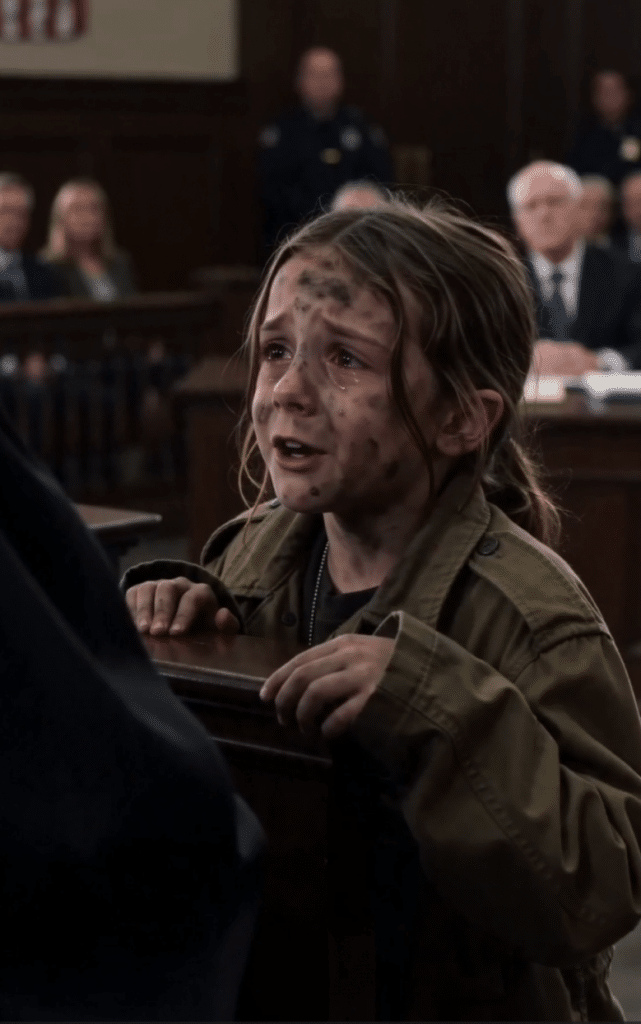
The little girl had to stand on her toes to reach the judge’s bench.
Her hands gripped the dark wood so tightly her knuckles turned pale. Dirt smudged one cheek. Her brown hair hung loose and tangled around her face. The olive green jacket she wore was too large for her small frame, its sleeves swallowing half her fingers.
Everyone in the courtroom watched her.
No one moved.
Behind her, on the defense side, a man in an orange jail uniform sat with his head bowed and his wrists cuffed in front of him. His name on the court file was Daniel Cross. Age thirty-six. Occupation: mechanic. Charge: felony theft from a private medical facility.
To most people, it was a simple case.
A desperate man had broken into a secured pharmacy and stolen medicine.
The law had a place for desperate men.
Usually, it was a cell.
But the girl standing at the judge’s bench did not know how to speak in legal language. She knew only that her father was behind her, that her baby brother was alive because of him, and that the woman in the black robe had the power to decide whether their family would break completely.
“Your Honor,” she said, her voice shaking, “if you let my dad come home, I can fix your legs.”
A murmur passed through the room.
Judge Eleanor Whitcomb leaned forward in her wheelchair.
She was seventy-two, white-haired, sharp-eyed, and known throughout the county as a woman who did not bend because tears entered the room. She had sentenced executives, gang leaders, corrupt officers, grieving parents, and frightened teenagers. Compassion, she often said, was not the opposite of law. It simply had to survive inside it.
But the child’s words struck something strange in her face.
“Why do you want him home so badly?” the judge asked.
The girl swallowed hard.
Her little body shook with a sob she was trying to hold back.
“He didn’t steal for bad reasons,” she said. “He stole medicine because my baby brother stopped breathing.”
The defense attorney closed his eyes.
Daniel Cross looked away, jaw trembling.
The prosecutor shifted uncomfortably at his table.
The judge’s expression remained firm, but her hand tightened around the armrest of her wheelchair.
“What is your name, child?”
“Lucy.”
“Lucy Cross?”
The girl nodded.
Then she reached into the pocket of her oversized jacket and pulled out a brass pocket watch.
Not a watch exactly.
A locket.
It was old, scratched at the edges, and tied with a dark piece of string because the chain had broken long ago. Lucy slid it across the bench with both hands as if it were too important to lift carelessly.
“My dad said to give you this if they wouldn’t listen.”
Judge Whitcomb stared at it.
For the first time that morning, she looked uncertain.
Slowly, she took the locket in her ringed hand and opened it.
Inside was a tiny photograph.
The courtroom disappeared from her face.
Her lips parted.
Her fingers trembled.
The photograph showed a young woman on courthouse steps, laughing through tears as she held a little boy in a brown coat. Around the boy’s neck was the same brass locket.
Judge Whitcomb had not seen that photograph in thirty-one years.
Lucy looked up at her with red, swollen eyes.
“My dad said you kissed him goodbye.”
The judge’s breathing changed.
Her voice came out almost too soft to hear.
“Who is your father?”
Lucy looked back at the man in cuffs.
Then she turned to the judge.
“Your son.”
And the courtroom, which had heard every kind of lie, every kind of plea, every kind of sorrow, went completely silent.
Act II
Judge Eleanor Whitcomb had spent thirty-one years not saying his name.
Samuel.
Not in chambers. Not in interviews. Not at memorials. Not even when she woke in the middle of the night with one hand on the empty space beside her bed and the other reaching for a child who was no longer there.
Samuel had been five years old when she lost him.
Back then, Eleanor was not yet a judge. She was a young public defender with cheap shoes, a stubborn heart, and a habit of taking cases no one else wanted. She had married into power by mistake — or love, depending on which part of the memory she trusted.
Her husband, Richard Whitcomb, came from a family of prosecutors, politicians, and men who smiled for cameras while burying anything inconvenient beneath polished words. At first, Richard admired her fire. Then he resented it. Then he began trying to put it out.
When Eleanor exposed a network of illegal medical contracts connected to Richard’s family foundation, the marriage collapsed overnight.
She remembered the last morning clearly.
Rain on the courthouse steps.
Samuel in his little brown coat.
The brass locket around his neck because he said it made him “brave like Mama.”
Richard had promised to bring him back after a weekend visit.
Eleanor knelt before her son, kissed his forehead, and whispered, “No matter what happens, you are mine.”
Samuel asked, “Even if I get lost?”
“Especially then.”
That was the last time she saw him.
Three days later, Richard’s car was found crushed and burned off a mountain road. The report said both father and child were dead. Richard’s body was identified. Samuel’s was not, but the investigators told Eleanor the fire had taken what a mother should not have to see.
She did not believe them.
Not at first.
She searched for months. Then years. She chased rumors through towns that looked the same after midnight. She spent her savings on investigators. She nearly lost her career because powerful people called grief obsession and obsession instability.
Eventually, the world moved on without asking her permission.
Eleanor became a judge.
Her spine was injured in a courthouse shooting eleven years later, when a defendant’s brother opened fire after sentencing. She survived. Her legs never fully recovered. Reporters wrote stories about courage, resilience, and the iron woman of the bench.
They never wrote that the real wound had happened long before the bullets.
They never wrote that a mother could lose a child and still be expected to become useful to society by Monday.
Now the brass locket lay open in her palm.
And the man she was about to sentence sat at the defense table under another name.
Daniel Cross.
Not Samuel Whitcomb.
Daniel Cross, who had been raised in foster homes after being found wandering near a bus station at age six with no papers, no family, and no memory except a woman’s kiss, a rainy courthouse, and a locket someone later stole from him.
Except it had not been stolen forever.
Somehow, it had come back.
Eleanor looked at him.
Daniel’s eyes were full of terror.
Not for himself.
For the little girl standing at the bench.
For the baby boy somewhere in a hospital crib.
For the family he had built without knowing where he came from.
“Why didn’t you say anything?” the judge whispered.
Daniel lifted his cuffed hands slightly.
His voice broke.
“Because I didn’t know it was you.”
Act III
The court recessed immediately.
No one argued.
Not the prosecutor. Not the clerk. Not even the reporters who had been waiting for a clean headline about a thief, a judge, and a stolen vial from Saint Agnes Medical Center.
Judge Whitcomb ordered Daniel’s cuffs removed in chambers.
The bailiff hesitated only half a second before obeying.
Lucy ran to her father the moment his hands were free. Daniel dropped to his knees and held her so tightly Eleanor had to turn away.
There are reunions people imagine for decades.
They imagine music, running, recognition, tears arranged by mercy.
Real reunions are messier.
They come with court files, jail uniforms, children who have not eaten breakfast, and thirty-one years of questions standing between two people who share a face but not a life.
Daniel looked at the judge like a man afraid to hope.
“My name was Samuel?”
Eleanor nodded.
“I called you Sammy.”
He pressed one hand over his mouth.
“I used to dream that.”
The words nearly undid her.
Lucy stayed pressed against her father’s side, watching Eleanor with the suspicion of a child who had learned that adults with power often called pain procedure.
Eleanor softened her voice.
“Lucy, where is your brother now?”
“At Mercy Children’s,” she said. “His name is Ben.”
Daniel looked down.
“He has a rare respiratory condition. The medicine was denied twice. Insurance said it was not approved fast enough. The hospital had it in storage for another patient trial. I begged them. I offered to pay over time. I called everyone.”
His jaw tightened.
“He stopped breathing in my arms.”
No one spoke.
“I broke into the storage room,” Daniel said. “I knew it was wrong. I knew they’d arrest me. But my son was turning blue, and the nurse kept saying we had to wait for authorization.”
The prosecutor looked down at the file.
The story in the official report had been cold: forced entry, stolen pharmaceutical property, defendant apprehended after fleeing scene.
It had not said father.
It had not said baby.
It had not said a man ran two blocks through rain holding medicine because the ambulance had not come fast enough.
Eleanor looked at Lucy.
“You said you could fix my legs.”
The girl wiped her nose with her sleeve.
“My dad makes braces. He fixed Mr. Alvarez’s hand after the factory accident. He made Ben’s breathing chair when the hospital one cost too much.”
Daniel closed his eyes.
“Lucy.”
“No,” she said, suddenly fierce. “They should know.”
She looked at Eleanor.
“He helps everyone. He fixes things people throw away.”
The sentence hit the judge like a verdict.
Eleanor turned to the brass locket.
“How did you get this?”
Daniel’s face changed.
“A woman came to my shop six months ago. Old. Sick. She said she knew my real name. I thought she was confused.”
“What was her name?”
“Marian Bell.”
Eleanor gripped the locket.
Marian had been Richard Whitcomb’s housekeeper.
She had testified at the custody hearing that Eleanor was unstable.
A lie.
One of the lies that helped Richard take Samuel that weekend.
Daniel continued.
“She said your husband didn’t die in the crash.”
Eleanor went still.
“He staged it,” Daniel said. “His family paid a man to take me across state lines. But something went wrong. The man abandoned me. Marian kept the locket and the photograph because she said one day the truth might need a face.”
Eleanor’s eyes closed.
For thirty-one years, she had believed her son died in fire.
Then she believed he had been stolen.
Now she understood the worst truth of all.
He had been stolen badly.
Not hidden in luxury. Not raised under a new name with care. Dropped into the machinery of poverty, paperwork, and indifference because powerful men cared only that Eleanor never found him.
Daniel looked at her.
“She said if I ever stood before Judge Whitcomb, I should show you the locket.”
His laugh was broken.
“I thought she meant for mercy.”
Eleanor looked at him.
“No,” she said. “She meant for justice.”
Act IV
The hearing resumed that afternoon, but it was no longer the same case.
Everyone could feel it.
Daniel sat beside his attorney with Lucy on the bench behind him, wrapped in a blanket one of the clerks had found. The prosecutor stood with a new expression, less certain now, the file in his hand suddenly inadequate to the life it described.
Judge Whitcomb returned to the bench in her wheelchair with the brass locket placed before her.
She did not hide it.
The courtroom watched the object shine under the dim lights like a small, stubborn piece of the past refusing to stay buried.
The prosecutor rose first.
“Your Honor, given the extraordinary circumstances—”
She lifted one hand.
“Before we discuss circumstances, we will discuss facts.”
Her voice was steady again.
Not cold.
Steady.
“Was the medicine recovered?”
The prosecutor paused.
“No, Your Honor. It was administered to the defendant’s infant son before officers arrived.”
“Did the child survive?”
“Yes.”
“Did Saint Agnes Medical Center confirm the medication was medically appropriate?”
Another pause.
“Yes, Your Honor.”
“Did the hospital deny emergency release pending administrative authorization?”
The prosecutor looked uncomfortable.
“That appears to be under review.”
“Under review,” the judge repeated.
Those two words filled the room with quiet disgust.
Daniel’s attorney stood.
“Your Honor, we have records showing Mr. Cross contacted the hospital, insurer, manufacturer, and county emergency aid office. All before the alleged theft. He exhausted every lawful avenue while his child’s condition worsened.”
The judge looked toward the hospital’s legal representative seated near the aisle.
A polished man with a briefcase and a bloodless expression.
“Is that accurate?”
He stood slowly.
“Your Honor, the hospital followed policy.”
Eleanor’s eyes hardened.
“Policy is not a sanctuary for cowardice.”
The room went still.
The man sat down.
Then Eleanor turned to the larger matter.
Her son.
Her own conflict.
Her own impossible place between law and blood.
“I will not pretend this court can proceed as if the revelation today has no consequence,” she said. “I have learned that the defendant may be my son, taken from me as a child through criminal deception. That must be investigated independently. I will recuse myself from future proceedings after emergency matters are addressed.”
Daniel’s face tightened, afraid already.
But Eleanor was not finished.
“However, the question of immediate detention remains before me. The defendant is not a flight risk. He is a father with a critically ill infant, a daughter in distress, and no violent history. He acted unlawfully, but the state has presented no evidence that he acted for profit, malice, or personal gain.”
The prosecutor did not object.
Perhaps he knew the cameras were rolling.
Perhaps he had a conscience after all.
Eleanor looked at Daniel.
“Mr. Cross, this court does not bless theft.”
Daniel lowered his eyes.
“But neither will it pretend that a system can deny a child breath and then act shocked when a father breaks a lock.”
Lucy began to cry silently.
Eleanor’s voice trembled only once.
“Daniel Cross is released on supervised recognizance pending review. He will be permitted to visit his son. The court orders an immediate investigation into Saint Agnes Medical Center’s medication access policies, the insurer’s denial record, and the newly presented evidence concerning the disappearance of Samuel Whitcomb.”
The gavel fell.
The sound echoed through the courtroom like a door opening.
Daniel bowed his head.
Lucy threw her arms around him.
The audience, trained by law and fear to remain silent, did not applaud.
But many of them cried.
And behind the bench, Judge Eleanor Whitcomb looked at the locket and understood that she had not gotten her little boy back.
Not exactly.
She had found the man he became.
And the man he became had spent his life doing what no one had done for him.
Trying to save children before the paperwork finished failing them.
Act V
The investigation broke open three cases at once.
The first was Daniel’s.
The charges were not dismissed overnight. The law does not move that gracefully, even when shame is standing in the room. But the public pressure changed everything. Saint Agnes Medical Center suspended two administrators. The insurer reversed its denial too late to look merciful. Emergency access rules were rewritten after reporters discovered three other families had faced similar delays.
Ben Cross came home two weeks later.
Small. Fragile. Alive.
Daniel carried him through the apartment door while Lucy danced in circles around them, warning everyone to be quiet and then making more noise than anyone else.
The second case was older.
Samuel Whitcomb.
A retired state investigator reopened the file. Marian Bell’s final statement was found in a sealed envelope at a legal clinic. Bank records tied Richard Whitcomb’s family to payments made after the staged crash. The man who transported Samuel had died years earlier, but not before leaving behind a prison interview in which he admitted abandoning a child when the plan “got too hot.”
Eleanor watched the recording alone.
She did not cry until it ended.
Then she allowed herself exactly what she had denied for thirty-one years.
Not dignity.
Not strength.
Grief.
The third case was the hardest.
Mother and son.
Because DNA can prove blood in a week, but it cannot restore bedtime stories. It cannot return lost teeth placed under pillows, school plays missed, birthdays unlit, fevers unwatched, or the thousand ordinary moments that turn love from fact into memory.
Daniel did not call her Mom right away.
Eleanor did not ask him to.
They began awkwardly.
Hospital visits.
Coffee gone cold.
Long silences.
Stories told in pieces because full truth was too large to carry all at once.
He told her about foster homes. Mechanics who taught him kindness. Hunger. Anger. The first time Lucy was born and he looked at her hand, saw a tiny crescent mark near her thumb, and felt a strange grief he could not name.
Eleanor told him about the courthouse steps. The brown coat. The locket. The years she searched. The day people stopped asking about Samuel because her pain made rooms uncomfortable.
One afternoon, Lucy climbed into Eleanor’s lap without asking.
Everyone froze.
Eleanor looked down at the child.
Lucy looked up.
“Does this hurt your legs?”
“No,” Eleanor said, voice soft. “It does not.”
“Good.”
Then Lucy rested her head against the judge’s robe, as if verdicts, history, and bloodlines meant nothing compared to the availability of a warm lap.
Daniel turned away.
Eleanor pretended not to see him wipe his eyes.
Months later, Daniel brought a package to Eleanor’s house.
Inside was not a miracle.
It was a brace.
Lightweight, carefully built, adjusted to the exact measurements her physical therapist had given him. He had made it in late nights between Ben’s treatments and garage shifts, refusing payment, refusing praise, refusing to call it anything grand.
“You said you could fix my legs,” Eleanor told Lucy, smiling.
Lucy pointed at Daniel.
“He did the hard part.”
Eleanor tried the brace with medical supervision. She did not rise dramatically from the chair. Life was not a movie generous enough to erase injury in one afternoon.
But she stood for twelve seconds.
Then twenty.
Then, weeks later, she took four steps between parallel bars while Daniel stood nearby pretending not to hover.
Eleanor laughed after the fourth step.
It startled everyone.
Especially her.
The sound was rusty, unpracticed, and so full of disbelief that Lucy began clapping before anyone else moved.
Daniel finally smiled.
Not carefully.
Not politely.
Like the boy in the photograph might have smiled if the world had been kinder.
A year after the courtroom plea, Eleanor retired.
At her farewell ceremony, there were speeches about justice, service, courage, and precedent. She listened patiently. Then she rolled to the podium with the brass locket around her neck.
“I spent my career believing the law was a house,” she said. “Strong walls. Clear doors. Rules for entry.”
She looked at Daniel, seated in the front row with Ben on his lap and Lucy leaning against his shoulder.
“But a house that cannot hear a child crying outside is not justice. It is architecture.”
The room went silent.
Eleanor touched the locket.
“My granddaughter reminded me of that.”
Lucy sat up straighter.
“My son reminded me too.”
Daniel’s face changed at the word.
Son.
Not defendant.
Not Mr. Cross.
Son.
He lowered his head, and Lucy squeezed his hand.
After the ceremony, they returned to the courthouse steps.
The same steps from the photograph.
Rain threatened, gray clouds gathering above the city, but no one moved to leave.
Daniel stood beside Eleanor’s wheelchair.
Lucy held the locket open, comparing the old photograph to the real place.
“This is where you kissed him goodbye?” she asked.
Eleanor nodded.
Lucy frowned.
“But now he came back.”
Eleanor looked at Daniel.
“Yes,” she said. “He did.”
Daniel knelt in front of her.
For a moment, he was a grown man with tired eyes, rough hands, and a life built from survival. Then he was also Samuel, the little boy with the brown coat and the brave locket, asking whether he was still hers if he got lost.
Eleanor reached out and touched his face.
“I looked for you,” she whispered.
Daniel closed his eyes.
“I know.”
“I am so sorry I did not find you sooner.”
He opened his eyes.
There was pain there.
But not only pain.
“You found me when my kids needed you.”
That was the mercy he gave her.
Not perfect forgiveness.
Something better.
A place to begin.
Lucy climbed onto the step beside them, impatient with adult sorrow.
“So,” she said, “can Dad come home now?”
Daniel laughed.
Eleanor did too.
“Yes,” Eleanor said. “He can come home.”
And as the first rain began to fall over the courthouse, the brass locket clicked shut in Lucy’s hand.
Not like a secret closing.
Like an old wound finally protected.
A father had stolen medicine because his child needed breath.
A daughter had begged a judge because love had no legal vocabulary.
And an old woman who thought her son was gone forever learned that sometimes justice does not enter the courtroom through the front doors.
Sometimes it stands on tiptoe at the bench, covered in dirt and tears, and asks for mercy before revealing it has brought the truth home.