Act I
The dog did not belong in a place like that.
Everyone seemed to agree.
The restaurant glowed with amber lights and polished wood, full of quiet laughter, silver cutlery, and people who did not look down unless something spilled.
Then a thin white dog slipped through the open door.
His fur was wet. His ribs showed faintly beneath his skin. His cream-colored ears hung low as he sniffed the floor, searching for anything that smelled like mercy.
A waiter saw him first.
“Get out of here!” he shouted.
The dog froze.
The waiter stepped closer, waving his arms like the animal was filth dragged in by the storm.
“Go on, get lost!”
The dog panicked. His paws slid on the smooth floor before he bolted through the door and disappeared into the rain.
Most diners turned back to their meals.
Only one man kept watching.
Arthur Hale sat beside the window, silver-haired, still in his tailored suit, staring through the glass as the dog huddled across the street beneath a dead streetlamp.
Then the waiter brought Arthur’s dinner.
A white plate of spaghetti.
One meatball steaming on top.
Arthur looked at the food.
Then at the dog.
And without saying a word, he stood.
Act II
Arthur Hale was the kind of man people assumed had stopped noticing small suffering.
He owned buildings. Signed contracts. Spoke in rooms where men interrupted each other for sport.
But loneliness had made him observant.
His wife had died three winters earlier. His daughter lived across the country. His house was too quiet, his calendar too full, and most evenings ended with him eating alone under expensive lighting.
So when he saw the dog through the rain, he did not see a nuisance.
He saw a creature that had already been turned away too many times.
The waiter frowned as Arthur picked up the plate.
“Sir?”
Arthur did not answer.
He crossed the restaurant, pushed open the door, and stepped into the storm.
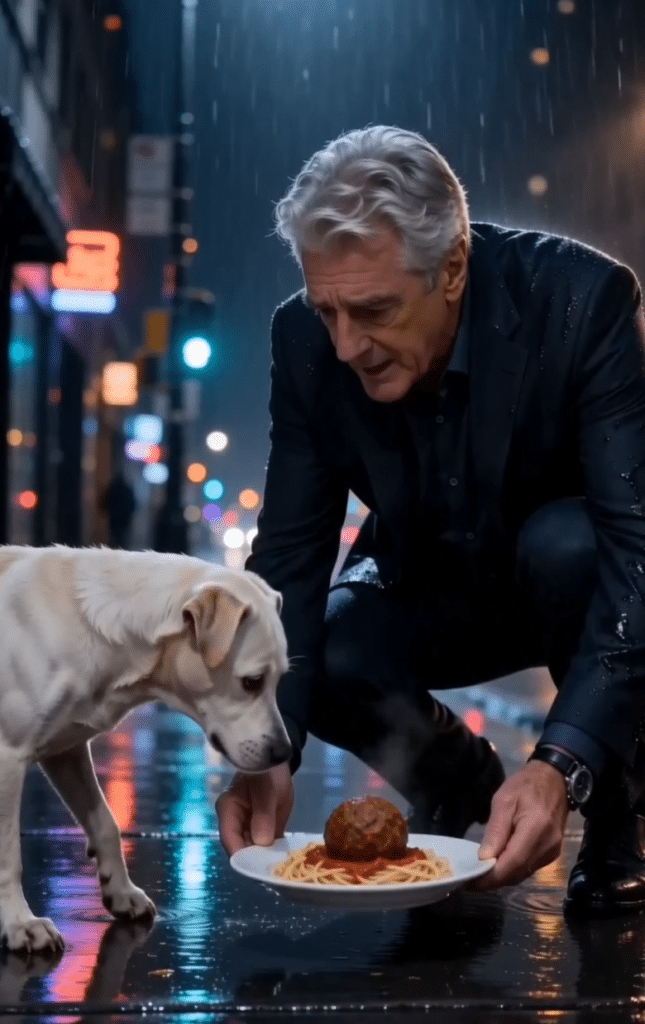
Rain struck his shoulders. Water soaked into his shoes. He crossed the slick road with the hot plate in both hands and crouched on the pavement without caring what happened to his suit.
The dog backed away at first.
Arthur kept his voice soft.
“It’s okay, little guy. I’m not gonna hurt you.”
The dog stared at him.
Hungry.
Afraid.
Hopeful in a way that looked almost painful.
Arthur slid the plate forward.
The dog sniffed once.
Then lowered his head and ate.
Arthur watched him with a tenderness no one in the restaurant had expected.
But kindness has a strange way of being remembered.
And that night, it would be remembered fast.
Act III
Arthur did not notice the dog following him.
Not at first.
He left the plate empty on the sidewalk, gave the animal one last gentle look, and walked toward the parking garage beneath the restaurant.
Behind him, the dog stood in the rain.
Then he followed.
Not too close.
Just close enough to keep Arthur in sight.
The garage was colder than the street. Concrete pillars rose from the floor like shadows. Fluorescent lights buzzed overhead, flickering in uneven strips.
Arthur was halfway to his car when the man stepped out.
A hood pulled low.
A fast movement.
Hands on Arthur’s collar.
Arthur hit the wall hard enough to lose his breath.
The mugger shoved him back again, pinning him against the concrete.
“Wallet,” the man growled.
Arthur raised his hands slowly.
He was not young enough to fight. Not foolish enough to provoke.
But before he could reach for his pocket, a sound rolled through the garage.
Low.
Deep.
Furious.
The mugger turned.
At the center of the lane stood the dog.
The same wet, starving dog everyone had dismissed minutes earlier.
Only now he did not look weak.
He looked like a promise with teeth.
Act IV
The dog growled again.
The sound filled the garage and bounced off the concrete walls.
The mugger froze.
Arthur froze too.
The dog stepped forward, lips curled, eyes fixed on the man holding Arthur against the wall. Rainwater still dripped from his fur, but there was nothing helpless in him now.
“Get back,” the mugger snapped.
The dog barked.
Sharp. Explosive. Unafraid.
The mugger flinched.
Arthur felt the man’s grip loosen.
That was enough.
Arthur shoved him away and stumbled sideways. The dog lunged forward—not to attack, but to drive the man back. The mugger cursed, staggered, then ran toward the exit, his footsteps fading into the rain.
For several seconds, Arthur could only breathe.
Then he looked down.
The dog stood between him and the darkness, still trembling, still soaked, still ready.
Arthur lowered himself carefully to one knee.
“You followed me,” he whispered.
The dog’s ears softened.
The growl disappeared.
He took one small step closer and pressed his wet head against Arthur’s hand.
Arthur laughed once, breathlessly, and it turned into something almost like a sob.
For the first time in years, he did not feel alone.
Act V
The police arrived twenty minutes later.
So did the restaurant manager, pale and apologizing too much.
The waiter stood behind him, silent now, watching the dog sit beside Arthur’s shoes like he had always belonged there.
Arthur did not yell.
He simply looked at the waiter and said, “You threw out the only decent soul in the building.”
No one had an answer.
Arthur took the dog home that night.
He named him Benny, after the meatball he had eaten like it was a miracle.
At the vet, they learned Benny was underfed, exhausted, and older than he looked. But his heart was strong.
Arthur understood that.
Weeks later, the restaurant placed a small bowl of water near its entrance. Then a heated shelter under the awning. Then a sign saying stray animals would be helped, not chased away.
People called it good publicity.
Arthur knew better.
It was guilt.
But Benny did not care about guilt.
He cared about the man who had crossed a rainy street for him.
On quiet evenings, Benny slept near Arthur’s chair, one paw resting against his shoe. And sometimes Arthur would look down at him and remember the dark garage, the growl, the impossible timing of grace.
He had thought he was saving a starving dog.
But the truth was much simpler.
That dog had been waiting for someone worth saving back.