Act I
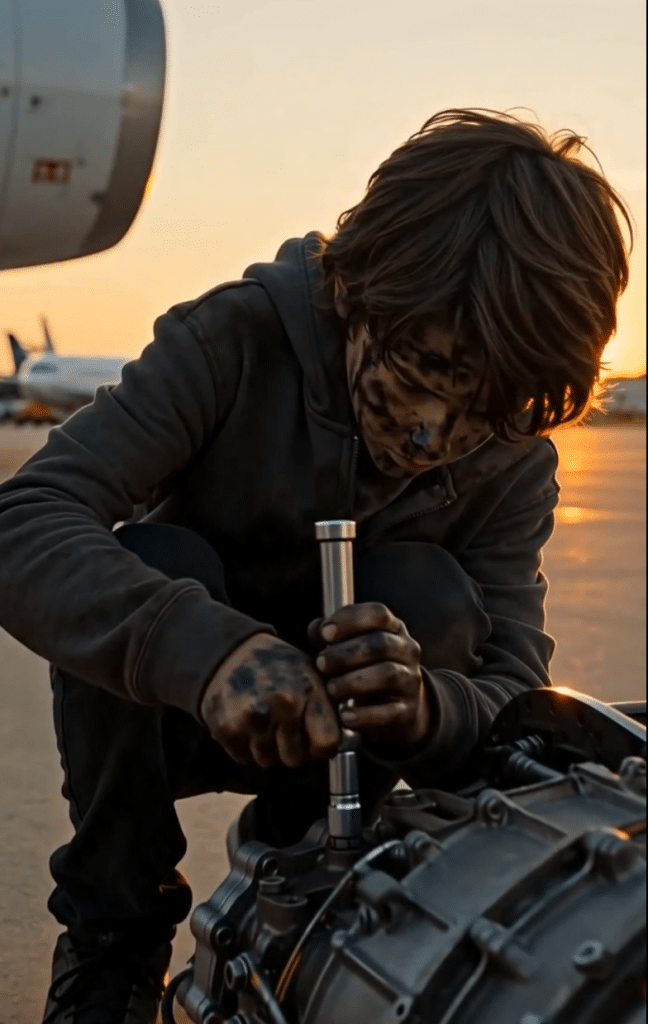
The first thing anyone noticed about the boy was the grease.
It covered his hands, stained his hoodie, smeared across his face like war paint. He looked less like a mechanic and more like a kid who had crawled out from under a machine after losing a fight with it.
But Tyler Reed never looked nervous.
Not even kneeling beside a disassembled jet engine worth more than most houses.
The airport tarmac glowed orange beneath the setting sun. Behind him, a massive passenger plane sat stranded near the hangar while ground crews rushed in nervous circles around it.
Then came the shouting.
“What the hell do you think you’re doing?!”
Victor Sterling stormed across the tarmac in a navy suit sharp enough to cut glass, followed by engineers, supervisors, and airport staff struggling to keep pace with his fury.
Tyler did not flinch.
Sterling pointed at the engine mounted on the red rolling stand.
“These parts are beyond repair! No one can fix them!”
The staff nodded nervously. The engine had failed three diagnostics already. Replacement components would take days to arrive. Hundreds of passengers were stranded. Investors were arriving tomorrow for a merger announcement Sterling could not afford to delay.
And now some filthy teenager had somehow gotten access to the damaged turbine.
Tyler slowly looked up.
Sunlight reflected in his dark eyes.
“Check them again,” he said calmly.
Sterling laughed once.
Then the engine behind Tyler started to spin.
Act II
At first, nobody moved.
The turbine blades rotated slowly, almost lazily, like the machine itself was waking up after a long sleep.
Then came the sound.
A deep mechanical thump.
Another.
Then the roar.
The engine surged alive with a blast of heat and vibration that rolled across the tarmac. Amber light glowed from inside the core as the turbine accelerated into a clean, stable rhythm.
Airport workers stared in disbelief.
One engineer nearly dropped his tablet.
Sterling stepped backward.
“That’s impossible,” he whispered.
Tyler stood up slowly, wiping grease onto the side of his hoodie.
“I fixed everything.”
The words were not arrogant.
That made them worse.
Because Tyler sounded like someone stating a fact he already knew nobody else could understand.
Sterling’s mouth hung open.
“Who are you?”
For the first time, something flickered behind Tyler’s calm expression.
Not fear.
Pain.
He held Sterling’s stare while the engine thundered behind them.
“I’m the son of—”
But he stopped himself.
And the name he almost said hit Sterling harder than if he had spoken it aloud.
Act III
Ten years earlier, Daniel Reed had been the best engineer Sterling Aeronautics ever hired.
Not rich.
Not polished.
Not politically useful.
But brilliant.
Daniel could hear problems inside engines before computers detected them. Mechanics trusted him more than manuals. Pilots requested him by name.
Sterling hated that.
Victor Sterling built companies on control, not loyalty. He liked employees who obeyed quietly and looked good in boardrooms. Daniel did neither.
Then came the accident.
A test aircraft suffered catastrophic engine failure during a demonstration flight. Two executives were injured. Investors panicked. The media demanded answers.
Sterling blamed Daniel publicly within twenty-four hours.
Negligence.
Unauthorized modifications.
Professional misconduct.
Daniel lost his job, his license, and eventually his health trying to fight the allegations.
He died three years later in a tiny rented garage, still insisting the crash had not been mechanical failure.
It had been sabotage.
Nobody listened.
Except his son.
Tyler was eleven when his father died.
And from that day forward, he rebuilt engines the way other boys played video games.
Quietly.
Obsessively.
Every ruined part became a lesson. Every scrap turbine became evidence. Every late-night repair became a conversation with the father nobody believed.
Until today.
Because the engine Tyler repaired on that tarmac was the same model involved in the crash that destroyed Daniel Reed.
And Tyler had just proven something terrifying.
His father had been right.
Act IV
The senior engineer reached the running turbine first.
He checked the diagnostics twice.
Then a third time.
His face turned pale.
“Sir…” he said slowly. “The fault pattern is gone.”
Sterling snapped, “What does that mean?”
The engineer looked toward Tyler.
“It means the damage wasn’t random.”
Silence spread through the group.
Tyler stepped closer to the engine and pointed toward a small internal assembly near the fuel regulator.
“That component was intentionally misaligned,” he said. “Same defect pattern as Flight 702.”
Sterling froze.
Nobody had mentioned Flight 702 in years.
Tyler continued calmly.
“It overheats slowly under pressure until the turbine destabilizes. Looks like natural failure unless someone knows where to look.”
One airport supervisor frowned.
“How would you know that?”
Tyler’s eyes locked onto Sterling again.
“Because my father documented it before you buried the report.”
The sunset suddenly felt colder.
Sterling’s face drained of color.
Years ago, Daniel Reed had submitted evidence claiming the crash resulted from cost-cutting substitutions in engine manufacturing. Sterling Aeronautics buried the findings because exposing them would destroy a merger worth billions.
Daniel became the scapegoat.
And Victor Sterling signed the papers personally.
Now Daniel’s son stood in front of a functioning engine proving the dead man had told the truth all along.
Sterling’s voice cracked.
“You have no idea what you’re talking about.”
Tyler reached into his backpack and removed an oil-stained notebook.
His father’s notebook.
Inside were diagrams, dates, signatures, thermal readings, and internal emails copied before Daniel lost access to company systems.
Evidence.
Enough to ruin careers.
Enough to resurrect a dead man’s name.
Tyler handed the notebook to the stunned engineer.
“My dad said eventually the engines would expose the lie themselves,” he said quietly. “He was right.”
Act V
By sunrise, federal investigators had grounded three aircraft.
By noon, financial news channels were broadcasting leaked internal reports from Sterling Aeronautics. Share prices collapsed before markets closed.
Victor Sterling resigned forty-eight hours later.
Officially for “health reasons.”
Nobody believed that either.
But none of it mattered most to Tyler.
Three weeks later, he stood in a small aviation museum beside a new exhibit.
Daniel Reed: Engineer. Innovator. Whistleblower.
For years, his father’s photograph had existed only in boxes and fading memories.
Now children stopped to read his story.
Mechanics nodded respectfully at his designs.
Pilots spoke his name without shame.
Tyler stood quietly in front of the display long after everyone else moved on.
An older mechanic approached him carefully.
“You really fixed that engine by yourself?”
Tyler shrugged slightly.
“My dad already figured it out years ago.”
The mechanic smiled.
“You know,” he said softly, “he used to say engines talk.”
Tyler looked toward the sky beyond the museum windows.
A passenger jet crossed through the orange evening light.
“Yeah,” Tyler answered. “Most people just never listened.”
For a moment, he imagined his father beside him again. Grease on his hands. Notebook under one arm. Smiling that tired, stubborn smile.
Not broken.
Not disgraced.
Finally seen correctly.
And somewhere high above the city, another engine roared cleanly through the clouds because a forgotten man’s truth survived long enough for his son to bring it back to life.