Act I
The orange juice hit the officer’s uniform like a firework.
For one bright, humiliating second, the whole banquet hall froze.
Crystal glasses rattled. A silver tray spun across the polished floor. Orange liquid splashed over a dark green military dress uniform, running down gold buttons, soaking ribbons, staining the polished perfection of a man who had arrived that night expecting applause.
The waitress stood there in horror.
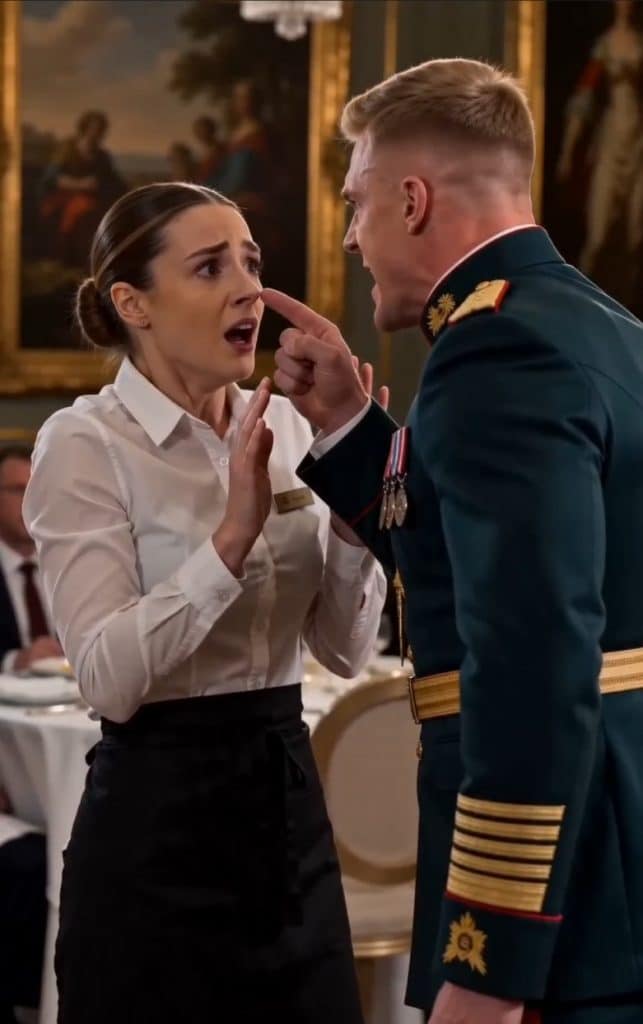
Her brown hair was pulled into a tight bun. Her white shirt was crisp, her black apron tied neatly at her waist, but her face had gone pale. She lifted both hands as if she could somehow pull the accident back out of the air.
“Oh my God,” she said, voice shaking. “I am so incredibly sorry, sir. It was a complete accident.”
The officer did not answer at first.
Captain Nolan Pierce stared down at himself.
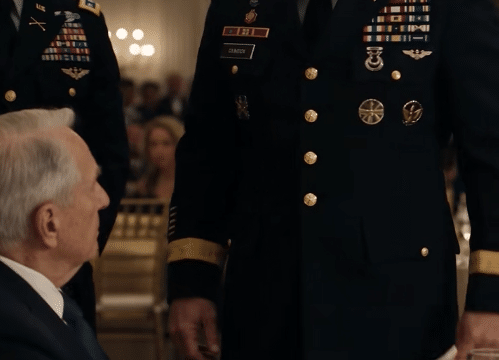
A few minutes earlier, he had been posing beneath the chandelier while donors praised his service and asked about the medals on his chest. He had smiled with that polished military stiffness that photographers loved. His blonde hair had been combed perfectly, his posture sharp, his jaw lifted just enough to look heroic without appearing vain.
Now orange juice dripped from his ribbons onto the white linen tablecloth.
Guests in tuxedos and evening gowns stared.
The waitress took one step back.
“I’ll get towels right away,” she said. “I’m so sorry.”
Pierce looked up.
His face had changed.
Not embarrassed. Not merely angry.
Insulted.
As if the spill had not touched fabric, but a throne.
“Look what you’ve done, idiot!”
The word cracked through the room.
The waitress flinched.
Around them, forks lowered. Conversations stopped. A woman near the oil painting of a hunting scene raised a hand to her mouth. A waiter by the kitchen doors froze with a tray of champagne balanced on one palm.
Pierce stepped toward the waitress and pointed a finger inches from her face.
“Do you have any idea what this uniform represents?”
The waitress swallowed. “Sir, I said I’m sorry.”
“Sorry?” He laughed once, sharp and cruel. “You think sorry fixes this?”
His hand moved before anyone understood what he meant to do.
The slap echoed beneath the chandelier.
The waitress’s head snapped to the side.
A gasp traveled through the banquet hall.
For a heartbeat, she stayed exactly that way, one hand pressed to her cheek, eyes lowered, body still as if the room had become too bright and too loud at once.
Pierce stood over her, breathing hard.
No one moved.
Not the donors. Not the restaurant manager. Not the officers seated near the head table. Everyone seemed trapped inside the same terrible hesitation, waiting for someone else to decide what kind of room they were in.
Then the waitress lowered her hand.
A single tear slipped down her cheek.
But her eyes were no longer afraid.
She inhaled slowly.
Her shoulders straightened.
The trembling stopped.
Pierce saw the change too late.
When he reached for her arm, she stepped inside his balance, gripped his lapel and collar, turned her hip, and used his own momentum against him.
The decorated officer left the floor.
His polished shoes flashed under the chandelier.
Then he landed hard on the slick marble, surrounded by spilled juice, scattered silverware, and the shattered silence of every person who had just watched a waitress fold a soldier in dress uniform like a lesson.
She dropped to one knee beside him, pinning him by the collar, her face inches from his.
Her voice came out low.
Controlled.
Final.
“Never,” she said, “ever hit a woman again.”
Captain Pierce stared up at her, stunned and breathless, all the arrogance drained from his face.
And that was when an old general at the head table stood up and whispered her name.
Act II
“Mara?”
The waitress froze.
Only for half a second.
But the old man noticed.
Everyone noticed him next.
General Thomas Waverly was eighty-one, retired, and still carried himself like command was something in the bones rather than the uniform. He had not spoken much all evening. He had sat at the head table with his hands folded over the program, watching younger men accept praise for wars he knew were never as clean as speeches made them sound.
Now he stared at the waitress as if the past had stepped out from behind a service door.
The restaurant manager finally found his courage.
“Miss Ellis,” he hissed, rushing forward, “get off him!”
The waitress released Pierce and stood.
She did not look at the manager.
She looked at the general.
Pierce rolled onto one elbow, gasping, his uniform stained and twisted. His face was flushed with humiliation now, not rage. Around him, the room remained too shocked to decide whether it had seen disgrace or justice.
The manager grabbed the waitress by the elbow.
“You’re fired,” he snapped. “Do you understand me? Fired. Get out before I call security.”
Mara Ellis pulled her arm free.
Not violently.
Just enough.
“I was defending myself.”
“You assaulted a decorated officer!”
The phrase seemed to restore Pierce.
He pushed himself up, adjusting his jacket with trembling hands. “You’re finished,” he said, voice low and venomous. “Do you know who I am?”
Mara looked at the wet ribbons on his chest.
“Yes,” she said. “That’s the problem.”
The room tightened again.
Pierce’s eyes narrowed.
General Waverly stepped away from the head table.
“Mara Ellis,” he said slowly. “Private First Class Mara Ellis. Fort Bragg. Third Training Battalion.”
Whispers rose.
The guests looked from the waitress to the general, then back again.
Mara’s jaw flexed.
“That was a long time ago, sir.”
“You were nineteen.”
“I’m twenty-four now.”
“And you were the best hand-to-hand trainee in your class.”
Pierce went still.
The manager looked suddenly uncertain.
Mara reached down and picked up the fallen silver tray. Her cheek was still red from the slap, but her voice remained steady.
“I’m not here as a soldier tonight,” she said. “I’m working.”
Pierce laughed bitterly. “You’re wearing an apron.”
Mara turned to him.
The quiet in her face was worse than anger.
“And you’re wearing medals.”
The words hit something hidden.
Pierce’s expression flickered.
Only for an instant.
But Waverly saw it.
So did a woman seated at table seven, a journalist from a veterans’ magazine who had been invited to cover the charity gala. Her pen, which had stopped moving after the slap, started moving again.
The banquet had been organized by the Sterling Foundation, a glossy nonprofit that raised money for military families. That night’s guest of honor was Captain Nolan Pierce, recipient of the foundation’s Courage Under Fire Award. The program described him as a battlefield leader, a protector of women and civilians, a man whose bravery had saved lives during a chaotic evacuation overseas.
His speech was supposed to come after dessert.
A speech about honor.
A speech about sacrifice.
A speech Mara Ellis had been listening to rehearsed all evening from behind the service station while trying not to crush a water glass in her hand.
She had not planned to spill the juice.
That part had been an accident.
But she had known Pierce would be there.
She had taken the shift because someone needed to look him in the eye before the room applauded him.
Pierce straightened, regaining his public voice.
“This woman is unstable,” he said to the room. “She was removed from service for disciplinary issues. I would be careful believing anything she implies.”
Mara’s face hardened.
There it was.
The old word.
Unstable.
A label neat enough to bury a woman with.
General Waverly turned to Pierce.
“How do you know her service record?”
Pierce’s mouth closed.
The question landed softly, but it opened a door he had not meant to unlock.
Mara looked at the general.
Then at the room.
Then she untied her black apron and laid it on the nearest table.
“If he wants to talk about my record,” she said, “we can talk about his.”
Pierce’s face went white.
Because there was one thing he had feared more than being thrown to the floor.
Being remembered by the woman he had tried to erase.
Act III
Two years earlier, Mara Ellis had believed in uniforms.
Not blindly.
Her father had been a mechanic, her mother a school nurse, and neither of them raised her to worship anyone with rank on their shoulder. But Mara believed in discipline. She believed in service. She believed that if she worked hard enough, stood straight enough, and never complained, the Army would become the first place in her life where effort mattered more than background.
She was wrong.
At nineteen, she was assigned under Captain Nolan Pierce during a joint training rotation that turned uglier after one night in a desert outpost.
Pierce was charming in front of superiors and vicious when no one important was watching. He spoke to lower-ranking soldiers as if fear were part of the chain of command. He called humiliation motivation. He called cruelty discipline. He called women distractions until he needed them to make him look fair.
Mara watched him target a young medic named Specialist Hannah Cole.
Hannah was quiet, precise, and better under pressure than most men who mocked her. She wrote everything down. Times. Orders. Missing supplies. Altered reports. When Pierce realized she was documenting him, he moved fast.
A failed inspection appeared in Hannah’s file.
Then a misconduct complaint.
Then a transfer order.
Mara went with her to report him.
The complaint disappeared.
The next week, Mara’s own file changed.
Disruptive attitude.
Failure to follow command.
Emotional instability.
The phrase was vague enough to ruin her and convenient enough to deny.
When she pushed harder, Pierce cornered her outside a barracks office and told her something she never forgot.
“People believe the uniform before they believe the girl.”
He had been right.
At least then.
Mara left the service six months later with no ceremony, no apology, and a record stained badly enough that every job interview after that felt like walking into court.
Hannah left too.
But Hannah did not go quietly.
She kept copies.
Photos. Dates. Statements. A recording of Pierce bragging that he could turn discipline into a weapon and paperwork into a grave. Most important of all, she had proof that Pierce’s decorated evacuation story was not what the foundation had been told.
He had not led the final transport.
He had delayed it.
He had ordered two junior soldiers to take responsibility for his mistake, then accepted a commendation rewritten by a colonel who owed his family money. Hannah had been one of the medics who stayed behind to fix what Pierce abandoned.
The official story made him a hero.
The real one made him a liability wearing gold epaulettes.
Hannah sent the file to Mara three weeks before the gala.
Then she disappeared from public contact, not in a dramatic way, but in the way frightened people do when they have learned systems can punish honesty faster than crime.
Mara took a waitress shift at the banquet because she needed to know whether Pierce had changed.
The slap answered that.
Now she stood in the center of the fine-dining hall, cheek still burning, while the man who destroyed two young women’s careers tried to hide behind a chest full of medals.
Pierce pointed at her.
“She’s lying.”
Mara reached into the pocket of her black trousers and pulled out a small flash drive.
Pierce stared at it.
The room seemed to lean toward her.
The journalist at table seven stood. “What is that?”
Mara looked at General Waverly.
“Evidence.”
Pierce laughed, but the sound cracked in the middle. “You brought a flash drive to a banquet?”
“No,” Mara said. “I brought it to a public lie.”
The restaurant manager backed away.
No one was asking him to fire her anymore.
General Waverly walked forward and held out his hand. “May I?”
Mara hesitated.
For the first time that night, she looked young.
Not weak.
Young.
Like someone who had carried too much proof for too long and knew evidence did not always save the person brave enough to hold it.
Then she placed the flash drive in his palm.
Pierce lunged.
He made it two steps before three men from the head table rose at once. Not bikers. Not brawlers. Retired officers in dark suits, old enough to know that panic often reveals what arrogance tries to hide.
Pierce stopped.
General Waverly looked at him.
“Captain,” he said, “sit down.”
It was not loud.
It did not need to be.
For the first time that evening, Pierce obeyed.
And Mara finally understood that the room had stopped seeing her as the waitress who spilled juice.
They were beginning to see him as the man afraid of what she carried.
Act IV
The banquet hall had a projector for the award presentation.
Ten minutes earlier, it was supposed to show a slideshow of Captain Pierce shaking hands with officials, standing beside flags, and smiling for cameras with children from military families.
Instead, General Waverly stood at the podium while Mara connected the flash drive with hands that did not shake.
Pierce sat rigidly at the front table, jaw clenched, one knee bouncing under the linen.
The first file opened.
A photograph appeared on the screen.
Not dramatic. Not graphic. Just a grainy image of a transport manifest, marked with a time stamp that contradicted the official report attached to Pierce’s award nomination.
The second file was an email.
Then another.
Then a signed statement from Specialist Hannah Cole.
A murmur spread through the room as the pieces assembled themselves into something no speech could polish.
Pierce had not saved the convoy.
He had left before the final clearance was complete.
He had let two lower-ranking soldiers absorb blame for the delay.
He had rewritten the story through channels friendly to his family.
And after Hannah Cole reported him, he had helped mark her as unfit.
Mara stood beside the screen, her cheek red under the chandelier light.
She did not look victorious.
She looked tired.
That made it worse for him.
Victory would have given Pierce something to attack. Tired truth left him nowhere to stand.
The journalist asked the first question.
“Captain Pierce, did you know these documents existed?”
Pierce stood too quickly.
“This is a smear.”
“Did you know?”
“My record speaks for itself.”
Mara looked at him.
“So did mine after you changed it.”
The room went silent.
Pierce turned on her with a flash of the same rage that had made him raise his hand.
“You don’t get to judge me.”
Mara stepped forward.
“I didn’t want to judge you,” she said. “I wanted the truth to survive you.”
He stared at her.
For a second, he looked like he might charge again.
Then he saw the phones.
Guests had begun recording. Donors. Servers. Officers. People who, minutes earlier, had been too stunned to act were now documenting every word.
Pierce’s power had always lived in private rooms.
Mara had dragged him into a public one.
General Waverly opened the last file.
Audio.
Mara closed her eyes when it began.
Pierce’s voice came through the speakers, younger but unmistakable.
People believe the uniform before they believe the girl.
No one breathed.
On the recording, Hannah Cole asked, “What happens if we keep talking?”
Pierce answered with a laugh.
You learn what a bad record can do to a good soldier.
The audio ended.
The silence afterward was colder than applause would have been.
Pierce’s face had gone slack.
General Waverly stepped away from the podium.
“I recommended this man for tonight’s award based on incomplete information,” he said to the room. “That recommendation is withdrawn.”
Pierce looked at him in disbelief.
“You can’t do that.”
“I just did.”
A woman from the Sterling Foundation rose, pale and shaken. “Captain Pierce, until these documents are reviewed, this organization will not present you with any honor tonight.”
Pierce’s voice rose. “You’re all reacting to a stunt by a disgruntled former private!”
Mara did not flinch.
She walked to the nearest table and picked up the program for the evening.
There he was on the cover.
Captain Nolan Pierce.
Courage Under Fire.
Mara tore the program once down the middle.
Not dramatically.
Not with a speech.
Just once.
Clean.
Then she placed the two halves on the table in front of him.
“Courage is what people show when you have power over them,” she said. “Not what you call yourself after they’re gone.”
Pierce’s mouth opened.
No words came.
The same guests who had stared helplessly when he struck her now watched him shrink under the weight of their attention.
Security entered through the side doors.
This time, they did not come for Mara.
They came for him.
Pierce looked at his stained uniform, at the ruined program, at the faces turned against him, and finally at the waitress he had assumed would stay small because her name tag did not outrank him.
Mara met his eyes.
She did not smile.
She did not need to.
The reversal was complete.
But the deepest wound in the room still had not spoken.
Act V
Hannah Cole arrived after the police.
No one expected her.
Mara least of all.
The banquet had already dissolved into clusters of whispered outrage and frantic phone calls. Donors demanded explanations. Foundation staff carried away the untouched award plaque. Servers moved quietly through broken glass and spilled juice, restoring order to a room that had mistaken elegance for dignity.
Mara stood near the kitchen doors with an ice pack against her cheek.
She was waiting for someone to tell her to leave.
Instead, Hannah walked in wearing a plain navy coat, her dark hair tucked behind her ears, one hand gripping the strap of her bag like she might turn around if courage gave out.
Mara saw her and forgot the room.
“Hannah.”
Hannah’s eyes moved to the mark on Mara’s face.
“He hit you?”
Mara lowered the ice pack.
“He tried to humiliate me.”
Hannah looked across the hall, where Pierce was being escorted out through a side corridor without his award, without his applause, and without the protection of silence.
“Then he picked the wrong woman.”
Mara laughed once.
It almost became a sob.
Hannah crossed the room and wrapped her arms around her.
For a moment, they were not whistleblowers or former soldiers or names in damaged files.
They were two young women who had once told the truth and paid for it alone.
Not anymore.
The story broke before midnight.
By morning, Captain Nolan Pierce’s name was everywhere. Not in the glowing profile his family had arranged. Not under the headline about a rising military star. He was now the officer who slapped a waitress, got thrown to the floor, and then watched his own record unravel beneath a chandelier.
But the viral clip was only the beginning.
The investigation widened.
Hannah’s complaint was reopened. Mara’s record was reviewed. Two officers who had signed off on the old reports were placed under inquiry. The Sterling Foundation issued a public apology to the women it had failed to contact before selecting Pierce as an honoree.
Mara did not watch most of the coverage.
She had work the next morning.
Her manager did not fire her.
He tried to apologize in his office, sitting behind a desk cluttered with reservation sheets, looking ashamed in a way that told Mara he had watched the video of himself doing nothing.
“I should have stepped in,” he said.
“Yes,” Mara replied.
He waited for her to soften it.
She did not.
Two weeks later, General Waverly invited Mara and Hannah to a closed hearing.
Mara nearly refused.
She was tired of rooms with polished tables where powerful people spoke about accountability as if it were a weather condition instead of a choice.
But Hannah wanted to go.
So Mara went with her.
This time, they were not called unstable.
This time, no one asked why they had waited.
This time, when Mara spoke, the room listened.
She did not exaggerate. She did not cry for effect. She simply told the truth in the same controlled voice she had used when she pinned Pierce to the floor.
“He believed status made him untouchable,” she said. “That belief was not his alone. People around him fed it every time they ignored what he did to someone with less power.”
Hannah testified after her.
When she finished, General Waverly removed his glasses and sat silently for a long moment.
Then he said, “We failed you.”
Hannah looked at him.
“Yes,” she said.
The honesty hurt more than anger.
That was why it mattered.
Months passed before the official letters arrived.
Mara opened hers in the back hallway of the restaurant, standing between stacked chairs and boxes of linen napkins. The letter cleared her record. The words were formal, restrained, and painfully late.
No evidence supporting prior adverse characterization.
Administrative correction approved.
Mara read it twice.
Then she sat on an overturned crate and pressed the paper to her chest.
For years, she had told herself she did not care.
That was a lie people tell when caring becomes too expensive.
Hannah received her correction the same day.
They met that evening at a small diner with chipped mugs and terrible coffee. No chandelier. No oil paintings. No polished silverware. Just two women sitting in a booth, reading proof that the thing used to bury them had finally been lifted.
“What now?” Hannah asked.
Mara looked out the window.
Across the street, a recruiting office glowed under fluorescent lights. A young woman stood outside reading a poster, her hands tucked into the sleeves of her hoodie.
Mara watched her for a long time.
Then she said, “Now we make sure girls like her know the uniform isn’t supposed to protect the man abusing it.”
A year later, Mara Ellis opened a training center three blocks from the restaurant where everything had changed.
She did not call it a gym.
She called it The Line.
On the front window, in clean white lettering, were the words:
Self-defense. Discipline. Dignity.
The first class was free for service members, veterans, restaurant workers, nurses, teachers, and anyone who had ever been told to stay quiet because someone powerful might be embarrassed.
Hannah helped run the intake desk.
General Waverly donated the mats.
The Sterling Foundation, desperate to repair its name, offered a large check. Mara accepted it on one condition: the first scholarship would be named for every woman whose complaint had been dismissed as emotional, difficult, unstable, or inconvenient.
On opening night, Mara found herself alone for a moment in the center of the room.
The mats were new. The windows were clean. The air smelled faintly of rubber, fresh paint, and possibility.
Her cheek had healed long ago.
But she could still remember the sound of that slap under the chandelier. More than the pain, she remembered the silence afterward. The terrible pause where everyone watched and waited for someone else to become brave.
That was what The Line was for.
Not revenge.
Not violence.
A place where hesitation ended.
The bell over the door rang.
A young waitress stepped inside, still wearing her black apron from a double shift, eyes nervous but determined.
“Is this the beginner class?” she asked.
Mara smiled.
“Yes.”
“I’ve never done anything like this.”
“Most people haven’t.”
The young woman glanced at the mats. “I don’t want to hurt anyone.”
Mara walked over and held out a pair of hand wraps.
“Good,” she said. “Then you’ll learn for the right reason.”
The class filled slowly.
A nurse. A college student. A veteran with quiet eyes. A mother and daughter standing close together. Hannah arrived last, carrying a box of donated gloves and laughing because she had parked badly again.
Mara stood at the front.
For a moment, the old banquet hall flashed in her mind: the spilled juice, the shattered glass, Pierce staring up at her in disbelief, the crowd finally understanding that rank was not character.
Then she looked at the women in front of her.
No one was laughing.
No one was pointing.
No one was alone.
Mara lifted her hands.
“We start with balance,” she said. “Because the first thing someone tries to take from you is your ground.”
The class listened.
Mara stepped onto the mat.
And this time, when she taught them how not to fall, the whole room stood with her.