Act I
The first sound was glass breaking.
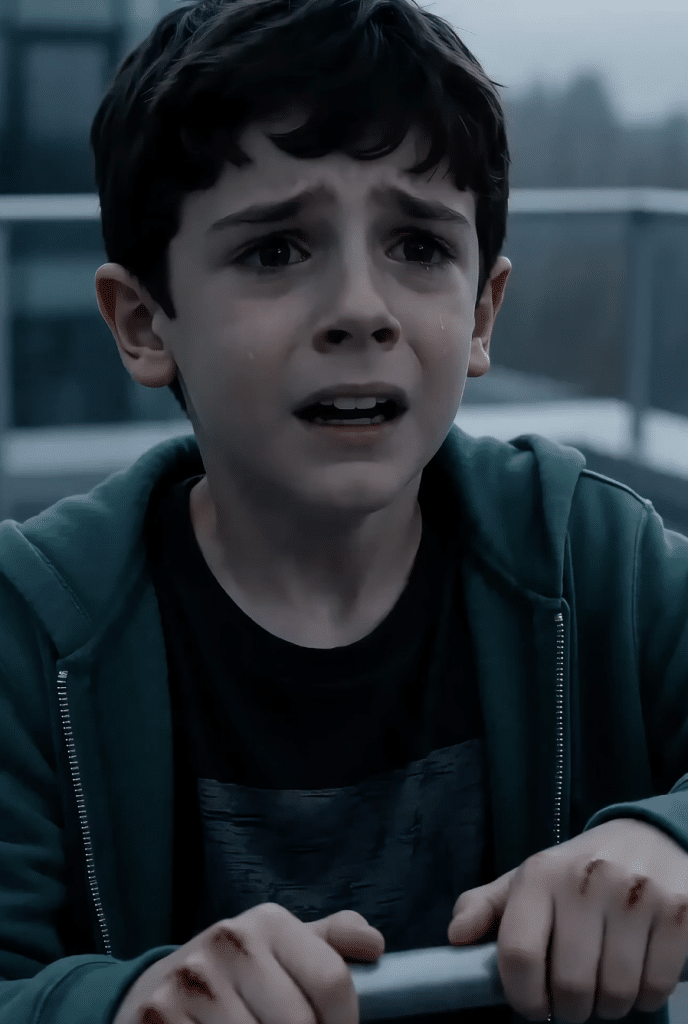
It cracked across the hospital courtyard like a gunshot, sharp enough to make a nurse on the fourth floor drop a clipboard and turn toward the window. Outside, under a gray afternoon sky, a boy in a green hoodie stood on a concrete balcony with both hands wrapped around a folded metal chair.
He was small for his age.
Too small to be swinging anything that heavy.
But fear can make a child stronger than anyone expects.
He hit the glass again.
The window shuddered.
Again.
A web of cracks spread across the pane.
Inside the building, somewhere beyond the locked corridor and the security doors, a girl was lying in a hospital bed with tubes at her arm and monitors blinking beside her head. Her name was Sophie Vale. She was eleven years old, unconscious, and everyone in the hospital had been told she might not wake up.
Caleb Moreno knew that was a lie.
He raised the chair one last time and slammed it forward.
The glass gave way.
Shards fell inward across the polished floor. Caleb dropped the chair, pulled his hood tighter, and climbed through the broken window with one desperate motion. A thin line of red appeared on his palm, but he barely looked at it.
He ran.
Down the corridor.
Past the signs.
Past the startled faces.
Past every rule adults had ever used to keep him away from the truth.
He reached Sophie’s room just as Dr. Malcolm Wren leaned over her IV line with a syringe in his hand.
The doctor was an older man with gray hair, a white coat, and the calm expression of someone used to being obeyed. Beside the hospital bed, Sophie’s father, Jonathan Vale, sat in a dark suit, one hand clasped around his daughter’s limp fingers.
He looked destroyed.
He looked like a man who had not slept in days.
He looked up only when Caleb burst through the door.
“Don’t let him put that in her IV!” Caleb shouted.
Everything stopped.
Dr. Wren froze with the syringe inches from the line.
Jonathan stood so fast his chair scraped the floor.
“What is this?” he demanded.
Caleb pointed at the doctor. His face was pale, his eyes wide, his breath coming in broken gasps.
“He’s lying to you!”
Dr. Wren recovered quickly.
That was what frightened Caleb most.
Not the shock.
The recovery.
The doctor lowered the syringe just enough to appear reasonable, then turned toward the hallway.
“Security!”
“No!” Caleb screamed.
Footsteps thundered behind him.
A security guard rushed in and grabbed Caleb from the back, pinning his arms to his sides. Caleb twisted hard, kicking at the floor, trying to keep one hand free.
In that hand was a small black recorder.
He lifted it as high as he could.
“I have proof!” he cried. “I have proof they wanna hurt her!”
The security guard tightened his grip.
Dr. Wren’s face changed.
Only for a second.
But Jonathan saw it.
The doctor was not angry anymore.
He was afraid.
Caleb shoved the recorder higher, tears streaking down his face.
“Please,” he gasped. “Please listen.”
The guard started dragging him toward the door.
Then Jonathan Vale’s voice filled the room.
“Stop!”
No one moved.
The monitor beside Sophie’s bed kept beeping.
The syringe remained in Dr. Wren’s hand.
And for the first time since Caleb had climbed through the broken glass, the adults in the room realized the boy had not come to cause trouble.
He had come too late to be polite.
But maybe not too late to save her.
Act II
Caleb Moreno had not always been the kind of boy who broke windows.
Most of his life, he tried very hard not to be noticed.
He lived three blocks from Hartwell Medical Center in a small apartment above a laundromat, where the walls shook every time the machines downstairs hit their spin cycle. His mother, Elena, used to work nights at Hartwell as a pediatric nurse. She came home exhausted, smelling faintly of antiseptic and coffee, with cartoon stickers in her pockets and stories about children who were braver than most grown-ups.
Caleb loved those stories.
He loved the hospital too, in the strange way children can love places that frighten adults. Hartwell had vending machines, warm blankets, and nurses who remembered his name. When Elena could not find childcare, he sat in the staff lounge with homework while she checked on patients.
That was how he first met Sophie Vale.
She was not sick then.
Not the way she was now.
She had been visiting the hospital after a riding accident that left her with a cast on her wrist and a bad mood. She was rich enough to have a private room, but lonely enough to sneak into the hallway looking for snacks.
Caleb found her trying to buy pretzels from a vending machine that had stolen her dollar.
“You have to hit C7 twice,” he told her.
She turned around, offended. “I know how to use a vending machine.”
“No, you know how to lose to one.”
That was the beginning.
After that, whenever Sophie came to Hartwell for follow-ups, she looked for Caleb. She told him about tutors, piano lessons, and a mansion so quiet she said it felt like a museum pretending to be a home. He told her about school lunches, his mother’s night shifts, and the neighbor downstairs who yelled at basketball games like the players could hear him through the TV.
They were not supposed to become friends.
They did anyway.
Sophie’s father, Jonathan Vale, was one of the most powerful men in the city. His name was on hospital wings, scholarship plaques, research grants, and newspaper articles about generosity. He had built a medical technology company after Sophie’s mother died, then donated millions to Hartwell in her memory.
Everyone said he was a good man.
Caleb believed them.
But good men could still be fooled.
Dr. Malcolm Wren had been at Hartwell for twenty-five years. He shook hands with donors, appeared on morning shows, and spoke with the soothing confidence of a man who understood both medicine and money. Parents trusted him because he seemed unshakable. Administrators protected him because his research brought prestige.
Elena did not trust him.
Caleb remembered that clearly.
Two years before Sophie collapsed, Elena began coming home quieter. She stopped telling hospital stories. She started writing things down in a blue notebook she hid behind the cereal boxes. Sometimes, when she thought Caleb was asleep, she sat at the kitchen table and listened to recordings on a small black device.
The same recorder Caleb was holding now.
One night, he heard her whisper into the phone, “They’re changing charts after the fact. I saw it. If anything happens to me, look at Wren.”
The next week, Elena was suspended for “misconduct.”
The hospital said she had mishandled medication logs.
Elena said they had framed her.
No one believed her loudly enough to matter.
She tried to fight it, but fighting powerful people costs money, sleep, and friends. Her health worsened under the stress. Bills piled up. The blue notebook disappeared. The recorder vanished too.
Then Elena was gone, and Caleb became a child passed between relatives who did not have room and systems that did not have time.
For almost a year, he stayed away from Hartwell.
Until Sophie found him.
She was standing outside the laundromat one rainy afternoon with a driver waiting at the curb and tears in her eyes.
“My dad says you moved,” she said.
Caleb shrugged. “People say lots of things.”
Sophie stepped closer.
“I think something’s wrong at the hospital.”
That was when Caleb learned she had been asking questions.
About his mother.
About Dr. Wren.
About an old research program connected to her mother’s death.
Sophie had access to places Caleb did not. Her father’s name opened doors. Her curiosity slipped through them. She found files, emails, and a billing record that should not have existed. She copied what she could. Then, three days later, Sophie Vale collapsed during a charity event at Hartwell.
Dr. Wren called it a sudden neurological crisis.
Caleb called it timing.
And when adults told him to stay away, he did exactly what children do when no one listens.
He came back through the only door no one expected him to use.
But the recorder in his hand held more than one secret.
Act III
Jonathan Vale stared at the boy in the green hoodie as if the room had split open.
“Let him go,” he said.
The security guard hesitated.
Dr. Wren turned sharply. “Mr. Vale, this child broke into a restricted hospital area.”
Jonathan did not look at him.
“I said let him go.”
The guard released Caleb.
Caleb stumbled forward, nearly falling. His chest rose and fell too fast, but he kept the recorder clutched in both hands.
Jonathan took one step toward him.
“What proof?”
Caleb looked at Sophie.
Her face was still. Too still. Her dark hair spread across the pillow, her skin pale beneath the hospital lights. She had once told Caleb she hated being treated like glass.
Now everyone in the room was speaking over her like she was already gone.
Caleb held out the recorder.
“Press the red button.”
Dr. Wren moved.
It was small. Just a shift of his shoulder, a step forward, a doctor reaching as if to calm a frightened boy.
Jonathan saw it and stepped between them.
“Don’t.”
Dr. Wren’s mouth tightened.
Caleb’s thumb shook as he pressed play.
At first, there was only static.
Then voices.
Not clear at first.
A door closing.
Footsteps.
Then Dr. Wren’s voice, lower than it had sounded in the room.
“The girl found the archived consent forms.”
A woman answered. “How much did she see?”
Caleb watched Jonathan’s face change.
He knew the woman’s voice.
Everyone in Jonathan Vale’s world knew it.
Marissa Vale.
Jonathan’s second wife.
Sophie’s stepmother.
Dr. Wren’s recorded voice continued. “Enough to become a problem if she wakes up and repeats it.”
Marissa said, “Then make sure she doesn’t.”
Jonathan went white.
The room seemed to shrink around the hospital bed.
Dr. Wren said sharply, “That recording is fabricated.”
Caleb shouted, “No, it’s not!”
Jonathan raised one hand, silencing them both.
The recorder kept playing.
Marissa’s voice again. “Once Jonathan signs the expanded grant, Hartwell gets its funding, you get your trial, and I get control of Sophie’s trust until she’s declared permanently incapacitated. No more surprises.”
Dr. Wren replied, “The next IV protocol will keep her unresponsive long enough for the petition.”
Caleb looked at Sophie’s father.
“That’s what he was putting in her,” he said.
Dr. Wren’s expression hardened. “This is absurd. Mr. Vale, your daughter’s condition is complex. That medication is part of an approved treatment plan.”
“Approved by whom?” Jonathan asked.
“By her care team.”
“Who signed it?”
Dr. Wren said nothing.
Jonathan looked toward the clipboard on the counter.
Caleb saw the doctor’s eyes flick to it.
So did Jonathan.
He crossed the room and picked it up.
For a moment, he only scanned the top page.
Then his hand tightened.
Because there, on the authorization line, was Jonathan Vale’s signature.
Or something pretending to be it.
“I never signed this,” he said.
Dr. Wren’s calm cracked.
“Your office sent authorization.”
“My office did not send my hand.”
The security guard shifted uneasily near the door.
Caleb felt dizzy. Now that the recorder had played, now that the words were out, his body seemed to remember he had climbed through broken glass and sprinted through half a hospital. But he could not sit down. Not yet.
Jonathan turned to him.
“How did you get this?”
Caleb swallowed.
“Sophie hid it.”
Jonathan’s eyes moved to his daughter.
“She was awake?” he whispered.
Caleb nodded.
“Yesterday morning. Just a little. She called me from a blocked hospital phone. She said she heard them outside her room. She said they were going to make her look worse.” His voice cracked. “She said nobody would believe her because she was just a kid.”
Jonathan closed his eyes.
The words hit him harder than the recording.
Because Sophie had once said the same thing to him.
Nobody listens when you’re little.
He had told her that was not true.
Then he had proven it was.
Caleb reached into the front pocket of his hoodie and pulled out a folded piece of paper.
“She gave me this before she passed out again. A nurse helped her hide it under the pillow.”
Jonathan took it.
It was Sophie’s handwriting.
Messy.
Weak.
But unmistakably hers.
Dad,
Don’t trust Dr. Wren. Don’t trust Marissa. Ask what happened to Caleb’s mom. Ask why Mom’s files were sealed. I heard them say I know too much.
Please believe me.
Jonathan pressed the paper to his mouth.
Dr. Wren took one step back.
That was when the monitor beside Sophie’s bed changed rhythm.
Everyone turned.
Sophie’s fingers moved.
And the girl everyone had been speaking around began fighting her way back to the surface.
Act IV
Jonathan reached the bed before anyone else.
“Sophie?”
Her eyelids fluttered.
The room held its breath.
Caleb took one step forward, then stopped, afraid that moving too close might break the moment. The security guard stood frozen. Even Dr. Wren looked at the monitor as if it had betrayed him.
Sophie’s eyes opened halfway.
Unfocused at first.
Then searching.
“Dad?” she whispered.
Jonathan bowed over her hand.
“I’m here. I’m right here.”
Her gaze drifted past him.
“Caleb?”
Caleb let out a sound that was almost a sob.
“I told them,” he said. “I played it.”
Sophie’s lips trembled.
“I knew you would.”
Dr. Wren spoke quickly. “This patient is unstable. Everyone needs to leave so I can assess—”
Jonathan turned on him.
“You are done speaking near my daughter.”
The doctor straightened. “You are making a catastrophic mistake.”
“No,” Jonathan said. “I made one already.”
He picked up the call button, then looked at the security guard.
“Get the hospital director. Now. And call the police.”
The guard stared at him, unsure which authority mattered most.
Jonathan’s voice dropped.
“Now.”
The guard ran.
Dr. Wren began gathering papers from the counter, but Caleb saw his hand slip toward his coat pocket.
“Don’t let him take anything!” Caleb shouted.
Jonathan moved fast, knocking the papers from Wren’s grip.
The doctor’s face flushed with anger.
“You have no idea what you’re destroying,” Wren snapped. “This hospital survives because people like you fund people like me. Your wife understood that.”
Jonathan went still.
“My wife?”
Wren’s mouth closed.
Too late.
Sophie’s eyes filled with tears.
“She found out,” she whispered. “My mom found out before she died.”
Jonathan turned slowly toward the doctor.
“What did Elizabeth find?”
Wren said nothing.
But Sophie did.
“She found the trial records. The ones that said patients had bad reactions before they told families it was safe.” Her voice was faint, but every word landed. “Mom wanted to stop the grant.”
Jonathan looked as if he had been struck.
For years, he had believed his first wife’s death had been a tragedy of illness and timing. A cruel turn in a life already touched by loss. He built wings in her name. Funded studies in her memory. Trusted the man who had stood beside her hospital bed and called himself helpless.
Now he saw the shape of the cage.
Elizabeth Vale had not died with all the answers hidden from everyone.
She had tried to reveal them.
And the people who profited from silence had waited until her daughter started asking the same questions.
The hospital director arrived with two administrators and another doctor behind him. Their faces carried the stiff panic of people realizing a scandal had outrun their ability to manage it quietly.
Jonathan handed over the forged authorization.
Then the recorder.
Then Sophie’s note.
“I want an independent physician in this room,” he said. “I want Dr. Wren removed from my daughter’s care. I want every medication order preserved. And I want police here before anyone touches a file.”
The director opened his mouth.
Jonathan cut him off.
“This is not a donor request. This is a father warning you that if one record disappears, I will spend the rest of my life making sure the world knows this hospital tried to bury a child.”
No one argued after that.
Dr. Wren was escorted from the room ten minutes later.
He did not look at Caleb as he passed.
But Marissa Vale arrived before the police did.
She walked into the corridor wearing a cream coat and dark sunglasses, her hair smooth, her expression arranged into concern. Then she saw Jonathan standing outside Sophie’s door with the recorder in his hand.
For the first time, Marissa looked uncertain.
“Jonathan,” she said softly. “What happened?”
He studied her face.
This was the woman who had held his hand at charity dinners. The woman who had decorated Sophie’s room while pretending to care what color she liked. The woman who told him grief made him suspicious when Sophie complained that Marissa went through her drawers.
“Your voice is on the recording,” he said.
Marissa’s eyes flicked toward the device.
Then toward Caleb.
That one glance told Jonathan everything.
Not shock.
Recognition.
Hatred.
“You’re going to believe some street kid over your wife?” she asked.
Caleb flinched.
Jonathan did not.
“I believed the wrong person once today,” he said. “I’m done.”
Marissa’s soft expression vanished.
“You have no idea what I kept from collapsing.”
“My family?”
“Your empire,” she snapped. “Your reputation. Your precious Elizabeth’s charity wing. You think people donate to grief? No. They donate to miracles. Wren gave you miracles.”
“He gave me lies.”
“He gave you a legacy.”
Jonathan looked through the glass at Sophie, pale but awake, holding Caleb’s hand while the new doctor checked her monitor.
“No,” he said. “That is my legacy.”
Police officers stepped out of the elevator.
Marissa turned to leave.
But Caleb lifted the recorder again.
“There’s more,” he said.
Marissa stopped.
Caleb looked at Jonathan.
“My mom recorded him too.”
And suddenly, the case was no longer only about Sophie Vale.
It was about every child and every family who had ever been told not to question the man in the white coat.
Act V
By nightfall, Hartwell Medical Center no longer looked untouchable.
Police moved through its corridors with sealed evidence bags. Administrators whispered behind glass doors. Reporters gathered outside beneath umbrellas, their cameras pointed toward the glowing entrance of the hospital wing Jonathan Vale had paid for in his dead wife’s name.
Inside Sophie’s room, the lights were dimmed.
For the first time in days, the room felt like a place where healing might happen.
Sophie was still weak. Her voice came and went. Her body had been pushed too hard by people who saw her as an obstacle, not a child. But she was awake, and every time her eyes opened, Jonathan was there.
So was Caleb.
He sat in the chair beside her bed with a bandage around his palm and a blanket around his shoulders. A nurse had tried to convince him to eat. He had refused until Sophie opened one eye and told him he looked like a haunted raccoon.
Then he ate two packs of crackers out of spite.
Jonathan watched them from the doorway.
He had spent years believing protection meant wealth, private rooms, trusted specialists, and locked doors. But the person who saved his daughter had come in through a broken window wearing a hoodie and carrying an old recorder.
A boy no one invited.
A boy no one believed.
A boy whose mother had tried to warn them before any of this reached Sophie’s bed.
Later that night, Jonathan sat with Caleb in a quiet family room while detectives listened to Elena Moreno’s old recordings.
Caleb stared at the floor the entire time.
On the tape, Elena’s voice was steady, though tired.
“This is Nurse Elena Moreno. I am recording this because the internal reports are being altered. Patient reactions are being minimized. Families are not being told the truth. Dr. Wren knows. Administration knows. If I lose my job after filing this, that is not a coincidence.”
Caleb’s face crumpled.
Jonathan felt something inside him crack open.
“Your mother was brave,” he said.
Caleb wiped his face with his sleeve. “They said she lied.”
“She didn’t.”
“Nobody helped her.”
Jonathan had no defense.
Only shame.
“No,” he said quietly. “They didn’t.”
Caleb looked at him then, angry in the way children become angry when grief has had nowhere safe to go.
“You had money. You had lawyers. People listened to you. Why didn’t you ask questions?”
Jonathan accepted the blow because it was deserved.
“Because I trusted the wrong people,” he said. “Because I was afraid of finding out my wife’s death meant something uglier than loss. Because it was easier to build a wing in her name than to ask why she died in one.”
Caleb looked away.
“That doesn’t fix my mom.”
“No,” Jonathan said. “It doesn’t.”
For a while, neither spoke.
Then Jonathan placed a business card on the table.
Not his corporate card.
A private one.
“I’m reopening every case connected to Wren’s program,” he said. “Your mother’s first. I’ll pay for independent counsel. Not mine. Yours. Someone who answers to you.”
Caleb stared at the card.
“I’m a kid.”
“I know.”
“Kids don’t get lawyers.”
“They do when adults finally do what they should have done before.”
Caleb’s eyes filled again, but he did not cry this time.
He just nodded once.
Dr. Malcolm Wren was arrested two days later.
Not in handcuffs on live television, not in some dramatic hallway scene, but quietly, outside a conference room where he had spent years convincing people that his reputation was evidence of innocence. When detectives walked him past the nurses’ station, no one applauded.
No one needed to.
The silence was enough.
Marissa Vale’s arrest came the next morning after investigators found emails, forged documents, and financial agreements connecting her to the petition for Sophie’s medical guardianship. Her plan had been simple in the way cruel plans often are.
Keep Sophie silent.
Control her trust.
Protect the research empire before it collapsed.
But Sophie had woken up.
Caleb had listened.
And a recorder small enough to fit in a child’s hand had carried the truth farther than power could reach.
Weeks passed before Sophie could leave Hartwell.
When she did, she refused the wheelchair until her doctor gave her a look so stern even Jonathan stepped back. Caleb walked beside her, hands in the pockets of his green hoodie, pretending not to worry every time the wheels bumped over a seam in the floor.
At the hospital entrance, cameras waited.
Jonathan had prepared a statement.
Then Sophie tugged his sleeve.
“Can Caleb say something?”
Caleb’s eyes went wide. “No.”
Sophie smiled faintly. “You broke a window. You can talk into a microphone.”
“That’s different.”
“How?”
“The window didn’t ask questions.”
For the first time in weeks, Jonathan laughed.
Not loudly.
Not easily.
But honestly.
In the end, Caleb did step forward. He stood in front of a dozen cameras, smaller than every adult around him, and held his mother’s recorder in both hands.
“My mom told the truth,” he said. “Sophie told the truth. People just didn’t want to hear it.”
He looked down, then back up.
“So maybe listen sooner next time.”
That was all.
It was enough.
The lawsuits came later. The hearings. The resignations. The sealed files opened in court. Families who had been dismissed for years finally received calls from attorneys instead of condolences wrapped in hospital language.
Elena Moreno’s name was cleared.
A scholarship for pediatric nurses was created in her honor, but Caleb refused to let them put it under Hartwell’s control. Jonathan agreed without argument.
Sophie recovered slowly.
Some days were good. Some days she got tired halfway through breakfast and cried because being brave had not made her body heal faster. Caleb visited after school with homework he pretended was urgent and snacks he smuggled in even though everyone knew.
Jonathan learned to knock before entering his daughter’s room.
He learned to ask what she wanted.
He learned that believing a child did not mean smiling at their stories when they were cute. It meant listening when their fear made adults uncomfortable.
One afternoon, months after the window shattered, Jonathan took Sophie and Caleb back to the hospital courtyard.
The broken glass had been replaced.
The balcony had been repaired.
A new security camera had been installed above the window, angled exactly where Caleb had stood with the chair in his hands.
Caleb looked at it and winced. “Am I still in trouble for that?”
Jonathan glanced at the window.
Technically, yes.
Morally, no.
Instead of answering, he handed Caleb a small envelope.
Inside was a photo.
Elena Moreno in her nurse uniform, standing beside Elizabeth Vale at a hospital fundraiser years earlier. Both women were smiling. Both looked younger. Between them was a little girl in a blue dress.
Sophie.
Caleb stared at it.
“My mom knew her?”
Jonathan nodded. “Your mother helped care for Sophie when she was little. Elizabeth trusted her.”
Caleb touched the edge of the photograph.
For a moment, he looked younger than twelve.
Sophie leaned over from her wheelchair. “So we were basically supposed to be friends.”
Caleb sniffed. “That is not how friendship works.”
“It is now.”
He rolled his eyes, but he put the photo carefully in his pocket.
The sky above the courtyard was no longer gray. Sunlight touched the hospital glass, turning the windows gold.
Jonathan looked at the repaired pane and thought about how close he had come to losing his daughter because he trusted credentials more than courage.
Then he looked at Caleb.
A boy with a scar healing on his palm.
A boy who had been called trouble because he refused to be silent.
A boy who had carried his mother’s truth through a locked hospital and placed it in front of the only person powerful enough to act.
Jonathan crouched so they were eye level.
“I’m sorry no one listened before,” he said.
Caleb shrugged, but his chin trembled.
“Yeah.”
“I’m listening now.”
Caleb looked at Sophie.
Then at the window.
Then back at Jonathan.
“Good,” he said. “Because I’m not breaking another one.”
Sophie laughed so hard she had to lean back in her chair.
Caleb smiled despite himself.
And for a moment, the hospital behind them was not a fortress of secrets.
It was just a building.
Glass could be replaced.
Records could be reopened.
Names could be cleared.
And a girl who was never supposed to wake up could sit in the sunlight with the boy who refused to let the world look away.