Act I
The baby was almost at the elevator when Noah found her.
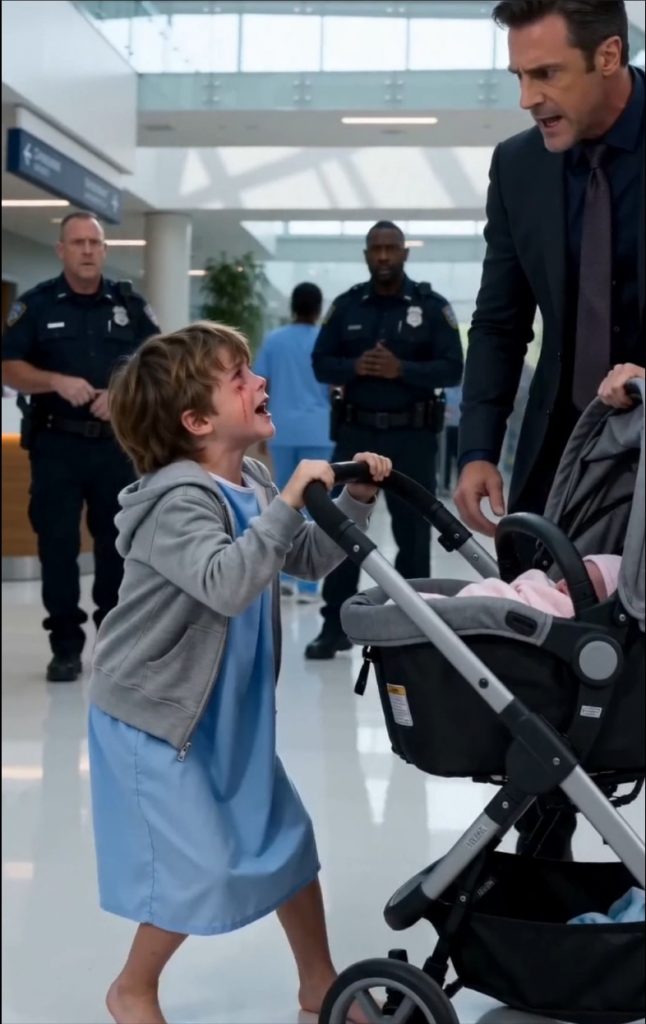
He came running down the hospital corridor barefoot, his gray hoodie hanging open over a pale blue gown, his small feet slipping on the polished white floor. His hair was tangled from sleep. His cheeks were wet. One of his hospital socks was missing, and his wristband flashed under the fluorescent lights as he reached the maternity lobby.
“Don’t take her!”
The scream cracked through the air so sharply that everyone turned.
A tall man in a black business suit froze beside a stroller. His hand tightened around the handle. Next to him, a woman in a cream suit clutched the side of the stroller with both hands, her pearl earrings trembling as she looked toward the boy.
Inside the stroller, wrapped in a soft pink blanket, was a newborn girl.
Noah lunged for the handlebar.
The businessman moved first.
“Let go of the baby!” he barked.
But Noah held on with both hands.
His knuckles turned white. His face twisted with terror, but he planted his bare heels against the floor and pulled backward with everything his thin little body had left.
“That’s my sister!”
The woman in cream went pale.
The businessman leaned down until his face hovered above Noah’s.
“This child is confused,” he snapped, loud enough for the lobby to hear. “He doesn’t know what he’s saying.”
Noah sobbed harder.
“She’s my sister!”
The maternity reception area, usually quiet except for soft announcements and rolling carts, had become a stage for something no one understood. Nurses stopped mid-step. A father holding flowers lowered them slowly. Two security guards exchanged uncertain glances near the glass railing.
The businessman pointed at Noah.
“Get him away from us.”
The woman in cream looked around as if waiting for someone to rescue her from the attention. But she did not let go of the stroller.
Noah did.
A nurse in blue scrubs pushed through the gathering crowd.
Her name badge read: Elena Morris, RN.
She did not rush at the boy. She did not grab him. She knelt in front of him, lowering herself until her eyes were level with his.
“Noah,” she said softly.
His eyes widened.
She knew his name.
The businessman stiffened.
Nurse Elena’s gaze flicked to his hospital bracelet, then to the stroller.
“Can I see your wrist?”
Noah nodded, shaking.
The businessman stepped forward.
“There’s no need for that.”
Elena ignored him.
She lifted Noah’s trembling wrist and read the white plastic band. Then, slowly, carefully, she reached into the stroller and lifted the newborn’s tiny arm from beneath the pink blanket.
The same last name.
The same maternity ward code.
The same mother.
The lobby went silent.
Noah looked up at her, his voice barely more than a whisper.
“I told you she’s my sister.”
Elena rose to her feet and stepped between the boy and the couple.
Her face changed completely.
The softness was gone.
“Nobody touch this boy.”
And for the first time, the businessman looked afraid.
Act II
Noah Reed had been in room 412 for three days.
He hated the hospital smell, the machines, and the way adults lowered their voices whenever they walked past his door. He hated how everyone smiled too carefully, like they were trying to hold something broken together with their teeth.
But most of all, he hated waking up without his mother.
His mother, Mara Reed, had arrived at St. Catherine’s Hospital in the middle of a thunderstorm. She was only thirty-one, widowed for two years, and already exhausted from working double shifts at a bakery while raising Noah alone.
The baby had come early.
Noah remembered the rush of nurses. The wheelchair. His mother gripping his hand and trying to smile through the pain.
“You’re going to be a big brother tonight,” she whispered.
He had nodded very seriously because he had practiced for months.
He knew how to hold a bottle. He knew babies needed their heads supported. He knew his sister’s name because he had helped choose it.
Lily.
His mother said the name sounded like something that could still bloom after a storm.
Then everything became confusing.
There were bright lights. A nurse guiding Noah into a waiting room. A doctor saying his mother needed rest. Later, someone told him the baby was healthy, but his mother had to stay in recovery longer.
Noah waited in the pediatric observation room because he had developed a fever from the same infection his mother had been fighting. He was not dangerously ill, they said. Just tired. Just monitored.
But Noah was old enough to know when adults were hiding worry.
He was also old enough to listen.
On the second night, he heard two nurses whispering near the door.
“Reed baby is in nursery bay six.”
“Is the mother awake?”
“Not fully.”
“What about the boy?”
“Poor thing keeps asking for his sister.”
Noah did keep asking.
Every time someone came in with juice or a thermometer, he asked, “Can I see Lily?”
Every time, they said soon.
Then, on the third morning, he woke to voices outside his room.
Not nurse voices.
A man’s voice.
Cold. Impatient.
“The paperwork has been signed. We’re leaving now.”
A woman answered, shaky but determined.
“What if someone checks?”
“They won’t. The mother can’t object, and the boy is just a child.”
Noah sat up.
His fever had broken in the night, but his body still felt weak. The hallway outside his room glowed bright and empty. He slid out of bed, pulled his hoodie over his hospital gown, and followed the voices.
He saw them near the maternity doors.
The man in the black suit.
The woman in cream.
The stroller.
He had only seen Lily once through the nursery glass, but he knew the pink blanket. He knew the tiny knitted cap their neighbor Mrs. Alvarez had made. And when the blanket shifted, he saw the small red birthmark near the baby’s left ear.
His mother had kissed that mark through tears.
“My little Lily,” she had whispered.
So Noah ran.
He did not think about security. He did not think about adults telling him to behave. He did not think about how small he was compared with the man pushing the stroller.
He only thought one thing.
They were taking his sister.
Now, in the lobby, Nurse Elena stood like a wall in front of him.
The businessman’s jaw tightened.
“This is absurd,” he said. “My wife just delivered a baby. We have discharge authorization.”
Elena looked at the woman in cream.
“Mrs. Whitaker,” she said, “where is your hospital bracelet?”
The woman’s eyes darted toward her husband.
“She removed it,” he said quickly. “It was irritating her skin.”
Elena’s gaze sharpened.
“Patients are not discharged from maternity without matching bracelets verified at exit.”
The businessman smiled, but it was thin.
“Then perhaps your staff made a mistake.”
At that exact moment, a code alert sounded softly from the maternity desk.
Not loud.
Not dramatic.
Just three quiet tones and a blinking red message on the reception monitor.
Infant security tag mismatch.
Elena turned her head toward the screen.
The businessman saw it too.
And his hand slid away from the stroller.
Act III
The security guards moved closer.
The woman in cream began to breathe too fast.
“I told you,” she whispered to her husband. “I told you this wouldn’t work.”
He snapped his head toward her.
“Stop talking.”
Noah hid behind Elena’s arm, but he did not let go of the stroller. One tiny hand remained locked around the handle as if his grip alone could keep Lily in the world where she belonged.
Elena kept her voice calm.
“Step away from the baby.”
The businessman’s face hardened.
“You have no authority to accuse us of anything.”
“I have authority to protect a newborn in my ward.”
“This is defamation.”
“This is a hospital lobby.”
The answer was so steady that the guests around them seemed to breathe again.
Behind the reception desk, another nurse was already calling the maternity supervisor. A security guard blocked the elevator. The second moved toward the main doors.
The woman in cream looked down at the baby, and something like grief crossed her face.
Not guilt exactly.
Something more tangled.
Longing twisted into panic.
Elena noticed.
So did Noah.
“Why does she have Lily?” he asked.
No one answered.
The businessman raised his voice again.
“This boy is sick. He wandered out of his room. He saw a baby and made up a story.”
Elena held up Noah’s wristband.
“He did not make up the matching ID.”
“Bracelets can be wrong.”
“Not both bracelets, the nursery code, the baby’s security tag, and the mother’s chart.”
The businessman went still.
For the first time, the elegant woman let go of the stroller with one hand and covered her mouth.
Elena turned to the reception desk.
“Call Dr. Patel. Wake Mara Reed if she is stable. And lock down all maternity exits.”
At the sound of his mother’s name, Noah looked up.
“Mommy’s awake?”
Elena’s face softened, but only for him.
“She’s waking up, sweetheart.”
The businessman’s eyes narrowed.
That was when Elena realized he recognized Mara’s name.
Not from paperwork.
From memory.
She studied him more closely.
The expensive suit. The watch. The calm arrogance beginning to crack at the edges. She had seen him before, though not in person.
On the donor wall outside the neonatal unit.
Julian Whitaker.
CEO of Whitaker Biomedical.
Major hospital benefactor.
His wife, Claire, had been admitted two floors above under a private obstetric team. Elena remembered the whispers among staff. Stillbirth. A devastating delivery. No announcement. No visitors allowed.
Her stomach tightened.
She looked at the baby again.
Then at Claire.
Claire’s eyes were filled with tears now, but she still said nothing.
Julian saw Elena understand.
“You have no idea what you’re interfering with,” he said.
Elena stepped closer, lowering her voice.
“I know exactly what I’m interfering with.”
His expression turned cold.
“My wife lost her child this morning.”
The words made several bystanders gasp.
Claire flinched as if he had struck a bell inside her chest.
Elena’s face remained steady, but her voice lowered.
“I am sorry for your loss.”
Julian leaned in.
“Then show some compassion.”
“No,” Elena said. “Compassion does not mean handing you someone else’s baby.”
Claire broke.
A sob escaped her before she could stop it.
Julian turned on her. “Claire.”
She shook her head.
“I can’t,” she whispered. “I can’t do this.”
The lobby changed again.
People who had been watching a confrontation now realized they were witnessing something far worse. Not a misunderstanding. Not a confused child.
A theft dressed in grief.
Noah’s hand tightened around the stroller.
Elena crouched briefly beside him.
“You did the right thing,” she whispered.
His lips trembled.
“Are they going to give her back?”
Elena looked at the baby, at the guards, at the man who thought money could bend reality around him.
“Yes,” she said. “They are.”
But Julian Whitaker had not built his life by losing quietly.
Act IV
The maternity supervisor arrived with two more nurses and a hospital administrator whose face had gone as white as her coat.
Behind them came Dr. Patel, still wearing surgical scrubs, his eyes sharp with alarm.
“What happened?” he asked.
Elena handed him the bracelets.
He read them once.
Then again.
His expression darkened.
“This baby is Lily Reed.”
Julian laughed, but there was no humor in it.
“You’re all making a very serious mistake.”
Dr. Patel looked at him.
“No, Mr. Whitaker. You are.”
The administrator swallowed hard. Everyone in the hospital knew the Whitaker name. His donations had renovated the west wing. His company supplied equipment to three departments. His wife’s suite upstairs cost more per night than most families made in a month.
But Lily Reed had a bracelet.
And Noah Reed had a voice.
That was enough.
“Security,” Dr. Patel said, “remove Mr. Whitaker from the stroller.”
Julian lifted his hands, finally understanding the optics of fighting in front of witnesses.
Claire stepped back first.
The moment she did, Noah pulled the stroller closer to Elena, tears pouring down his face again.
The baby stirred beneath the pink blanket.
A tiny sound rose from her.
Noah looked down.
“Hi, Lily,” he whispered.
His voice broke everyone who still had a heart in that room.
Claire covered her face and turned away.
Julian pointed at her.
“She is unwell,” he said quickly. “She is grieving. She didn’t know what she was doing.”
Claire lowered her hands.
For the first time, she looked at him with something stronger than fear.
“You said Mara agreed.”
The words struck the lobby like a dropped tray.
Julian’s head snapped toward her.
Claire’s voice shook, but she kept speaking.
“You said the mother couldn’t care for the baby. You said she had signed a private placement. You said the boy was being taken by relatives.”
Elena’s eyes narrowed.
Dr. Patel looked toward the administrator.
“There is no private placement in Mara Reed’s chart,” he said.
Julian’s face flushed.
“She was going to sign.”
Claire stared at him.
“She was unconscious.”
The lobby went silent again.
Noah looked confused, too young to understand every word, old enough to feel the danger.
Elena placed a hand on his shoulder.
Julian’s mask finally cracked.
“You don’t understand what I’ve lost,” he said, voice rising. “You don’t understand what my wife has endured. Years of treatments. Years of failures. We finally had a child, and then—”
He stopped himself before the pain could make him human.
Then his eyes moved to the stroller.
“And this baby’s mother has nothing.”
Elena’s face hardened.
Noah whispered, “We have Mommy.”
Julian looked down at him.
For one terrible second, all his power had no answer for a barefoot boy in a hospital gown.
Then an elevator opened behind the reception desk.
A bed was wheeled slowly into the lobby by two nurses.
Mara Reed lay propped against pillows, pale and exhausted, one hand pressed weakly against the blanket over her stomach. Her hair was damp at her temples. Her eyes searched the room in panic until they found Noah.
Then the stroller.
“My baby,” she whispered.
Noah ran to her, stumbling into the side of the bed.
“Mommy! I stopped them!”
Mara reached for him with trembling arms.
He climbed carefully against her, sobbing into her shoulder.
Dr. Patel lifted Lily from the stroller with practiced gentleness and placed the newborn against Mara’s chest.
The moment Lily touched her mother, Mara closed her eyes and began to cry.
Not loudly.
Not theatrically.
Just a broken, silent release from a woman who had woken to discover the world had nearly stolen her child.
Noah pressed his hand lightly over the baby’s blanket.
“I told them,” he said. “I told them she was mine.”
Mara kissed his hair.
“My brave boy.”
Across the lobby, Claire Whitaker stared at them.
Her grief was written openly now, no longer hidden behind pearls and cream tailoring. She looked at Lily in Mara’s arms, then at Noah clinging to his mother, and something inside her surrendered.
She turned to the security guards.
“I’ll tell them everything.”
Julian stared at her.
“Claire.”
She did not look at him.
“I will tell them everything.”
And for the first time that morning, it was not Noah who refused to let go.
It was Claire.
Act V
The police arrived within minutes.
Not with sirens screaming through the maternity ward, but quietly, professionally, with questions and notebooks and the kind of seriousness that made the hospital lobby feel smaller.
Julian Whitaker tried to speak first.
He always had.
But Claire spoke louder.
She told them about the private suite upstairs. About the loss of her baby before dawn. About Julian disappearing for nearly an hour, then returning with papers and a plan already in motion.
He told her there was another mother who could not manage two children.
He told her the woman had no money, no husband, no support.
He told her the paperwork would be handled discreetly.
And because Claire was drowning in grief, because she wanted to believe the impossible could be softened by wealth, she had followed him down the elevator and placed her hands on a stroller that did not belong to her.
“I knew something was wrong,” she said, crying quietly. “I knew it when I saw the boy. I just didn’t want to know.”
Julian denied everything until the administrator produced the discharge forms.
Mara Reed’s signature had been forged.
The nurse listed as witness was not on shift.
The private transfer authorization used an outdated hospital seal.
Julian’s money had opened doors, but arrogance had made him careless.
By evening, the story had spread through the hospital without anyone needing to name it. Nurses spoke softly in medication rooms. Security guards checked every exit twice. Administrators who had once smiled too quickly at donors began asking uncomfortable questions about who had access to maternity records.
But in room 412, the world became small again.
Mara lay with Lily sleeping against her chest. Noah sat beside them in bed, wrapped in a warm blanket, his bare feet tucked under him. Nurse Elena brought him pudding from the staff refrigerator and pretended not to notice when he ate two cups.
“You saved her,” Mara whispered.
Noah shook his head seriously.
“Elena helped.”
Elena smiled from the doorway.
“Noah told the truth. That was the hardest part.”
Mara looked at the nurse, and no words seemed big enough. So she simply reached out.
Elena took her hand.
The days after were not easy.
Mara still had healing to do. Noah still woke from nightmares, reaching for Lily’s bassinet to make sure it was there. The hospital arranged counseling, legal support, and a patient advocate who promised Mara that no donor, no executive, no man in an expensive suit would decide what happened to her family.
Julian Whitaker’s name came down from the donor wall one week later.
The blank space remained for a while, brighter than the plaques around it.
Claire visited once.
She came without pearls, without her husband, without lawyers. She stood outside Mara’s room holding a small white envelope and looking like a woman who had aged years in days.
Mara could have refused to see her.
No one would have blamed her.
But she said yes.
Claire entered slowly.
Noah immediately moved closer to the bassinet.
Claire saw it and stopped several feet away.
“I won’t come closer,” she said.
Mara looked at her carefully.
“What do you want?”
Claire’s eyes filled.
“To say I’m sorry. Not because sorry fixes anything. It doesn’t. But because I need you to hear that I know she was never mine to take.”
Mara’s hand moved protectively over Lily’s blanket.
“No,” she said. “She wasn’t.”
Claire nodded through tears.
“I’ve told the police everything. I’m filing for divorce. I don’t expect forgiveness.”
Mara’s voice stayed quiet.
“Then don’t ask for it.”
Claire accepted that.
She placed the envelope on the table by the door.
“It’s for Noah. A college fund. No conditions. No contact required. If you don’t want it, throw it away.”
Mara stared at the envelope.
Then at the woman who had nearly walked out of the hospital with her daughter.
“I’ll decide later,” Mara said.
Claire nodded again.
Before she left, she looked at Noah.
“You were very brave.”
Noah did not answer.
He only stood between her and Lily until the door closed.
Months passed.
Lily grew round-cheeked and loud, the kind of baby who refused to be background noise. Noah became an expert big brother. He learned how to warm bottles, how to sing off-key lullabies, and how to announce to strangers in grocery stores, “This is my sister. I saved her.”
Mara always corrected him gently.
“You protected her.”
Noah liked that better.
Protecting sounded like something he could keep doing.
The hospital changed too.
St. Catherine’s introduced stricter maternity exit protocols, retrained staff, and created a new patient advocacy fund. They named it after no donor. No executive. No rich family.
They named it The Lily Reed Family Safety Fund.
At the small ceremony, Mara stood in the lobby holding Lily, while Noah stood beside Nurse Elena in a new pair of sneakers that lit up when he walked.
He kept pressing his heels down to make them flash.
Elena leaned toward him.
“Big day.”
Noah nodded solemnly.
Then he looked at the spot near the elevators where he had grabbed the stroller months before.
“Was I loud?” he asked.
Elena smiled.
“Very.”
“Good.”
Mara laughed for the first time in what felt like years.
When it was time for her to speak, she stepped to the microphone with Lily asleep against her shoulder.
She looked at the doctors, nurses, guards, administrators, and families gathered in the lobby.
Then she looked down at Noah.
“My son was seven years old when he saw adults doing something wrong,” she said. “He was scared. He was sick. He was barefoot. But he held on.”
Noah looked at the floor, embarrassed and proud.
Mara’s voice trembled.
“He held on because love made him braver than fear.”
Elena wiped quickly at one eye.
Across the lobby, hospital staff stood silent.
Not the terrible silence of that morning.
A different silence.
Respectful. Tender. Alive.
After the ceremony, Noah asked to visit the nursery window.
Mara pushed Lily’s stroller beside him. This time, no one tried to take it. No one questioned where the baby belonged. No one called him confused.
Noah stood on his toes and looked at the newborns sleeping behind the glass.
“They’re tiny,” he whispered.
“You were tiny once,” Mara said.
He made a face. “Not that tiny.”
Lily stirred in her stroller, making a soft sound.
Noah immediately turned and reached for her blanket.
“I’m here,” he told her.
Mara watched him bend over his sister, his messy hair falling into his eyes, his small hand careful near her face.
For a moment, she could still see the boy from that morning. Barefoot. Crying. Digging his heels into the hospital floor while a powerful man shouted down at him.
But that was not the whole memory anymore.
Now she could see what came after.
The nurse who listened.
The truth that surfaced.
The baby returned to her mother’s arms.
And Noah, small but unmovable, proving that sometimes the person who saves a family is not the strongest one in the room.
Sometimes it is the one who loves too fiercely to let go.