Act I
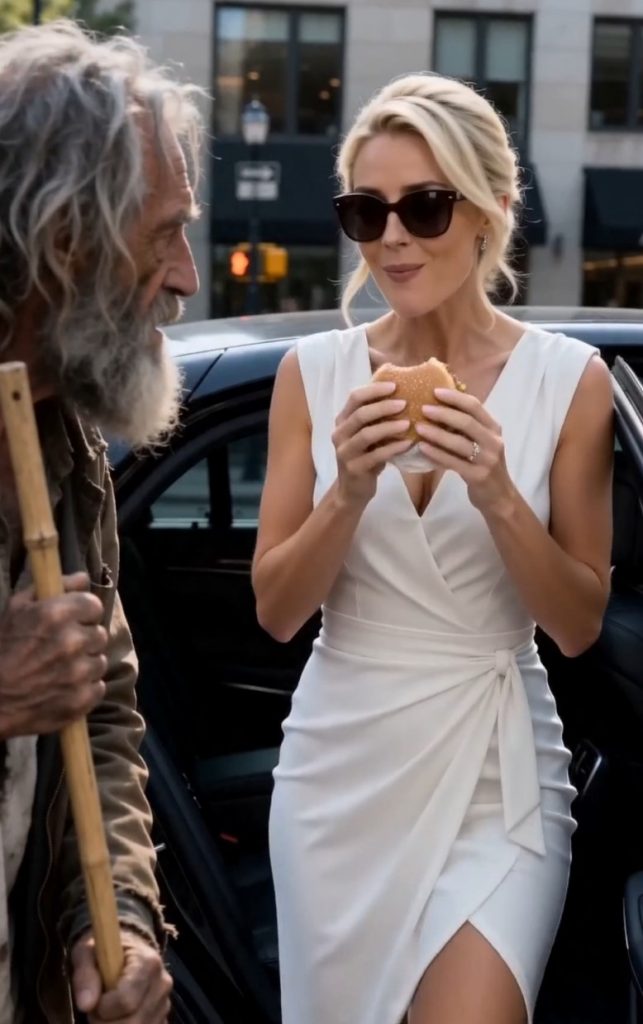
The old man did not answer when she dropped the burger at his feet.
He only looked down.
The bun had split open on the sidewalk, meat and sauce sliding against the curb beside his worn boots. A few pigeons fluttered closer, then scattered when a taxi horn cut through the morning noise.
The woman in the white wrap dress adjusted her sunglasses.
She had stepped out of a black luxury sedan as if the city itself had been waiting to receive her. Blonde hair swept over one shoulder. Diamond bracelet catching the sunlight. Coffee in one hand, half-eaten burger in the other.
She took one final bite, made a face, and tossed the rest down.
“That’s where trash belongs.”
The old man leaned on his straw broom.
His gray hair hung in uneven strands around his face. His beard was thick, untrimmed, almost silver in the light. His brown jacket had been patched at the elbows, and his boots looked like they had walked through winters nobody had thanked him for surviving.
For a moment, he lifted his eyes to her.
Not angry.
Not pleading.
Just tired.
The woman gave a small laugh, the kind meant to be heard by people nearby.
“You people are always in the way,” she said.
Then she turned and walked toward the revolving doors of the glass tower across the street.
No one stopped her.
The city kept moving. Men in suits stepped around the mess. A cyclist cursed at a cab. A woman with headphones glanced down, then away. New York had seen worse things before breakfast and had learned to make indifference look efficient.
The old man sighed.
He bent slowly, one hand pressing against his knee, and began to sweep the wasted food toward the gutter.
That was when someone shouted.
“Sir!”
The old man paused.
A young executive in a dark blue suit came running through the crowd, his tie crooked from the sprint. Behind him, two men in black suits pushed through pedestrians with practiced urgency.
The old man tightened his hand around the broom.
The young executive stopped in front of him, breathing hard.
Then, to the shock of everyone watching, he lowered his head.
“Mr. Hawthorne,” he said, voice shaking. “We’ve been looking for you everywhere.”
The old man stared at him.
The name seemed to strike some distant place inside him.
“I’m sorry,” he murmured. “You have the wrong man.”
The executive’s face twisted with relief and grief all at once.
“No, sir. We don’t.”
He gestured toward the black sedan waiting at the curb, the same kind of car the blonde woman had stepped out of moments earlier.
“Please,” he said. “Come with me.”
The old man looked down at the burger pieces near his broom, then at the polished car door being opened for him.
“I have work,” he said softly.
The executive swallowed.
“Not anymore.”
Across the street, the woman in white had already disappeared into the tower, unaware that the man she had humiliated was being escorted into a car like royalty.
And by the time she reached the lobby, her entire life was already turning toward ruin.
Act II
His name was Thomas Hawthorne.
At least, that was the name buried beneath the years.
Most people on West 47th Street called him Tom. Some called him old man. A few called him nothing at all, which was the safest name in a city where being noticed could be a blessing or a punishment.
He swept the same stretch of sidewalk every morning.
Not because the city paid him.
It did not.
He did it because the pharmacy owner gave him coffee, the flower vendor let him sleep in the alley when the rain was bad, and the doorman at the corner hotel pretended not to see him washing his hands in the service bathroom before sunrise.
Thomas had once worn suits finer than any passing banker.
He had once walked into rooms where men stood before he spoke. His name had been etched on buildings, printed on contracts, whispered in boardrooms, and cursed by competitors who could not understand how a quiet man from Ohio had built one of the most powerful private investment firms in America.
Hawthorne Capital.
That was before the accident.
Before the scandal.
Before his wife died and his mind broke around the grief.
At least, that was what the newspapers had been told.
The truth was messier.
Thomas had disappeared fifteen years earlier after a private plane went down in bad weather over the Adirondacks. The wreckage burned for hours before rescue crews arrived. His wife was found. His chief financial officer was found. Thomas was not.
The world declared him dead in three days.
His company mourned for one week.
Then the men he had trusted began carving his life into pieces.
But Thomas had survived.
Barely.
A hunter found him wandering near a logging road, concussed, half-frozen, and unable to remember why his hands were stained with ash. There had been hospitals. Shelters. Names written wrong on intake forms. Months missing inside his own head.
When memory returned, it did not return kindly.
It came in fragments.
His wife’s hand in his.
A boy crying in a courthouse hallway.
A signature he did not remember giving.
A man in a gray tie telling him, “If you go back, they’ll finish what the crash didn’t.”
By then, Thomas had learned something terrible.
Power was loud when it wanted applause, but quiet when it wanted a man erased.
So he stayed gone.
For years, he moved between cities, carrying his past like a wound under dirty fabric. He accepted soup from churches named after saints. He slept beneath scaffolding. He watched men in imported suits step over him while speaking into phones about legacy.
Only one piece of his old life remained.
A brass token, scratched and darkened with age, tucked inside the lining of his jacket.
On one side was the Hawthorne crest.
On the other, three engraved words:
Build what lasts.
He had given a matching token to a boy once.
A boy with bruised knuckles, hungry eyes, and too much pride to admit he needed saving.
That boy had grown up.
That boy had been searching.
And now, in the back of a luxury sedan, Thomas Hawthorne stared at the skyline through tinted glass while the young executive beside him tried not to cry.
“Mr. Vale is waiting,” the executive said.
Thomas turned his head.
“Vale?”
“Yes, sir. Daniel Vale.”
The name reached him slowly.
Daniel.
The boy from the courthouse.
The one Thomas had pulled away from a life built to crush him.
Thomas closed his eyes.
And for the first time in fifteen years, the dead man remembered who had been waiting for him.
Act III
The lobby of Vale Tower was made to intimidate.
Floor-to-ceiling glass rose forty stories above polished marble. Sunlight poured through the walls and turned the air almost white. Security guards stood in two perfect lines, broad-shouldered and motionless, dressed in black suits with earpieces at their collars.
When Thomas entered, every guard lowered his head.
Not deeply.
Just enough.
Respect has a sound when it moves through a room. It is quieter than applause and heavier than fear.
Thomas stopped at the threshold.
His worn boots stood on marble that reflected him too clearly. The brown jacket. The wild hair. The broom-callused hands. He looked like a mistake inside all that wealth.
But no one laughed.
No one looked away.
The young executive led him forward as if escorting a head of state.
At the center of the lobby stood Daniel Vale.
He was in his forties now, powerful in the way self-made men become when they have had to fight for every inch of dignity. Tailored charcoal suit. Steel watch. Dark hair touched with gray at the temples. A face the financial magazines called ruthless.
But when he saw Thomas, ruthlessness vanished.
Daniel took one step forward.
Then another.
His eyes reddened.
“Do you remember me?”
Thomas stared at him.
For a long moment, the lobby held its breath.
Then Daniel reached into his jacket and removed a small brass token.
The same crest.
The same words.
Build what lasts.
Thomas’s hand began to tremble.
“Danny,” he whispered.
Daniel broke.
Not loudly. Not in a way cameras could use. His face simply collapsed, and he crossed the distance between them like a child running through a storm.
He took Thomas’s hands in both of his.
“You found me when nobody wanted me,” Daniel said. “Now I found you.”
Thomas looked down at the brass token.
His memory opened.
Daniel at fourteen, sitting outside a juvenile courtroom after being blamed for a theft he had not committed. Daniel refusing to cry because he thought tears made adults crueler. Thomas, still a rising businessman then, stopping because everyone else had stepped around the boy.
Thomas paying for the lawyer.
Thomas calling the foster home.
Thomas showing up again a week later, then a month, then every birthday after that.
“You told me I wasn’t trash,” Daniel said, voice shaking. “You told me men become what someone dares to believe about them.”
A sound moved through the lobby.
Some people cried openly.
Others looked down, ashamed by the intimacy of the moment.
Then Thomas’s eyes shifted.
Beside Daniel stood the blonde woman in the white dress.
Her sunglasses were gone now.
Her face had lost every trace of color.
Vanessa Clarke, senior partner at Vale Tower’s philanthropic division, had arrived that morning believing she would be named executive director of Daniel’s new homelessness initiative. She had spent months building a campaign around compassion, dignity, and urban renewal.
Ten minutes earlier, she had dropped food at an old man’s feet and called him trash.
Now that same old man stood hand in hand with the CEO.
Daniel noticed Thomas looking at her.
He turned.
“Vanessa?”
She opened her mouth.
Nothing came out.
Thomas lowered his eyes, not in submission, but recognition.
“She was on the sidewalk,” he said quietly.
Daniel’s expression changed.
Vanessa shook her head.
“Daniel, I can explain.”
The lobby went still again.
And this time, the silence belonged to her.
Act IV
Vanessa had always trusted presentation.
A soft voice in meetings. Expensive simplicity. The right charity boards. The right photographs with the right children, the right shelters, the right language about giving people “a path forward.”
She knew how to make cruelty look like standards.
She knew how to make ambition sound like service.
But there was no presentation polished enough for this.
Daniel stared at her.
“What happened on the sidewalk?”
Vanessa tried to smile.
It failed.
“There was a misunderstanding.”
Thomas said nothing.
That made it worse.
Daniel turned to the young executive. “Pull the street feed.”
Vanessa’s face tightened.
“Daniel, that’s unnecessary.”
He did not look at her.
“Now.”
The executive moved to a security desk. Seconds later, the lobby’s enormous wall screen flickered on.
The image appeared in brutal clarity.
The black sedan.
The old man by the curb.
Vanessa stepping out in white, sunglasses perfect, burger in hand.
Her mouth moving.
The food dropping at Thomas’s boots.
Her face.
Her disgust.
The screen had no audio, but it did not need it.
Everyone could read the shape of the moment.
Vanessa clasped her hands together.
“I didn’t know who he was.”
Daniel turned to her slowly.
The words had condemned her before she understood why.
“You didn’t know who he was,” he repeated.
Her eyes filled with panic.
“I mean, I thought he was just—”
She stopped.
But the missing word had already entered the room.
Just homeless.
Just old.
Just dirty.
Just someone without the power to make her regret it.
Daniel’s voice was low.
“Say it.”
Vanessa looked around at the guards, executives, assistants, board members gathering at the edges of the lobby.
She swallowed.
“I made a mistake.”
“No,” Daniel said. “A mistake is signing the wrong line. You revealed who you are when you thought there would be no consequence.”
Thomas touched Daniel’s sleeve.
“Danny.”
The old nickname softened the room, but not Daniel.
Vanessa saw the opening and turned toward Thomas.
“Mr. Hawthorne,” she said quickly. “I am deeply sorry. Truly. I had a stressful morning, and I behaved poorly.”
Thomas studied her.
He had seen apologies like that before.
Apologies addressed to power, not pain.
“You dropped food at my feet,” he said. “Then you told me where trash belongs.”
A few people gasped.
Vanessa’s eyes closed.
Daniel’s face went cold.
The young executive at the security desk looked furious enough to speak, but did not.
Daniel stepped back from Vanessa as if physical distance could protect him from what she represented.
“You were supposed to lead the Hawthorne House project,” he said.
Vanessa’s voice cracked. “I still can. Daniel, please. This has been my work for a year.”
Thomas looked at him.
“Hawthorne House?”
Daniel turned back to him, and the anger softened into grief.
“I named it after you,” he said. “A permanent shelter and legal aid center. Not a place to hide people. A place to bring them back.”
Thomas looked down.
For fifteen years, he had been invisible beside buildings built by men who once feared his signature.
Now his name was on a door meant to open.
Vanessa stepped closer. “Daniel, the donors trust me.”
“No,” Daniel said. “They trusted the version of you we put in brochures.”
Her face twisted.
“You’re going to destroy my career over one sentence?”
Daniel’s answer was immediate.
“No. You did.”
Then Thomas spoke.
“Do not destroy her.”
Everyone turned.
Vanessa looked up, stunned by hope.
Thomas’s voice remained quiet.
“Let her work one month at the night intake desk. No cameras. No press. No title. Let her look people in the eye when they come in cold and hungry.”
Vanessa’s hope vanished.
Daniel studied him.
Thomas continued, “If she refuses, she was never sorry. If she stays, maybe she learns the difference between charity and mercy.”
The lobby was silent.
Vanessa stared at him as if he had offered something worse than punishment.
Humility.
Daniel nodded once.
“Done.”
Vanessa’s lips parted.
But before she could protest, the elevator doors opened behind her.
Three board members stepped out.
And with them came the man who had spent fifteen years making sure Thomas Hawthorne stayed dead.
Act V
Martin Sloane stopped when he saw the old man.
For half a second, his face betrayed him.
It was not surprise.
It was fear.
Thomas recognized him at once.
Older now. Heavier. Still wearing gray ties. Still carrying himself with the careful ease of a man who had stolen things through paperwork instead of force.
Martin had been Thomas’s chief legal officer before the crash.
He had signed the statements.
Managed the estate.
Helped bury the company’s founder before the body was found.
Daniel saw Thomas’s expression.
“Mr. Sloane,” he said slowly. “You knew.”
Martin recovered with astonishing speed.
“This is extraordinary,” he said, smiling thinly. “Thomas. My God. We all thought—”
“No,” Thomas said.
One word.
It cut through fifteen years.
Martin’s smile faltered.
Thomas reached into the lining of his old jacket and removed the brass token. Then, from a second hidden pocket, he pulled a folded strip of oil-stained paper, so worn it looked ready to fall apart.
Daniel took it carefully.
“What is this?”
Thomas’s voice was rough.
“The last thing I remembered after the crash. I wrote it before I forgot again.”
Daniel opened the paper.
There were only six words.
Sloane cut the fuel line. Margaret knew.
Daniel looked up.
The lobby changed.
No one breathed normally.
Martin’s face went slack.
“This is absurd.”
But Daniel was already moving.
“Lock down legal archives,” he ordered. “Now.”
The young executive ran.
Security shifted.
Martin stepped back. “Daniel, be careful. That man has been living on the street. His mind—”
Thomas looked at him.
For the first time all morning, the old man’s weariness became something sharper.
“I remembered enough.”
Martin’s eyes flicked toward the door.
The guards noticed.
He did not leave.
The investigation that followed did not end in the lobby. Men like Martin Sloane were not undone by dramatic moments alone. They were undone by records, accounts, old insurance filings, deleted emails restored by people who knew where powerful men hid cowardice.
But the first crack happened there.
In marble and sunlight.
In front of a woman who had called a man trash because she thought his life was smaller than hers.
Weeks later, Hawthorne House opened.
There were reporters, but Thomas did not speak to them. He refused the new suit Daniel bought him for the ceremony and wore the brown jacket instead, cleaned and repaired but still unmistakably his. His beard was trimmed. His hair was tied back. His boots remained worn at the edges.
Daniel stood beside him as the ribbon was cut.
Not behind him.
Beside him.
The brass plaque near the entrance read:
For every person the world stopped seeing.
Inside, there were beds, showers, hot meals, legal clinics, addiction counselors, job placement offices, and a small courtyard where no one was moved along for sitting too long.
Vanessa Clarke worked the night intake desk for thirty days.
At first, she looked like someone serving a sentence. She wore no diamonds. No white dresses. No sunglasses. She learned names. She was cursed at, cried on, ignored, thanked, and once handed a sleeping child while a mother filled out emergency housing forms with shaking hands.
On the twenty-sixth night, Daniel found her outside the kitchen, quietly wiping tears from her face.
He did not comfort her.
That was not his job.
But he did not humiliate her either.
Thomas had taught him the difference.
Martin Sloane was arrested two months after the lobby confrontation. The old crash was reopened. Margaret Hawthorne’s death was no longer called weather. The newspapers changed their language carefully, the way institutions do when they are afraid of being sued for finally telling the truth.
Thomas read none of it.
He spent most mornings in the courtyard at Hawthorne House, sweeping leaves from the path with a new broom someone had left outside his door.
Daniel found him there one day.
“You know we have staff for that,” he said.
Thomas kept sweeping.
“I know.”
Daniel smiled faintly. “You built half the skyline and still want to clean sidewalks.”
Thomas looked at the people moving through the courtyard. A man in a borrowed coat drinking coffee. A young woman filling out a job application. A teenager sleeping safely on a bench in the sun.
“No,” he said. “I want to remember what the ground feels like.”
Daniel stood beside him.
For a while, they said nothing.
Then Daniel reached into his pocket and took out the brass token Thomas had given him when he was fourteen.
Build what lasts.
“I kept it,” Daniel said.
Thomas nodded.
“I hoped you would.”
Daniel’s voice thickened. “I became who I am because you saw me.”
Thomas looked at him then, really looked at him.
“No, Danny. You became who you are because you refused to become what they called you.”
Across the courtyard, the front doors opened.
Vanessa stepped in, holding two bags of donated winter coats. No cameras followed her. No assistant carried her things. She saw Thomas and hesitated, then walked over.
Her face was different now.
Less polished.
More human.
“Mr. Hawthorne,” she said. “The women’s shelter sent these.”
Thomas nodded.
“Thank you.”
She stood there for a moment.
“I’m sorry,” she said.
This time, she did not explain. Did not defend. Did not ask for forgiveness to make herself feel clean.
Thomas studied her, then gave one small nod.
That was all.
It was enough.
She went inside.
Daniel watched her go.
“Do people really change?” he asked.
Thomas leaned on his broom.
“Some do. Usually after the mirror hurts enough.”
Daniel laughed softly.
The city moved beyond the gates, loud and impatient and hungry. People still hurried past one another. Cars still honked. Towers still shone like monuments to money.
But on that street, one door stayed open.
And sometimes, when the morning light hit the glass just right, passersby could see an old man with silver hair sweeping the path outside a building that bore his name.
Not because he had to.
Because no one who entered that place would ever again be told where trash belonged.