Act I
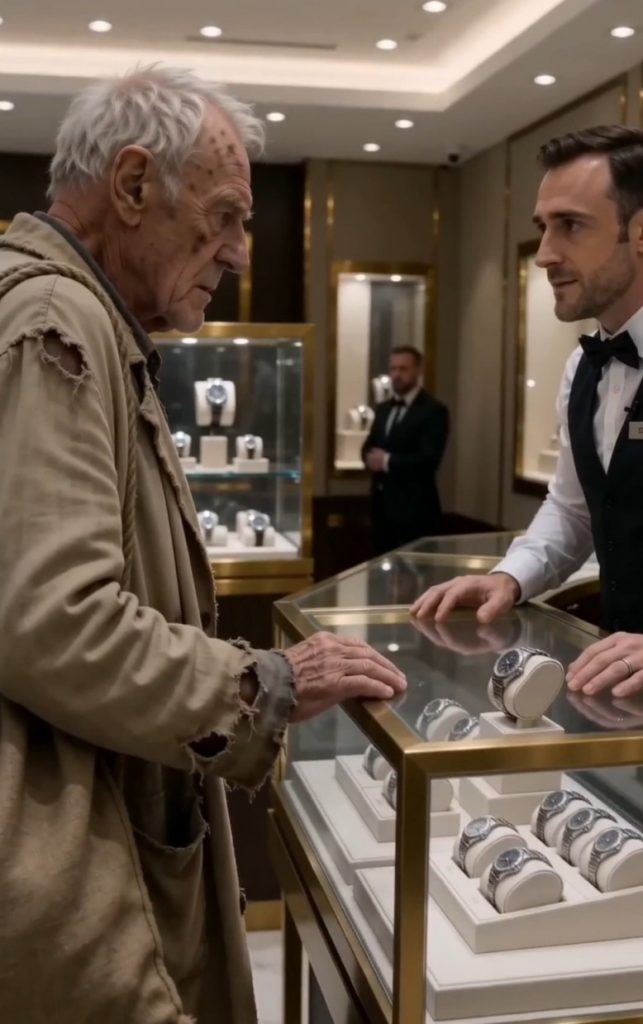
The old man entered the boutique carrying a sack no one in that room wanted to look at directly.
It was burlap, stained at the bottom, tied with a fraying rope and slung over one shoulder like something dragged from an alley. His beige coat was torn near the sleeve. His shirt was yellowed with age and marked by old coffee stains. His shoes made a dull, uneven sound against the polished white marble floor.
Inside Laurent & Bell, every sound was supposed to be beautiful.
The soft click of watch clasps. The whisper of silk sleeves over glass counters. The low murmur of rich clients pretending price was an afterthought.
The old man ruined the atmosphere simply by existing in it.
A woman wearing diamonds glanced at him, then clutched her handbag closer.
A man in a navy suit stepped aside with visible disgust.
Behind the nearest gold-trimmed display case, a sales clerk named Bienis looked up and froze. His smile remained in place, but it hardened instantly, like painted porcelain cracking beneath the surface.
The old man kept walking.
He stopped before the central case, where the boutique displayed its rarest pieces beneath a circle of warm light. Gold, platinum, moonphase complications, skeleton dials, diamond bezels. Tiny kingdoms of time sitting on velvet.
He lifted one weathered hand and pointed to a watch with a deep blue face and a rose-gold case.
“I want to buy this one.”
Bienis blinked.
For half a second, he seemed unsure whether he had heard correctly.
Then his mouth curled.
“Get out,” he said.
The old man looked at him.
Bienis leaned across the glass, lowering his voice just enough to make the insult feel personal, but not enough to hide it from the nearby customers.
“This place is not for people like you.”
The old man did not flinch.
He only stared back with pale blue eyes so still that Bienis’s smirk wavered.
The customers waited for embarrassment. For the old man to mumble an apology. For him to drag his sack out and return the boutique to its clean, glittering order.
Instead, the manager came rushing from the back office.
His name was Anton Greaves, and he was not a man who rushed. He glided through wealthy rooms for a living. But now he moved quickly, adjusting his black suit jacket with one hand, panic already draining the color from his face.
“Sir,” Anton said, breathless. “I didn’t know you were here.”
Bienis turned.
The old man did not take his eyes off the clerk.
“So this is how you treat customers?”
Anton swallowed.
“No, sir. Absolutely not.”
The old man finally looked at him.
Then he lifted the burlap sack from his shoulder and dropped it onto the glass counter.
The sound was heavy enough to make every watch tremble in its velvet tray.
Bienis stared.
The old man untied the rope, opened the mouth of the sack, and pulled the fabric wide.
Inside were stacks of hundred-dollar bills.
Dozens of them.
Neatly bundled. Packed tight. More money than Bienis had ever seen outside a screen.
The boutique went silent.
The old man looked down at the cash, then back at the clerk.
“I asked for a watch,” he said. “Not permission.”
And only then did Bienis begin to understand that the man he had tried to throw out might own more than the watch in the case.
Act II
His name was Elias Laurent.
Most people in the boutique knew the Laurent name because it was etched in gold above the door, printed on receipts, stamped inside velvet boxes, whispered in auction rooms, and worn by people who wanted time itself to look expensive.
Almost no one knew Elias anymore.
That was by design.
For twenty years, the world believed Laurent & Bell belonged to a board, a luxury group, and a series of polished executives who appeared in glossy interviews beside words like heritage, precision, and legacy.
All of that was partly true.
But before the board, before the flagship stores in New York, London, Dubai, and Singapore, there had been a single repair bench in Queens.
Elias was twenty-two when he opened it.
He could not afford a proper sign, so he painted his own on a piece of wood and hung it crooked over a narrow storefront between a laundromat and a pawnshop. His wife, Mara, made coffee for customers while he repaired watches under a lamp with a cracked shade.
Back then, men in expensive suits brought him family heirlooms and spoke to him like he was invisible.
He let them.
Then he fixed what they thought was broken forever.
Mara always said that was his gift. Not making timepieces shine, but finding the heartbeat in things people had given up on.
The first watch he ever designed himself had a blue dial the color of evening after rain. Mara said it looked like the sky over the river the night he proposed. He named it the Marabelle.
Only twelve were made.
The first went to Mara.
The second sold to a collector in Geneva for enough money to pay three months’ rent.
The rest built an empire.
Elias never forgot the people who laughed when he began. He remembered every banker who denied him a loan. Every supplier who demanded payment in advance because they thought he would disappear. Every client who asked to speak to “the real watchmaker” after seeing his patched coat and worn hands.
He wore suits later because business required it, not because he respected the costume.
Mara hated the suits.
“You look like one of them,” she used to tease, straightening his tie.
“And what should I look like?”
“Like yourself.”
After she died, Elias stopped attending openings. He signed documents from his library, approved designs by handwritten notes, and left public appearances to younger men with smoother voices.
The company grew without him.
Too well.
Boutiques became colder. Staff became sharper. Customers were sorted before they spoke. A person’s watch, shoes, skin, accent, and posture became silent currency long before a credit card appeared.
Elias heard rumors.
At first, he dismissed them as isolated arrogance. Then letters began arriving.
A retired teacher who had saved for seven years to buy a watch for her husband was ignored until a wealthier client entered.
A young engineer in a hoodie was told the boutique was appointment-only, while walk-ins in suits were welcomed seconds later.
A delivery driver carrying a repaired family watch was asked to use the service entrance.
The final letter came from a man named Samuel Ortiz, a mechanic from the Bronx.
He had gone to the flagship store to buy the cheapest Laurent watch in the building. Not cheap to him. Cheap to them. He had saved to buy it for his son, who had just become the first doctor in their family.
The clerk laughed.
Not loudly. Not dramatically.
Just enough.
Samuel left without buying anything.
He wrote to Elias because his late wife had loved Laurent watches from the repair-bench days, before the brand learned how to look down.
That letter sat on Elias’s desk for two weeks.
Then he took out Mara’s old beige coat.
She had worn it on winter mornings when the heat failed in the shop. It was torn now, stained from years of storage, but when Elias put it on, he remembered who he had been before rich men learned his name.
He filled the burlap sack himself.
Not because he needed cash. Any card in his wallet could have bought the room.
He wanted weight.
He wanted the absurd, undeniable image of wealth carried in the roughest possible container.
Then he walked into Laurent & Bell to see whether his company still knew the difference between a customer and a costume.
Bienis answered that question in less than ten seconds.
But the watch Elias pointed to was not random.
It was the last Marabelle in public inventory.
And he had come to buy it back.
Act III
Anton Greaves stood beside the counter, sweating through a suit that cost more than most people’s rent.
“Mr. Laurent,” he said carefully, “please allow me to apologize on behalf of the boutique.”
The name passed through the room like a match touching dry paper.
Mr. Laurent.
A woman near the diamond cases lowered her champagne flute.
The man in the navy suit looked suddenly fascinated by the floor.
Bienis did not move.
His face had gone slack, his eyes fixed on the old man, then the sack, then the manager, as if the order of reality had been rearranged without his consent.
“Mr. Laurent?” he repeated faintly.
Elias looked at him.
“That is the name over the door, isn’t it?”
Bienis opened his mouth, closed it, then tried the smile that had worked on rich clients for years.
“Sir, I had no idea.”
“No,” Elias said. “You had an idea. That was the problem.”
Anton turned sharply toward Bienis.
“Step away from the counter.”
Bienis obeyed, but badly. His hands shook. His bow tie suddenly looked ridiculous, a little black knot trembling at his throat.
Elias reached into the sack and removed one bundle of cash, then placed it gently on the counter.
“I came to buy the Marabelle.”
Anton hesitated.
“Sir, that piece is part of the private collector preview. It is not currently—”
“I designed it.”
Anton went silent.
Elias looked through the glass at the blue-faced watch.
For the first time since entering, his expression shifted.
Not softened exactly.
It opened.
That watch had been drawn at his kitchen table while Mara slept with her head on folded arms, exhausted from helping him count inventory after midnight. The curve of the lugs had come from the arch of the old shop window. The blue dial had been her favorite shade. The rose-gold case had been chosen because she said yellow gold shouted but rose gold remembered.
He had sold ten because they needed money.
Kept one because Mara refused to let him sell the first.
Lost one because of his son.
The thought tightened his jaw.
Anton followed his gaze.
“We can arrange a private purchase, sir.”
“No,” Elias said. “Ring it up like any other sale.”
He looked at Bienis.
“With him watching.”
The customers shifted uneasily.
No one wanted to be seen enjoying the humiliation now that the humiliated man had become powerful. That was the cowardice Elias hated most. Their disgust had not changed. Only its target had.
Anton unlocked the display case with careful hands.
The Marabelle was lifted from the velvet tray and placed on a black presentation cloth. Under the boutique lights, the dial seemed almost alive, blue deepening toward the edges like twilight around a memory.
Elias touched the case with two fingers.
“Do you know why this watch matters?” he asked.
Bienis swallowed.
“It’s a rare Laurent original.”
“That is what the catalog says.”
No one spoke.
Elias continued.
“It matters because my wife wore the first one for thirty-six years. She wore it when we were poor, when we were rich, when doctors told her she was sick, and when she told me not to become cruel just because the world had been cruel to us.”
His voice did not break.
That made the grief worse.
“This one was meant for my grandson.”
Anton’s eyes flickered.
Bienis looked confused.
Elias looked toward the door, past the marble and glass, beyond the boutique’s carefully guarded world.
“My son sold it.”
The room held its breath.
Elias turned back.
“He stole from the family archive before he disappeared into his habits and debts. This watch passed through collectors for eleven years. I found it last month.”
He looked at the sack of cash.
“The current owner requested payment in person. He thought it would amuse him to watch an old man carry money like a beggar.”
A faint edge entered Elias’s voice.
“I decided to make the trip useful.”
Anton closed his eyes briefly.
He understood now.
This was not only a purchase.
It was a test.
And everyone in the boutique had just failed it in public.
Act IV
The sale should have taken three minutes.
Instead, it became a reckoning.
Anton personally entered the transaction at the register, though his hands remained stiff. The system recognized the item code and paused. A rare-piece authorization alert appeared on the screen.
Then another.
Then a third.
The boutique’s internal network realized what the people in the room had just been told: the founder of Laurent & Bell was standing in the flagship store in a torn coat, buying back one of the most important watches in company history with cash carried in burlap.
Head office began calling within seconds.
Anton silenced the phone.
Elias noticed.
“Answer it.”
Anton did.
A voice spoke frantically on the other end. Anton listened, then looked at Elias.
“Yes,” he said. “He is here.”
A pause.
“No. It is worse than that.”
Bienis stared at the floor.
Elias turned toward him.
“How long have you worked here?”
“Seven years,” Bienis whispered.
“And how many people have you dismissed at the door?”
Bienis looked up, panicked.
“Sir, I was trained to protect the brand.”
The words landed like a confession.
Elias nodded slowly.
“There it is.”
Anton’s face tightened.
Bienis rushed on.
“We get people who wander in. People taking pictures. People who can’t afford anything. People wasting time. I was only trying to maintain the environment.”
“The environment,” Elias repeated.
He looked around the boutique.
Gold-trimmed cases. Marble floors. Soft lights arranged to make metal glow. Security guards near the entrance. Sales staff trained to smile at watches before people.
“Mara would have hated this room,” he said.
No one dared ask who Mara was now.
Elias continued, “Do you know what the first Laurent customer wore?”
Bienis said nothing.
“Work boots,” Elias said. “He was a subway conductor. He brought me his father’s watch wrapped in a sock. He paid me in small bills and coins. I repaired it, and he cried when I handed it back.”
The boutique stayed silent.
“That man sent me ten clients. One of them introduced me to the investor who paid for my first manufacturing run.”
He stepped closer to the counter.
“If I had treated him the way you treated me, this company would not exist.”
Bienis’s mouth trembled.
“I’m sorry.”
Elias studied him.
“No. You are frightened.”
The truth stripped the apology bare.
Anton looked toward the assistants and staff gathered near the back wall.
“Everyone to the floor,” he said.
They moved quickly, forming a nervous line near the cases.
Elias did not raise his voice.
That made every word easier to hear.
“I built Laurent & Bell because time belongs to everyone. The rich decorate it. The poor survive by it. A mother counts the minutes until her child comes home. A night worker counts the hours until dawn. A dying woman counts the days she has left. Do not stand behind my name and decide whose time is worth respect.”
A young sales associate near the back began to cry quietly.
Elias looked at Anton.
“This store will close tomorrow.”
Anton stiffened.
“For renovation?” he asked, though he already knew the answer was not that simple.
“For retraining,” Elias said. “For review. For removing anyone who believes cruelty is luxury.”
Bienis looked up.
“Sir, please. I need this job.”
Elias held his gaze.
“So did every person you made feel small before they even reached the counter.”
Bienis had no answer.
The transaction finally approved.
Anton placed the Marabelle in its box with reverence, but Elias stopped him.
“No box.”
He picked up the watch and fastened it around his own wrist.
For a moment, the old coat, the stained shirt, the sack of money, and the rose-gold watch existed together in one impossible image.
Then Elias lifted the burlap sack again.
Not onto his shoulder.
Onto the counter.
“Deposit the payment properly,” he said. “Every dollar. Documented.”
Anton nodded.
“And the clerk?” Anton asked quietly.
Elias looked at Bienis one last time.
“Let him finish the day standing at the entrance.”
Bienis blinked.
“I don’t understand.”
“You will greet every person who walks in,” Elias said. “No judgment. No assumptions. No deciding. You will open the door and say, ‘Welcome to Laurent & Bell.’ Tomorrow, your employment will be reviewed.”
Bienis’s face burned.
The punishment was not theatrical.
It was worse.
He had to become the thing he had refused to offer.
Respectful.
Act V
By closing time, the story had already spread.
Not through official channels. Luxury brands hated messy truth. But customers talked. Staff texted. Someone had taken a photograph of Elias in the torn coat with the Marabelle on his wrist and the sack of cash open on the counter.
The image moved faster than the company could contain.
Old man humiliated in watch boutique turns out to be founder.
It was the kind of headline people loved because it made arrogance visible and punishment satisfying.
But Elias did not care about the headline.
He left the boutique through the front door just as evening settled over the city. The doorman, who had avoided looking at him when he entered, now held the door open with both hands.
“Good evening, Mr. Laurent.”
Elias paused.
“What did you say to me when I arrived?”
The doorman went pale.
“I said nothing, sir.”
“That is correct.”
The doorman lowered his eyes.
Elias stepped outside.
A black car waited at the curb, but he did not get in immediately. Instead, he stood beneath the boutique sign and looked at his reflection in the glass.
Tattered coat.
Old face.
Blue eyes.
Rose-gold watch.
For a second, he could almost see Mara beside him, smiling that sad little smile she used when he was right but had taken too long to do something about it.
“You look like yourself,” he imagined her saying.
The next morning, Laurent & Bell did not open.
A notice appeared on the door.
Closed for internal review.
Inside, executives arrived in dark cars and entered through the front, not the private entrance. Anton Greaves submitted a full report. Surveillance footage was reviewed. Customer complaints were pulled from archives where they had been softened, ignored, or labeled “unverified.”
There were more than Elias expected.
Too many.
A young couple laughed out of the engagement collection.
A nurse told to come back after changing out of scrubs.
A grandfather ignored for forty minutes because staff assumed he was waiting for someone wealthier.
Samuel Ortiz, the mechanic from the Bronx, had written three times before his letter reached Elias.
Three times.
Elias read every complaint in the founder’s room above the boutique, the Marabelle ticking softly on his wrist.
By noon, Bienis was gone.
Not destroyed. Not publicly dragged through the papers. Just removed from the counter he had mistaken for a throne.
Several others followed.
Anton kept his job, but not untouched. Elias told him plainly that recognition after cruelty was not the same as prevention.
“You knew the scent of rot,” Elias said. “You waited until it reached me.”
Anton accepted the rebuke because it was true.
Within three months, Laurent & Bell changed in ways small enough to be real.
Security guards stopped hovering near clients based on clothing. Staff training began with the history of the Queens repair shop, not the celebrity ambassador campaigns. Every boutique received a framed photograph of Elias and Mara standing in front of their first storefront, young and tired and grinning beside a crooked wooden sign.
Under the photograph were Mara’s words.
Look first. Judge never.
The company also created the Marabelle Fund, which repaired family watches free of charge for people who could not afford restoration. Not luxury pieces only. Any watch with a story. Pocket watches from grandfathers. cracked graduation gifts. retirement watches, flea market finds, old timepieces kept in drawers because memory had outlived money.
Elias personally attended the first repair day.
He wore the beige coat.
Cleaned, but not mended.
Reporters asked why he kept wearing it.
He answered only once.
“So I don’t forget who gets turned away.”
One afternoon, Samuel Ortiz came in with his son, Dr. Mateo Ortiz, who still had his hospital badge clipped to his jacket. Samuel looked nervous crossing the marble floor, but this time the door was opened for him before he touched the handle.
A young sales associate greeted him warmly.
“Welcome to Laurent & Bell.”
Samuel glanced around, then saw Elias standing near the central case.
“You got my letter,” he said.
Elias walked toward him.
“I should have gotten it sooner.”
Samuel’s eyes lowered.
“My wife loved your watches. We could never afford one when she was alive.”
Elias nodded.
“What was her name?”
“Lucia.”
Elias looked at Mateo.
“And you became a doctor.”
Mateo smiled shyly.
“Because of them.”
Elias understood.
Parents who counted minutes, shifts, bus rides, payments, sacrifices. Parents who gave children futures they would never enter themselves.
He removed the Marabelle from his wrist.
Anton, standing nearby, inhaled softly.
Elias held the watch out to Samuel.
Samuel stepped back. “No. Mr. Laurent, I can’t.”
“You can,” Elias said. “But you don’t have to keep it.”
He placed it in Samuel’s hands.
“Wear it today. Let your son see what his mother’s time built.”
Samuel’s hands shook as he held the rose-gold case.
Mateo looked away, overwhelmed.
For a while, no one spoke.
The boutique was still beautiful. Still marble. Still gold. Still filled with watches most people would never buy.
But something had shifted.
The silence no longer felt like intimidation.
It felt like respect.
Later, after Samuel returned the Marabelle with tears in his eyes, Elias sat alone in the founder’s room. Outside the window, the city moved in its endless hurry. Cars, footsteps, signals, appointments, lives measured and mismeasured by clocks no one could stop.
He opened the old burlap sack one last time.
It was empty now.
No stacks of money. No spectacle. No weaponized proof.
Just rough fabric, worn thin at the seams.
Elias folded it carefully and placed it in the archive beside Mara’s first watch box, the original sketch of the Marabelle, and a photograph of the repair shop where everything began.
He looked at the watch on his wrist.
Its second hand moved smoothly over the blue dial.
One small circle.
One quiet heartbeat.
Elias had spent his life proving poor men could build rich things. But in the end, that was not the lesson his company needed.
The lesson was simpler.
A man can walk in wearing rags and carry a fortune.
A woman can enter in work clothes and hold a family’s whole history in her pocket.
A boy can press his face to the glass and grow up to buy the building.
And a luxury house that forgets how to honor people before price has already gone bankrupt in the only way that matters.
Downstairs, the doors opened.
A new customer stepped inside.
He wore a faded jacket and held an old watch wrapped in a handkerchief.
The young associate smiled, walked forward, and greeted him before anyone could decide what he was worth.
“Welcome to Laurent & Bell.”
Upstairs, Elias heard the words through the open door.
For the first time in years, he smiled.