Act I
The parking lot shimmered like a warning.
Heat rose from the asphalt in waves, bending the air around the dark gray sedan parked beneath the noon sun. The metal roof flashed hard white under the light. No trees. No shade. No breeze. Just rows of empty spaces and the cruel silence of a summer afternoon.
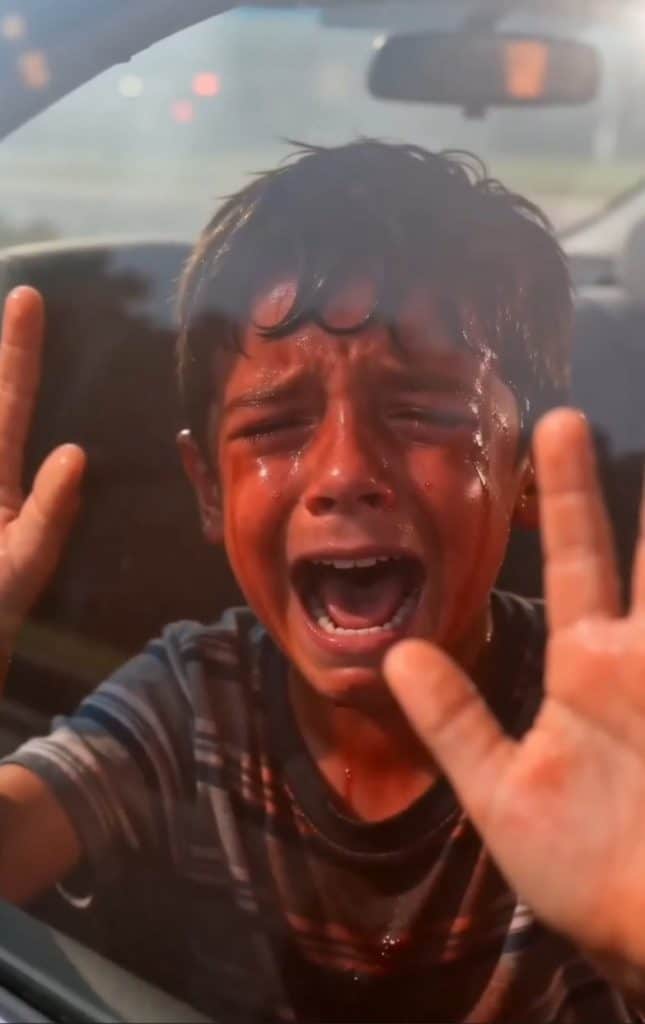
Inside the car, a little boy was screaming.
He was buckled into a car seat in the back, his striped shirt soaked through, his dark hair plastered to his forehead. His face was an alarming shade of red, and his small palms slapped weakly against the rear passenger window.
Outside, county firefighter Ethan Cole yanked at the door handle.
Locked.
He ran to the other side.
Locked.
He pressed his face near the glass and saw the boy’s mouth open in another soundless cry.
“Hey! Hey, buddy, look at me!”
The child’s eyes rolled toward him, terrified and unfocused.
Ethan’s heart slammed against his ribs.
He pulled out his phone with shaking hands and called dispatch before the screen fully lit.
“This is Ethan Cole, County Fire and Rescue. I’m off duty at the Westbridge Plaza lot. I have a small child locked in a vehicle. Dark gray sedan. Rear passenger seat. He’s overheating and fading fast. Send rescue now.”
The dispatcher’s voice sharpened.
“Units are en route.”
Ethan slammed his palm against the window.
“Stay with me! You hear me? Stay with me!”
The boy tried to lift his hand again.
It slid down the glass.
Ethan’s throat closed.
He shoved the phone into his pocket and looked around wildly. No emergency vehicle. No tools. No crowd. Just a baking lot, a locked car, and a child disappearing by the second.
He spotted a loose red brick near a broken curb.
He grabbed it and sprinted back.
The first blow hit the rear window with a hollow crack.
The glass did not break.
He struck again.
Again.
Again.
White scuff marks bloomed across the surface, but the window held.
“Come on!” Ethan roared.
Inside, the boy’s movements slowed.
His head dipped forward.
Then his body went limp against the straps.
The brick slipped from Ethan’s hand.
For one terrible second, the world stopped.
He pressed both palms to the window, his breath fogging the glass.
“No. No, no, no. Stay with me.”
Then he saw it.
A small faded sticker on the lower corner of the rear window.
County Fire Family Day.
Two years old.
With a child’s name written beneath a cartoon fire helmet.
Milo.
Ethan froze.
He knew that name.
And suddenly this was no longer a stranger’s child trapped in a car.
It was a secret someone had buried right beside him.
Act II
Two years earlier, Ethan Cole had stood under a row of red balloons at the county fire station, holding a paper plate of hot dogs and pretending his life was not falling apart.
It was Family Day, the one Saturday when firefighters brought spouses, children, parents, and grandparents to climb through engines, ring bells, wear plastic helmets, and believe the world was safer because people in uniforms existed.
Ethan had loved that day once.
Then his younger brother, Daniel, disappeared.
Daniel had been a paramedic. Bright, reckless, funny in a way that made people forgive him too quickly. He could calm a terrified patient with one bad joke and a warm hand on the shoulder. He could also make enemies without realizing it, because Daniel had one fatal flaw.
He could not ignore something wrong.
Three weeks before he vanished, Daniel told Ethan that a private childcare center had been falsifying emergency records. Children were being transported in unsafe conditions. Staff were signing forms for checks that never happened. The owner had connections to local donors, a councilman, and half the people who smiled for photos at charity events.
Daniel said he had proof.
Then his car was found near the river.
No body.
No note.
No answers.
The official report called it a probable accident.
Ethan never believed it.
At Family Day that year, Daniel’s fiancée, Lena, arrived late with a toddler boy in her arms. The child had dark hair, round cheeks, and Daniel’s exact stubborn frown.
Milo.
Ethan remembered kneeling in front of him with a toy fire helmet.
“Hey, little man,” he said. “You want to drive the engine?”
Milo hid his face in Lena’s shoulder.
Lena smiled, but her eyes were swollen from crying.
After Daniel disappeared, Lena changed.
She stopped answering calls. She moved apartments. She told Ethan she needed distance because seeing him reminded her of everything she had lost.
Then one day, she was gone too.
Not missing in the official sense.
Just unreachable.
New number. No forwarding address. No trace of Milo.
Ethan spent months calling, searching, asking questions people told him to leave alone. Eventually, grief became exhaustion. Exhaustion became silence. And the world moved on, the way it always does when a family cannot prove its wound.
But Ethan had never forgotten Milo’s face.
Now that face was behind reinforced glass, unconscious in the rear seat of a locked sedan.
Ethan staggered back from the window, the sticker burning into his vision.
Milo.
The siren finally wailed in the distance.
Ethan turned and saw a county rescue truck coming fast through the lot, lights cutting across the glare. He ran into the lane and waved both arms.
“Here! Here!”
The truck screeched to a stop.
Two firefighters jumped out, followed by a medic with a red kit.
Ethan did not waste time explaining the sticker. He only pointed.
“He’s unconscious. Rear passenger. Car locked.”
His crew moved with practiced speed. No panic. No hesitation. The kind of motion that looks calm only because training is holding fear by the throat.
Within seconds, the rear door was opened.
Ethan reached in with both hands, but the medic stopped him.
“Let me.”
Ethan stepped back, shaking.
The boy was lifted carefully from the car seat and carried into the strip of shade beside the rescue truck. His skin was burning hot. His body sagged in the medic’s arms.
Ethan dropped to one knee.
“Milo,” he whispered.
One of the firefighters looked up.
“You know him?”
Ethan could not answer.
Because across the parking lot, a woman had just come running from the glass doors of an upscale salon, screaming into her phone.
“My car! What happened to my car?”
And Ethan recognized her too.
Not Lena.
Vivian Cross.
The owner of the childcare center Daniel had been investigating before he vanished.
Act III
Vivian stopped when she saw the firefighters.
She was dressed in a white linen suit, her hair freshly styled, sunglasses pushed onto her head. She looked less like a panicked mother than a woman furious that something expensive had been touched without permission.
Then she saw Milo on the ground beside the rescue truck.
Her face changed.
Not with love.
With fear.
Ethan rose slowly.
“Is this your car?”
Vivian looked at him, then at the broken door, then at the child.
“I was only gone a minute.”
The medic snapped, “He was in there much longer than a minute.”
Vivian’s lips tightened.
“You don’t know that.”
Ethan stepped closer.
“His name is Milo?”
Her eyes flashed.
For one second, she looked trapped.
Then she recovered.
“Yes. He’s my nephew.”
Ethan’s pulse thundered in his ears.
“Where is his mother?”
Vivian’s hand tightened around her phone.
“That is none of your business.”
“It became my business when I found him dying in your back seat.”
A police cruiser pulled into the lot, followed by another ambulance. The growing sirens drew shoppers from the plaza doors. People stood at a distance, hands over their mouths, whispering as the medics worked over Milo.
Ethan barely heard them.
Vivian lowered her voice.
“You’re emotional. I understand. But you have no idea what’s going on.”
Ethan stared at her.
“That’s funny. My brother said the same thing about you before he disappeared.”
The color drained from her face.
There it was.
Recognition.
She knew him.
“Ethan Cole,” she said quietly.
He took one step closer.
“You remember me.”
Vivian looked toward the police officers.
“I want him removed. He’s harassing me.”
But one of the officers had already noticed the child’s condition, the car seat, the heat, the broken rescue scene. His expression was not friendly.
“Ma’am,” he said, “you’re going to need to answer some questions.”
Vivian’s voice sharpened.
“I told you, he’s my nephew. I had an appointment. He was asleep. I left the air conditioning running.”
Ethan looked at the sedan.
“The engine was off when I got here.”
“That’s impossible.”
The officer looked through the front window.
“No keys in the ignition.”
Vivian’s eyes moved quickly.
Too quickly.
Then Milo made a small sound.
Everyone turned.
The medic leaned over him.
“He’s breathing. We need to transport now.”
Ethan closed his eyes for half a second.
Alive.
Not safe yet.
But alive.
As they loaded Milo into the ambulance, Ethan saw something fall from the child’s clenched hand.
A small plastic bracelet.
Not a toy.
A medical ID band.
The kind used at intake centers, day programs, emergency clinics.
Ethan picked it up.
Printed on the inside, beneath Milo’s first name, was another name.
Lena Hart.
Mother.
And beneath that, in faded ink, was an address.
Ethan looked up at Vivian.
She saw the bracelet in his hand and stopped breathing.
The old case, the missing brother, the vanished fiancée, the child in the locked car — all of it suddenly began pulling toward the same dark center.
Act IV
The hospital became a different kind of battlefield.
No sirens now. No burning asphalt. Just white walls, fast footsteps, clipped voices, and Ethan standing outside a pediatric treatment room with his hands still trembling.
A doctor came out after twenty minutes.
“He’s stable,” she said.
Ethan pressed one hand over his mouth.
The doctor’s voice softened.
“He needs monitoring, but he’s responding.”
Ethan nodded because speaking felt impossible.
Milo was alive.
That truth landed inside him slowly, like rain on dry ground.
The police kept Vivian in a consultation room down the hall. She had demanded an attorney. Then a private room. Then to know whether the press had arrived. Every request made her look less like a guardian and more like someone trying to manage a scandal.
Ethan gave his statement.
Then he gave Daniel’s name.
The officer’s pen paused.
“Your brother was Daniel Cole?”
“Yes.”
“The paramedic who disappeared?”
Ethan looked through the glass at Milo’s small body beneath a cooling blanket.
“Yes.”
The officer asked for the bracelet.
Ethan handed it over.
By evening, the address printed inside led police to a modest house outside county limits. There they found Lena Hart.
Alive.
Weak. Frightened. Hidden.
She had been living under the protection of an older neighbor who thought she was escaping domestic abuse. In a way, she was.
When Lena arrived at the hospital, she ran so fast down the corridor that a nurse had to guide her before she collapsed.
“Milo!”
Ethan stepped aside.
Lena reached the room and broke when she saw her son. She pressed her hands to the glass, sobbing his name.
Ethan stood behind her, stunned.
For two years, he had imagined anger if he ever saw her again. Anger for leaving. For taking Milo. For vanishing when Daniel’s family was already broken.
But the woman in front of him did not look like someone who had abandoned anyone.
She looked like someone who had been running for a long time.
Lena turned and saw Ethan.
Her face crumpled.
“I’m sorry,” she whispered.
“What happened?”
She shook her head, tears sliding down her cheeks.
“Daniel found records. Transport logs. Payments. Vivian was moving children through her center for families who wanted private adoptions without questions. Some mothers were pressured. Some were lied to. Daniel had proof.”
Ethan went cold.
“He told me he was going to expose her,” Lena continued. “Then he disappeared. Vivian came to me two days later. She said if I talked, Milo would vanish too.”
Ethan’s hands curled at his sides.
“So you ran.”
“I tried,” Lena said. “But she found us last week. She said she could help me start over. She said she was sorry. I was stupid.”
“You weren’t stupid.”
“She took Milo this morning,” Lena whispered. “She said she was bringing him to a summer program. Then she stopped answering.”
Ethan looked down the hall toward the room where Vivian sat with police.
“Why would she leave him in the car?”
Lena closed her eyes.
“Because Milo saw her files.”
Ethan frowned.
“He’s four.”
“He knows Daniel’s face,” Lena said. “I kept photos. Vivian had one in her office. Milo pointed at it and said, ‘That’s Daddy’s brother.’ She realized he knew more than she thought.”
Ethan’s stomach turned.
Vivian had not left a child in a hot car because she was careless.
She had left him there because he had become inconvenient.
A little boy who connected her to a dead man’s investigation.
A little boy who could lead people back to Lena.
A little boy she believed no one would reach in time.
But Ethan had reached him.
And Daniel, in some impossible way, had too.
Because that faded fire station sticker had made Ethan look twice.
Act V
Vivian Cross was arrested before sunrise.
Not only for what happened in the parking lot.
That was just the door.
Behind it came transport records, hidden accounts, falsified childcare documents, private adoption payments, and a storage unit filled with files Daniel Cole had copied before he vanished.
Police found the unit key taped beneath the dashboard of Lena’s old car, where Daniel had hidden it the night before he disappeared.
He had been trying to build a case.
He had been trying to come home with proof.
Instead, the people he threatened made him vanish into rumor.
But truth has a strange patience.
Sometimes it waits in envelopes, in dashboards, in medical bracelets, in the memory of a child, in a sticker on a car window that should have been peeled off years ago.
Milo woke fully the next morning.
Lena was beside him.
So was Ethan.
The little boy blinked at him for a long moment, sleepy and confused.
Then he whispered, “Fire truck man?”
Ethan laughed once, but it broke in the middle.
“Yeah,” he said. “That’s me.”
Milo’s eyes moved to his mother.
“Mommy cried.”
Lena kissed his forehead.
“Happy tears now.”
Milo thought about that, then looked back at Ethan.
“Did you save me?”
Ethan swallowed.
“We all did.”
Milo lifted a weak hand.
Ethan took it carefully.
The grip was small.
Alive.
Everything after that moved slowly, the way healing does when it refuses to be rushed.
Lena gave statements. Police reopened Daniel’s case. Families connected to Vivian’s childcare center came forward, some angry, some grieving, some finally able to name the thing that had always felt wrong.
The local news called Ethan a hero.
He hated that.
Heroes, people said, as if the word could erase the image of Milo going still behind the glass. As if it could quiet the terrible second when Ethan thought he had failed. As if it could make up for two years of not finding Daniel, not finding Lena, not knowing Milo was close enough to save and far enough to lose.
At Daniel’s memorial, Ethan stood beside Lena and Milo under the same fire station balloons from Family Day, this time tied to the fence in blue and white.
Daniel’s body had still not been found.
But the case was no longer buried.
That mattered.
Lena held Milo’s hand while the county chief spoke about courage, service, and sacrifice. Ethan barely heard the speech. His eyes stayed on Milo, who wore a small fire helmet and leaned against his mother’s leg.
After the ceremony, Milo walked up to Ethan holding a folded drawing.
It showed a gray car, a red fire truck, and a stick-figure man with very large muscles breaking open a door.
Ethan stared at it.
“That’s me?”
Milo nodded solemnly.
“You were loud.”
Lena covered her mouth, half laughing, half crying.
Ethan crouched down.
“I was scared.”
Milo looked surprised.
“Grown-ups get scared?”
“All the time.”
“Then how did you help me?”
Ethan looked at the boy’s face, at Daniel’s stubborn frown living there, at the small miracle of breath and heat and survival.
“Because being scared doesn’t mean you stop.”
Milo considered that.
Then he hugged him.
Ethan froze for one second, overwhelmed by the small arms around his neck. Then he closed his eyes and held on.
A year later, the Westbridge parking lot looked different.
The plaza owners planted shade trees. The fire department installed emergency call stations. Signs appeared near every entrance reminding people to check the back seat before locking their cars.
But the real change was quieter.
Ethan no longer drove past dark sedans without looking.
Lena no longer slept with a chair beneath the doorknob.
Milo no longer cried when sunlight hit the car window, though he still preferred sitting where he could see his mother’s face.
Vivian’s trial lasted six weeks.
The courtroom heard about money, fear, missing records, and children treated like paperwork. It heard Daniel’s name spoken not as a rumor, but as a man who had tried to stop something monstrous. It heard Lena’s testimony. It heard Ethan describe the parking lot, the locked doors, the heat rising from the asphalt, and the boy going still inside the car.
When Vivian was convicted, Ethan did not feel victory.
He felt the weight of a door finally closing.
Afterward, he drove to the fire station alone.
In the back lot, where Family Day banners were being stored, he found the old box of plastic fire helmets. One still had Milo’s name written on the inside in faded marker.
Ethan sat on the bumper of the engine and held it for a long time.
Then his phone buzzed.
A photo from Lena.
Milo asleep on the couch, one hand resting on the toy helmet Ethan had given him.
The message below read:
He says firefighters always come back.
Ethan looked at the words until they blurred.
Then he typed back:
We try.
Outside, the afternoon sun burned bright over the station roof.
Hot days would still come. Mistakes would still happen. Cruel people would still believe locked doors could hide what they had done.
But not always.
Sometimes a stranger heard a scream.
Sometimes a rescuer refused to stop.
Sometimes a child everyone expected to disappear opened his eyes again.
And sometimes, on the other side of unbreakable glass, love arrived just in time to pull the truth into the light.