Act I
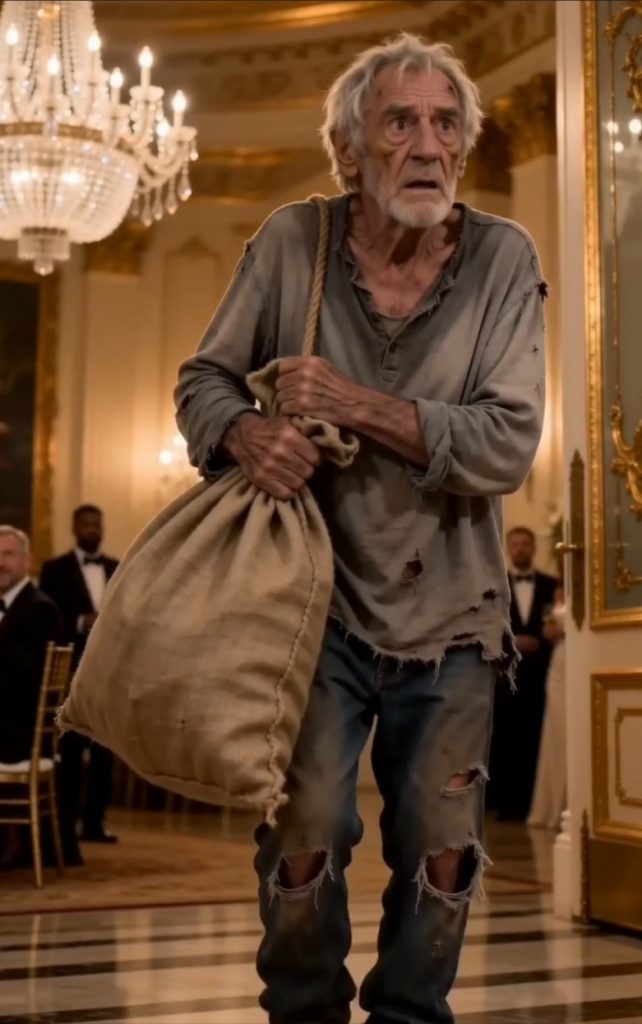
The old man did not belong in the chandelier light.
That was what everyone thought when he stepped into Bellmont Hall with a burlap sack hanging from one hand and rainwater drying on the shoulders of his tattered gray shirt. Around him, the ballroom glittered with crystal, gold, white linen, and old paintings of men who had never worried about being asked to leave.
He looked like a mistake.
The kind of mistake rich people noticed quickly and corrected without getting their hands dirty.
At table seven, a woman in a white gown lifted her champagne glass and laughed.
“This is not a place for you!”
The laughter spread.
Soft at first, then bold, then cruel.
The old man stopped near the entrance, his weathered face tightening. He clutched the heavy sack closer, not because he was afraid someone would steal from him, but because it was the only thing in the room that seemed to belong to him.
A young waiter in a navy-and-gold uniform marched toward him.
“Sir,” he snapped. “You need to leave.”
The old man looked past him, toward the center of the ballroom. Toward the grand staircase. Toward the portrait above it.
A woman in a blue evening dress, painted decades ago, smiling like she knew a secret.
“I have a reservation,” the old man said quietly.
The waiter laughed.
“You have a reservation?”
More guests turned.
The woman in white, Cassandra Vale, leaned back in her chair, her diamond necklace blazing beneath the chandelier.
“Check under ‘sidewalk,’” she said.
Her table erupted.
The waiter smiled at the applause, suddenly performing for the room.
“You are poor,” he said, stepping into the old man’s space. “Get out of here.”
The old man’s blue-gray eyes lifted.
“Careful, son.”
That should have been enough.
Something in his voice should have warned them.
But cruelty rarely stops when it has an audience.
The waiter shoved him.
Not hard enough to look violent in his own mind. Just hard enough to prove power. Just hard enough to make the old man stumble backward, his shoes slipping on the polished marble.
He fell.
The sack hit the floor beside him.
The rope snapped loose.
Hundred-dollar bills burst across the marble like green leaves in a storm.
Stacks slid from the burlap mouth, thick and banded. Loose bills spun beneath the tables. One landed beside Cassandra’s diamond heel. Another stuck against the base of a champagne bucket.
The laughter died so suddenly it felt like the chandeliers had gone out.
The old man remained on the floor for one long second.
Then he lifted his head.
His eyes had changed.
The weakness was gone. The uncertainty too.
What looked back at the room now was colder than money and older than fear.
And from the back of the ballroom, the general manager whispered one horrified sentence.
“Mr. Bellmont?”
Act II
His name was Henry Bellmont, though most of the people in that ballroom knew him only as a portrait, a signature, or a story told during expensive charity dinners.
The Bellmont name was carved above the entrance, printed on the menus, embroidered on the napkins, and whispered with reverence by families who measured status in how many generations they had been allowed through the doors.
But Henry had not built Bellmont Hall for people like Cassandra Vale.
Not at first.
He had built it for Rose.
Rose Bellmont had been a waitress when he met her.
She worked double shifts in a downtown supper club where bankers arrived drunk and left cruel, and she carried trays with the grace of a dancer. Henry was a young dishwasher then, the son of an elevator repairman, with two shirts to his name and a talent for fixing anything with gears, wires, or broken hinges.
Rose used to sneak him leftover rolls from the kitchen.
He used to fix her cheap wristwatch every time the clasp broke.
They married with no money and a borrowed suit.
Years later, when Henry opened his first restaurant, Rose insisted on one rule.
“No one hungry gets turned away from our back door.”
Henry had laughed at first. He thought she meant friends, neighbors, delivery boys, old musicians down on their luck.
Rose meant everyone.
For thirty-eight years, Bellmont Hall had a private back kitchen meal line that nobody from the front room was allowed to interfere with. After midnight, when the wealthy guests left smelling of perfume and wine, the side entrance opened. Workers, widows, veterans, runaway teenagers, and men with nowhere to sleep came quietly through the alley for hot soup, bread, and coffee.
Rose served them herself when she could.
“No one becomes invisible just because they cannot afford a table,” she would say.
Then Rose died.
And Henry, who could survive business wars, recessions, lawsuits, and betrayal, could not survive the silence of their bedroom.
He withdrew from the restaurant. His board took over. His nephews argued over licensing deals. Consultants redesigned the menu, raised the prices, restricted the guest list, and called it “preserving legacy.”
The soup line ended without anyone asking him.
The side door was locked.
The alley was cleaned.
The ballroom became more profitable than ever.
And colder.
Henry heard rumors from old staff. At first, he ignored them because grief made everything sound far away. Then letters began arriving at the house where he lived alone.
A retired schoolteacher denied entry because her dress was “not formal enough.”
A delivery man forced through the service hall though he was there as a guest of honor for a charity award.
A young pianist asked to use a different entrance because her shoes were scuffed.
Then came the final letter.
It was written in shaky handwriting by a woman named Adele, who had once worked in Rose’s kitchen. She told Henry that a homeless man had come to the alley asking whether Mrs. Bellmont’s meals were still served.
A waiter told him to try the trash bins.
Henry read that line three times.
The next morning, he opened Rose’s old trunk.
Inside was his gray work shirt from the first restaurant, folded beside her apron. He put the shirt on. He found an old pair of jeans. He let his driver leave. He walked ten blocks in the rain carrying a burlap sack filled with cash.
Not because he needed to prove he could pay.
Because he wanted to know whether a man with nothing visible would still be treated like a man inside the house Rose built.
That evening, Bellmont Hall was hosting its annual Legacy Dinner.
Cassandra Vale was the chairwoman.
Her family foundation had promised a seven-figure donation in exchange for the renaming of the Rose Bellmont Community Kitchen into the Vale Hospitality Initiative.
Henry had not yet signed the papers.
He arrived without warning.
And the ballroom answered him before he ever reached a table.
Act III
The general manager, Felix Armand, hurried across the floor so fast that one of the guests had to step aside.
His face was gray.
“Mr. Bellmont,” he said again, louder this time.
The name moved through the room like a blade sliding from its sheath.
Cassandra’s smile collapsed.
The waiter who had shoved Henry took one step back.
Henry did not accept Felix’s hand right away. He pushed himself up slowly, one palm pressed against the marble, his movements stiff but controlled. The bills lay scattered around him, absurd and damning beneath the chandeliers.
When he stood, the room seemed to lower itself around him.
Felix bent at once to gather the money.
Henry stopped him with one word.
“No.”
Felix froze.
“Leave it,” Henry said.
The manager straightened, shame already burning through his professionalism.
“Sir, I am deeply sorry. I had no idea you were coming tonight.”
Henry looked at him.
“That is why I came.”
The words were quiet, but they reached every table.
Cassandra stood, smoothing the front of her white gown with trembling fingers.
“Mr. Bellmont,” she said, forcing a laugh that fooled no one. “What an extraordinary entrance. I’m sure this is all a misunderstanding.”
Henry turned toward her.
A hundred people watched her confidence weaken under the weight of his stare.
“You laughed,” he said.
Her lips parted.
“I thought—”
“You thought I was poor.”
Cassandra’s face flushed.
The waiter swallowed hard.
Henry looked at him next.
“And you thought that gave you permission to put your hands on me.”
The young man’s mouth opened, but no sound came out.
Felix stepped forward. “Leo, apologize immediately.”
Henry raised a hand.
“No. Not yet.”
He turned and looked toward the portrait above the staircase.
Rose.
The painted version of her seemed almost alive in the golden light. Young, elegant, kind-eyed. The woman every guest praised at speeches while ignoring everything she had actually loved.
Henry walked to the nearest table and picked up one loose bill. He held it between two fingers.
“This room was paid for by people who were once laughed at,” he said. “Dishwashers. Porters. seamstresses. Musicians. Immigrants who worked until their hands shook. My wife and I were two of them.”
No one moved.
“When Bellmont Hall opened, Rose made me promise that it would never become a temple to rich people worshiping themselves.”
A few guests lowered their eyes.
Henry turned back to Cassandra.
“And yet tonight, I walked through that door looking poor, and the first thing this room did was decide I was dirtying it.”
Cassandra’s jaw tightened. She was not used to public correction. Especially not from an old man in rags.
“Mr. Bellmont,” she said carefully, “with respect, there are standards. This is a formal event. Security concerns are real. The waiter was protecting your establishment.”
Henry’s expression did not change.
“My establishment?”
He reached into his torn shirt pocket and removed a folded document.
Felix’s face fell further.
Henry handed it to him.
“Read it.”
Felix opened the document with shaking hands.
His voice came out thin.
“Effective immediately, full operational authority of Bellmont Hall returns to Henry Bellmont, founder and majority owner, pending board review.”
The room inhaled.
Cassandra gripped the back of her chair.
Henry looked at the waiter.
“You did not protect my establishment,” he said. “You exposed it.”
Act IV
The room should have stayed silent.
Cassandra would not allow it.
Her pride, bruised in front of half the city, rose faster than her judgment.
“This is outrageous,” she snapped. “Do you have any idea how much money my foundation brings into this institution?”
Henry’s eyes shifted back to her.
“There it is,” he said.
She blinked.
“The price of kindness,” Henry continued. “The number people say before they expect everyone to excuse their character.”
Cassandra’s face hardened.
“My foundation saved your community programs.”
“No,” Henry said. “Your foundation tried to buy my wife’s name.”
A murmur moved through the ballroom.
Cassandra’s hand flew to her necklace.
Felix looked sick.
Henry turned to him.
“Bring the file.”
Felix hesitated only a second before signaling to an assistant near the service doors. She rushed out and returned with a leather folder.
Cassandra looked from the folder to Henry.
“What is that?”
“The agreement your lawyers sent,” Henry said. “The one that removes Rose’s name from the kitchen. The one that turns a meal program into a branding opportunity. The one that requires all recipients to be ‘properly screened’ before receiving help.”
He opened the folder.
“Do you know what Rose called that?”
Cassandra said nothing.
Henry answered anyway.
“Making hunger audition.”
The guests looked at Cassandra now with the same appetite they had turned on Henry minutes earlier. It was ugly, but it was useful.
Cassandra’s voice shook with anger.
“You are twisting philanthropic language.”
“No,” Henry said. “I am reading it.”
Then he looked toward the waiter.
“And you. Leo, is it?”
The waiter nodded stiffly.
“Who trained you to treat people this way?”
Leo’s eyes flicked toward Felix.
Felix closed his eyes.
Henry saw it.
“Answer.”
Leo’s voice cracked.
“We were told to maintain the atmosphere.”
“By whom?”
Leo swallowed.
“Management.”
Felix looked as if the word had struck him.
Henry turned to him.
“Is that true?”
Felix took a breath.
“Yes.”
The admission moved through the staff gathered near the walls like a tremor.
Felix continued, voice low.
“After Mrs. Bellmont passed, the board pushed for stricter guest presentation standards. We were told the clientele expected discretion. Cleanliness. Exclusivity. I enforced it.”
Henry looked around the golden room.
“And the kitchen door?”
Felix could barely meet his eyes.
“Closed two years ago.”
Henry’s face tightened.
For the first time all night, grief broke through the ice.
Just a flash of it.
Enough.
“Who authorized that?”
Felix whispered, “The board.”
“And who chaired the hospitality advisory committee?”
No one had to answer.
Everyone looked at Cassandra.
Her expression changed from anger to calculation. Then, when she realized there was no elegant exit, to fear.
Henry nodded once.
“Of course.”
Cassandra stepped away from her table.
“You cannot humiliate me like this.”
Henry looked at the cash still scattered on the floor.
“You laughed while I was on the ground.”
The sentence ended her.
Not legally. Not financially.
Morally.
And the room knew it.
Henry turned to the staff.
“Open the side kitchen tonight.”
Felix looked up.
“Sir?”
“Tonight,” Henry repeated. “Every untouched meal from this dinner goes out the back door in proper containers. Soup, bread, coffee. The old line returns before midnight.”
Felix nodded quickly.
“Yes, sir.”
Henry looked at Leo.
“You will help serve it.”
Leo’s face went red.
“Yes, sir.”
“No uniform jacket,” Henry said. “No gold trim. Just an apron.”
Leo lowered his eyes.
“And tomorrow,” Henry continued, “you may decide whether you want to work in hospitality or just wear the costume.”
Then Henry faced Cassandra one final time.
“The Vale donation is declined.”
Her mouth fell open.
“You can’t be serious.”
“I have never been more serious.”
“That money was going to fund your programs.”
Henry bent slowly and picked up one banded stack of cash from the floor.
“This is tonight’s funding.”
Then another.
“And this.”
Then he looked at the sack.
“And there is more where it came from.”
The ballroom watched as the old man in rags stood surrounded by money, power, shame, and the memory of a woman whose kindness had outlived everyone’s performance.
Act V
The dinner ended early.
No one announced it. The music simply stopped, and conversations became too thin to survive. Guests left in clusters, stepping carefully around the last few bills as staff collected them under Henry’s supervision.
Cassandra left without dessert, her diamond necklace flashing like a warning as she passed the portrait of Rose Bellmont.
Henry did not watch her go.
He stood near the side hallway, looking at the door that had once led to Rose’s kitchen line.
The brass handle was polished. The lock was new.
That offended him more than the laughter.
Felix stood behind him.
“I failed her,” the manager said.
Henry did not answer immediately.
Beyond the ballroom, staff moved quickly. Trays were repacked. Soup was heated. Bread baskets were refilled. Leo had removed his navy-and-gold jacket and now wore a white apron over his shirt, his face pale and quiet as he stacked containers with both hands.
At last, Henry spoke.
“You failed the people she loved.”
Felix swallowed.
“Yes, sir.”
Henry reached for the side door key.
His hand paused before turning it.
For years after Rose died, he had avoided this hallway. The smell of broth, coffee, and warm bread hurt too much. It reminded him of nights when she came upstairs exhausted and happy, saying, “We fed sixty-three tonight,” as if she had won a war.
Maybe she had.
Henry unlocked the door.
Cold air entered from the alley.
Outside, a few people had already gathered. Word traveled quickly among those who needed warmth. A woman in a patched coat. An old veteran with a cane. Two young men with backpacks. A mother holding a sleeping child against her shoulder.
They looked nervous, as if expecting to be turned away again.
Henry stepped into the doorway.
For a moment, no one recognized him as anything but another old man in worn clothes.
That suited him.
“Coffee is coming,” he said. “Soup too.”
The mother’s face changed first.
Hope is a dangerous thing when life has trained you not to trust it.
“Is Mrs. Bellmont’s kitchen open again?” the veteran asked.
Henry’s throat tightened.
“Yes,” he said. “It is.”
Inside, Leo carried the first tray out.
He looked at the people waiting, then at Henry.
The arrogance was gone. So was the performance. What remained was a young man ashamed enough to either become better or become bitter.
Henry watched carefully.
Leo handed a container to the mother.
“Ma’am,” he said quietly. “It’s hot. Please be careful.”
The mother nodded.
“Thank you.”
Leo blinked as if he had not expected gratitude to hurt.
The line grew.
By midnight, the alley smelled like soup and coffee again.
Henry sat on an overturned crate near the door, the burlap sack folded beside him, now empty of cash. Across the alley, Felix served bread without his suit jacket. Other staff followed. Some awkwardly. Some sincerely. All under Rose’s portrait in Henry’s mind.
Three days later, Bellmont Hall released a statement.
It did not mention Cassandra by name. It did not need to.
The Rose Bellmont Kitchen would reopen permanently. The advisory committee would be dissolved. All staff would retrain under new hospitality standards. Any guest who mistreated employees, service workers, or visitors would lose membership privileges.
The city talked for weeks.
They talked about the old man in rags.
The money on the marble floor.
The socialite who laughed before learning who he was.
But the real story happened more quietly.
It happened when Leo showed up the next night without being scheduled and asked to serve the kitchen line again.
It happened when Felix personally called every person who had written complaints and apologized without excuses.
It happened when Henry converted the ballroom’s most exclusive private dining room into a community supper hall every Monday night.
At first, donors hated it.
Then the right donors found it.
Not the ones who wanted their names carved above hungry people.
The ones who understood that dignity was not charity’s decoration. It was the point.
One month after the fall, Henry returned to Bellmont Hall wearing a dark suit.
He hated how easily people smiled at him now.
The same doorman who would have blocked him before bowed.
The same guests who had looked away sent notes and flowers and invitations.
Henry accepted none of them.
He walked straight to Rose’s portrait and stood beneath it.
“You were right,” he said softly.
Of course, she had been right about many things. About kindness. About pride. About how money could polish a room until everyone inside forgot what human warmth looked like.
But mostly she had been right about him.
Years ago, when the first rich critic praised Bellmont Hall as “a palace for the deserving,” Rose had taken Henry’s hand under the table and whispered, “Promise me you’ll never believe that.”
He had promised.
Then he had grieved, withdrawn, and let others break the promise for him.
Never again.
A small sound came from the entrance.
Henry turned.
A boy stood just inside the ballroom, maybe twelve, holding the hand of his younger sister. Their clothes were clean but worn. Behind them, their mother looked embarrassed to have wandered too far from the kitchen hallway.
“I’m sorry,” she said quickly. “We were looking for the meal entrance.”
Before any staff member could answer, Henry walked toward them.
The boy stiffened, expecting correction.
Henry smiled gently.
“This way,” he said. “You came through the beautiful door. That’s allowed too.”
The mother stared at him.
The little girl looked up at the chandeliers.
“They look like stars,” she whispered.
Henry followed her gaze.
For years, those chandeliers had reflected diamonds, crystal, and pride. Tonight, they reflected a child’s wonder.
That was better.
Much better.
He led the family through the ballroom, past the white linens and oil paintings, past tables once reserved for people who thought belonging could be bought.
At the side door, the smell of soup drifted warm into the hall.
Leo was already there, sleeves rolled up, handing out bread.
He saw Henry and straightened.
Henry nodded once.
Not forgiveness.
Not yet.
But possibility.
The little girl tugged on Henry’s sleeve.
“Do you own this place?”
Henry looked down at his worn hands, then back at Rose’s portrait across the room.
“For a long time, I thought I did,” he said. “But I was wrong.”
The girl tilted her head.
“Who owns it?”
Henry opened the kitchen door wider.
“The people who are treated with kindness inside it.”
And for the first time in years, Bellmont Hall sounded the way Rose had wanted it to sound.
Not like wealth.
Like welcome.